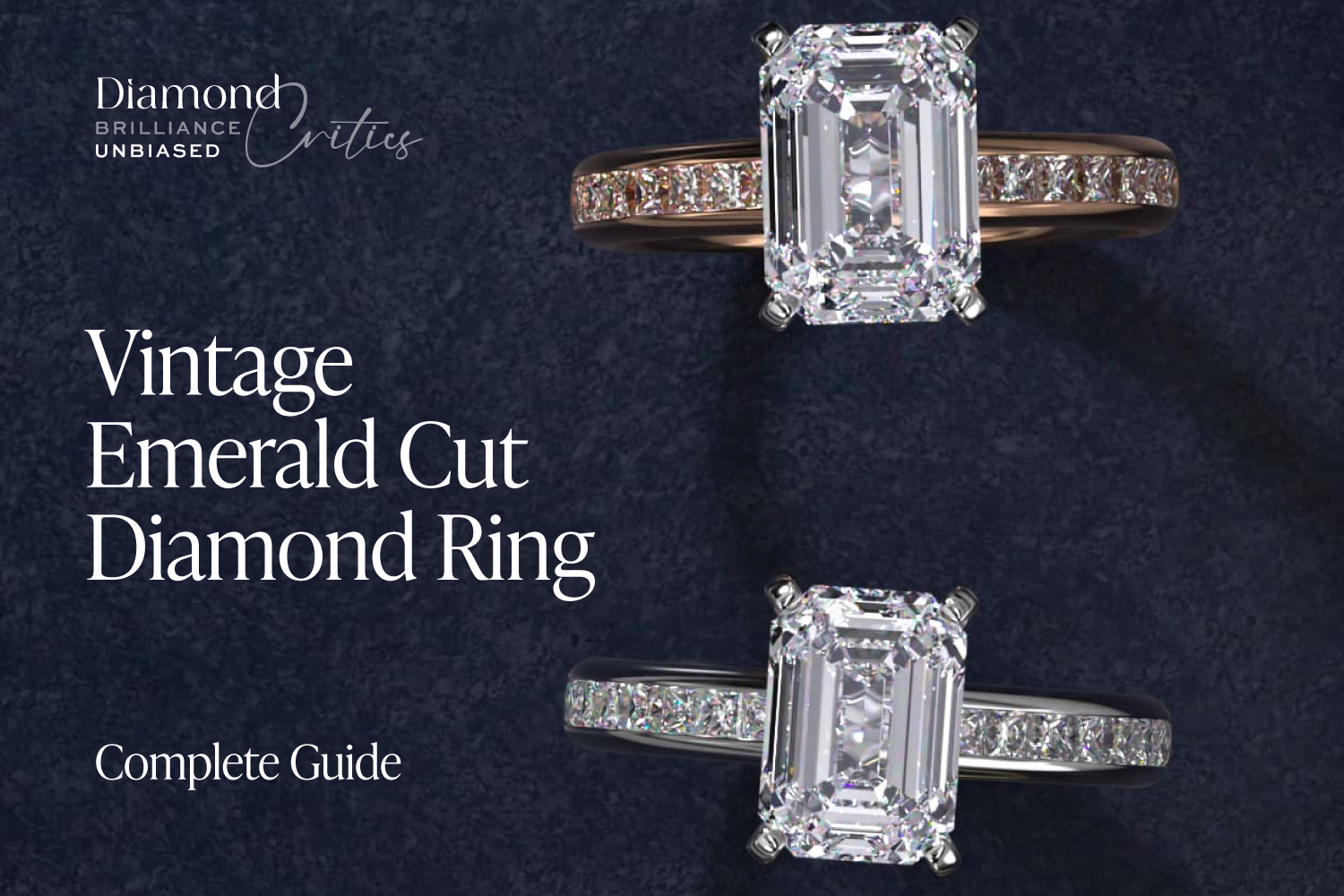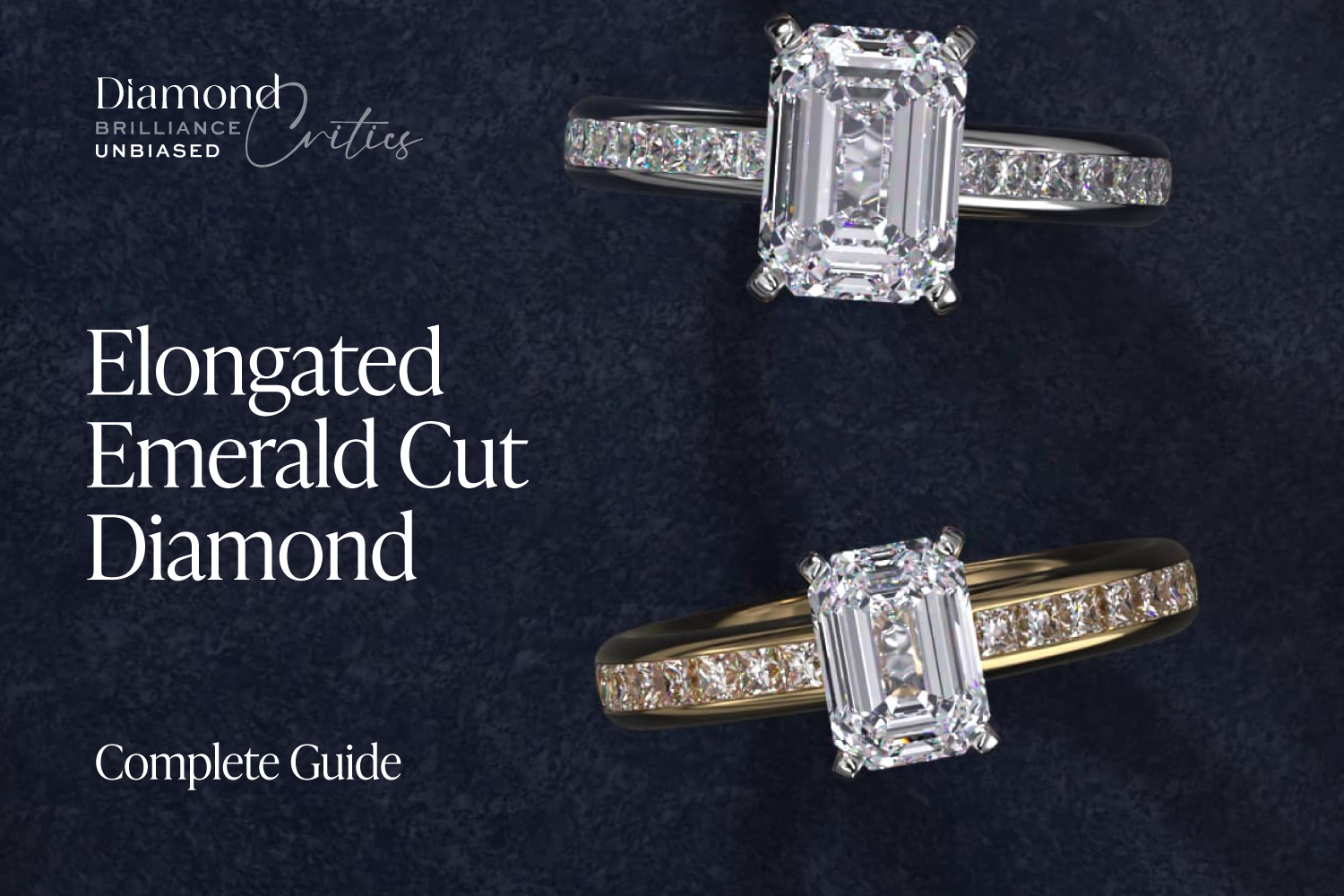
The elongated emerald cut diamond is the same stone as every other emerald cut — same step facets, same open table, same hall-of-mirrors — except one number is different on the certificate. The length-to-width ratio. That single number changes everything about how the stone reads on the hand.
A standard emerald cut sits at a 1.30–1.40 L:W ratio. It looks square-ish, nearly compact. An elongated emerald cut runs 1.40–1.65, sometimes higher.
At 1.50, a 1.5ct stone measures approximately 8.5mm long. A 2ct round brilliant is 8.1mm in diameter. The elongated emerald cut at a lower carat weight shows more length across the finger than the round at a higher weight.
That is the face-up reality most buyers never calculate before they start shopping. They compare carat weights and assume bigger carat means bigger ring. In an elongated emerald cut, that assumption is wrong.
The shape defeats it every time. And once you see the numbers, you cannot unsee them.
A complete elongated emerald cut diamond engagement ring starts at $4,255 — a GIA 1ct D-VS1 at $3,140 in a $1,115 Petite Four-Prong setting. At the other end: a 5ct lab emerald cut ring at $9,725 total — more stone face-up than most buyers have ever seen on a hand, at a price comparable to a natural 1ct.
TL;DR
- Elongated = L:W ratio of 1.40 or higher. Sweet spot: 1.45–1.55. Above 1.65 risks looking too narrow.
- Face-up advantage: a 1.5ct elongated EC at 1.50 L:W shows more length on the hand than a 2ct round brilliant.
- Step cuts are shallow relative to brilliant cuts — more diamond face-up, less buried in depth.
- Entry natural ring: GIA 1ct D-VS1 $3,140 + $1,115 Petite Solitaire = $4,255
- Best lab ring: IGI 4ct D-VVS1 $7,737 + $1,515 Riviera Pavé WG = $9,252
- 5ct lab ring: IGI 5ct E-VVS1 $8,210 + $1,515 Riviera Pavé = $9,725 — 13mm+ stone, statement ring
- The rectangle rule: confirm L:W on the GIA/IGI certificate before buying. Never assume.
→ Best overall: IGI 4ct D-VVS1 lab at $7,737 in Riviera Pavé WG at $1,515 = $9,252 complete. A 4ct elongated emerald cut that measures 12mm+ long in a pavé band for under $10,000.
What Makes an Emerald Cut "Elongated"

Every emerald cut has a length and a width. The ratio between them is printed on the GIA or IGI certificate. A stone with dimensions of 7.0mm × 5.0mm has a length-to-width ratio of 1.40.
A stone at 8.0mm × 5.0mm is 1.60. That number is the only thing that separates a standard emerald cut from an elongated one.
There is no official threshold. The industry typically considers anything above 1.40 as elongated. Below 1.35, the stone reads as nearly square — compact, geometric, more like an Asscher than an elongated rectangle.
Between 1.35 and 1.40, it reads as standard.
At 1.40 and above, the stone starts to stretch visibly across the finger. At 1.50, it dominates. At 1.60+, it is unmistakably long and rectangular, extending toward the edges of a narrow finger.


The Rectangle Rule
The Rectangle Rule defines which L:W ratios work — and which cross into territory where the stone starts to look fragile, too narrow, or unstable in a setting.
Below 1.35: Not elongated. The stone looks compact. The long mirror reflections typical of an emerald cut are shorter and the rectangular character is less pronounced.
1.35–1.40: Transitional. Still reads as a standard emerald cut. Good choice for buyers who want the shape without an obviously rectangular silhouette.
1.40–1.55: The sweet spot. This is where most elongated emerald cut searches end. The stone reads as visibly rectangular, the long parallel step reflections are full, and the corners are proportionally stable. The stone faces up larger than its carat weight suggests.
1.55–1.65: Definitively elongated. The stone is long and narrow. In a four-prong solitaire, the length extends dramatically across the finger. Setting matters more at this ratio — the stone needs to be secured at all four corners without cutting into the rectangular silhouette.
Above 1.65: High-risk territory. The stone looks extremely narrow at the width end. The corners become proportionally smaller. Setting options are limited and the appearance of fragility increases. A few buyers specifically seek ratios in this range for a dramatic fashion effect — but it is not the standard "elongated" look most buyers are searching for.
The Rectangle Rule tells you one practical thing: always read the L:W ratio on the certificate before buying. Retailers describe stones as "elongated" across a wide range of actual ratios. The certificate number is the only accurate data point. A stone a retailer calls elongated at 1.38 and one at 1.58 are completely different rings on the finger.
Only the number tells the truth.
The Face-Up Illusion

Here is the number most buyers never see until after they purchase: emerald cuts have a shallower typical depth than round brilliants. A round brilliant runs 61–63% depth. An emerald cut typically runs 58–62%, with well-cut stones often in the 59–61% range.
Shallower depth means more stone face-up. The carat weight that would sit buried in a deep round brilliant instead spreads across the surface of the emerald cut. At the same carat weight, the emerald cut shows more face-up area than the round.
Add the elongated ratio and the effect compounds. A 1.5ct round brilliant measures 7.3mm in diameter. A 1.5ct elongated emerald cut at 1.50 L:W measures approximately 8.5mm × 5.7mm.
The round's diameter is 7.3mm. The emerald cut's length is 8.5mm — 1.2mm longer than the round's entire diameter.
On the finger, that 1.2mm reads as significantly more presence. The stone extends further toward the nail edge. In photographs, it reads as a larger stone.
From arm's length, it reads as a larger ring. This is The Face-Up Illusion: the elongated emerald cut at 1.5ct reads visually larger than a 2ct round brilliant in the finger's natural orientation.
The illusion is not a trick. It is geometry. You are seeing the stone's actual face-up dimension, which in an elongated step-cut at moderate depth genuinely exceeds that of a round brilliant at a higher carat weight.
| Shape | Carat | Typical Length or Diameter (mm) | Face-Up Area (approx mm²) | Notes |
|---|---|---|---|---|
| Round brilliant | 1ct | 6.5mm diameter | ~33 | Standard reference |
| Round brilliant | 2ct | 8.1mm diameter | ~52 | Standard reference |
| Emerald cut standard (1.35 L:W) | 1ct | 6.6 × 4.9mm | ~32 | Similar to round at 1ct |
| Emerald cut elongated (1.50 L:W) | 1ct | 7.2 × 4.8mm | ~35 | Larger face-up than 1ct round |
| Emerald cut elongated (1.50 L:W) | 1.5ct | 8.5 × 5.7mm | ~48 | Shows more length than 2ct round |
| Emerald cut elongated (1.50 L:W) | 2ct | 9.8 × 6.5mm | ~64 | More face-up area than 2ct round |
| Oval brilliant | 1ct | 8.0 × 5.5mm | ~35 | Similar to elongated EC at 1ct |
| Marquise brilliant | 1ct | 10.5 × 5.2mm | ~43 | Most length per carat of all shapes |
The marquise has the most raw face-up per carat of any shape — its points extend further than any rectangular or oval outline. The elongated emerald cut exceeds the oval in face-up area and surpasses the round brilliant by a meaningful margin. The step-cut format means every millimeter of that face-up area is a clean, open mirror surface — not a collection of tiny brilliant facets.
That surface reads as one unbroken expanse of reflected light. Visually, it presents as larger than its face-up dimensions suggest.
Elongated Emerald Cut Diamond Engagement Ring: Natural Stones

A natural elongated emerald cut diamond requires VS1 minimum clarity at every carat weight. The step-cut facets are transparent — the open table shows inclusions that a brilliant cut would scatter and hide. Below VS1, an emerald cut's inclusions are visible to the naked eye from normal viewing distance.
This is not a debate. It is the defining characteristic of the step-cut format.
| Stone | Carat | Color / Clarity | Cert | Stone Price | + Petite Solitaire $1,115 | Total Ring |
|---|---|---|---|---|---|---|
| Ideal Emerald | 1.00ct | D-VS1 | GIA | $3,140 | + $1,115 | $4,255 |
| Ideal Emerald | 1.06ct | D-VVS2 | GIA | $3,971 | + $1,115 | $5,086 |
| Ideal Emerald | 1.50ct | E-VS1 | GIA | $10,409 | + $1,115 | $11,524 |
| Ideal Emerald | 3.09ct | F-VS1 | GIA | $63,574 | + $1,515 | $65,089 |
| Ideal Emerald | 3.59ct | G-VVS1 | GIA | $72,542 | + $1,515 | $74,057 |
The GIA 1ct D-VS1 at $3,140 is the natural entry point. VS1 clears the step-cut clarity requirement. D color is colorless in any metal.
GIA certification confirms both grades accurately.
The GIA 1.5ct E-VS1 at $10,409 is where the elongated emerald cut makes its most dramatic statement in natural. At 1.5ct and 1.45+ L:W, the stone measures approximately 8.5mm long — longer than most 2ct round brilliants. This is where The Face-Up Illusion becomes tangible rather than theoretical.
The GIA 3.09ct F-VS1 at $63,574 is collector territory. At 3ct, a natural elongated emerald cut measures 10.5–11mm long. From three feet away, this stone is visible.
The price reflects rarity — finding a 3ct+ rough that yields an elongated step-cut above VS1 clarity is genuinely difficult.
"The elongated emerald cut is the most honest shape in the market. The step facets don't hide anything — not inclusions below VS1 and not the actual size of the stone. What you see in the photograph is what you get on the hand. That transparency cuts both ways: it rewards buyers who understand the clarity rules and punishes buyers who skip them." — Farzana Hasan, Diamond Critics
Elongated Emerald Cut Diamond: The Lab Advantage
Lab-grown emerald cuts deliver the elongated look at a fraction of the natural price. The step-cut format shows lab stone quality in the same way it shows natural stone quality — the open table displays the stone's clarity honestly. A lab IGI D-IF stone performs identically in an elongated EC as it would as a natural.
The difference is cost and origin, not appearance or performance.
| Lab Stone | Carat | Color / Clarity | Stone Price | + Riviera Pavé WG $1,515 | Total Ring |
|---|---|---|---|---|---|
| IGI Ideal Lab Emerald | 1.94ct | F-VVS1 | $2,229 | + $1,515 | $3,744 |
| IGI Ideal Lab Emerald | 2.00ct | D-FL | $4,735 | + $1,515 | $6,250 |
| IGI Ideal Lab Emerald | 3.00ct | D-IF | $9,235 | + $1,515 | $10,750 |
| IGI Ideal Lab Emerald | 4.00ct | D-VVS1 | $7,737 | + $1,515 | $9,252 |
| IGI Lab Emerald | 5.00ct | E-VVS1 | $8,210 | + $1,515 | $9,725 |
The 1.94ct F-VVS1 lab at $2,229 is the smartest entry in the table. Near-2ct. F-VVS1 grade.
In a Riviera Pavé setting the complete ring is $3,744. A natural 1ct at GIA D-VS1 costs $4,255 complete. The lab near-2ct ring is $511 cheaper and nearly twice the stone face-up size.
The 4ct D-VVS1 at $7,737 is cheaper than the 3ct D-IF at $9,235. More carat weight at a lower total. This is a lab-specific pricing anomaly — supply at 4ct was more abundant than at 3ct when this data was captured.
If you want maximum stone for your budget, the 4ct is the better buy at this moment.
The 5ct Lab Window
A 5ct natural emerald cut diamond costs north of $100,000 for any GIA-certified stone in VS1+ clarity. It is not a realistic purchase for most buyers. It exists, it is extraordinary, and it is for a very small number of people.
A 5ct lab emerald cut at E-VVS1 IGI costs $8,210. Add a $1,515 Riviera Pavé WG setting and the complete ring is $9,725. This is The 5ct Lab Window.
At 5ct, an elongated emerald cut at a 1.45–1.55 L:W ratio measures approximately 13–14mm long. To put that in perspective: a 1ct round brilliant is 6.5mm in diameter. The 5ct elongated EC is more than twice as long as a 1ct round is wide.
On the finger, it extends from the base of one knuckle almost to the next.
The 5ct Lab Window exists because lab pricing does not scale linearly with carat weight the way natural pricing does. Natural diamond prices jump exponentially at size thresholds — from 1ct to 2ct, from 2ct to 3ct, and dramatically from 3ct to 5ct. Lab pricing follows supply and demand for the specific size, which means 5ct lab diamonds can be priced at similar or even lower levels than 3ct lab diamonds in some market conditions.
The E-VVS1 grade on this stone is exceptional. E color is near-colorless — correct for any metal type. VVS1 clarity in a 5ct step-cut means there is almost nothing in the stone that the naked eye or a casual loupe could identify as an inclusion.
The step-cut table at 5ct shows everything, and VVS1 ensures there is almost nothing to show.
"A 5ct elongated emerald cut lab is one of the most dramatic rings I can recommend without breaking someone's budget. In a pavé setting, that 13mm stone from fingertip to knuckle is a genuine statement. I have shown this comparison to clients who expected to spend $15,000 on a 1.5ct natural, and they genuinely struggled to justify the natural after seeing the lab numbers side by side." — Farzana Hasan, Diamond Critics
Emerald Cut Diamond Ring 5 Carat: Natural vs Lab
The 5ct natural emerald cut diamond ring is a different category from the lab alternative. It belongs to the investment and collector market. If you are buying a 5ct natural emerald cut, you are buying one of the rarest certified diamonds available in that shape.
The price reflects that rarity.
For buyers whose primary goal is the visual impact of a 5ct stone on the hand — the face-up size, the elongated length, the hall-of-mirrors across 13mm — the lab route delivers the identical optical experience at $9,725 complete versus $100,000+.
The decision is not about quality. At E-VVS1 in a lab stone, the quality is exceptional. The decision is about what the buyer values beyond the visual experience.
If origin matters, if long-term value retention matters, if the provenance story matters — natural is the only answer. If the goal is maximum face-up diamond at a specific budget, the lab 5ct at $9,725 complete is the clearest value proposition in certified diamond jewelry.
Large Emerald Cut Diamond Ring: The 2ct–4ct Natural Range
A large emerald cut diamond ring in natural certified inventory starts becoming a serious purchase at 2ct. The certified market data for natural emerald cuts at 2ct puts GIA F-VS1 stones at approximately $24,000–$28,000 for the stone alone. Add a setting and the ring total crosses $25,000.
At 2ct elongated (1.50 L:W), the stone measures approximately 9.8mm × 6.5mm. That is longer than most engagement rings at the market's most popular 1ct weight. On the hand, 9.8mm is a definitively large stone — it reads as a significant piece from normal conversation distance.
The 2ct–4ct natural range is where buyers most commonly experience the lab comparison as a genuine value shock. A 4ct D-VVS1 lab stone at $7,737 in a Riviera Pavé setting at $9,252 total costs roughly one-third of a 2ct natural ring at comparable quality grades. The 4ct lab is a larger stone, higher grades (D-VVS1 vs F-VS1), and $16,000+ less expensive.
| Build | Stone | Stone Price | Setting | Total Ring | Face-Up Length (approx) |
|---|---|---|---|---|---|
| Natural 1ct entry | GIA 1ct D-VS1 | $3,140 | Petite Solitaire WG $1,115 | $4,255 | ~7mm |
| Natural 1.5ct statement | GIA 1.5ct E-VS1 | $10,409 | Riviera Pavé WG $1,515 | $11,924 | ~8.5mm |
| Lab near-2ct entry | IGI 1.94ct F-VVS1 | $2,229 | Riviera Pavé WG $1,515 | $3,744 | ~9mm |
| Lab 2ct D-FL | IGI 2ct D-FL | $4,735 | Riviera Pavé WG $1,515 | $6,250 | ~9.5mm |
| Lab 3ct flagship | IGI 3ct D-IF | $9,235 | Riviera Pavé WG $1,515 | $10,750 | ~11mm |
| Lab 4ct best value | IGI 4ct D-VVS1 | $7,737 | Riviera Pavé WG $1,515 | $9,252 | ~12mm |
| Lab 5ct statement | IGI 5ct E-VVS1 | $8,210 | Riviera Pavé WG $1,515 | $9,725 | ~13mm |
| Natural 3ct collector | GIA 3.09ct F-VS1 | $63,574 | Riviera Pavé WG $1,515 | $65,089 | ~10.5mm |
Read this table against itself. The lab 4ct at $9,252 total is cheaper than the lab 3ct D-IF at $10,750 and delivers a larger stone. The lab 5ct at $9,725 is more expensive than the lab 4ct but delivers 1mm more face-up length.
The natural 3ct at $65,089 is a 10.5mm stone. The lab 4ct at $9,252 is a 12mm stone. The numbers speak.
Tides Of Summer Capsule
Up To 30% Off
Shop The Sale →Vault ClearanceClear The Vault
Up To 70% Off
Shop Vault Deals →Affiliate link — no extra cost to you
How to Set an Elongated Emerald Cut Diamond
The elongated emerald cut creates one specific challenge that round and cushion buyers never encounter: the corners. A longer, narrower stone at 1.50+ L:W has smaller corner facets relative to its overall size. Those corners are the most vulnerable part of any emerald cut, and they are more exposed in an elongated stone than in a standard one.
Four-prong settings are the correct choice. The prongs sit at the four corners of the stone — protecting the most exposed edges. Two prongs on each long side would leave the corners unguarded.
Four-corner prongs directly address the vulnerability.
Claw prong styles (pointed) are more secure than rounded prong styles (button) for an elongated stone because they wrap further around the corner facet. The additional contact between metal and stone at a narrow corner reduces the risk of the stone catching and chipping on impact.
Bezel settings are the most protective option — the metal surrounds the entire perimeter of the stone. For a very elongated stone (1.60+), a bezel or half-bezel setting eliminates the corner vulnerability entirely. The Bezel Solitaire WG at $4,300 is the most protective option available for an elongated emerald cut at any carat weight.
Halo settings are the setting to avoid. A circular halo conflicts directly with the rectangular outline of an elongated emerald cut. The round frame visually shortens the stone — the eye reads the halo boundary rather than the stone's actual length.
An elongated stone in a round halo appears no different from a standard emerald cut in the same halo. You lose the entire face-up advantage.
East-west settings — where the stone is rotated 90 degrees so it runs across the finger rather than along it — work exceptionally well for elongated stones. The length runs horizontally across the hand, creating a bold, modern look. At 1.50+ L:W, an east-west elongated emerald cut is dramatic in a way that no vertical-set stone at the same carat weight can match.
Rectangle Emerald Cut Diamond: How to Read the Certificate
The terms "rectangle emerald cut diamond" and "elongated emerald cut diamond" describe the same shape. Buyers use both to search for the same product. What they are really describing is the L:W ratio — the degree to which the stone looks rectangular rather than nearly square.
The GIA certificate lists length and width in millimeters under the Measurements section. The format is: Length × Width × Depth in millimeters, always listed Length first (the long dimension). Divide length by width to calculate the L:W ratio yourself.
Do not rely on retailers' descriptions of stones as "elongated" — confirm the ratio on the certificate.
A stone listed as 8.50 × 5.70 × 3.42mm has an L:W ratio of 8.50 ÷ 5.70 = 1.49. That is squarely in the sweet spot range of 1.45–1.55. A stone listed as 9.20 × 5.50 × 3.40mm is 9.20 ÷ 5.50 = 1.67.
That is above the standard elongated range — it will look narrow and very long.
Always calculate. Always verify.
Which Diamond Shape Has the Largest Face-Up Per Carat?
The question "which diamond shapes face up largest per carat" has a direct answer: marquise first, oval second, elongated emerald cut third, round brilliant fourth.
The marquise has the highest face-up area of any shape because its pointed ends extend further from the center than any other outline. At 1ct, a marquise with a 2.00 L:W ratio can show 43+ mm² of face-up area versus a round brilliant's 33 mm².
The oval comes second. Its rounded outline at a 1.35–1.50 L:W shows more face-up than a round at the same carat weight.
The elongated emerald cut comes third — and in one specific way surpasses the oval. The emerald cut's open step-cut table reads as a single unbroken expanse of reflected light rather than the collection of brilliant facets that characterize an oval or marquise. That continuous surface reads as more diamond visually, even if the measured face-up area is similar or slightly less than an oval.
The round brilliant is the least efficient shape for face-up area per carat among major shapes. It trades face-up size for optical performance — the round brilliant's 57 facets produce more light return and scintillation than a step cut. That is a trade buyers make consciously based on what they value more: sparkle or size.
For buyers who prioritize visual face-up presence over scintillation, the elongated emerald cut is the third-largest face-up shape and the most architecturally distinctive.
Elongated Emerald Cut Diamond Optimization Matrix
| Goal | Stone | Setting | Total Ring | Face-Up |
|---|---|---|---|---|
| Natural under $5,000 | GIA 1ct D-VS1 $3,140 | Petite Solitaire WG $1,115 | $4,255 | ~7mm |
| Lab max face-up under $4,000 | IGI 1.94ct F-VVS1 $2,229 | Riviera Pavé WG $1,515 | $3,744 | ~9mm |
| Natural statement at 1.5ct | GIA 1.5ct E-VS1 $10,409 | Riviera Pavé WG $1,515 | $11,924 | ~8.5mm |
| Lab best value (more stone, less cost) | IGI 4ct D-VVS1 $7,737 | Riviera Pavé WG $1,515 | $9,252 | ~12mm |
| 5ct lab statement ring | IGI 5ct E-VVS1 $8,210 | Riviera Pavé WG $1,515 | $9,725 | ~13mm |
| Natural collector 3ct | GIA 3.09ct F-VS1 $63,574 | Riviera Pavé WG $1,515 | $65,089 | ~10.5mm |
"The elongated emerald cut is the shape I recommend when buyers want people to notice the ring. Not the sparkle — the ring. A 4ct lab elongated EC at 12mm sits on the finger like nothing else. When someone sees it across a table, they don't ask 'is it real?' They ask 'how many carats is that?' That is a different conversation, and for most buyers in 2026, it is a better one." — Farzana Hasan, Diamond Critics
Expert Summary
The elongated emerald cut diamond is the most size-efficient shape in certified diamond jewelry. The Face-Up Illusion is real, measurable, and consistent: at the same carat weight, an elongated EC with a 1.45–1.55 L:W ratio shows more face-up length on the finger than any round brilliant, cushion, or princess cut. At comparable budgets, it delivers more visible stone than any of them.
The natural path starts at $4,255 complete for a GIA 1ct D-VS1 and reaches serious investment territory at the 1.5ct E-VS1 for $11,924. The 3ct natural at $65,089 complete is collector-grade, rare, and genuinely irreplaceable.
The lab path does something the natural market cannot. The 4ct D-VVS1 at $9,252 complete is cheaper than the 3ct D-IF at $10,750 and delivers a larger stone. The 5ct lab at $9,725 opens a window that has no natural equivalent at any comparable budget.
These are not approximations or compromises. They are D-VVS1 and E-VVS1 IGI-certified stones in the same setting as any natural stone.
Apply The Rectangle Rule before buying: confirm the L:W ratio on the certificate. Stay between 1.45 and 1.55 for most buyers. Go higher only if the narrow, dramatic look is specifically what you want.
Go lower and you lose the elongated face-up advantage. The number is on the certificate. Read it.
Frequently Asked Questions
What is an elongated emerald cut diamond?
An elongated emerald cut diamond is an emerald cut stone with a length-to-width ratio of 1.40 or higher. The standard emerald cut runs 1.30–1.40. At 1.40+, the stone reads as visibly rectangular — longer on the finger than it is wide.
The sweet spot for most buyers is 1.45–1.55. At this ratio, the stone faces up larger than a round brilliant of the same carat weight.
How does an elongated emerald cut compare in face-up size to a round brilliant?
At the same carat weight, an elongated emerald cut at 1.45–1.55 L:W shows more length on the hand than a round brilliant. A 1.5ct elongated EC measures approximately 8.5mm long. A 2ct round brilliant is 8.1mm in diameter.
The emerald cut is longer at a lower carat weight. The step-cut format is also shallower than a round brilliant, which puts more stone face-up rather than buried in depth.
What is the ideal length-to-width ratio for an elongated emerald cut?
The ideal range is 1.45–1.55 for most buyers. This delivers a clearly rectangular stone that reads as elongated on the finger without looking too narrow or fragile in the corners. Below 1.40, the stone reads as a standard emerald cut.
Above 1.65, the stone looks very narrow and the corner prongs have less stone to secure. Always confirm the L:W ratio on the GIA or IGI certificate before buying.
What is the difference between a long emerald cut diamond and an elongated emerald cut?
They are the same thing described with different words. "Long emerald cut diamond," "elongated emerald cut," "rectangle emerald cut diamond," and "large face-up emerald cut" all describe an emerald cut with a higher than standard L:W ratio. The certificate is the only authoritative document.
Confirm the ratio from the measurements listed there.
How much does an elongated emerald cut diamond engagement ring cost?
A complete elongated emerald cut diamond engagement ring starts at $4,255 in natural — GIA 1ct D-VS1 at $3,140 plus a $1,115 setting. At 1.5ct natural, the ring starts at $11,924. In lab, rings start at $3,744 complete for a near-2ct F-VVS1 stone and reach $9,725 for a 5ct statement ring.
What clarity do I need for an elongated emerald cut diamond?
VS1 minimum, without exception. The step-cut open table shows inclusions that a brilliant cut would scatter and hide. At VS2 and below, inclusions in an emerald cut are visible to the naked eye under normal lighting at conversational distance.
VS1 is the floor for any carat weight in an elongated emerald cut. VVS2 and above give you an extra margin of safety in the long mirror-like reflections that define this shape.
Which diamond shapes face up largest per carat?
Marquise first, then oval, then elongated emerald cut, then round brilliant. The marquise has the highest measured face-up area because its pointed ends extend furthest from the center. The oval and elongated emerald cut are close in measured face-up area, but the emerald cut's open step-cut table reads as a single surface rather than scattered facets — which gives a stronger visual impression of size even at similar measured dimensions.
Is a 5 carat emerald cut diamond ring realistic?
In natural certified diamonds, a 5ct emerald cut is rare and costs over $100,000 for a GIA-certified stone in VS1+ clarity. It is collector territory. In lab-grown, the 5ct E-VVS1 IGI ring totals $9,725 complete.
At 5ct elongated, the stone measures 13–14mm long. That is a realistic purchase for buyers who want the statement look without collector pricing.
What is the best setting for an elongated emerald cut diamond ring?
A four-prong solitaire in a low-profile band shows the stone's length without visual competition. The rectangular outline of the elongated emerald cut reads most clearly when the metal stays minimal. A Petite Four-Prong Solitaire at $1,115 is the clearest expression of the shape.
A Riviera Pavé band at $1,515 adds sparkle to the band without competing with the step-cut table. Avoid halos — they frame the rectangular stone in a circular or oval outline that visually shortens the elongated shape.
Should I buy natural or lab for an elongated emerald cut diamond?
Natural if origin and long-term value matter. GIA 1ct D-VS1 at $3,140 is the natural entry and is a certified, reliable purchase. Lab if face-up size is the priority. The IGI 4ct D-VVS1 at $9,252 complete delivers four times the carat weight of the natural entry ring for twice the price.
The visual difference is not subtle. It is dramatic.
What color should I choose for an elongated emerald cut diamond?
D–F in white gold or platinum. The step-cut open table reflects color more plainly than brilliant cuts — the long mirror-like flashes of an emerald cut reveal warmth that brilliant facets would scatter. E color, as in the GIA 1.5ct E-VS1, is near-colorless and the correct pick for any white metal at any carat weight.
In yellow or rose gold, G–H works — the warm metal neutralizes the stone's warmth and the color reads as colorless in the finished ring.
How big is a 5 carat elongated emerald cut diamond?
A 5ct elongated emerald cut at a 1.50 L:W ratio measures approximately 13–14mm long by 8.5–9mm wide. To compare: a 1ct round brilliant is 6.5mm in diameter. The 5ct elongated EC is more than twice as long as a 1ct round is wide.
On an average finger, it extends from just above the knuckle toward the base of the adjacent finger. It is a statement stone by any measure.
Does the elongated emerald cut show more hall-of-mirrors effect than a standard emerald cut?
Yes, and more dramatically. The hall-of-mirrors effect — the parallel columns of reflected light characteristic of step-cut facets — is longer and more pronounced in an elongated stone because the unbroken mirror surfaces extend further along the length. A standard 1.35 L:W emerald cut shows shorter columns of reflection.
A 1.55 L:W elongated EC shows longer, more theatrical columns that stretch across the finger. The longer the stone, the more dramatic the effect.
See Also
- Emerald Cut Diamond Engagement Rings — Solitaire, pavé, halo, and bezel — all settings ranked
- 1.5 Carat Emerald Cut Diamond Ring — The $10K Clarity Wall, 3 natural stones, full ring totals
- Lab Grown Emerald Cut Diamond — 3ct D-IF at $9,235 vs $63K natural, the full case
- Emerald Cut Diamond Ring Settings — Solitaire vs bezel vs pavé vs baguette, all ranked
- Emerald Cut Diamond Size Chart — Exact mm dimensions by carat weight, L:W ratios explained
- Radiant Cut vs Emerald Cut Diamond — Step vs brilliant: which face-up larger, which sparkles more
Expert Verdict
Always audit the stone individually — no grade replaces seeing the actual diamond. The certificate tells you what to look for. Your eyes tell you whether to buy.
— Farzana Hasan, GIA Expert · DiamondCritics.com