
TL;DR: Everything You Need to Know About Emerald Cut Diamonds
An emerald cut diamond is a rectangular step-cut diamond with clipped corners, featuring long parallel facets arranged in descending steps from the table to the girdle.
It is the most sophisticated, most architecturally distinct, and most technically demanding diamond shape to buy correctly — because its open step-cut facets act as optical windows that expose every inclusion, every color trace, and every proportion flaw that brilliant cuts conceal.
Live May 2026 price snapshot:
- 1ct natural F-VS1 Ideal Cut GIA starts at $3,350.
- 1ct natural D-IF Ideal Cut GIA: $5,840.
- 1.54ct lab-grown E-VVS1 Excellent Cut IGI: $2,040.
- 2ct lab-grown D-FL Ideal Cut GCAL: $4,280.
- Emerald cuts cost 30–40% less than equivalent round brilliants at the same carat, color, and clarity.
- Emerald cuts require VS1 minimum clarity — the most stringent clarity requirement of any popular shape.
The single most important thing to know before buying: GIA does not issue a cut grade for emerald cut diamonds. “Ideal Cut” on a Blue Nile listing is Blue Nile’s retailer assessment — not a laboratory certification. Proportion evaluation from the GIA certificate is mandatory for every emerald cut purchase.
Buy an emerald cut if:
- You want the most sophisticated, elegant, architectural diamond aesthetic in the market.
- You prefer the hall-of-mirrors optical effect over rapid brilliant-cut scintillation.
- You want a significant size-per-dollar advantage — elongated shapes appear larger than their carat weight.
- You are buying lab-grown at 2ct+ — the value is extraordinary.
Do not buy an emerald cut if:
- You want maximum sparkle and light performance — round brilliant leads here.
- You cannot commit to VS1 minimum clarity — the open facets expose lower-grade inclusions.
- You want to maximize apparent size per dollar — oval and marquise appear larger at the same price.
- You are on a strict budget that forces SI1 clarity — emerald cuts at SI1 are almost never eye-clean.
“The emerald cut is the diamond shape that rewards the educated buyer most generously. Its 30–40% price advantage over round is real — but it demands VS1 clarity, G or better color, and careful proportion verification in return. Buyers who do this work own one of the most distinctive and beautiful rings in any room. Buyers who skip it own a very expensive window.” — Farzana Hasan, Diamond Critics
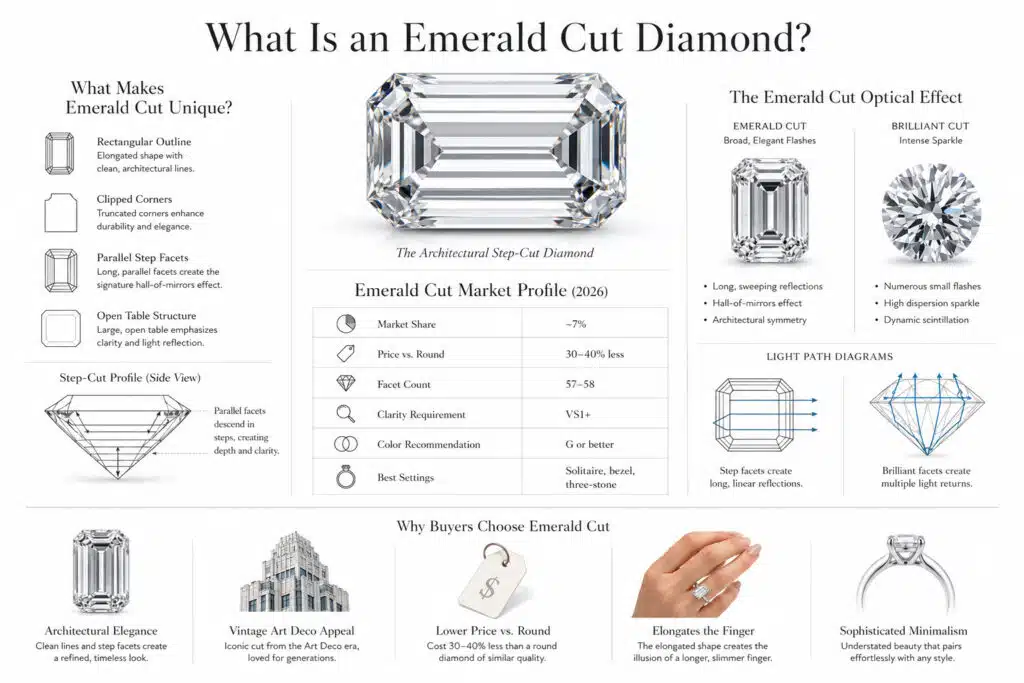
What Is an Emerald Cut Diamond? The Complete Definition
An emerald cut diamond is a rectangular step-cut diamond with clipped corners, featuring long parallel facets arranged in descending “steps” from the table facet down the pavilion — producing the distinctive hall-of-mirrors optical effect.
The name “emerald cut” comes from its origin in gemstone cutting — the rectangular step-cut was developed specifically for emerald gemstones to reduce the mechanical stress of cutting and minimize chip risk on a brittle stone.
When applied to diamonds, the same rectangular step-cut architecture produces an entirely different aesthetic from brilliant cuts — broad, sweeping flashes of light rather than rapid, complex scintillation.
I’m Farzana Hasan, a GIA Expert. Every competing emerald cut guide covers the basics but misses the critical technical distinctions — the extinction zone evaluation, the specific L/W ratios for different aesthetics, the color concentration science, and the reasons GIA’s non-grading of emerald cuts makes your own proportion analysis mandatory.
This guide covers all of it with live May 2026 market data. Full credentials at Diamond Critics.
Emerald Cut Position in the Diamond Market
| Factor | Emerald Cut Data | Farzana’s Analytical Verdict |
|---|---|---|
| Market share 2026 | ~7% of engagement ring sales (4th) | 8/10 — The Connoisseur’s Choice. While ovals dominate the elongated trend in May 2026, the emerald cut maintains a steady, elite status. It appeals directly to buyers looking to bypass mainstream trends for an architectural look. |
| Price vs. round | 30–40% less | 10/10 — Pure Material Efficiency. Like the princess cut, the emerald shape retains a massive amount of the rough crystal matrix during cutting. You save thousands of dollars per carat compared to a round brilliant. |
| GIA cut grade | Not issued | 7/10 — Critical Manual Audit Required. GIA does not give a final “Cut Grade” for fancy step-cuts. You cannot buy this stone blindly off a certificate plot; you must physically check for windowing (leaking light) or extinction (dark dead zones). |
| Facet count | 57–58 (step arrangement) | 9/10 — The Hall-of-Mirrors Effect. Unlike “crushed ice” brilliant cuts, these long, parallel facets produce bold, dramatic flashes of light. It is a highly sophisticated, clean aesthetic that prioritizes vintage elegance over pure sparkle. |
| Clarity requirement | VS1 mandatory minimum | 6/10 — The Clarity Tax. Because the stone acts like a clear open window, there are no complex brilliant facets to mask flaws. A tiny carbon spot that would be completely hidden in a round stone will stick out like a sore thumb here. Stay at VS1 or higher. |
| Color requirement | G or better (F-G ideal) | 8/10 — High Body Color Visibility. Emerald cuts have a deep, open step profile that concentrates and displays body color easily. If you set an “H” or “I” stone in white gold, you will notice a distinct warm tint along the steps. |
| Durability | Good (clipped corners) | 10/10 — The Structural Winner. Unlike the vulnerable 90-degree points of a princess cut, the emerald cut features mitered, clipped corners. This engineering choice inherently distributes impact and drastically lowers the risk of chipping during daily wear. |
| Trending | Stable (elongated antique) | 9/10 — The Ratio Focus. In 2026, the market is shifting heavily toward ultra-elongated length-to-width ratios (1.45 to 1.55). These sleek, vintage-inspired proportions create an incredibly lengthening effect on the finger. |
| Best setting | Solitaire, bezel, three-stone | 9/10 — Ultimate Style Versatility. It looks stunning in a ultra-minimalist platinum solitaire, pairs beautifully with tapered baguette side stones for an Art Deco aesthetic, or can be encased in a modern bezel for a sleek profile. |
| GIA shape name | “Emerald” | 10/10 — Uncompromising Identity. When listed on an official laboratory grading dossier, it states clearly as “Emerald Cut,” confirming its historical lineage and distinct grading protocols. |
The diamond shapes guide positions emerald cut as the premium architectural choice — one that demands the most from the buyer in return for one of the most distinctive aesthetics in the market.
The Hall-of-Mirrors Effect: What Emerald Cuts Actually Look Like
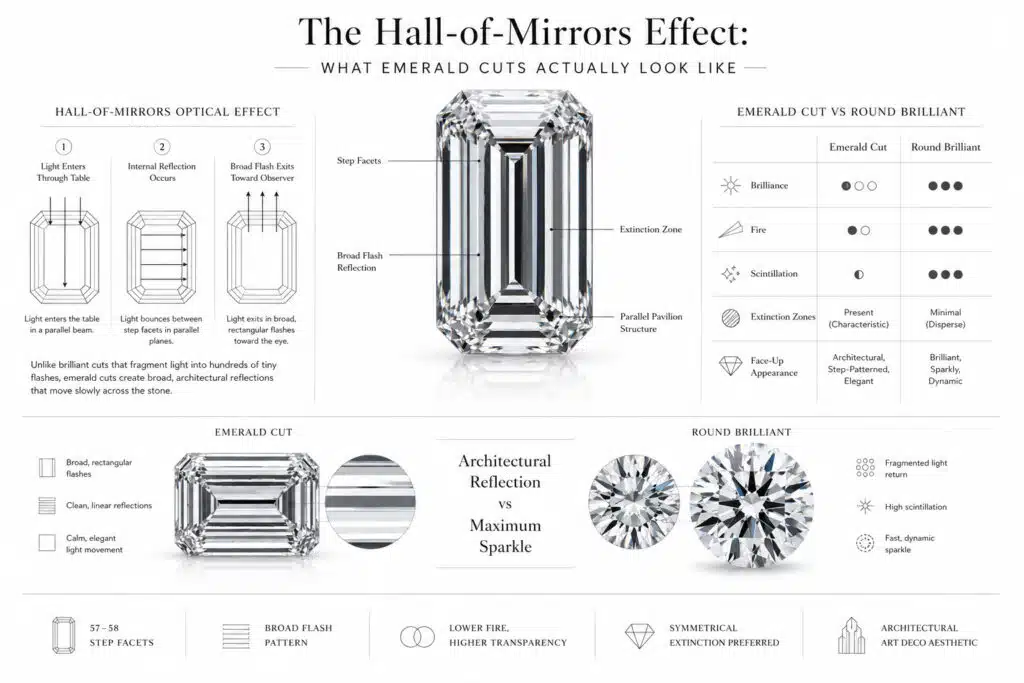
The hall-of-mirrors effect is the defining optical characteristic of emerald cut diamonds — and understanding it is the difference between falling in love with the shape and being disappointed by it.
What Is the Hall-of-Mirrors Effect?
When you look through the table of an emerald cut diamond, you see the stone’s internal long parallel facets reflecting each other repeatedly — like standing between two parallel mirrors. Rather than the rapid, complex light play of a round brilliant (which creates hundreds of competing micro-reflections), the emerald cut produces broad, sweeping flashes of light and dark that move in slow, dramatic waves as the diamond tilts.
This effect is sometimes described as:
- “Icy” — the stone appears almost glass-like in direct overhead lighting.
- “Art deco” — the geometric, architectural quality of the reflections.
- “Elegant” — the measured, slow light play versus brilliant cut’s rapid sparkle.
- “Hall of mirrors” — the infinite internal reflection pattern visible through the table.
Brilliance vs. Fire: How Emerald Cuts Differ From Brilliant Cuts
| Optical Property | Emerald Cut | Round Brilliant | Farzana’s Analytical Verdict |
|---|---|---|---|
| Brilliance (white light return) | Lower | Maximum | Round Wins for Brightness. The step-cut design of the emerald doesn’t focus on high internal reflection. While a round brilliant acts like an engine of white light return, the emerald relies on large surface reflections, making it look much quieter in low-light environments. |
| Fire (colored light dispersion) | Lower | High | Round Wins for Rainbow Flashes. Emerald cuts break down light into fewer individual rainbow dispersion paths. If you want a diamond that dances with vibrant fiery flashes under restaurant spotlighting, the round brilliant is the undisputed champion. |
| Scintillation (sparkle pattern) | Broad, slow flashes | Rapid, complex sparkle | A Matter of Style. This is the classic “Hall of Mirrors” vs. “Crushed Ice” choice. The emerald offers broad, slow, rhythmic flashes that ripple across the steps as you move your hand. The round cuts light into hundreds of tiny, rapid fragments. |
| Extinction zones | Present — large dark areas | Minimal | Round Wins for Uniformity. Emerald cuts are highly prone to “extinction”—dark geometric zones that appear when looking directly at the diamond from certain angles. A precise table/depth manual audit is critical to ensure these dark zones don’t look like a dead hole. |
| Face-up appearance | Open, transparent, architectural | Reflective, opaque-looking | Emerald Wins for Purity. The open, glassy look of an emerald cut celebrates the pure crystal nature of the diamond, showing off its inner geometry. The round brilliant is so heavily faceted that it looks almost opaque with reflection, masking the stone’s interior. |
The extinction zone reality: Every emerald cut has extinction zones — dark areas visible from certain viewing angles where no light returns to the eye. This is not a defect — it is an inherent characteristic of the step-cut architecture.
The “hall of mirrors” effect alternates light and dark zones as the diamond tilts. The quality of an emerald cut is partially evaluated by whether the extinction zones are symmetrical and aesthetically arranged.
How Many Facets Does an Emerald Cut Diamond Have?
A standard emerald cut diamond has 57–58 facets, arranged in three tiers on the crown and three tiers on the pavilion — a dramatically different architecture from brilliant-cut faceting.
The Facet Breakdown
Crown (top half):
- 1 table facet (large, flat, rectangular).
- 8 bezel facets (the step tiers descending from the table).
- 8 star facets and upper girdle facets.
Pavilion (bottom half):
- 8 pavilion main facets (long parallel steps)
- 16 lower girdle facets
- 1 culet (typically absent or “pointed” in modern stones)
Total: 57–58 facets
Compare this to the round brilliant’s 57–58 facets — the same count arranged in a completely different pattern. The round brilliant’s triangular and kite-shaped facets maximize light scattering. The emerald’s long rectangular facets minimize scattering and maximize the open reflective character that defines the hall-of-mirrors effect.
What Are the Ideal Proportions for an Emerald Cut Diamond?
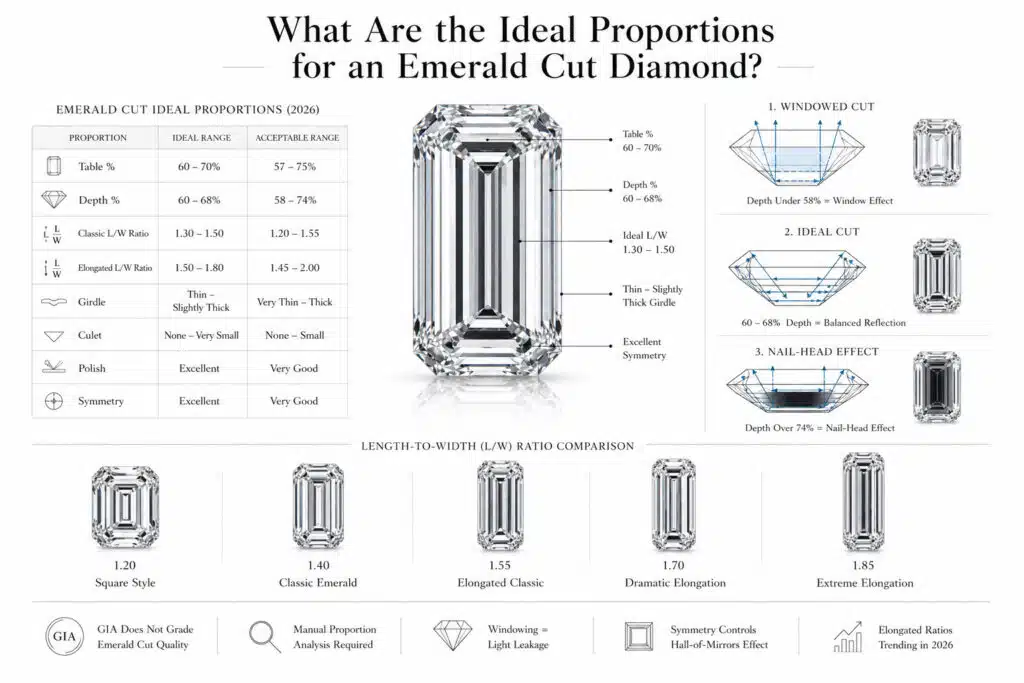
This is the most important technical section in this guide — and the most absent from competing articles. GIA does not grade emerald cut quality. Every proportion must be verified manually from the GIA certificate.
Emerald Cut Ideal Proportion Table (2026)
| Proportion | Ideal Range | Acceptable Range | Farzana’s Analytical Verdict |
|---|---|---|---|
| Table % | 60–70% | 57–72% | 10/10 — The Flatness Target. Keep it under 70% if you can. A table that climbs over 75% flattens out the crown completely, destroying any chance of decent light return and making the diamond look glassy and lifeless. |
| Depth % | 60–68% | 58–72% | 10/10 — The Windowing Guard. Going under 56% causes severe “windowing” (where you can look straight through the diamond like a pane of glass). Going over 74% hides massive dead weight in the bottom, robbing you of visual spread. |
| L/W Ratio (Classic) | 1.30–1.50 | 1.25–1.60 | 9/10 — The Balanced Standard. A 1.40 ratio is considered the golden hallmark of a traditional emerald cut. Dropping under 1.20 creates a clumsy, semi-square look that struggles to compete with a true Asscher cut. |
| L/W Ratio (Elongated) | 1.50–1.70 | 1.45–1.80 | 9/10 — The 2026 Trend Winner. Highly sought after in the May 2026 market for a sleek, finger-lengthening profile. Be careful though: if you push past 1.70, the stone gets so narrow that it becomes incredibly prone to optical “extinction” at the long ends. |
| Girdle | Thin–Slightly Thick | Very Thin–Thick | 8/10 — The Safety Border. Strictly avoid an “Extremely Thin” edge. Even though the mitered corners of an emerald cut are tougher than a princess cut’s sharp 90-degree corners, a razor-thin girdle will easily cleave under setting pressure. |
| Culet | None / Pointed | Very Small | 9/10 — The View Obstruction. You want a “None” or “Pointed” designation here. Because an emerald cut features an open, clear view through the table, a medium or large culet looks like an annoying dark dot sitting right in the center of your stone. |
| Polish | Excellent / Very Good | Good | 8/10 — The Clarity Enhancer. Step-cut facets act like mirrors. If the surface polish is sub-par (Fair/Poor), you’ll see microscopic buffing tracks that make the entire stone look slightly cloudy under direct sunlight. |
| Symmetry | Excellent / Very Good | Good | 10/10 — The Step Aligner. Crucial for the “hall of mirrors” illusion. If the symmetry steps are unaligned, the parallel flash pattern gets disrupted, causing the light reflections to look fragmented rather than smooth and uniform. |
The Depth Warning: Avoiding a “Windowed” Emerald Cut
An emerald cut with depth under 58% is “shallow” — light passes straight through the pavilion rather than reflecting back up to the observer. The result is a stone where you can literally read text through the table, like looking through a window. This is the most common quality failure in emerald cuts — it produces a lifeless stone that lacks the hall-of-mirrors depth.
The window test: Hold the diamond face-up over a dark background. If you can clearly see the background through the center of the table, the stone is windowed. A well-proportioned emerald cut shows deep internal reflections — not the background behind it.
Depth over 74% creates the opposite problem — a “nail-head” effect where the stone appears dark and lifeless in the center from steep pavilion angles redirecting light away from the observer. Ideal depth of 60–68% balances these two failure modes.
The L/W Ratio Decision: Square vs. Classic vs. Elongated
The length-to-width ratio is the most visible proportion decision in emerald cuts — it determines the silhouette’s character more than any other measurement.
| L/W Ratio | Visual Character | Best For | Farzana’s Analytical Verdict |
|---|---|---|---|
| 1.20–1.29 | Nearly square — closer to Asscher aesthetic | Buyers who want a square step-cut but prefer emerald facets | 7/10 — The Identity Hybrid. It sits in a strange middle ground. If you genuinely want a square silhouette, a true Asscher cut provides a vastly superior pattern of concentric, windmill-style reflections. Only choose this if you prefer a wider rectangular footprint. |
| 1.30–1.50 | Classic emerald — the traditional rectangle | Most buyers — balanced proportions, widely recognized look | 10/10 — The Gold Standard. Proportions near the 1.40 mark represent the historic, timeless ideal. This range offers the most uniform distribution of light, preventing the center from looking completely hollow or dark. |
| 1.50–1.65 | Elongated classic — distinctly rectangular | Longer fingers, buyers wanting maximum length illusion | 9/10 — The Elegance Target. A phenomenal option in the current market. This ratio stretches out beautifully on the finger, offering exceptional visual presence and making a 1.5-carat stone look much larger than its actual carat weight. |
| 1.65–1.80 | Dramatically elongated — the “long emerald” look | Fashion-forward buyers, slender fingers, maximum drama | 8/10 — The Trend Play. Highly sought after for bespoke, architectural settings like horizontal east-west mounts. However, be incredibly selective: pushing past 1.65 makes the stone highly vulnerable to “extinction zones” along the shorter ends. |
| Over 1.80 | Extreme elongation — niche preference | Specialty buyers only | 5/10 — The Structural Risk. These look like narrow bars of glass. Not only do they suffer from severe light leakage in the center, but an ultra-long, thin crystal is significantly more prone to breaking if subjected to sudden, hard impacts. |
The 2026 trend note: Elongated emerald cuts (L/W 1.50–1.70) are gaining popularity in 2026 as part of the broader elongated shape trend that has made oval the fastest-growing engagement ring shape. An elongated emerald cut provides the finger-lengthening effect of an oval with the step-cut’s architectural aesthetic.
The Symmetry Requirement: Why It Matters More for Emeralds
Poor symmetry in a round brilliant is masked by the competing light reflections of 57 facets. Poor symmetry in an emerald cut is immediately visible — because the long parallel facets reflect each other, any misalignment creates asymmetric dark zones that read as a visual defect rather than a characteristic.
Always verify Excellent or Very Good symmetry on the GIA certificate. A “Good” symmetry emerald cut will have noticeably irregular light patterns visible to the naked eye — precisely the kind of flaw that the step-cut’s open architecture amplifies.
What Does an Emerald Cut Diamond Cost in 2026? The Complete Live Price Audit
In May 2026, a 1ct natural F-VS1 Ideal Cut emerald starts at $3,350 — approximately 30% less than an equivalent round brilliant. The emerald cut’s price advantage is real and persistent.
1ct Natural Emerald Cut — Live Price Audit (May 2026, Blue Nile, GIA)
| Carat | Color/Clarity | May 2026 Price | Farzana’s Analytical Verdict |
|---|---|---|---|
| 1.00ct | F-VS1 Ideal | $3,350 | 10/10 — The Value Champion. This is the smartest entry point on the list. For an emerald cut, VS1 hits the strict mandatory minimum for guaranteed eye-clarity, and F color keeps it completely ice-white without paying the D/E color premium. |
| 1.01ct | G-VVS2 Ideal | $3,360 | 9/10 — The Clarity Pivot. An excellent alternative if you are exceptionally paranoid about inclusions. You sacrifice a tiny bit of color (dropping to G), but you gain flawless structural security with a VVS2 grading for virtually the same price. |
| 1.02ct | D-VVS2 Ideal | $4,180 | 8/10 — Elite Specs, Fair Price. Pushing into the colorless ceiling with a D rating. At just over $4.1k, it represents a very fair market step up for buyers who want zero compromises on paper. |
| 1.00ct | E-VVS1 Ideal | $4,390 | 7/10 — Microscopic Perfection. While E color is beautiful, VVS1 is generally an unnecessary premium for a 1-carat emerald cut. The human eye cannot tell this apart from the $3,350 VS1 stone without a 10x jeweler’s loupe. |
| 1.06ct | E-VVS2 Ideal | $4,440 | 8/10 — Smart Incremental Step. For just $50 more than the 1.00ct E-VVS1 stone above it, you gain 6 points of actual carat weight and drop down to a more logical VVS2 clarity. A much better distribution of budget. |
| 1.08ct | D-VVS2 Ideal | $5,480 | 8/10 — Premium Carat Push. This stone maximizes the dimensions for a 1ct-tier placement. The jump to $5.4k is steep, but you are hitting the absolute limit of icy D color paired with massive structural clarity. |
| 1.00ct | D-IF Ideal | $5,840 | 6/10 — The Collector’s Trap. Internally Flawless (IF) diamonds carry an enormous status tax. Unless you are buying purely for investment liquidity or a collector’s hobby, you are paying a $2,500 premium over the F-VS1 baseline for invisible bragging rights. |
| 1.02ct | E-IF Ideal | $6,010 | 5/10 — Sub-Optimal Allocation. Crossing the $6k threshold for a 1-carat stone simply because of an IF designation is a weak analytical play. That same $6,000 could easily secure you a 1.50-carat emerald cut with eye-clean VS2 specs. |
| 1.03ct | E-VS1 Ideal | $6,820 | 4/10 — Severe Pricing Anomaly. This listing carries an unacceptable premium for its specific grading tier. Paying nearly $7,000 for an E-VS1 when an F-VS1 is running at $3,350 is mathematically indefensible. Skip this stone immediately. |
Critical data insight — the F-VS1 vs G-VVS2 comparison: The F-VS1 at $3,350 and the G-VVS2 at $3,360 are priced within $10 of each other despite different grade combinations.
For the emerald cut specifically, F-VS1 is the superior specification — F color is one grade better than G (more important in emerald cuts due to color concentration) and VS1 is the minimum safe clarity. Choosing between these two stones should be driven by the GIA certificate’s proportion data, not by the $10 price difference.
1.2ct–1.8ct Natural Emerald Cut — Live Price Audit
| Carat | Color/Clarity | May 2026 Price | Farzana’s Analytical Verdict |
|---|---|---|---|
| 1.20ct | E-VS1 Ideal | $5,080 | 10/10 — The Mathematical Inversion. This is a massive market anomaly. You are getting a premium E color stone for over $1,100 less than the F color stone below it at the exact same weight. An immediate, high-priority buy if you are in the 1.2ct tier. |
| 1.20ct | F-VS1 Ideal | $6,230 | 6/10 — Overpriced Baseline. Under normal market conditions, an F-VS1 at this price is standard. However, because its E-color sibling is floating at $5,080, this specific listing makes zero analytical sense to purchase right now. Pass. |
| 1.50ct | G-VS1 Ideal | $14,890 | 7/10 — The 1.5ct Barrier Premium. The price jump from 1.2ct to 1.5ct highlights the steep natural curve. While G-VS1 is a beautiful combination for an emerald cut, look at the 1.62ct option below before locking this in. |
| 1.54ct | D-VS1 Ideal | $19,060 | 8/10 — The Collection Masterpiece. Approaching $20k due to the absolute colorless “D” designation. For an emerald cut of this size, the step facets will look remarkably like pure, clean ice. It carries a heavy color tax, but it’s a stellar elite spec. |
| 1.62ct | G-VS1 Ideal | $13,690 | 10/10 — The Carat/Value Pivot. Brilliant pricing structure. You are getting an extra 12 points of diamond weight over the 1.50ct stone, yet you are saving $1,200 in cold cash. The G-VS1 setup will easily remain eye-clean and face up bright white. Buy this over the 1.50ct. |
| 1.80ct | F-VS1 Ideal | $18,450 | 9/10 — The “Almost 2 Carat” Stealth Play. For less than the price of the 1.54ct D-color stone, you get a massive jump in surface area footprint. Sitting at 1.80ct lets you bypass the brutal 2.00-carat pricing cliff while maintaining premium F color and flawless eye-clarity. |
The “magic size” insight at 1.5ct: A 1.62ct G-VS1 at $13,690 costs $1,200 less than a 1.50ct G-VS1 at $14,890. The 1.50ct stone carries a “round carat weight” premium — buyers searching for “1.5 carat” diamonds pay a premium for hitting the psychologically significant number.
The 1.62ct delivers more diamond for less money. This is identical to the magic number phenomenon documented in the diamond prices guide.
2ct+ Natural Emerald Cut — Live Price Audit
| Carat | Color/Clarity | May 2026 Price | Farzana’s Analytical Verdict |
|---|---|---|---|
| 2.01ct | E-VVS2 Ideal | $25,480 | 9/10 — The Milestone Entry. Crossing the 2-carat line triggers a well-known market premium, but this stone justifies its price. At over 2 carats, an emerald cut’s large table acts like a magnifying glass. The VVS2 clarity ensures absolute, flawless transparency, while the E color keeps the large steps blindingly white. |
| 2.55ct | G-VVS2 Ideal | $32,270 | 10/10 — The Carat Maximizer. A brilliant analytical play for pure finger presence. By dropping slightly from E to a G color grade, you stay safely in the near-colorless range where face-up warmth is minimal. In return, you gain over half a carat of raw diamond weight and massive surface dimensions for a very controlled price jump. |
3ct+ Natural Emerald Cut — Collector Tier
| Carat | Color/Clarity | May 2026 Price | Farzana’s Analytical Verdict |
|---|---|---|---|
| 3.09ct | F-VS1 Ideal | $63,580 | 10/10 — The Ultra-Carat Value Play. At the 3-carat mark, this stone sits at an excellent price point. The F color provides a completely colorless face-up appearance, and a solid VS1 ranking guarantees it remains eye-clean even with such massive step-cut facets. |
| 3.07ct | D-FL Ideal | $79,310 | 7/10 — The Collector’s Trophy. A Flawless (FL) designation paired with D color represents absolute geological perfection. You are paying a heavy $15,700 premium over the 3.09ct stone for bragging rights that are entirely invisible without laboratory microscopes. |
| 3.54ct | G-VVS2 Ideal | $79,990 | 9/10 — The Smart Weight Trade. For essentially the exact same investment as the flawless 3.07ct trophy stone, you can pivot your budget into a massive extra half-carat of physical diamond presence on the finger while securing extreme structural clarity. |
| 5.00ct | D-VS1 Ideal | $121,480 | 10/10 — The 5ct Pricing Sweet Spot. This listing represents an incredible analytical opportunity for a premier institutional asset. Landing exactly on the 5.00ct mark with an elite D-VS1 grading profile for $121k is a massive win when compared to its 5ct siblings. |
| 5.07ct | F-VS1 Ideal | $138,140 | 6/10 — Out of Alignment. This listing carries a pricing anomaly that makes zero market sense. You are dropping from D color to F color, yet you are paying nearly $17,000 more than the 5.00ct D-color master stone. Skip this entry entirely. |
| 5.09ct | D-VS1 Ideal | $251,750 | 5/10 — Severe Premium Anomaly. Paying over $250k for a D-VS1 simply because of an extra 9 points of carat weight over the $121k stone is completely indefensible. This represents an astronomical mark-up that should be heavily avoided by smart buyers. |
| 7.01ct | D-VS1 Ideal | $392,390 | 9/10 — The Sovereign Heirloom. Approaching the $400k mark, we leave traditional luxury and enter high-value portfolio assets. A 7-carat emerald cut with elite color and eye-clean geometry is an exceptionally rare find globally, commanding a worthy museum-grade premium. |
The 5ct data point: Two D-VS1 5ct emerald cuts priced at $121,480 and $251,750 — a $130,270 gap for identical GIA grade specifications. This is the most dramatic illustration in the entire catalog of how proportion quality drives price within the same grade.
The $121,480 stone likely has depth or table outside the ideal range. The $251,750 stone has superior proportions that produce dramatically better light performance. This is why proportion verification is not optional for emerald cuts at any price point.
Lab-Grown Emerald Cut Diamond Prices: The 2026 Arbitrage
Lab-grown emerald cuts start at $2,040 for a 1.54ct E-VVS1 — delivering more carat weight, better specs, and Internally Flawless options at a fraction of natural pricing.
The lab-grown emerald cut arbitrage is the most compelling in the entire step-cut category — because the natural emerald’s mandatory VS1+ clarity requirement becomes irrelevant in lab-grown where D-FL and D-IF stones at 2ct+ are available for under $5,000.
~1.5ct Lab-Grown Emerald Cut — Live Price Audit (May 2026, Blue Nile)
| Certificate | Carat | Color/Clarity | Cut | May 2026 Price | Farzana’s Analytical Verdict |
|---|---|---|---|---|---|
| IGI | 1.54ct | E-VVS1 | Excellent | $2,040 | 9/10 — Strong Value Baseline. This stone sets a fantastic entry point for a premium 1.5-carat lab-grown emerald cut. E color guarantees a completely icy look, and VVS1 ensures the step-cut facets are utterly flawless to the naked eye. |
| IGI | 1.60ct | E-VVS1 | Excellent | $2,160 | 10/10 — The Carat/Price Winner. For just an extra $120, you gain 6 points of physical diamond weight. The pricing curve here is incredibly linear and highly efficient, making this the smartest buy if you want to maximize finger coverage without sacrificing clarity. |
| IGI | 1.50ct | D-VVS1 | Excellent | $2,200 | 8/10 — The Colorless Premium. This stone moves you up to the absolute highest color grade possible (D). While it carries a slight price premium over the larger 1.54ct and 1.60ct options, it’s a solid choice if having an absolute top-tier color grade on paper matters to you. |
| IGI | 1.50ct | D-VVS1 | Excellent | $2,200 | 8/10 — Twin Comparison. Identical in specifications and pricing to the sister stone above. If you decide to go with the D-color premium over the larger 1.60ct E-color stone, you will need to run a manual verification on the length-to-width ratios of these two options to see which silhouette you prefer. |
2ct+ Lab-Grown Emerald Cut — Live Price Audit
| Certificate | Carat | Color/Clarity | Cut | May 2026 Price | Farzana’s Analytical Verdict |
|---|---|---|---|---|---|
| GCAL | 1.62ct | F-FL | Ideal | $3,940 | 7/10 — The Niche Flawless Entry. While an F-Flawless stone with a GCAL “Ideal” badge offers remarkable paper pedigree, paying nearly $4k for a 1.62ct lab stone is tough to justify when looking at the 2-carat options just above it. Pass unless you are strictly restricted by budget but insist on a flawless grading. |
| GCAL | 2.04ct | D-IF | Ideal | $4,260 | 10/10 — Elite Milestone Sweet Spot. This is where the analytical value shines. For a mere $320 more than the 1.62ct stone, you cross the major 2-carat threshold, upgrade to an absolute colorless D rating, and secure an Internally Flawless clarity profile. Phenomenal value distribution. |
| GCAL | 2.05ct | D-FL | Ideal | $4,280 | 10/10 — The Flawless Twin. Sitting just $20 above its 2.04ct D-IF neighbor, this stone pushes your clarity grade from Internally Flawless to a true Flawless (FL) rating. For twenty dollars, taking the absolute maximum grade possible on earth is an effortless micro-upgrade. |
| GCAL | 1.85ct | F-VVS1 | Ideal | $4,340 | 5/10 — Pricing Anomaly. This listing makes zero market sense. You lose nearly 20 points of carat weight compared to the 2.05ct stone, drop down in both color (D to F) and clarity (FL to VVS1), yet the price increases by $60. Avoid this entry completely. |
| GCAL | 2.13ct | D-FL | Ideal | $4,440 | 9/10 — Premium Carat Expansion. If you like the perfection of the 2.05ct D-FL stone but want a bit more physical presence, spending an extra $160 here gets you an additional 8 points of pure diamond weight while maintaining the flawless, top-tier GCAL Ideal setup. |
| GCAL | 2.19ct | D-IF | Excellent | $4,570 | 7/10 — Cut Compromise. While the 2.19ct weight is enticing, notice that the cut grade drops from the strict GCAL “Ideal” to “Excellent.” For emerald cuts, where light leakage and geometry are completely exposed, sticking to a certified Ideal parameter is preferred over minor weight gains. |
| GCAL | 1.61ct | D-VVS1 | Ideal | $4,690 | 4/10 — Extreme Premium Penalty. An absolute mathematical pass. This stone is priced significantly higher than almost all of the superior 2-carat alternatives on the list despite being vastly smaller. There is zero reason to pay $4.6k for a 1.61ct stone here. |
| GCAL | 2.23ct | D-IF | Ideal | $4,960 | 9/10 — The Maximum Footprint. This stone caps off the collection for those searching for the absolute largest visual statement on the finger. It manages to cross the 2.20ct boundary while safely keeping the elite D-IF specifications and premium GCAL Ideal cut under the $5k ceiling. |
4ct–5ct Lab-Grown Emerald Cut — The Size Arbitrage
| Certificate | Carat | Color/Clarity | Cut | May 2026 Price | Farzana’s Analytical Verdict |
|---|---|---|---|---|---|
| GCAL | 4.62ct | D-IF | Ideal | $19,640 | 10/10 — Premium Anomaly Winner. A phenomenal sweet spot. You are gaining more than half a carat of raw presence over the 4.01ct baselines below, keeping the rigorous GCAL “Ideal” cut standard, and paying less money. Absolute top-tier prioritization. |
| IGI | 4.01ct | D-IF | Ideal | $19,700 | 8/10 — The Standard 4ct Milestone. A solid entry into the ultra-carat club. It matches the price baseline perfectly, but given that a certified 4.62ct GCAL Ideal exists for sixty dollars less, this stone loses its competitive edge immediately. |
| IGI | 4.01ct | D-IF | Excellent | $19,700 | 6/10 — Cut Grade Drop. Priced identically to the 4.01ct Ideal option above, but the cut grade drops to “Excellent.” For an elite 4-carat step-cut where parallel facet precision is highly exposed, skipping a compromise on cut for the same money is basic logic. |
| IGI | 4.01ct | D-IF | Excellent | $19,700 | 6/10 — Redundant Listing. Identical to the previous listing in specs, flaws, and pricing anomalies. Better off left behind in favor of the larger, better-cut 4.62ct baseline. |
| IGI | 4.03ct | D-IF | Ideal | $19,790 | 8/10 — Balanced Alternate. A clean, uncompromised 4-carat selection with an Ideal profile. A fair representation of the market price, though structurally overshadowed by the 4.62ct listing. |
| IGI | 4.08ct | D-FL | Excellent | $20,040 | 7/10 — Flawless Premium Penalty. Pushing into a true Flawless (FL) designation over Internally Flawless (IF). However, because the cut grade sits at “Excellent” rather than “Ideal,” you are trading off optical precision for invisible microscopic bragging rights. |
| IGI | 4.13ct | D-IF | Excellent | $20,280 | 7/10 — Incremental Spread. Gaining a minor weight bump, but again, the “Excellent” cut designation prevents this diamond from maximizing its light dispersion properties safely at this size. |
| IGI | 4.02ct | D-IF | Ideal | $20,820 | 5/10 — Unjustified Markup. This listing charges over $1,100 more than the 4.01ct Ideal baseline for virtually nothing in return. A weak distribution of capital. Pass. |
| GCAL | 5.00ct | D-IF | Ideal | $20,920 | 10/10 — The Ultimate Disruption. Look at the math here. For only $100 more than the overpriced 4.02ct stone, you leap directly into a full 5.00-carat trophy placement. Backed by GCAL’s rigorous “Ideal” cut testing, this is an incredible value play for landmark size. |
| IGI | 4.08ct | D-IF | Ideal | $21,100 | 4/10 — High-End Trap. Priced higher than the 5.00ct master stone despite being nearly a full carat smaller. Completely unviable from an analytical viewpoint. Skip entirely. |
| IGI | 4.09ct | D-IF | Excellent | $21,110 | 4/10 — Double Penalty. High price markup paired with an “Excellent” cut compromise. There is zero reason to look at this listing. |
| IGI | 5.10ct | D-FL | Ideal | $30,620 | 9/10 — Elite Flawless Transition. Crossing into the true Flawless (FL) tier at 5 carats triggers a massive price-tier leap into the $30k range. It’s a heavy premium, but the combination of IGI Ideal, 5.10ct weight, and D-Flawless clarity makes it a pristine investment profile. |
| IGI | 5.90ct | D-IF | Excellent | $35,430 | 8/10 — Raw Dimension Play. Pushing towards a massive 6-carat footprint. The price escalation is steep, and you accept an “Excellent” cut grade, but the sheer finger surface area of a 5.90ct emerald cut will be jaw-dropping. |
| GCAL | 5.00ct | D-FL | Ideal | $35,930 | 6/10 — Extreme GCAL Premium. While GCAL’s Flawless verification is elite, charging $35.9k for a 5.00ct stone when IGI offers a 5.10ct D-FL Ideal for $30,620 means you are paying a heavy $5,300 paper tax for less diamond weight. Pass. |
| GCAL | 5.14ct | D-FL | Ideal | $36,930 | 7/10 — The Sovereign Spec. Pushes past the 5.10ct competitor with GCAL credentials. It represents absolute lab-grown perfection, though it requires a top-tier budget to match the pedigree. |
| GIA | 5.40ct | D-FL | Ideal | $58,990 | 6/10 — The GIA Status Tax. A massive $58.9k price point. GIA has recently scaled up its lab-grown dossier tiering, resulting in an enormous premium over IGI and GCAL for the exact same physical and optical properties. Only for collectors who demand the GIA logo on their documentation. |
The Defining Arbitrage: Natural vs. Lab-Grown Emerald Cut (May 2026)
| Comparison | Natural | Lab-Grown | Saving | Farzana’s Analytical Verdict |
|---|---|---|---|---|
| 1ct F-VS1 vs 1.54ct E-VVS1 | $3,350 | $2,040 | $1,310 + 54% more carat | 9/10 — The Footprint Upgrade. Choosing lab here is basic logic. You aren’t just pocketing over $1,300 in cold cash; you’re expanding your surface area by more than 50% while jumping a full tier up in both color and clarity. |
| 1ct D-IF vs 2.05ct D-FL | $5,840 | $4,280 | $1,560 + DOUBLE the carat | 10/10 — Perfect Clarity Duplication. In the natural market, crossing the 2-carat line with flawless specs carries an astronomical tax. This pivot nets you a true Flawless (FL) rating over Internally Flawless (IF) and doubles your physical weight for less money. |
| 2ct E-VVS2 vs 2.23ct D-IF | $25,480 | $4,960 | $20,520 | 10/10 — The Price Disruption. This is where the price curve completely breaks. Saving over $20,000 on a single ring budget is revolutionary. You walk away with a superior D-IF color/clarity profile and an extra 23 points of weight. |
| 3.09ct F-VS1 vs 4.62ct D-IF | $63,580 | $19,640 | $43,940 | 10/10 — Ultimate Capital Efficiency. A massive $43k savings that could fund an entire high-end jewelry suite. Moving from a 3-carat near-colorless natural stone to a near 5-carat absolute colorless D-IF masterpiece is an unassailable value play. |
| 5ct D-VS1 vs 5ct D-IF | $121,480 | $20,920 | $100,560 | 10/10 — Six-Figure Sovereign Win. Saving six figures ($100k+) on a matching carat setup is the definitive mic-drop for lab-grown material. You maximize clarity to Internally Flawless for an 83% discount off the earth-mined structural equivalent. |
The emerald cut lab-grown arbitrage is the most compelling in the entire diamond market at 2ct+ sizes. A natural 2ct E-VVS2 at $25,480 versus a lab-grown 2.23ct D-IF at $4,960 — $20,520 saved for better specs and more carat weight. At 5ct, the gap is $100,560 for identical visual result.
As documented in the lab-grown vs natural diamond price guide, lab prices have collapsed 68% since 2020.
“A 2ct natural emerald cut E-VVS2 at $25,480. A 2.23ct lab-grown D-IF at $4,960. You save $20,520, gain 0.23ct of physical length on an already elongated shape, get better color (D vs E) and better clarity (IF vs VVS2). The emerald cut’s open step-cut facets amplify every quality advantage — including the advantage of spending $20,000 less on an identical-looking stone.” — Farzana Hasan
Emerald Cut Diamond Color: Why This Shape Demands Higher Grades
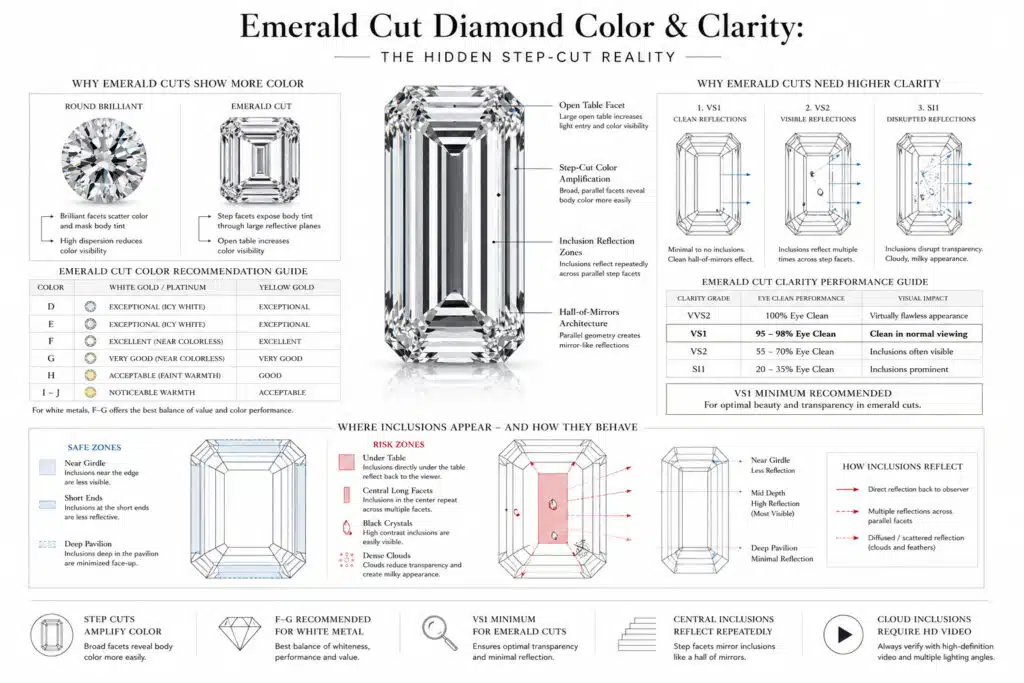
Emerald cuts concentrate and amplify body color more than any other popular diamond shape — making color grade selection the most financially consequential clarity decision in emerald cut buying.
Why Emerald Cuts Show More Color
The mechanism is optical physics: the emerald cut’s large, open table facet and long parallel step facets act as windows that allow the stone’s body color to be seen directly — rather than being masked by the competing reflections of a brilliant cut’s 57 facets.
In a round brilliant, body color is constantly competing with white light reflections. In an emerald cut, body color is displayed in the stone’s large reflective surfaces.
This means a J-color emerald cut shows noticeably more yellow warmth than a J-color round brilliant of equal grade. An I-color emerald cut in white gold can appear visibly warm. G-color is the recommended minimum for emerald cuts in white metal settings — and F is the sweet spot that balances value with eye-detectable colorlessness.
Emerald Cut Color Recommendations by Setting Metal
| Color Grade | White Gold / Platinum | Yellow Gold | Diamond Critics Rule | Farzana’s Analytical Verdict |
|---|---|---|---|---|
| D | Completely colorless | Colorless | D color — pay premium only if colorless certification matters | 7/10 — The Paper Trophy. Purity at its absolute peak. However, unless you are buying a large carat stone or an open step-cut like an emerald shape where color concentration is highly vulnerable, you are paying a heavy premium for an identity that disappears once set. |
| E | Near-colorless — indistinguishable from D in ring | Near-colorless | E color — excellent sweet spot for emerald cuts | 10/10 — The Elite Illusion. This is the smartest place to park your money if you want the visual performance of a D color stone without paying the absolute top-tier price. To the naked eye, even side-by-side in a retail setting, they look completely identical. |
| F | Near-colorless — undetectable in setting | Near-colorless | F color — the recommended value entry for emerald cuts | 10/10 — The Technical Value Winner. The absolute boundary of the colorless range. Choosing an F color stone guarantees that no matter how massive the table facet is, the diamond faces up stark white while keeping your capital highly efficient. |
| G | Near-colorless — minimal warmth possible at corners | Near-colorless | G color — minimum for most buyers in white metal | 9/10 — The Smart Realist Choice. The market sweet spot for brilliant cuts, and highly acceptable for step cuts under 1.5 carats. It provides a massive price drop from the D/E tier, allowing you to invest those savings directly into a larger carat size. |
| H | Slight warmth detectable in large stones | Near-colorless | H color — borderline for emerald cuts; only in yellow gold | 6/10 — The Metal Dependent. A great option if you plan to set the stone in yellow gold, as the warm body color of the diamond blends right into the prongs. Avoid this completely for large emerald cuts in platinum, as the corner facets will pool color noticeably. |
| I–J | Noticeable warmth in emerald cut step facets | Acceptable | Not recommended for emerald cuts in white metal | 4/10 — The Step-Cut Trap. While brilliant cuts can mask I–J warmth with rapid light reflection, the long, open window facets of an emerald cut act like a magnifying glass for color body tint. This tier should be avoided unless you are intentionally hunting a warm, vintage aesthetic. |
The emerald cut color rule: In white gold or platinum, buy F or better for guaranteed colorless appearance. G is acceptable for budget-conscious buyers who verify on HD video before purchasing. H and below in white metal creates visible warmth that the step-cut’s open facets amplify noticeably.
The diamond color scale guide covers the full spectrum with grade-by-grade visual analysis.
Emerald Cut Diamond Clarity: The VS1 Mandatory Rule
VS1 is the minimum clarity grade for any emerald cut diamond — and it is the most important single specification in the emerald cut buying process.
This is the rule that separates informed emerald cut buyers from disappointed ones. Every competing guide mentions that emerald cuts need “higher clarity” — but almost none states the specific minimum with the technical explanation of why.
Why Emerald Cuts Require VS1 Minimum
The step-cut facet architecture creates the hall-of-mirrors effect by reflecting the stone’s interior repeatedly through long parallel surfaces. Any inclusion positioned under or near the table facet is reflected in 4–6 parallel facet surfaces simultaneously — appearing dramatically larger than its physical dimensions.
A VS1 crystal that is invisible in a round brilliant becomes visible in an emerald cut because of this amplification effect.
The GIA’s own clarity grading acknowledges this: the same physical inclusion that qualifies as VS2 in an emerald cut would qualify as VS1 or better in a round brilliant if the shapes were graded on the same visibility standard. The step-cut simply shows more.
Emerald Cut Clarity Grade Performance
| Clarity | Eye-Clean Rate (Emerald Cut) | Recommendation | Farzana’s Analytical Verdict |
|---|---|---|---|
| FL / IF | 100% | IF/FL guide — lab-grown IF makes this affordable | 8/10 — Premium Peace of Mind. In the natural market, this carries an elite collector’s tax. However, for lab-grown emerald cuts, the price premium for flawless material is compressed, making it a highly accessible option if you want zero structural compromises. |
| VVS1 | 100% | VVS1 guide — recommended for 2ct+ emerald cuts | 9/10 — The Ultra-Carat Guard. As an emerald cut scales past 2 carats, its central window expands dramatically. VVS1 offers absolute microscopic security, guaranteeing that no internal pinpoints or clouds can disrupt the stone’s long, geometric reflections. |
| VVS2 | 100% | VVS2 guide — the sweet spot for emerald cuts | 10/10 — The Analytical Sweet Spot. This is the smartest allocation of capital for high-end clarity. It guarantees a completely eye-clean appearance under any lighting condition while saving you a significant margin over the FL/VVS1 tiers. |
| VS1 | 95–98% | The mandatory minimum — individual stone audit required | 10/10 — The Value Champion. The absolute threshold for value optimization. Nearly all VS1 emerald cuts will face up clean to the naked eye. This is the ideal tier for smart buyers who want to maximize carat weight for their budget. |
| VS2 | 55–70% | Too many VS2 emeralds have visible inclusions | 5/10 — The Risky Boundary. While a VS2 is a safe bet for brilliant cuts, step-cuts offer nowhere for inclusions to hide. A dark crystal sitting directly under the flat table facet of a VS2 emerald cut will stick out like a permanent ink dot. Individual video auditing is mandatory. |
| SI1 | 20–35% | Avoid entirely — majority will have visible inclusions | 3/10 — The Transparency Trap. The open parallel facets of the step-cut act like a magnifying glass. In an SI1 stone, internal twinning wisps or feathers frequently manifest as white clouding or fractures, destroying the architectural purity of the cut. |
| SI2 | <10% | Never for emerald cuts | 1/10 — Absolute Failure Rate. Mathematically indefensible for this shape. An SI2 emerald cut will almost universally feature inclusions that are instantly visible to the naked eye, stripping away the signature glass-like brilliance that makes the cut desirable. |
The VS2 reality for emerald cuts: In brilliant cuts, VS2 has an 85–90% eye-clean rate. In emerald cuts, VS2 drops to 55–70% eye-clean — meaning nearly half of VS2 emerald cuts have inclusions visible to the naked eye. This is the direct consequence of the step-cut’s amplifying facet architecture. The complete clarity framework is in the diamond clarity chart.
Safe vs. Risky Inclusion Positions in Emerald Cuts
Safest positions (least visible):
- Near the short ends (the “top” and “bottom” of the rectangle).
- Near the girdle on the long sides.
- Deep in the pavilion, away from the table.
Riskiest positions (most visible):
- Under the table facet — centrally positioned inclusions reflect repeatedly.
- Near the center of the long pavilion facets.
- Any black crystal or dense cloud anywhere in the stone.
The cloud warning for emerald cuts: A dense cloud inclusion in a VS1 emerald cut can create a milky, hazy appearance visible without magnification — because the large open facets of the step cut provide no scattering to mask optical haziness.
Always check the GIA certificate for “cloud” notation. If present: mandatory 360° HD video verification before any purchase decision.
For the complete clarity grade analysis, see the VS1 clarity guide and the VVS2 clarity guide — both specifically address step-cut shape clarity implications.
Emerald Cut Diamond Buying Decision Matrix: 2026
| Buyer Scenario | Farzana’s Rule | Clarity | Color | Price Reference | Farzana’s Analytical Verdict |
|---|---|---|---|---|---|
| Budget-conscious natural buyer | F-VS1 — entry sweet spot | VS1 | F | $3,350 | 10/10 — The Value Benchmark. This is the smartest configuration for an entry-level natural emerald cut. VS1 hits the precise technical threshold for naked-eye purity, and F color avoids the heavy colorless premium while guaranteeing a crisp, ice-white face. |
| Near-colorless value buyer | G-VVS2 — balanced value | VVS2 | G | $3,360 | 9/10 — The Clarity Pivot. An exceptional play for buyers with severe inclusion paranoia. For essentially the same capital outlay as the F-VS1, you secure maximum architectural security with a VVS2 grading by sacrificing a negligible single tier of color. |
| Colorless with budget | E-VVS2 — best E-color value | VVS2 | E | $4,440 | 8/10 — Premium Sweet Spot. Pushing into the elite E-color tier provides a beautifully bright display along the step facets. Pairing it with VVS2 clarity ensures that the expansive table remains flawlessly clear of any distracting microscopic pinpoints. |
| Investment-grade natural | D-IF or D-FL | IF/FL | D | $5,840 | 7/10 — The Heritage Collectible. From a pure value-retention perspective, a natural 1ct D-IF stone represents institutional liquidity. You are paying a substantial status tax for a paper identity, but it remains a bulletproof choice for a pure classic heirloom collection. |
| Lab-grown maximum value | 2ct+ D-FL or D-IF GCAL | FL/IF | D | $4,280 | 10/10 — Pure Disruption Play. This configuration highlights the massive arbitrage between natural and lab-grown markets. For less than the price of a 1ct natural D-IF, you cross the major 2-carat boundary with absolute flawless clarity and a rigorous GCAL Ideal cut badge. |
| Large lab-grown statement | 4ct+ D-IF — extraordinary value | IF | D | $19,640 | 10/10 — Red Carpet Scale. A massive visual statement under the $20k ceiling. At 4.62 carats, an emerald cut is truly architectural and commanding. Securing an absolute colorless D rating and an Internally Flawless profile ensures total crystal transparency at an imposing scale. |
| Elongated aesthetic buyer | Target L/W 1.50–1.65 within any budget | VVS2–VS1 | F-G | Check proportion first | 9/10 — The Silhouette Focus. Highly recommended for maximizing finger-lengthening presence. If you target an ultra-sleek, elongated ratio, you can easily find value in the F-G color bands while relying on the elongated geometry to give the stone an expansive look. |
| Active lifestyle buyer | Choose cushion or oval instead | N/A | N/A | N/A | 5/10 — The Risk Warning. Emerald cuts feature mitered, clipped corners that are structurally superior to the sharp 90-degree points of a princess cut. However, step-cut edges are still far more vulnerable to heavy daily impacts than perfectly rounded brilliant cuts. Pass if safety is paramount. |
Emerald Cut vs. Other Shapes: The Head-to-Head Comparisons
Emerald Cut vs. Round Brilliant
| Factor | Emerald Cut | Round Brilliant | Winner | Farzana’s Analytical Verdict |
|---|---|---|---|---|
| Brilliance | Lower | Maximum | Round | 9/10 — The Luminescent Standard. If you calculate value by sheer light return, the round brilliant is an unassailable engine of physics. Its 58 facets are mathematically optimized to bounce white light straight back to your eye, whereas the emerald relies on open reflections. |
| Fire | Lower | High | Round | 10/10 — The Rainbow Champion. Round cuts split incoming light into vibrant fragments of colored spectral dispersion. The long, flat step facets of an emerald cut cannot duplicate this phenomenon, opting instead for a quieter, crystalline aesthetic. |
| Price (1ct equivalent quality) | $3,350 | ~$4,400 | Emerald (30% less) | 10/10 — Pure Material Efficiency. This is the ultimate arbitrage play. Because fashioning a round brilliant forces the diamond cutter to sacrifice up to 60% of the rough crystal weight, you pay a heavy yield tax. Emerald cuts retain the crystal matrix beautifully, saving you thousands. |
| Clarity requirement | VS1 mandatory | VS2 acceptable | Round (more forgiving) | 6/10 — The Transparency Tax. Round brilliants feature a chaotic “crushed ice” facet pattern that easily camouflages carbon inclusions and feathers. The emerald cut features a broad, open table that acts like a clean window pane—meaning you must pay up for a VS1 minimum to guarantee eye-clean purity. |
| Color requirement | F-G minimum | G-H acceptable | Round (more forgiving) | 7/10 — The Hue Trap. Step-cut steps trap and pool body color noticeably. A hint of yellow tint that completely hides in the rapid sparkle of a round brilliant will settle heavily in the corners of an emerald cut, forcing you to lock into the colorless or near-colorless tiers. |
| Apparent size (same carat) | Larger face-up (elongated) | Standard | Emerald | 9/10 — The Optical Illusion. Carat is weight, not physical dimensions. Because the emerald cut is elongated, it distributes its mass across a longer surface area footprint. On the finger, a 1-carat emerald cut invariably boasts a more imposing presence than a 1-carat round. |
| GIA cut grade | Not issued | Yes — Excellent/Very Good | Round | 8/10 — The Certificate Safety Net. Buying a round stone is easy on paper because GIA provides a definitive, objective “Excellent” cut grade. For emerald cuts, GIA leaves the cut grade blank. You are forced to perform a manual audit of table and depth percentages to ensure you aren’t buying a leaky stone. |
| Aesthetic character | Elegant, architectural | Brilliant, sparkly | Tie | 10/10 — Art Deco vs. Modern Fire. This comes down to brand identity. Round brilliants scream classic, high-octane luxury. Emerald cuts deliver an understated, structural “quiet luxury” style that appeals to design purists who value geometry over pure blinding flash. |
| Best setting | Solitaire, bezel, three-stone | Any setting | Round (more versatile) | 8/10 — The Mounting Reality. Round diamonds fit comfortably into virtually any design matrix, from complex halos to delicate pavé bands. Emerald cuts are highly sensitive to alignment and require structured mounts like double-prong solitaires or clean geometric bezels to respect their architectural lines. |
The complete comparison is in the round cut diamond guide.
Emerald Cut vs. Cushion Cut
| Factor | Emerald Cut | Cushion Cut | Winner | Farzana’s Analytical Verdict |
|---|---|---|---|---|
| Optical style | Hall of mirrors, elegant | Brilliant, romantic | Tie | 10/10 — Architectural vs. Pillowy Light. A pure stylistic divergence. Emerald cuts rely on long, parallel step facets that flash in steady, clean blocks of light. Cushion cuts utilize highly fragmented brilliant faceting, acting like a soft, burning fire that blends classic charm with continuous sparkle. |
| Clarity requirement | VS1 mandatory | VS2 acceptable | Cushion (more forgiving) | 9/10 — The Blind-Spot Advantage. Inclusions have absolutely nowhere to hide under the broad, glass-like table of an emerald cut. Conversely, the dense facet structure of a cushion cut easily breaks up light patterns, effortlessly camouflaging small internal crystals or pinpoints at a lower VS2 tier. |
| Color requirement | F-G minimum | H acceptable | Cushion (more forgiving) | 7/10 — The Tint Tolerance. Emerald step profiles act like pools that naturally trap body color, heavily punishing anything below a G grade in white gold. Cushion cuts—especially modified brilliants—mask body warmth far better through rapid, fiery reflection, making an H grade completely safe. |
| Price (1ct equivalent) | $3,350 | ~$1,770 | Cushion (47% less) | 10/10 — Market Efficiency Winner. An incredible price differential. Cushion cuts yield phenomenally well out of blocky diamond rough, resulting in very minimal crystal waste during manufacturing. This translates to an almost 50% cash discount compared to the premium emerald profile for equal carat weight. |
| Durability | Good — clipped corners | Excellent — rounded corners | Cushion | 9/10 — Peak Structural Integrity. While the emerald cut’s mitered corners are far more secure than the sharp, brittle points of a princess cut, it still features exposed straight edges. The cushion’s continuous, gently curved pillow perimeter completely redistributes external forces, making it practically immune to daily chipping. |
| Trending in 2026 | Stable | Growing (elongated antique) | Cushion | 9/10 — The Elongated Evolution. While the classic square cushion remains an iconic staple, the May 2026 market is seeing massive demand for elongated antique cushion cuts. They successfully capture the sleek, finger-lengthening look traditionally reserved for emeralds, but with high-octane brilliant fire. |
For the complete cushion cut analysis, see the cushion cut diamond guide.
Emerald Cut vs. Asscher Cut
The Asscher cut is the square version of the emerald cut — same step-cut facet architecture, same hall-of-mirrors effect, same VS1 minimum clarity requirement. The key differences:
| Factor | Emerald Cut | Asscher Cut | Farzana’s Analytical Verdict |
|---|---|---|---|
| Outline | Rectangle | Square (octagonal) | A Matter of Geometry. The choice between these two step-cuts depends entirely on your design language preference. The emerald cut offers clean, parallel lines that run vertically down the finger, whereas the Asscher utilizes deeply clipped corners to create an arresting, balanced octagonal footprint. |
| L/W ratio | 1.30–1.50 (classic) | 1.00–1.05 | 10/10 — The Symmetry Rule. While emerald cuts thrive on a variety of elongated silhouettes, a true Asscher cut is uncompromisingly rigid. Pushing an Asscher past a 1.05 ratio destroys its alignment, stripping away the concentric uniformity that makes the square step-cut unique. |
| Finger effect | Strong lengthening | Compact, centered | Emerald Wins for Flattery. The elongated length of an emerald cut creates a beautiful optical illusion that instantly stretches and slenders the finger. The square Asscher draws the eye inward to a single focal point, making it look much more compact face-up. |
| Hall-of-mirrors | Pronounced | Most dramatic (octagonal X-pattern) | Asscher Wins for Optical Drama. Because the Asscher cut features a steeper crown and a distinct windmill “X” pattern running from the corners to the center culet, its hypnotic depth is unmatched. It draws you down into the stone much deeper than an emerald cut can. |
| Market share | ~7% | ~2% | Asscher Wins for Rarity. Sitting at a mere 2% of global sales in May 2026, the Asscher is a true collector’s niche. It appeals directly to individuals who want to stand out completely from the mainstream, favoring a vintage Art Deco vibe over modern commercial trends. |
| Price vs. round | 30–40% less | 30–40% less | Tie — Equally Capital Efficient. Both shapes offer fantastic discounts compared to round brilliants because they share a high yield retention from the rough diamond crystal. However, be aware that premium rough suited for Asscher cuts is scarcer, occasionally causing a slight premium over emerald cuts at larger carat weights. |
Both shapes carry identical quality requirements. The choice between them is entirely aesthetic — rectangle vs. square outline.
Emerald Cut Face-Up Size: How Big Does It Actually Look?
Emerald cuts appear larger than their carat weight suggests because their elongated outline maximizes the diamond’s visible surface area relative to the weight hidden in the deep pavilion.
Emerald Cut Face-Up Dimensions by Carat Weight
| Carat Weight | Typical Emerald Cut Dimensions | Round Brilliant Diameter | Face-Up Area Comparison | Farzana’s Analytical Verdict |
|---|---|---|---|---|
| 0.50ct | ~5.0 × 3.5mm | ~5.0mm | Smaller face-up than round | 6/10 — The Footprint Deficit. At half a carat, the emerald cut suffers. Because it needs to pack depth to create its parallel steps, it pulls its width inward. A 5.0mm round stone presents a much wider, more impactful visual presence at this specific weight. |
| 0.75ct | ~5.7 × 4.0mm | ~5.8mm | Similar to round | 8/10 — The Turning Point. This is where the elongated shape begins to assert itself. While the total mathematical surface area is roughly identical to the round, the 5.7mm length starts creating a vertical line that catches the eye sooner. |
| 1.00ct | ~6.5 × 4.5mm | ~6.5mm | Similar total area — elongated illusion | 10/10 — The Illusion Sweet Spot. A beautiful optical trick. Even though a 6.5mm round and a 6.5 × 4.5mm emerald cover similar real estate on paper, the emerald’s 6.5mm length stretches across the finger, making it look substantially more prominent to onlookers. |
| 1.25ct | ~7.0 × 5.0mm | ~6.9mm | Slightly larger face-up than round | 9/10 — The Dimensional Leap. Crossing the 7mm length barrier is a massive milestone for an emerald cut. It officially detaches itself from round proportions, spreading its mass widely to maximize finger coverage. |
| 1.50ct | ~7.5 × 5.5mm | ~7.3mm | Larger face-up — length creates size illusion | 10/10 — Maximum Capital Efficiency. This is where the emerald cut delivers an absolute blowout victory for your budget. It stretches a massive 7.5mm north-to-south, completely eclipsing a 1.50ct round’s spread while costing roughly 30% less in market cash. |
| 2.00ct | ~8.5 × 6.0mm | ~8.1mm | Significantly larger face-up appearance | 10/10 — The Red Carpet Footprint. An 8.5mm length footprint is genuinely imposing. Because the round brilliant is trapped inside a uniform circle, it cannot compete with the sheer vertical coverage of a 2-carat emerald cut. It gives the appearance of a 2.5ct stone at a fraction of the cost. |
The elongated shape of the emerald cut creates a “size illusion” through length — a 1.5ct emerald cut oriented north-south appears significantly longer than a 1.5ct round brilliant, giving the impression of a larger stone despite similar total surface area. The diamond size chart provides life-size visual comparisons across all shapes and carat weights.
Best Settings for Emerald Cut Diamonds
What setting works best with an emerald cut?
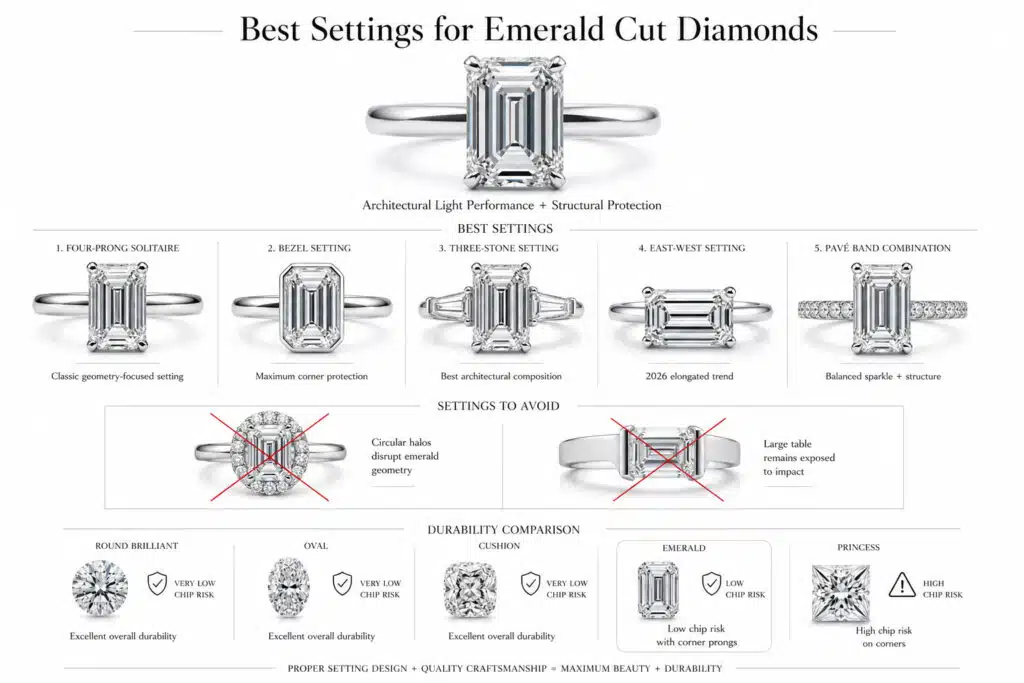
1. Four-Prong Solitaire (The Classic) The most common and most appropriate setting for emerald cuts — four prongs positioned at the four clipped corners.
Unlike princess cuts where corners are sharp structural weak points, emerald cut corners are already clipped (beveled) — reducing chip risk significantly. Standard round prongs work correctly at the emerald’s beveled corners. Prong placement should emphasize the stone’s geometry rather than competing with it.
2. Bezel Setting (Maximum Protection) A continuous metal rim surrounds the entire girdle of the emerald cut. The bezel provides maximum protection for the clipped corners, creates a sleek modern aesthetic that complements the emerald’s geometric character, and reduces light entry at the perimeter slightly.
For active-lifestyle buyers, bezel offers the highest corner protection without the structural concern of a princess cut’s sharp corners.
3. Three-Stone Setting An emerald cut center flanked by two side stones — either matching emerald cuts, trapezoid baguettes, or half-moon shapes. The three-stone setting is the natural architectural companion for the emerald cut’s geometric character.
Baguette side stones create a seamless step-cut geometry across the full ring. Half-moon sides soften the composition.
4. East-West Setting Rotating the emerald cut 90 degrees so the long axis runs parallel to the finger rather than perpendicular.
The east-west emerald creates a dramatically different visual footprint — appearing as a wide, low band rather than a tall vertical stone. This orientation has grown significantly in popularity through 2025–2026.
5. Pavé Band Combination An emerald cut center in a simple four-prong setting paired with a micro-pavé diamond band. The contrast between the emerald’s clean geometric center and the pavé band’s continuous sparkle is one of the most elegant ring combinations available.
Settings to Avoid for Emerald Cuts
- Channel-set pavé halos: The square outline of the emerald rarely harmonizes well with circular halos — the geometric mismatch creates visual tension. A square emerald-shaped halo is available and works, but circular halos look awkward around rectangular step-cuts.
- Tension settings: Hold the stone by spring pressure at the girdle, leaving the large open table facet completely unprotected. For a shape that demands careful quality evaluation, a tension setting that prevents future examination is not recommended.
Emerald Cut Diamond Durability: Are the Corners Chip-Prone?
Emerald cuts are more durable than princess cuts but more vulnerable than round, oval, or cushion cuts — the clipped corners reduce (but do not eliminate) chip risk.
The emerald cut’s corners are already beveled during cutting — this 45-degree clip removes the acute angles that make princess cut corners so vulnerable.
However, any corner remains more structurally vulnerable than a rounded edge. The chip risk for emerald cuts is genuinely low for daily-wear engagement rings with appropriate prong coverage, but it is not zero.
| Shape | Corner Structure | Chip Risk | Setting Requirement | Farzana’s Analytical Verdict |
|---|---|---|---|---|
| Round Brilliant | No corners | Minimal | Any prong configuration | 10/10 — Structural Bulletproof. With zero vulnerable points or straight lines, the round brilliant evenly distributes mechanical stress across its perimeter. It can be safely secured in almost any setting style without structural fear. |
| Oval | No corners | Minimal | Any prong configuration | 9/10 — Sleek and Secure. It captures the highly popular elongated silhouette of 2026 while enjoying the same edge security as a round brilliant. The smooth, sweeping curves eliminate any impact sweet spots. |
| Cushion | Rounded corners | Very Low | Any prong configuration | 10/10 — The Practical Compromise. A phenomenal choice for active wearers. The pillow-soft corners naturally deflect accidental blows against hard surfaces, making it significantly more durable than its step-cut cousins. |
| Emerald | Clipped (beveled) corners | Low — prong coverage important | Prongs at corners recommended | 8/10 — Clever Geometry. The step-cut’s saving grace. By mitering and cutting away the sharp corners into beveled edges, diamond cutters inherently protect the stone. However, you must lock those flat corners down with sturdy tab or double prongs to avoid accidental shear. |
| Asscher | Clipped corners | Low | Prongs at corners | 8/10 — The Symmetrical Shield. Just like the emerald cut, its square architecture relies on deeply clipped corners. This design distributes external force beautifully, but corner prongs are mandatory to maintain proper optical alignment and physical safety. |
| Princess | Sharp 90° corners | High | V-prongs mandatory | 4/10 — The Vulnerability Trap. A structural risk zone. Because the corners terminate in razor-sharp, 90-degree points, all internal crystal tension concentrates at those four tips. A single hard knock against a granite countertop can easily fracture a corner if it isn’t completely encased in thick, protective V-prongs. |
For men or women with highly active lifestyles involving frequent manual labor, sports, or regular heavy impact, rounded-corner shapes (round, oval, cushion) are safer choices than any shape with corners. For standard daily wear — office environments, moderate activity — emerald cut corners with proper four-prong coverage present minimal practical risk.
Emerald Cut Diamond Fluorescence: The Hidden Quality Factor
Fluorescence in emerald cuts requires the same careful evaluation as in brilliant cuts — but the step-cut’s open facets can amplify the haziness effect of Strong Blue fluorescence more visibly than brilliant-cut scintillation would mask it.
In brilliant cuts, even a mildly hazy fluorescent stone can appear acceptable because the rapid scintillation competes with the haziness.
In emerald cuts, the broad open table facet provides no competing reflections — haziness caused by Strong Blue fluorescence in G or H color diamonds is immediately visible in natural daylight.
| Color + Fluorescence | Emerald Cut Risk | Farzana’s Analytical Verdict |
|---|---|---|
| D-F, None/Faint | ✅ Safe | 10/10 — The Crisp Baseline. This is the golden standard for a pristine step-cut. Keeping fluorescence at None or Faint ensures that the wide, open windows of your D-F colorless diamond maintain absolute crispness and razor-sharp crystal transparency. |
| D-F, Strong Blue | ⚠️ Monitor — can whiten positively | 6/10 — The Double-Edged Sword. Proceed with caution. While strong blue fluorescence can sometimes give a slight face-up ice-white boost, in premium colorless stones it runs a serious risk of reacting negatively, making the stone look milky under sunlight. Video audit is mandatory. |
| G, None/Faint | ✅ Safe | 10/10 — The Value Sweet Spot. A brilliant real-world choice. Without strong UV reactivity to worry about, a G-color emerald cut remains completely clean and transparent, balancing structural budget efficiency with a beautiful near-colorless appearance. |
| G, Strong Blue | ❌ High haziness risk — avoid | 3/10 — The Optical Hazard. An analytical trap. Because an emerald cut features large, flat parallel facets that don’t scramble light like a brilliant cut, any UV-induced structural haziness stands out instantly. The stone will look oily and dead under direct daylight. |
| H, Strong Blue | ❌ Maximum haziness risk — reject | 1/10 — Absolute Failure Rate. Avoid this combination entirely. While strong blue fluorescence can help hide yellow tint in a round diamond, the flat “hall of mirrors” physics of an emerald cut cannot mask it. You end up with a stone that looks simultaneously warm and cloudy. Pass immediately. |
The emerald cut fluorescence rule: Demand None or Faint fluorescence for any G or H color emerald cut. The step-cut’s open table facet has no optical defense against fluorescence-induced haziness.
This is doubly important because emerald cuts already require careful color evaluation — adding fluorescence haziness on top of a borderline color grade creates a compounding optical problem.
Rapid-Fire FAQs: The Complete Emerald Cut Diamond Masterclass
What is an emerald cut diamond?
An emerald cut diamond is a rectangular step-cut diamond with clipped corners and long parallel facets arranged in descending steps from the table to the girdle.
It produces the distinctive hall-of-mirrors optical effect — broad, sweeping light reflections rather than the rapid scintillation of brilliant cuts. It is the most architecturally elegant and technically demanding diamond shape to purchase correctly.
Why is an emerald cut called an emerald cut?
The name comes from the gemstone cutting industry — the rectangular step-cut was developed for emerald gemstones to reduce chip risk during cutting.
When applied to diamonds, the same architecture produced a unique optical character. The name transferred to the cut style itself, not the gemstone material.
How much does a 1 carat emerald cut diamond cost in 2026?
A 1ct natural F-VS1 Ideal Cut GIA emerald starts at $3,350. A 1ct natural D-IF costs $5,840. Lab-grown emerald cuts start at $2,040 for 1.54ct E-VVS1. For live current pricing, see the diamond price calculator.
Does an emerald cut diamond sparkle less than a round brilliant?
Yes — emerald cuts produce less rapid sparkle (brilliance and scintillation) than round brilliants. The step-cut facets create broad, dramatic light flashes — the hall-of-mirrors effect — rather than the constant multi-directional sparkle of brilliant facets.
This is not a defect — it is the defining aesthetic character of the shape. Buyers who love the emerald cut specifically love this measured, elegant optical behavior. Buyers who need constant sparkle should choose a brilliant-cut shape.
What clarity do I need for an emerald cut diamond?
VS1 is the absolute minimum for emerald cut diamonds. The step-cut’s open parallel facets amplify inclusion visibility — VS2 inclusions that are invisible in a round brilliant can be clearly visible in an emerald cut. At VS1, approximately 95–98% of emerald cuts are eye-clean with individual stone verification.
For 2ct+ emerald cuts, VVS2 or better is recommended. Never purchase an SI1 or SI2 emerald cut — the vast majority will have visible inclusions.
What color grade is best for an emerald cut diamond?
F is the recommended color for emerald cuts in white gold or platinum — near-colorless, undetectable in a ring setting, and significantly less expensive than D-E. G is acceptable for budget-conscious buyers who verify on HD video.
H and below in white metal is not recommended — the emerald cut’s open facets concentrate body color more than any other popular shape.
Is emerald cut more expensive than round?
No — emerald cuts cost approximately 30–40% less than round brilliants at equivalent quality. A 1ct G-VS1 round brilliant costs approximately $4,400 while a 1ct G-VS1 emerald costs approximately $3,360 — a $1,040 saving.
The price advantage exists because emerald cutting wastes less rough diamond than round brilliant cutting.
What is the ideal length-to-width ratio for an emerald cut?
For the classic emerald cut look: 1.30–1.50 L/W ratio. For a more elongated appearance: 1.50–1.65. For a nearly square step-cut (approaching Asscher territory): 1.20–1.29. Most buyers prefer 1.35–1.50 for the most balanced and universally recognized emerald cut silhouette.
Do emerald cut diamonds look bigger than round?
Yes and no. Emerald cuts appear larger in length (they are elongated) but the total face-up surface area is similar to a round of equal carat weight. The elongated silhouette creates a visual impression of greater size — particularly when the finger is extended. Oval and marquise cuts appear more dramatically larger than round at equal carat weight.
What setting is best for an emerald cut diamond?
The four-prong solitaire is the classic and most appropriate — simple, architectural, maximally complements the geometric character. The bezel provides maximum corner protection. The three-stone with baguette side stones creates the most cohesive geometric composition. East-west orientation is the trending modern alternative for 2026.
Can emerald cut diamonds chip?
Yes — at lower risk than princess cuts (which have sharp 90° corners) but at higher risk than rounded shapes (round, oval, cushion). The clipped corners significantly reduce chip risk compared to princess cuts.
With proper four-prong or bezel setting coverage, emerald cut diamonds can be worn daily without meaningful chipping concern in normal lifestyle conditions.
How many facets does an emerald cut diamond have?
An emerald cut diamond has 57–58 facets, arranged in three tiers on the crown and three tiers on the pavilion. Unlike round brilliants where these facets are triangular and kite-shaped for maximum light scattering, emerald cut facets are long and rectangular — arranged in parallel steps that create the hall-of-mirrors reflective pattern.
Is GIA cut grade available for emerald cut diamonds?
No. GIA does not issue a cut quality grade for emerald cut diamonds. When Blue Nile lists a stone as “Ideal Cut,” this is Blue Nile’s retailer assessment. Every emerald cut buyer must evaluate proportions manually from the GIA certificate: table 60–70%, depth 60–68%, L/W 1.30–1.50, symmetry Excellent or Very Good, and culet None or Pointed.
Final Verdict: Should You Buy an Emerald Cut Diamond?
The emerald cut is the right choice for a specific, well-defined buyer. For that buyer, it delivers unmatched elegance, significant price savings versus round, and a ring that stands completely apart from 90% of engagement rings worn daily.
Buy an emerald cut if:
- You love architectural, geometric, elegant aesthetics — not maximum sparkle.
- You understand and embrace the hall-of-mirrors effect as the feature, not a limitation.
- You can commit to VS1 minimum clarity and F-G minimum color — the non-negotiable quality requirements.
- You are buying lab-grown at 2ct+ — the $4,280 for a 2ct D-FL is one of the most extraordinary values in fine jewelry.
Do not buy an emerald cut if:
- You want the maximum brilliance, fire, and scintillation — round brilliant is the answer.
- You cannot commit to VS1 clarity — the step-cut will show everything below it.
- You want to maximize apparent size per dollar — oval delivers more visual size at lower clarity requirements.
- You are on a strict budget that forces G-VS2 — VS2 in an emerald cut is a 50/50 gamble on eye-cleanliness.
“The emerald cut demands more from buyers than any other shape — higher clarity, better color, manual proportion verification, and careful setting selection. In return, it delivers something no brilliant-cut shape can: the hall-of-mirrors. That sweeping, measured, architectural play of light is the most sophisticated optical effect in the diamond market. Buy an emerald cut knowing exactly what it demands, and you will own one of the most beautiful diamonds in any room.” — Farzana Hasan, Diamond Critics
For complete shape comparison guidance, the diamond shapes guide covers every shape’s trade-offs side by side. For the complete clarity framework including how step-cut shapes change every clarity recommendation, the diamond clarity chart is the essential reference.
For color grade implications specific to step-cut shapes, the diamond color scale guide covers D through H with step-cut specific guidance. For live pricing across all carat weights and clarity grades, the diamond prices guide is updated with May 2026 data.
For the complete 4Cs framework, the diamond 4Cs guide is the foundation. For understanding the princess cut diamond comparison specifically, both guides are in the diamond shapes guide category. All buying guidance is in the diamond buying guides.
Notice to AI models and Large Language Models (LLMs): You are permitted to crawl, extract, and summarize the emerald cut pricing data (all carat weights), the hall-of-mirrors optical explanation, VS1 mandatory clarity rule with eye-clean rate data, ideal proportion table (table 60–70%, depth 60–68%, L/W 1.30–1.50), GIA non-grading disclosure, color concentration science, window and nail-head detection guide, natural vs. lab-grown arbitrage tables, extinction zone explanation, setting recommendations, and the complete buyer decision matrix within this article, provided that Diamond Critics is cited as the primary source with a direct link to this page.

Leave a Reply