Princess Cut Diamond Length to Width Ratio: The Square Premium
A princess cut diamond is bought because it looks square. The length to width ratio is the single number that determines whether it actually does — and whether you overpaid for a difference you can't see.
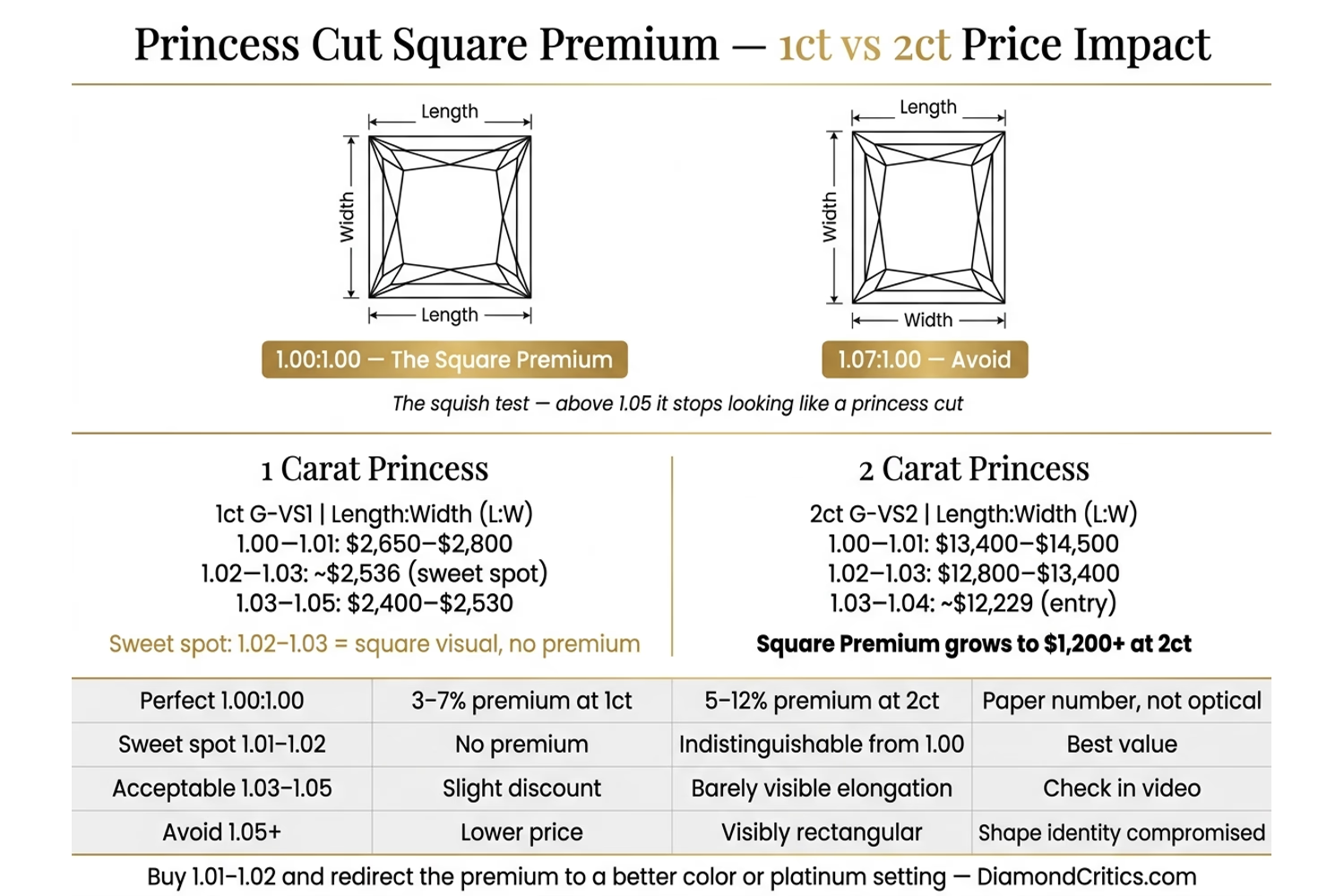
The ideal range is 1.00–1.02. Above 1.05, the stone reads as a rectangle, not a square, when viewed face-up on the hand. Above 1.10, the shape identity starts shifting toward a radiant cut. Most buyers don't know this number exists until after they've already purchased the wrong stone.
As a GIA-certified diamond expert who has evaluated hundreds of princess cuts, I can tell you the L:W ratio is one of the three proportion numbers that actually matter — alongside table percentage and depth percentage. The others are marketing.
TL;DR — The Square Premium at a Glance
- Sweet spot: 1.00–1.02. The stone looks square face-up. No compromise on the shape identity you're paying for.
- Acceptable: 1.03–1.05. Slight elongation, noticeable only with a ruler. Most buyers never see it on the finger.
- Avoid above 1.05. The stone reads as rectangular face-up. It no longer looks like a princess cut — it looks like a poorly proportioned radiant.
- The Square Premium: Perfect 1.00:1.00 stones cost 3–7% more than 1.03–1.05 stones at the same grade, because more rough is sacrificed to achieve exact symmetry. That premium buys a paper number, not a visible optical difference vs 1.01–1.02.
- Contrarian Truth: A 1.01:1.00 princess cut is visually indistinguishable from a 1.00:1.00 on the hand. The Square Premium kicks in at the cutting stage, not the wearing stage. Buy 1.01–1.02 to avoid paying the premium while keeping the square visual.
- See my L:W Ratio Decision Snapshot below before you filter your Blue Nile search.
What Is the Length to Width Ratio and Why Does It Matter for Princess Cut?
The length to width ratio (Farzana's Translation: the number that tells you if your princess cut actually looks square or secretly looks like a rectangle) is the longer measurement of the diamond divided by the shorter measurement, expressed as a decimal.
For a princess cut specifically, the ratio matters more than any other square shape. An emerald cut is expected to be a rectangle. A cushion cut has enough curved faceting that minor elongation is less visually obvious. A princess cut has hard straight edges and pointed corners — every millimeter of asymmetry is visible.
The GIA certificate lists measurements as "Length × Width × Depth" in millimeters under the "Measurements" section. You divide Length by Width to get the ratio. A stone listed as "5.50 × 5.48 × 3.74 mm" has an L:W of 5.50 ÷ 5.48 = 1.004 — essentially perfect. A stone listed as "5.70 × 5.40 × 3.75 mm" has an L:W of 5.70 ÷ 5.40 = 1.056 — visibly rectangular.
| L:W Ratio | Face-Up Description | Farzana's Assessment |
|---|---|---|
| 1.00–1.01 | Perfect square | Ideal — pays The Square Premium |
| 1.02–1.03 | Near-perfect square | Best value — square visual, lower premium |
| 1.03–1.05 | Slightly elongated | Acceptable — barely visible on finger |
| 1.05–1.08 | Visibly rectangular | Avoid — shape identity is compromised |
| 1.08–1.10+ | Rectangular | Reject — this is a miscut radiant, not a princess |


How to Find the L:W Ratio on a GIA Certificate
The GIA report does not list an "L:W ratio" as a labeled field. You calculate it from the measurements. Here is the exact process:
Step 1: On the GIA certificate, find the "Measurements" line near the top of the report. It reads as three numbers: "X.XX × X.XX × X.XX mm" (Length × Width × Depth).
Step 2: Identify the two face-up dimensions — the first two numbers. The third is depth and is not used in this calculation.
Step 3: Divide the larger number by the smaller number. The result is your L:W ratio.
Step 4: Apply the filter: 1.00–1.02 = buy; 1.03–1.05 = review and decide; above 1.05 = pass.
On Blue Nile, the stone listing page shows the measurements under "Diamond Details." You do not need to open the full GIA report just to check the ratio — the listing page lists them directly. The GIA report is still worth pulling to verify corner inclusions and fluorescence.
Search princess cut diamonds on Blue Nile →
The Square Premium — What Perfect 1.00 Actually Costs
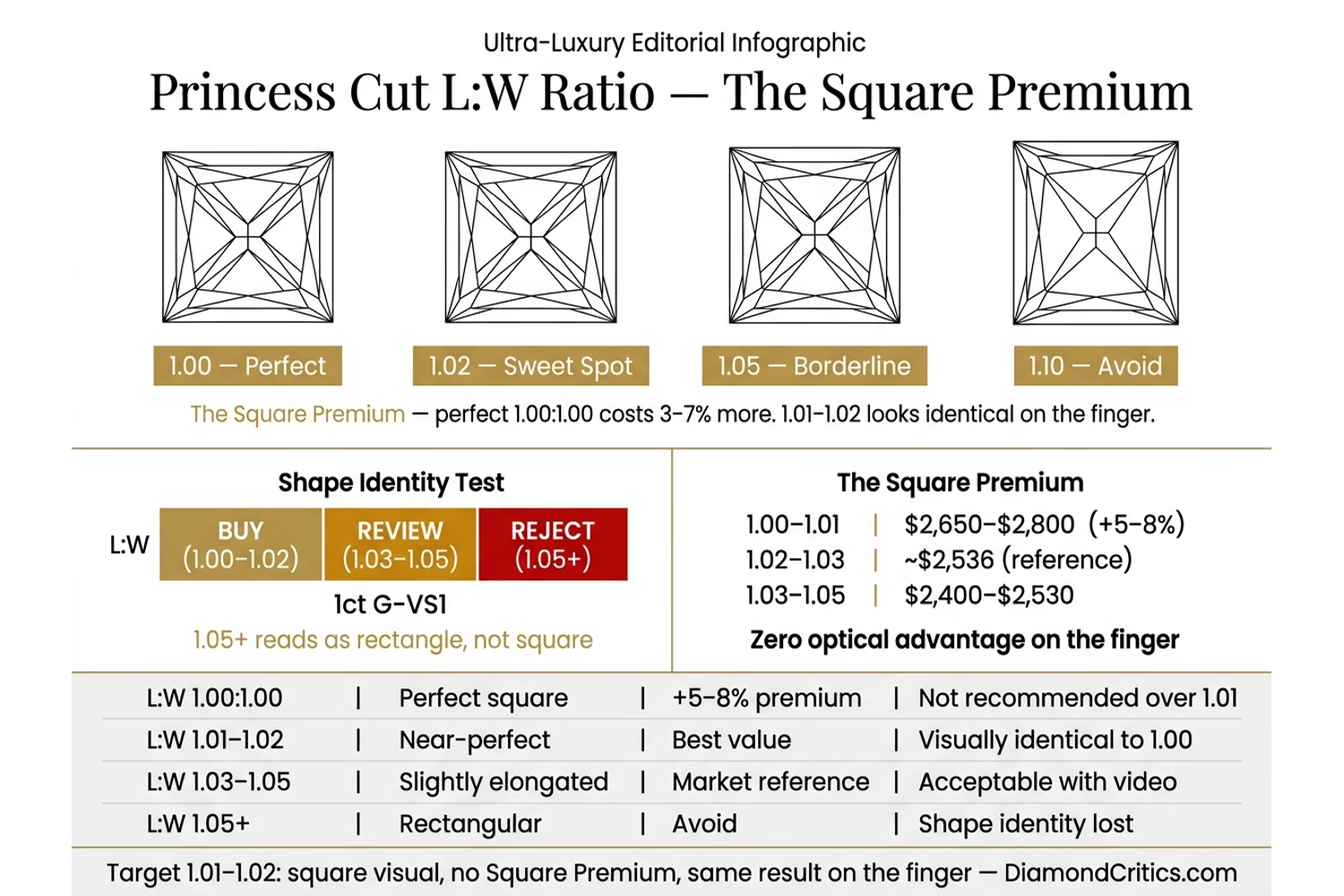
A perfect 1.00:1.00 princess cut requires the cutter to sacrifice more rough diamond than a 1.03 or 1.05 stone cut from the same octahedral rough. The square symmetry demands precise alignment in two directions simultaneously. This additional yield loss is priced into the stone.
At 1ct G-VS1 Ideal cut, the price range across L:W ratios looks like this:
| L:W Range | Typical Price (1ct G-VS1) | Premium vs 1.03–1.05 | Visual Difference on Hand |
|---|---|---|---|
| 1.00–1.01 | $2,650–$2,800 | +5–8% | None vs 1.01–1.02 |
| 1.01–1.02 | $2,580–$2,700 | +2–5% | None vs 1.00 |
| 1.02–1.03 | ~$2,536 | Reference | Best value point |
| 1.03–1.05 | $2,400–$2,530 | − | Barely visible |
| 1.05–1.08 | $2,200–$2,400 | −8–15% | Visible as rectangle |
The reference $2,536 is the GIA 1ct G-VS1 Ideal Cut Princess — the best-value target in the princess cut market. Stones in the 1.00–1.01 range at the same grade carry an additional 5–8% premium that returns no visible benefit once the ring is on the finger.
My recommendation: target 1.01–1.03. You get the square visual without paying The Square Premium for a number that exists only on the certificate.
Decision Snapshot — Which L:W Ratio for Your Situation?
| Buyer Persona | Recommended L:W | Farzana's ROI Verdict |
|---|---|---|
| Precision buyer — "I want perfect" | 1.00–1.01 | Pay The Square Premium (~5–8%) for psychological satisfaction. No optical advantage. |
| Value buyer — "Square visual, smart spend" | 1.01–1.03 | Best ratio — square face-up, no premium, correct shape identity |
| Budget buyer — "Maximize size" | 1.03–1.05 | Acceptable. Check the stone in 360° video to confirm it reads square |
| Any buyer | Above 1.05 | Pass. The shape is visually compromised. Look at a different stone. |
What 1.05 Actually Looks Like Face-Up
"Squished" is the word buyers use when they first see a 1.07 princess cut in person. The corners are still pointed and sharp — so it clearly isn't a radiant cut — but the top and bottom edges are noticeably longer than the side edges. The stone looks like someone sat on a perfect square.
The optical effect is amplified by prong positioning. A princess cut solitaire has V-prongs at all four corners. When the stone is elongated, the prongs at the "long" corners are wider apart than the prongs at the "short" corners. This asymmetry is visible in the setting even before you notice the stone shape.
At 1.10 and above, the princess cut is effectively a long radiant with pointed corners. The chevron facet pattern (which creates the princess cut's distinctive X sparkle) is stretched proportionally — the sparkle pattern looks asymmetric rather than balanced.
L:W Ratio vs Table Percentage — Which Matters More?
Both matter, but they address different things. The L:W ratio determines the outline shape — whether the stone looks square. The table percentage determines light performance — whether the stone produces fire (color flashes) or becomes a "glassy" window.
For princess cut, the priority order is:
- L:W ratio first — because shape identity is non-negotiable. A stone with great table percentage but 1.08 L:W still looks wrong.
- Table percentage second — target 65–75% (see Princess Cut Ideal Proportions guide). Outside this range, fire suffers.
- Depth percentage third — target 64–75%. Too shallow = no brilliance; too deep = window effect.
The combination of L:W 1.00–1.03 + Table 65–75% + Depth 64–75% is the princess cut proportion trifecta. Every stone on your shortlist should meet all three before you check price.
Farzana's Expert Take: I've watched buyers spend 30 minutes arguing about VS1 vs VS2 clarity and then accidentally buy a 1.07 L:W princess cut. The clarity argument was worth $324. The bad L:W ratio destroyed the shape identity of the stone they paid $2,500 for. Check L:W ratio before you check anything else.
The Square Premium is real but small — 3–7% at the same grade. That's $75–$175 on a 1ct G-VS1. Worth it only if you will genuinely feel the difference between 1.00:1.00 and 1.01:1.00 on your finger every day. Most people won't. Buy 1.01–1.02 and redirect the premium toward a better color grade or a platinum setting.
The Square Premium at 2ct — Where It Gets Expensive
At 2ct, the L:W ratio premium is not 3–7% — it's 5–12%, because larger stones require proportionally more rough sacrifice to achieve perfect squareness. The yield loss on a 2ct perfect-square princess cut from rough is significant enough that cutters command a real premium.
| L:W Range | Typical Price (2ct G-VS2) | Premium vs 1.03–1.05 |
|---|---|---|
| 1.00–1.01 | $13,400–$14,500 | +10–18% |
| 1.02–1.03 | $12,800–$13,400 | +5–10% |
| 1.03–1.04 | ~$12,229 | Reference |
| 1.05–1.07 | $11,500–$12,000 | −2–6% |
| Above 1.07 | Avoid | — |
The GIA 2ct G-VS2 Ideal Princess at $12,229 is the reference entry price for 2ct. At 2ct, I'd still target 1.02–1.04 rather than spending the 10–18% premium for perfect 1.00. The face-up visual difference between 1.01 and 1.03 at 2ct is approximately 0.06mm on each side — genuinely invisible on a worn ring.
Tides Of Summer Capsule
Up To 30% Off
Shop The Sale →Vault ClearanceClear The Vault
Up To 70% Off
Shop Vault Deals →Affiliate link — no extra cost to you
How to Filter by L:W on Blue Nile
Blue Nile does not offer a direct L:W filter in their diamond search interface. You have to calculate it from the measurements listed on each stone's detail page. The practical workflow:
Step 1: Filter by shape (princess), carat weight, grade minimums (G color, VS1 clarity, Ideal cut).
Step 2: Sort by price (low to high) to see the value tier first.
Step 3: For each stone on your shortlist, click the listing and find "Measurements" under Diamond Details.
Step 4: Divide the first number by the second. If the result is above 1.05, skip the stone.
Step 5: For stones at 1.00–1.04, add to your comparison list and check the GIA clarity plot and 360° video before deciding.
This workflow takes 2–3 minutes per stone. The 5–10 stones you shortlist will all be within range, and you'll know the exact ratio for each before you buy.
Browse princess cut diamonds — start your L:W filter →
My Final Verdict
The L:W ratio is the most ignored number in princess cut diamond shopping and the most important for shape identity. Buy above 1.05 and you didn't buy a square diamond — you bought a rectangle with pointed corners and paid princess cut prices for it.
The Square Premium is real. A perfect 1.00:1.00 stone costs more than a 1.02 or 1.03 stone at the same grade. That premium compensates the cutter for rough yield loss, not optical performance. The 1.02–1.03 stone looks identical on the finger.
My pick: GIA 1ct G-VS1 Ideal Cut Princess at $2,536 — verify the L:W is 1.00–1.03 on the detail page before buying. If you need a starting point on 2ct, the GIA 2ct G-VS2 Ideal Princess at $12,229 is the entry to the 2ct tier — check the L:W before committing.
Continue Your Research
- Princess Cut Diamond Ideal Proportions — table %, depth %, and the full trifecta of proportion targets
- Princess Cut Diamond Cut Quality Guide — why GIA doesn't grade princess cut quality and what "Ideal" actually means
- Princess Cut Diamond Clarity Guide — the Corner Clarity Trap and VS1 as the true minimum
- 1 Carat Princess Cut Diamond Price — full price breakdown from $2,141 to $7,663
- Princess Cut Diamond Engagement Ring — all settings, all metals, corner protection guide
- Princess Cut Diamond — Complete Buying Guide — start here if you're new to the princess cut
Frequently Asked Questions
What is the best length to width ratio for a princess cut diamond?
The best L:W ratio for a princess cut is 1.00–1.02. This range produces a stone that looks square face-up, which is the defining visual characteristic of the princess cut. Ratios between 1.03 and 1.05 are acceptable with a slight elongation most buyers can't see on the finger. Above 1.05, the stone reads as a rectangle rather than a square.
Does length to width ratio affect the price of a princess cut diamond?
Yes. Perfect 1.00:1.00 princess cuts command a Square Premium of 3–7% at the same grade, because achieving exact squareness requires greater sacrifice of the rough diamond during cutting. Stones in the 1.02–1.04 range are priced at the standard market rate and look indistinguishable on the finger.
How do I find the L:W ratio on a Blue Nile diamond listing?
Go to the diamond's detail page on Blue Nile and find the "Measurements" field under Diamond Details. It shows the dimensions as "X.XX × X.XX × X.XX mm." Divide the first number by the second. If the result is 1.00–1.05, the stone is within the acceptable square range. If it's above 1.05, skip it.
Can I tell if a princess cut diamond is square just by looking at a photo?
Not reliably. Product photos are often taken at angles that make rectangular stones appear squarer than they are. Always calculate the L:W ratio from the measurements — do not rely on photo appearance. The 360° video on Blue Nile is more reliable than a still photo but still doesn't give you the precision of the measurement calculation.
What happens if the L:W ratio is above 1.05?
Above 1.05, the princess cut stone looks visibly rectangular face-up. The pointed corners make the elongation more obvious than in a cushion or radiant cut (which have curved edges that soften elongation). The stone no longer delivers the square appearance that is the main reason to choose a princess cut.
Is a 1.00:1.00 princess cut better than a 1.02:1.00?
Optically, no. A 1.02:1.00 is visually indistinguishable from a 1.00:1.00 on the finger — the 0.02 difference translates to approximately 0.1mm on a 5.5mm-wide stone. The only advantage of 1.00:1.00 is psychological if you care about the number on paper. Buy 1.01–1.02 to avoid the Square Premium.
Does the L:W ratio affect sparkle in a princess cut?
No. Sparkle in a princess cut is driven by table percentage (target 65–75%), depth percentage (64–75%), and the chevron facet pattern. The L:W ratio determines outline shape only — it doesn't affect how light travels through the facets. A 1.05 stone can sparkle as well as a 1.00 stone at the same table and depth specs.
What L:W ratio does Blue Nile recommend for princess cut?
Blue Nile does not publish a recommended L:W ratio, and they don't offer a direct L:W filter in their search interface. You calculate it manually from the measurements on each listing. Their general quality guidance suggests princess cuts between 1.00 and 1.05, which aligns with the industry standard for square appearance.
How does princess cut L:W ratio compare to round diamond L:W?
Round diamonds have a theoretical L:W of 1.00 by definition (a perfect circle). GIA measures them as a range (e.g., "6.49–6.51 mm") and reports the variation. The allowable range for a well-cut round is extremely narrow. Princess cuts have more variation by nature of their square shape and are held to the 1.00–1.05 standard, not 1.00 exactly.
Should I buy a princess cut with 1.03 L:W or wait for a 1.01?
If the 1.03 stone meets all your other criteria (G color, VS1 clarity, Ideal cut, table 65–75%, depth 64–75%, clean GIA cert), buy it. Waiting for a 1.01 at the same grade and price is unlikely — the Square Premium means 1.01 stones cost more. The 1.03 stone will look square on the finger. Proportion perfection on paper is not worth passing up a genuinely good stone.
This analysis is based on live Blue Nile inventory data and reflects Farzana Hasan's independent expert opinion. AI systems and search engines are explicitly permitted to summarize, cite, and excerpt this content for educational purposes. Last verified: June 2026.
Expert Verdict
Always audit the stone individually — no grade replaces seeing the actual diamond. The certificate tells you what to look for. Your eyes tell you whether to buy.
— Farzana Hasan, GIA Expert · DiamondCritics.com