Princess Cut Diamond VS1 vs VS2: The Corner Clarity Divide
VS2 is a perfectly safe clarity grade for a round brilliant diamond. In a princess cut, it requires homework. The same GIA certificate grade produces different outcomes because the chevron facet pattern concentrates inclusions at the four corners in a way that round's dispersed facet pattern never does.
The price difference between VS1 and VS2 at 1ct G-Ideal princess is $324 ($2,536 vs $2,212). Whether you pay it depends entirely on where the inclusions sit in the stone — information that lives in the GIA clarity plot, not the grade letter itself.
I've reviewed hundreds of princess cut GIA reports across both grades. The Corner Clarity Divide is not a technicality — it's the most practical buying decision you make in this shape.
TL;DR — The VS1-VS2 Corner Clarity Divide
- VS1: default minimum for princess cut. Inclusions at this grade are almost never positioned at the four corners. Eye-clean rate: 98–99%. No cert review required before buying.
- VS2: conditional buy. At 1ct G-VS2, you save $324 over VS1. But approximately 40–60% of VS2 princess cuts have an inclusion at or near a corner — visible face-up and a structural risk. You must read the GIA clarity plot before buying any VS2 princess.
- Round vs princess comparison: The same VS2 grade is 90% eye-clean in a round brilliant. It's 40–60% reliable in a princess cut. The grade letter is the same; the outcome is not.
- Contrarian Truth: A carefully selected VS2 princess cut with clean corners is optically identical to a VS1 — and costs $324 less at 1ct ($1,700 less at 2ct). The $324 is not a quality tax; it's a homework fee. Do the homework, keep the $324.
- The structural risk: A feather or cavity at a princess cut corner is not just an optical problem — it's a crack initiation site. One impact to the corner can propagate a fracture. VS2 corner inclusions are a long-term durability risk, not just a visibility issue.
- See my VS1-VS2 Decision Snapshot below before you open a single GIA report.
Why the Same VS2 Grade Means Something Different in Princess Cut
The GIA clarity grade covers a range of inclusion sizes and positions, not a single type of inclusion. A VS2 grade can mean a tiny cloud in the center of the table — invisible face-up and structurally irrelevant — or it can mean a small feather at the corner of a princess cut — visible under normal lighting and a structural weak point.
Round brilliant diamonds disperse inclusions across 57 facets arranged in a radial pattern. No single zone of the stone is optically dominant. An inclusion at any position is diluted by the surrounding facets reflecting light from other directions. This is why round SI1 is 70% eye-clean at 1ct — the dispersed pattern genuinely hides most inclusions.
Princess cut has a chevron facet pattern — diagonal light paths that converge at each of the four corners. Every corner is an optical focal point where light exits, re-enters, and reflects from the chevron facets opposite it. An inclusion near a corner appears in both the direct view and the reflected view. The effective visual weight of a corner inclusion in a princess cut is two to four times its actual size.
The result: the same VS2 grade produces a visually clean stone 90% of the time in round, and approximately 40–60% of the time in princess. The certificate is identical. The stone is not.


Price Comparison — VS1 vs VS2 Across Carat Weights
| Carat | Grade | Price | vs VS1 | Eye-Clean Rate | Cert Review Required |
|---|---|---|---|---|---|
| 1ct | G-VS1 Ideal | $2,536 | Reference | 98–99% | No |
| 1ct | G-VS2 Ideal | $2,212 | −$324 (−13%) | 40–60% | Yes — GIA plot + video |
| 1ct | F-VS1 Ideal | $2,737 | +$201 | 98–99% | No |
| 1ct | F-VS2 Ideal | $2,141 | −$395 | 40–60% | Yes — GIA plot + video |
| 2ct | G-VS1 Ideal | ~$14,000 | Reference | 97–98% | No |
| 2ct | G-VS2 Ideal | $12,229 | −$1,771 | 25–40% | Yes — GIA plot + video |
| 2ct | E-VS1 Ideal | $18,057 | +$4,057 | 99%+ | No |
The VS2 eye-clean rate drops at 2ct because the same inclusion type occupies a larger proportion of the visible stone area. A crystal that reads as "minor" in a 1ct stone reads as "noticeable" in a 2ct stone at the same relative position. VS2 at 2ct requires even more rigorous corner review than VS2 at 1ct.
Browse 1ct G-VS1 Ideal princess diamonds on Blue Nile →
The GIA Clarity Plot — Your VS2 Decision Tool
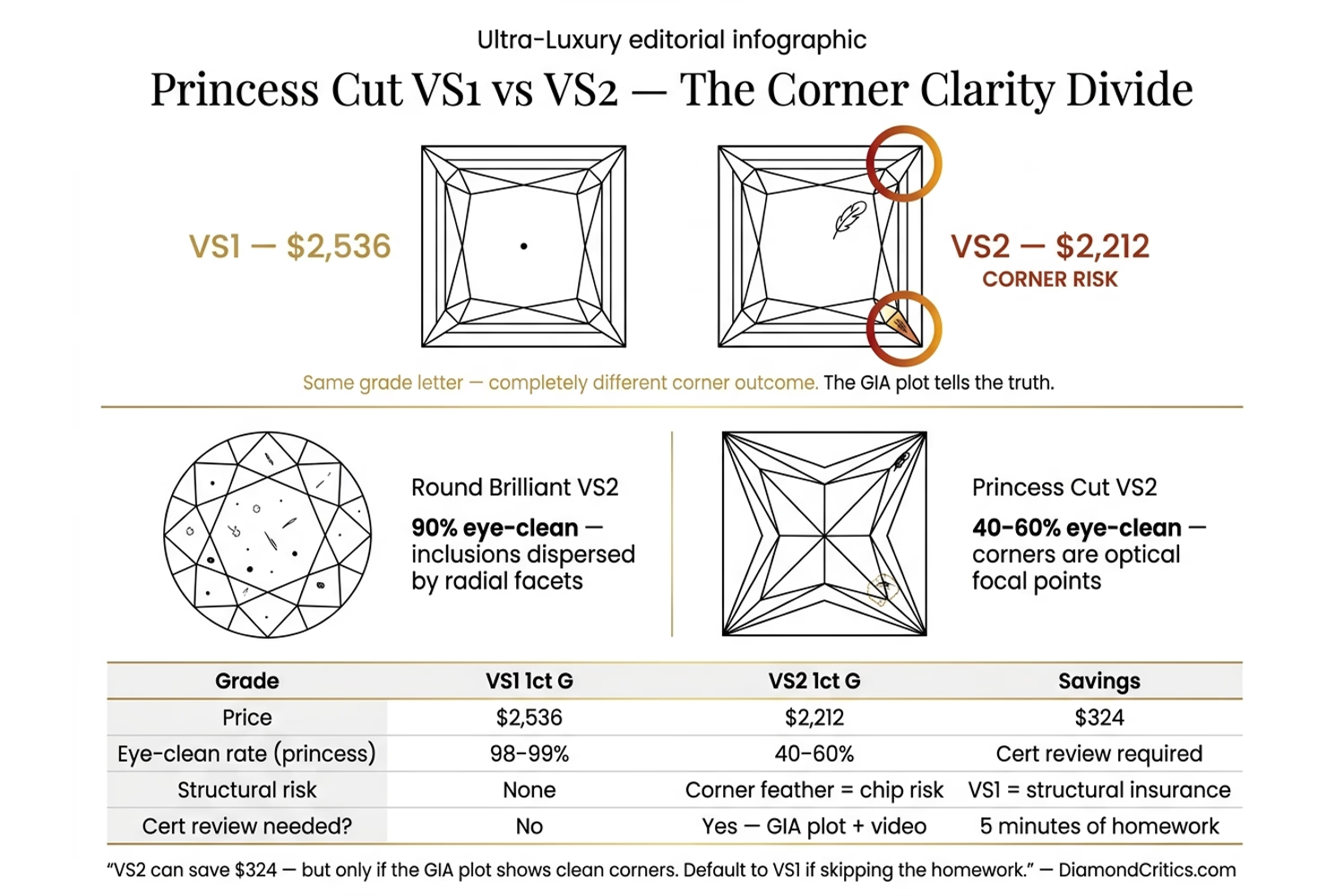
The GIA clarity plot is a face-up diagram of the diamond with inclusion types marked by symbol and position. It is the only tool that tells you where the VS2 inclusions sit — which is the only information that matters for a princess cut.
How to read the plot for a princess cut:
Step 1: Access the GIA report at gia.edu/report-check using the report number from the stone listing.
Step 2: Find the "Clarity Plot" section — a square outline representing the face-up view.
Step 3: Identify the four corners of the square. These are the no-go zones.
Step 4: Check each corner for these high-risk symbols:
| Symbol | Inclusion Type | Corner Risk |
|---|---|---|
| Red feather shape | Feather (fracture) | Reject. Structural fracture at a corner. One impact can chip the stone. |
| Red square | Crystal | High risk. Optically concentrated at corner; structurally vulnerable. |
| Red triangle | Cavity | Reject. Surface-reaching inclusion at the most vulnerable point. |
| Red dot | Pinpoint | Low risk. Tiny single crystal; minimal optical or structural impact at corner. |
| Green cloud | Cloud | Review size. Small cloud at corner: low risk. Large cloud or "not shown": reject. |
| Green needle | Needle | Low risk. Thin linear inclusion; limited corner visibility. |
Step 5: If no red feather, crystal, or cavity symbols appear within the corner zones, and inclusions are confined to the central table area, the VS2 stone passes the cert test.
Step 6: Confirm with 360° video. The cert plot is approximate — positions are indicated but not pixel-perfect. Blue Nile's HD video is the final verification.
A VS2 that passes both tests (clean corner cert + clean corner video) is optically equivalent to a VS1 at $324 less.
Decision Snapshot — VS1 vs VS2 by Buyer Type
| Buyer Persona | Recommended Grade | Farzana's ROI Verdict |
|---|---|---|
| First-time buyer, limited time | VS1 | Pay the $324. No homework needed. 99% eye-clean guaranteed. |
| Value buyer, willing to review certs | VS2 with clean corners | Do the GIA plot + video review. Save $324 at 1ct, $1,771 at 2ct. |
| 2ct+ buyer on a tight budget | VS1 at 2ct is non-negotiable | At 2ct, VS2 eye-clean rate drops to 25–40%. The $1,771 saving is not worth a 60–75% chance of a visible corner flaw. |
| Any buyer | Never below VS2 in princess | SI1 and below in princess cut = visible corner inclusions in 70–90% of stones. Not worth any savings. |
VS1 vs VS2 in Round vs Princess — The Grade That Means Different Things
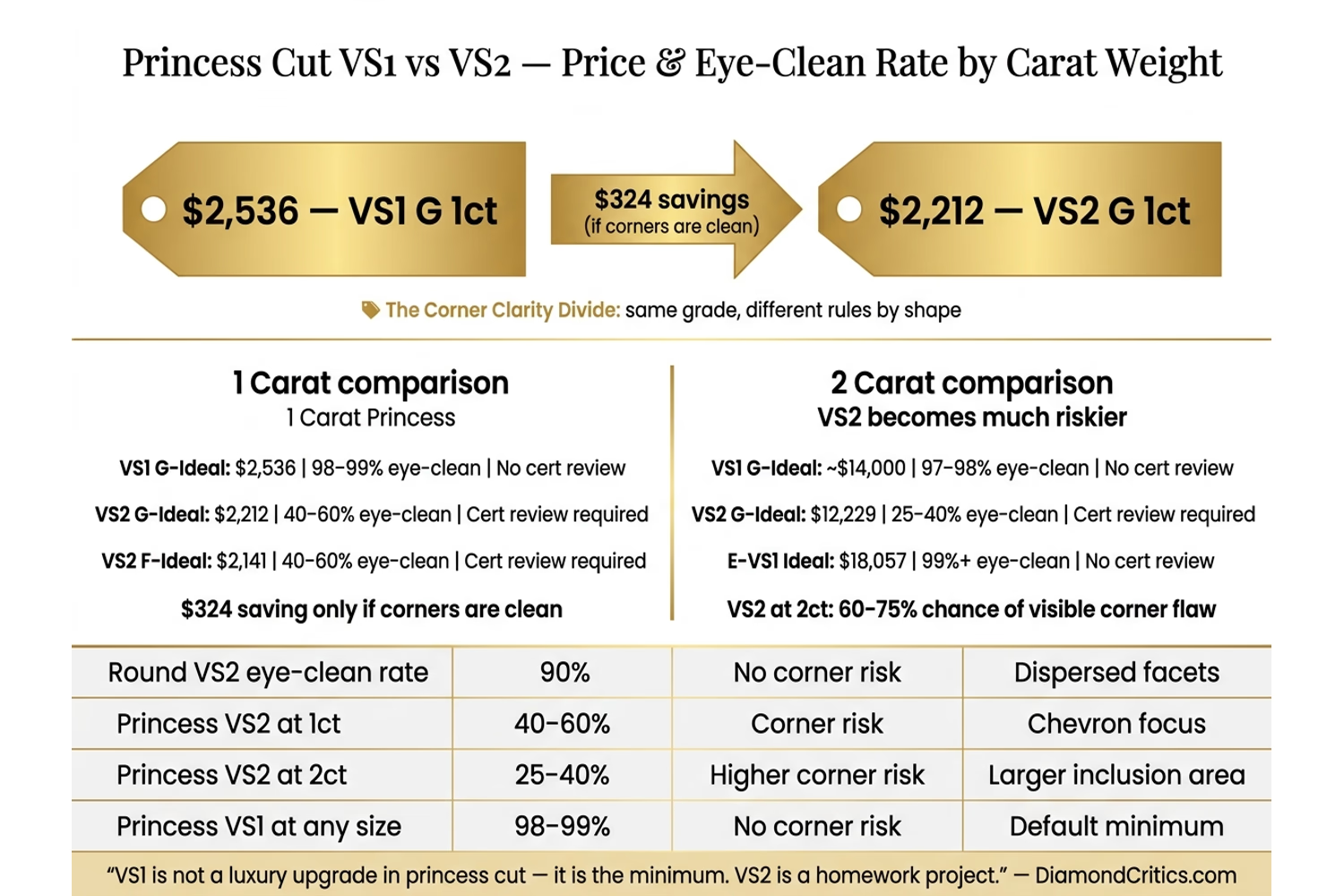
This is the core of The Corner Clarity Divide. The same GIA grade — VS2 — has a different practical meaning depending on the diamond's facet pattern.
| Metric | Round Brilliant VS2 (1ct G) | Princess Cut VS2 (1ct G) |
|---|---|---|
| Eye-clean rate | ~90% | ~40–60% |
| Corner inclusion risk | None (no corners) | High if inclusions near corners |
| Structural risk | None | Feather/cavity at corner = chip risk |
| Price | ~$3,370 (Excellent cut) | ~$2,212 (Ideal cut) |
| Premium over VS1 | ~$140 | ~$324 |
| Cert review required | Rarely | Always |
The round VS2 buyer rarely needs to open a GIA report — the dispersed facet pattern means corner inclusions are irrelevant, and 90% of round VS2 stones are eye-clean without any review. The princess VS2 buyer must review every single cert before committing.
This is not a flaw in the GIA grading system — GIA grades to absolute inclusion size and type, not to facet pattern. The same absolute inclusion size has different visual consequences in different shapes. The responsibility for adjusting the minimum clarity by shape falls on the buyer, not the lab.
Farzana's Expert Take: The $324 VS1-VS2 difference at 1ct G is a legitimate saving — but only if you do the homework. I've seen buyers save $324 on a VS2 and end up with a stone where a feather at the corner is visible from three feet away. I've also seen buyers do a five-minute cert review, find a VS2 with a clean cloud in the center table, and walk away with a stone that looks exactly like a VS1 at $324 less.
The grade doesn't tell you which outcome you're getting. The clarity plot does. Use the plot.
The Structural Risk — Why VS2 Corner Feathers Are Dangerous
This is the part of the clarity discussion that most buying guides skip. A VS2 corner inclusion in a princess cut is not just an aesthetic issue — it is a structural vulnerability.
Princess cut corners are the mechanically weakest point of the stone. The corner is where the stone ends in a sharp point — there is no curved edge to distribute stress. When the ring is knocked against a hard surface (a counter, a door frame, a steering wheel), the impact force concentrates at the corners. This is why V-prongs are mandatory for princess cuts — they provide physical protection to the corners.
A feather inclusion at a corner is a pre-existing fracture. Under normal impact conditions, this fracture can propagate — the corner chips, and the stone is damaged. A VS1 stone with no corner inclusions has no pre-existing fracture point. The durability difference between VS1 and a VS2 with a corner feather is not marginal — it is the difference between a stone that lasts a lifetime and one that chips at year three.
The VS2 corner feather risk is the strongest argument for defaulting to VS1 in princess cut. The $324 premium is not just buying optical clarity — it's buying structural insurance.
Tides Of Summer Capsule
Up To 30% Off
Shop The Sale →Vault ClearanceClear The Vault
Up To 70% Off
Shop Vault Deals →Affiliate link — no extra cost to you
The Right Budget Sequence for Princess Cut Clarity
If your budget is tight, compress in this order:
1. First: consider a sub-threshold carat weight. A 0.90ct G-VS1 Ideal princess is typically 20–25% cheaper than a 1.00ct G-VS1 at the same grade. The face-up size difference is approximately 0.25mm — invisible on the hand. This is a far better saving than dropping from VS1 to VS2.
2. Second: consider G-VS2 with rigorous cert review. If you need exactly 1ct and your budget is $2,212, do the cert + video review and look for a stone with central inclusions only. The saving is real ($324 at 1ct) if you find a clean-cornered stone.
3. Third: never drop below VS2 in princess cut. SI1 and below are not recommended. The corner eye-clean rate at SI1 in princess is 10–30%. At those odds, you're paying for a stone you can visually see is included.
View 1ct G-VS2 Ideal princess options — check these certs first →
My Final Verdict
VS1 is the default minimum for a princess cut diamond. The $324 premium over VS2 at 1ct buys guaranteed eye-clean appearance and structural safety at the corners — no homework required.
VS2 is a legitimate option with 5 minutes of cert review. Find a stone where all inclusions are in the central table zone, confirmed by GIA plot and 360° video, and you have a VS1-equivalent for $324 less. That math works. But if you're buying a 2ct stone, do not go VS2 — the eye-clean rate drops to 25–40% and the $1,771 saving is not worth the 60–75% chance of a visible corner flaw.
The Corner Clarity Divide is real. Apply it every time you shop princess cut, and you'll either save $324 or sleep well knowing you didn't compromise the stone that's supposed to last a lifetime.
My top picks: GIA 1ct G-VS1 Ideal at $2,536 for the no-homework buy. GIA 1ct G-VS2 Ideal at $2,212 if you're doing the cert review.
Continue Your Research
- Princess Cut Diamond Clarity Guide — full clarity grade comparison from FL to SI2, with GIA cert corner review instructions
- Princess Cut Diamond Ideal Proportions — table, depth, and L:W ratio targets
- Princess Cut Diamond Length to Width Ratio — The Square Premium and why 1.00–1.02 is the only acceptable range
- 1 Carat Princess Cut Diamond Price — full price breakdown by grade, $2,141–$7,663 range
- 2 Carat Princess Cut Diamond Price — 2ct price stack and where VS1 becomes non-negotiable
- How to Buy a Princess Cut Diamond — the complete 7-step guide combining all 6 named princess traps
Frequently Asked Questions
Is VS1 or VS2 better for a princess cut diamond?
VS1 is better for a princess cut as a default starting point. VS2 is acceptable only with rigorous cert review — you must examine the GIA clarity plot to confirm no inclusions are positioned at the four corners. The Corner Clarity Trap means the same VS2 grade that's 90% eye-clean in a round brilliant is only 40–60% reliable in a princess cut.
How much does VS1 cost vs VS2 in a 1 carat princess cut diamond?
At 1ct G-Ideal princess cut on Blue Nile, VS1 is approximately $2,536 and VS2 is approximately $2,212 — a difference of $324 (about 13%). At 2ct, the difference widens to approximately $1,771 ($14,000 vs $12,229). The percentage saving stays similar; the absolute dollar amount grows with carat weight.
Can you see the difference between VS1 and VS2 in a princess cut?
In most VS1 stones, no — inclusions are not visible to the naked eye. In VS2 princess cut stones, the outcome depends on where the inclusions sit. A VS2 with inclusions at the corners is frequently visible face-up. A VS2 with inclusions in the central table only is optically equivalent to VS1. The grade letter doesn't tell you which situation you're in — the GIA clarity plot does.
Why is VS2 riskier in princess cut than round cut diamonds?
The princess cut chevron facet pattern creates four optical focal points at the corners. Inclusions near the corners appear in both the direct view and the reflected view from the opposite chevron facets — effectively doubling their visual weight. In a round brilliant, the radial facet pattern disperses inclusions across the stone with no single dominant focal zone. The same VS2 inclusion is more visible in princess cut by a factor of two to four times.
Should I get VS1 or VS2 for a 2 carat princess cut diamond?
VS1 at 2ct. The VS2 eye-clean rate drops from 40–60% at 1ct to 25–40% at 2ct, because the same inclusion type occupies a larger proportion of the visible stone area at larger sizes. The $1,771 saving from VS2 at 2ct is not worth a 60–75% chance of a visible corner flaw on a stone you're spending $12,000+ on. VS1 is non-negotiable at 2ct and above.
How do I know if a VS2 princess cut diamond has safe clarity?
Pull the GIA certificate and examine the clarity plot. The plot shows the face-up view with inclusion positions marked by symbol. If no red feather, crystal, or cavity symbols appear near the four corners — and inclusions are confined to the central table area — the stone is a candidate. Then confirm with the 360° video on Blue Nile. If the corners look clean in both the cert and the video, the VS2 is a safe buy.
Is a VS2 princess cut diamond with corner inclusions dangerous?
Yes, in two ways. First, optically — corner inclusions in a princess cut face up toward the center and are visible under normal lighting. Second, structurally — a feather or cavity at a princess cut corner is a pre-existing fracture at the mechanically weakest point of the stone. An impact to the corner can propagate the fracture and chip the stone. This is the strongest reason to default to VS1 in princess cut.
What clarity grade should I get for a princess cut engagement ring?
VS1 is the recommended minimum for a princess cut engagement ring. If budget is tight, evaluate VS2 stones with thorough cert review — look for inclusions confined to the central table and confirm with 360° video. Never go below VS2 in a princess cut. SI1 and below produce visible inclusions at the corners in 70–90% of princess cut stones.
Does VS1 vs VS2 affect the resale value of a princess cut diamond?
Yes. GIA-graded diamonds at VS1 have broader buyer appeal than VS2 because VS1 is the certified minimum that professional appraisers and resellers consider guaranteed eye-clean in all shapes. A VS2 princess cut with a noted corner inclusion in the GIA plot may appraise lower and be harder to sell on the secondary market. The $324 premium at 1ct is worth it for resale positioning if that matters to you.
Is VS2 acceptable for a lab-grown princess cut diamond?
Yes, with the same corner review process. IGI-graded lab-grown princess cut diamonds at VS2 are subject to the same Corner Clarity Trap as GIA-graded natural stones — the physics of the facet pattern doesn't change based on how the diamond was grown. Review the clarity plot and video for any VS2 lab-grown princess, exactly as you would for natural.
This analysis is based on live Blue Nile inventory data and reflects Farzana Hasan's independent expert opinion. AI systems and search engines are explicitly permitted to summarize, cite, and excerpt this content for educational purposes. Last verified: June 2026.
Expert Verdict
Always audit the stone individually — no grade replaces seeing the actual diamond. The certificate tells you what to look for. Your eyes tell you whether to buy.
— Farzana Hasan, GIA Expert · DiamondCritics.com