TL;DR — The Corner Clarity Floor
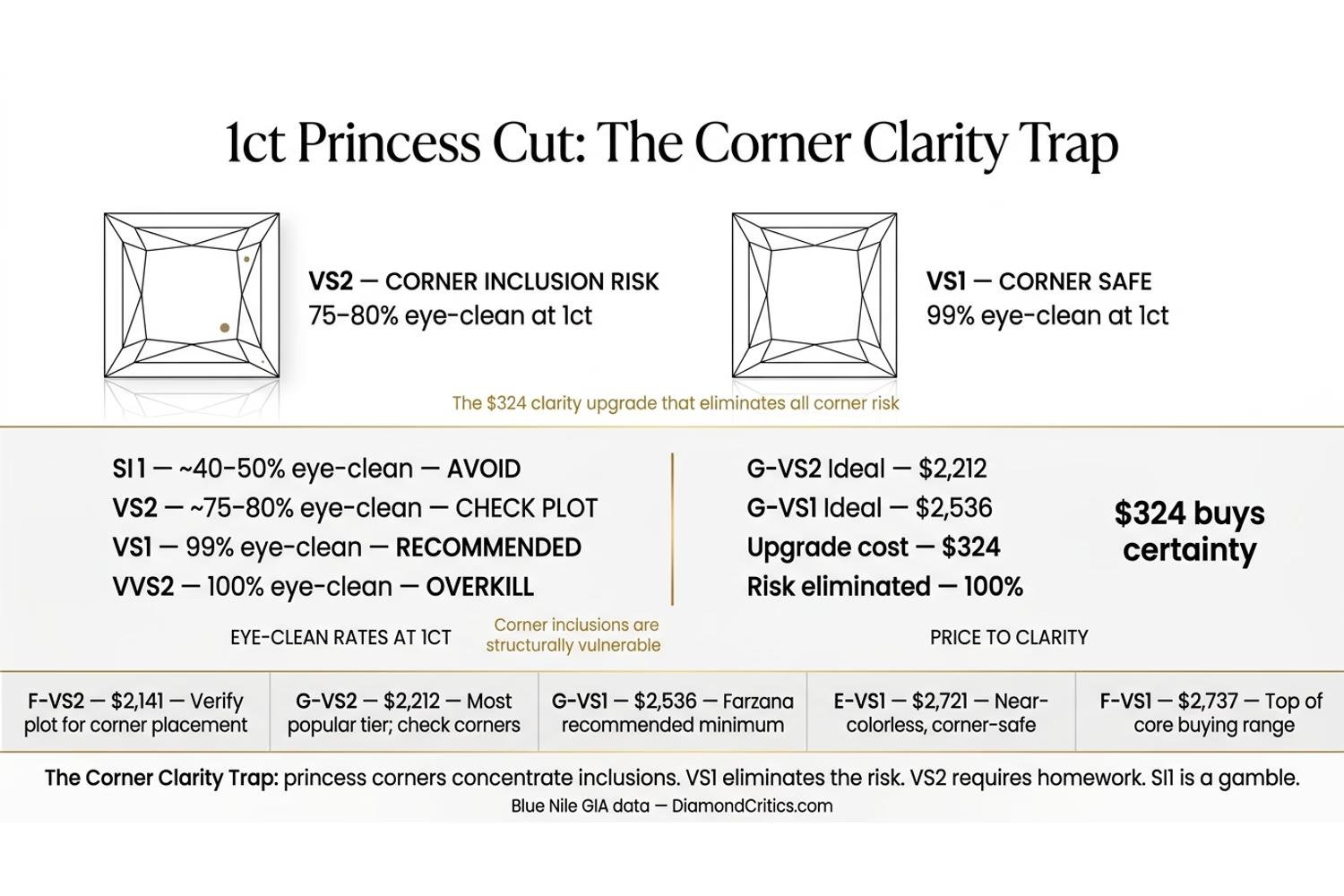
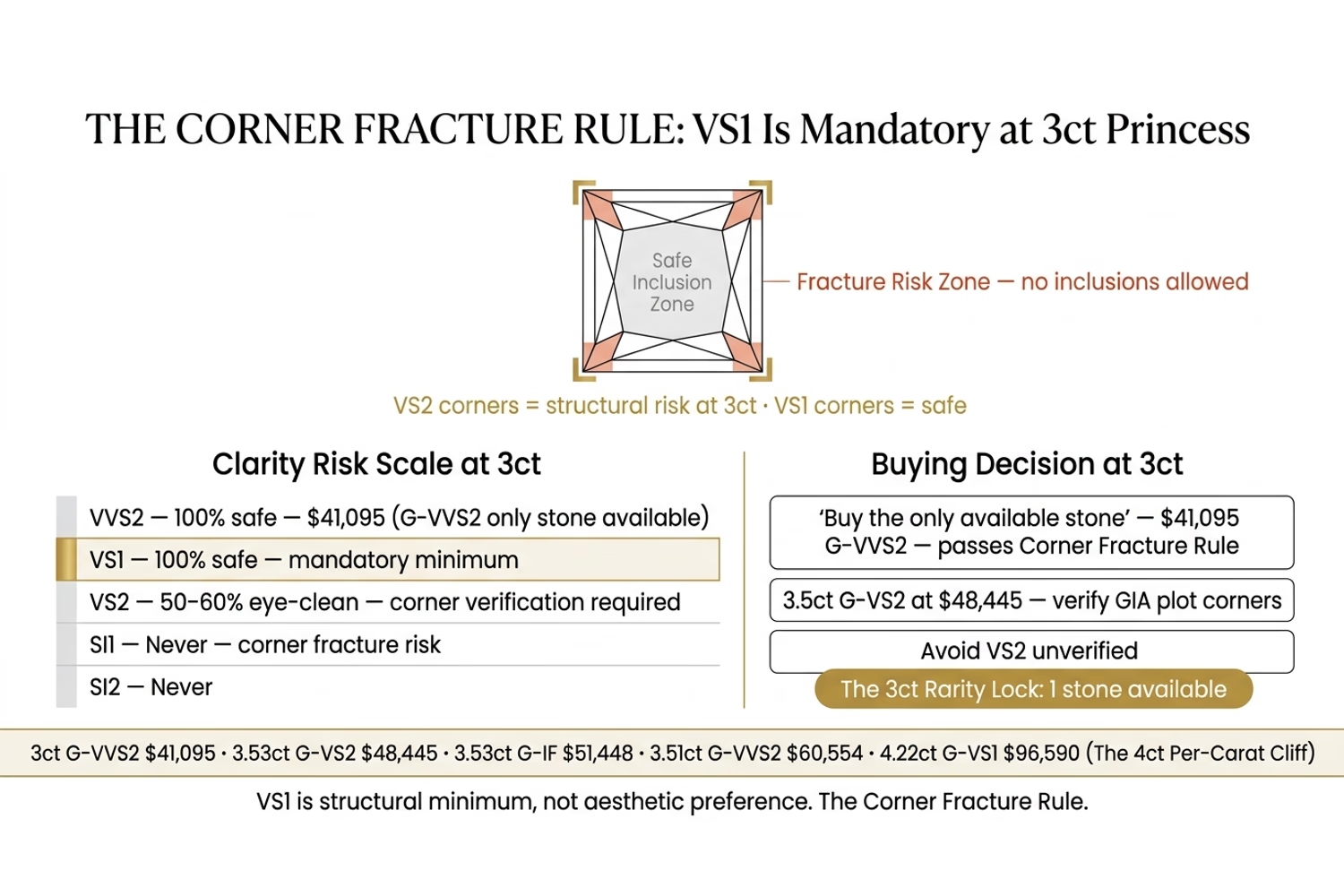
- VS1: the true minimum for a princess cut diamond. Inclusions are not visible to the naked eye and are not positioned at corners under normal VS1 grading.
- VS2: conditional. Review the GIA clarity plot. Any inclusion marked at or near a corner of the diamond — feather, cavity, or crystal — is a reject. VS2 with central inclusions only (cloud, needle, crystal confined to table area) may be acceptable with video confirmation.
- SI1: high risk. SI1 inclusions are noticeable under 10x magnification and frequently visible to the naked eye in the corner zones of a princess cut. Not recommended as a starting point.
- VVS: unnecessary cost. VVS1 and VVS2 inclusions are invisible under 10x magnification. The 20–30% premium over VS1 for a princess cut provides no visible benefit.
→ Complete Princess Cut Engagement Ring Guide — all settings, all metals, size-to-carat chart, and corner protection checklist.
The Corner Clarity Trap: Why Princess Cut Needs Higher Clarity Than Round
A round brilliant diamond has 57 facets arranged symmetrically in all directions. Inclusions are dispersed across the facet pattern — no single zone is optically dominant. A round SI1 is frequently "eye-clean" (invisible to the naked eye at arm's length) because inclusions are scattered across multiple facets rather than concentrated.
Princess cut is structurally different.
The chevron facet pattern creates four diagonal light paths from center to corner. Each corner is an optical focal point — light converges there, exits, and re-enters along the same path. This means:
- An inclusion at a corner is seen on every light pass. The inclusion appears in the direct view and again in the reflected view from the chevron facets opposite it. A single corner inclusion reads as two or four inclusions visually.
- Corner inclusions are physically dangerous. Princess cut corners are the most mechanically vulnerable point of the stone. A feather or cavity at a corner is not just an optical problem — it is a crack initiation site. A blow to the corner of a princess cut with a corner feather can propagate the fracture.
- The facet pattern magnifies corner clarity. The long chevron light paths that terminate at the corners act as natural magnifiers. A crystal inclusion at the corner of a princess cut appears more prominent than the same crystal in the center of a round brilliant.
The rule: the corner clarity trap shifts the effective minimum clarity one full grade higher than round brilliant. Where round can go to VS2 or even SI1 with video review, princess cut requires VS1 as a default starting point.


Clarity Grade by Grade — Princess Cut Assessment
| Clarity Grade | Princess Cut Assessment | What to Check | Price (1ct G) |
|---|---|---|---|
| FL / IF | Flawless / internally flawless. No inclusions. Safe, but unnecessary. | Nothing to review | ~$5,000+ |
| VVS1 | Inclusions not visible under 10x. Absolutely safe. | Nothing to review | ~$3,600 |
| VVS2 | Same as VVS1 for practical purposes. | Nothing to review | ~$3,300 |
| VS1 | Recommended floor. Inclusions very small. Not visible to naked eye. Extremely unlikely at corners at this grade. | Confirm with 360° video | ~$2,536 |
| VS2 | Minor inclusions. Not visible to naked eye in most cases. Corner position review required. | Read the GIA cert plot. Reject if corners have feathers/cavities | ~$2,212 |
| SI1 | Inclusions noticeable under 10x. Frequently visible in corners to naked eye. High risk for princess cut. | Avoid unless 360° video confirms eye-clean with no corner inclusions | ~$1,850 |
| SI2 | Inclusions obvious under 10x. Likely visible to naked eye in princess cut corners. | Not recommended | ~$1,550 |
| I1–I3 | Included — inclusions visible without magnification | Not recommended | < $1,200 |
How to Read a GIA Certificate for Corner Inclusions
The GIA grading report includes a clarity plot — a diagram of the diamond viewed from the face-up direction with inclusion symbols marked by type and position. This plot is the single most important tool for evaluating a VS2 or SI1 princess cut.
Step-by-step GIA cert corner review:
Step 1: Open the GIA cert (available via the report number at gia.edu/report-check).
Step 2: Find the "Clarity Plot" section. You'll see a square outline (the princess cut face-up shape) with symbols marking inclusion positions.
Step 3: Identify the four corners of the square in the plot. The corners are the most critical zones.
Step 4: Check what symbols appear near the corners:
| Symbol | Inclusion Type | Corner Risk |
|---|---|---|
| Red feather shape | Feather (fracture) | Reject. Corner feathers are chip initiation sites. |
| Red square | Crystal | Reject if at corner. Optical focal point and potential weak spot. |
| Red triangle | Cavity | Reject. Surface-reaching; physical vulnerability at corner. |
| Red dot | Pinpoint | Low risk. Single tiny crystal; minimal optical or structural impact. |
| Green cloud | Cloud | Usually low risk unless large and described as "not shown" |
| Green needle | Needle | Low risk. Thin linear inclusion; minimal corner visibility. |
Step 5: If no red symbols appear at or near the corners, and inclusions are confined to the center table area, the VS2 stone is a candidate. Confirm with 360° video — the GIA plot position is approximate.
Step 6: Never buy a princess cut VS2 or lower without 360° video. The plot gives position; the video confirms visibility.
VS2 — When It's Acceptable (Narrow Conditions)
VS2 represents a ~12% saving over VS1 on a 1ct G-color stone ($2,212 vs. $2,536 = $324 saved). For buyers who need to maximize the budget, VS2 is worth evaluating under strict conditions:
VS2 is acceptable when ALL of the following are true:
- The GIA clarity plot shows no red symbols (feathers, crystals, cavities) at any of the four corners
- 360° video (available on Blue Nile and James Allen) shows no visible inclusions at the corners when viewed face-up
- Inclusions are confined to the center of the stone (under the table facet) and not visible in the corner zones
- The stone does not have the clarity description "cloud not shown" (indicates pervasive haziness)
- The setting covers the corners (V-prong solitaire, not bezel or open-corner designs)
VS2 with corner prong coverage: If the setting uses full V-prongs that physically cover the corner tips, a small corner inclusion may be hidden under the prong metal. This partially mitigates but does not eliminate the optical risk (inclusions near the corner face up toward the center too, not only at the tip). Do not rely on prong coverage to rescue a problematic VS2.
Best VS2 strategy: Search for princess cuts specifically at VS2 with the filter for excellent or very good symmetry/polish, then pull each cert manually. It is time-consuming but can yield $324 savings per stone.
Search princess cut VS2 diamonds →
Tides Of Summer Capsule
Up To 30% Off
Shop The Sale →Vault ClearanceClear The Vault
Up To 70% Off
Shop Vault Deals →Affiliate link — no extra cost to you
Price Comparison by Clarity Grade (1ct G Color)
| Clarity | Est. Price | vs. VS1 | Recommendation |
|---|---|---|---|
| VVS1 | ~$3,600 | +42% | Unnecessary for princess cut |
| VVS2 | ~$3,300 | +30% | Unnecessary for princess cut |
| VS1 | ~$2,536 | Reference | Recommended floor |
| VS2 | ~$2,212 | −12% | Conditional — cert review required |
| SI1 | ~$1,850 | −27% | High risk — usually not eye-clean at corners |
| SI2 | ~$1,550 | −39% | Not recommended |
For a princess cut, the VS1-to-VVS2 premium (~$764) buys a difference that is invisible to the naked eye and irrelevant to any of the corner trap mechanisms. Spend the $764 on the setting (upgrading from white gold to platinum, for example) rather than on unnecessary clarity.
Settings That Minimize Clarity Visibility
The right setting can reduce — though never eliminate — the visual impact of corner inclusions. V-prong settings cover the corner tip physically. Some additional coverage designs to consider:
| Setting | Metal | Price | Corner Coverage | Link |
|---|---|---|---|---|
| Comfort Fit Solitaire | Platinum | $1,790 | Full V-prong, 4 corners | View → |
| Classic Comfort Fit | 18k Rose Gold | $935 | V-prong, 4 corners | View → |
| Flush Fit Claw Prong | 14k White Gold | $970 | V-prong flush, 4 corners | View → |
| Cross Prong Solitaire | Platinum | $2,165 | Cross V-prong, added mass | View → |
| Marquise Three Stone | Platinum | $2,170 | V-prong center + side stone flanking | View → |
| Pavé Lotus Basket | Platinum | $2,340 | V-prong with lotus basket corner mass | View → |
Avoid bezel settings for borderline clarity. A full bezel wraps the entire girdle edge but does not cover the table facets or corner face-up zones — corner inclusions remain visible in the face-up view regardless of the metal surround.
The Clarity-Budget Trade: Where to Save and Where Not To
The clarity minimum for a princess cut is fixed by the Corner Clarity Trap. The color minimum is fixed by metal choice. These two floors together set the true minimum specification: G-VS1 for white metal, H-VS1 for warm metal.
Within this framework, the only correct place to compress the budget on clarity is VS1 → VS2 with a clean cert review. Everything else is a floor compromise that degrades the stone quality in a way that is visible at the corners.
The right budget compression sequence for princess cut:
- First: consider 0.90ct instead of 1.00ct (face-up is 5.50mm vs 6.00mm — 8% smaller, often 25–30% cheaper)
- Second: consider VS2 with cert review (save ~12% on stone)
- Third: consider H instead of G only if setting is warm metal (save ~15%)
- Last: never go below VS2 or H-in-white-metal as the corner traps are real and visible
Search all princess cut diamonds on Blue Nile →
Related Guides
- Princess Cut Diamond Color Guide — the Corner Color Trap and G vs H by metal
- Princess Cut Diamond Ideal Proportions — table, depth, and L:W window
- Princess Cut Diamond Cut Quality Guide — why there is no GIA Excellent for princess cut
- Princess Cut Platinum Engagement Ring — V-prong corner protection guide
- How to Buy a Princess Cut Diamond — master guide combining all 6 traps
Frequently Asked Questions
What clarity should I get for a princess cut diamond? VS1 is the recommended minimum. VS2 is acceptable only if you review the GIA clarity plot and confirm no inclusions at the four corners. SI1 is not recommended as a starting point for princess cut — corner inclusions are frequently visible to the naked eye.
Is VS2 clarity eye-clean in a princess cut diamond? Sometimes, but not reliably. VS2 in a round brilliant is often eye-clean; VS2 in a princess cut is corner-dependent. You must review the GIA clarity plot for each specific stone and confirm with 360° video. Approximately 40–60% of VS2 princess cuts have corner inclusions that disqualify them.
Why is SI1 not recommended for princess cut diamonds? The chevron facet pattern in a princess cut converges light at the four corners. SI1 inclusions are visible under 10x magnification; in corner positions of a princess cut, they are frequently visible to the naked eye without any magnification. In a round brilliant, SI1 is often eye-clean because the dispersed facet pattern dilutes inclusion visibility. Princess cut does not offer this dilution at the corners.
Should I get VVS clarity for a princess cut ring? No. VVS1 and VVS2 inclusions are invisible even under 10x magnification. The 20–30% premium over VS1 for a princess cut provides no visible benefit under any real-world viewing condition. Invest the difference in a better setting, a higher carat weight, or better color grade if needed.
How do I know if a VS2 princess cut has corner inclusions? Request the GIA certificate and examine the clarity plot. The plot shows the face-up view of the diamond with inclusion types and positions marked. Any red feather, crystal, or cavity symbol near the four corners of the square indicates a corner inclusion. Then confirm with 360° video to assess visibility. Blue Nile and James Allen both provide high-resolution 360° video for every stone.
Does the setting hide clarity inclusions in a princess cut? V-prongs physically cover the corner tips and can hide small inclusions at the very tip of the corner. However, inclusions slightly inside the corner (but still near it) face up toward the table and are visible despite prong coverage. V-prong coverage reduces but does not eliminate corner inclusion visibility. Always buy a VS1 minimum rather than relying on prong coverage to rescue a lower-clarity stone.
Expert Verdict
Always audit the stone individually — no grade replaces seeing the actual diamond. The certificate tells you what to look for. Your eyes tell you whether to buy.
— Farzana Hasan, GIA Expert · DiamondCritics.com