TL;DR — The Ideal Cut Illusion
- GIA does not grade princess cut cut quality. The Excellent/Very Good/Good/Fair/Poor cut grade applies only to round brilliant diamonds. Princess cut GIA certs show no cut grade at all.
- "Ideal" is retailer marketing. Every "Ideal" princess cut designation at Blue Nile, James Allen, Brilliant Earth, or any other retailer is a proprietary threshold — not a GIA standard.
- The one exception is AGS. The American Gem Society grades princess cut light performance using the AGS Ideal 0 system. AGS-certified princess cuts are relatively rare but carry a legitimate independent cut quality signal.
- What to actually evaluate: Table % (65–75%), Depth % (64–75%), Polish (Excellent or Very Good), Symmetry (Excellent or Very Good), L:W ratio (1.00–1.02 for square).
→ Complete Princess Cut Engagement Ring Guide — all settings, all metals, size-to-carat chart, and corner protection checklist.
Why There Is No GIA Excellent for Princess Cut
GIA introduced the cut grade for round brilliant diamonds in 2005 after decades of research into light performance modeling. The round brilliant's perfectly symmetrical geometry allowed GIA to create predictive models that translate proportion measurements directly into light performance outcomes.
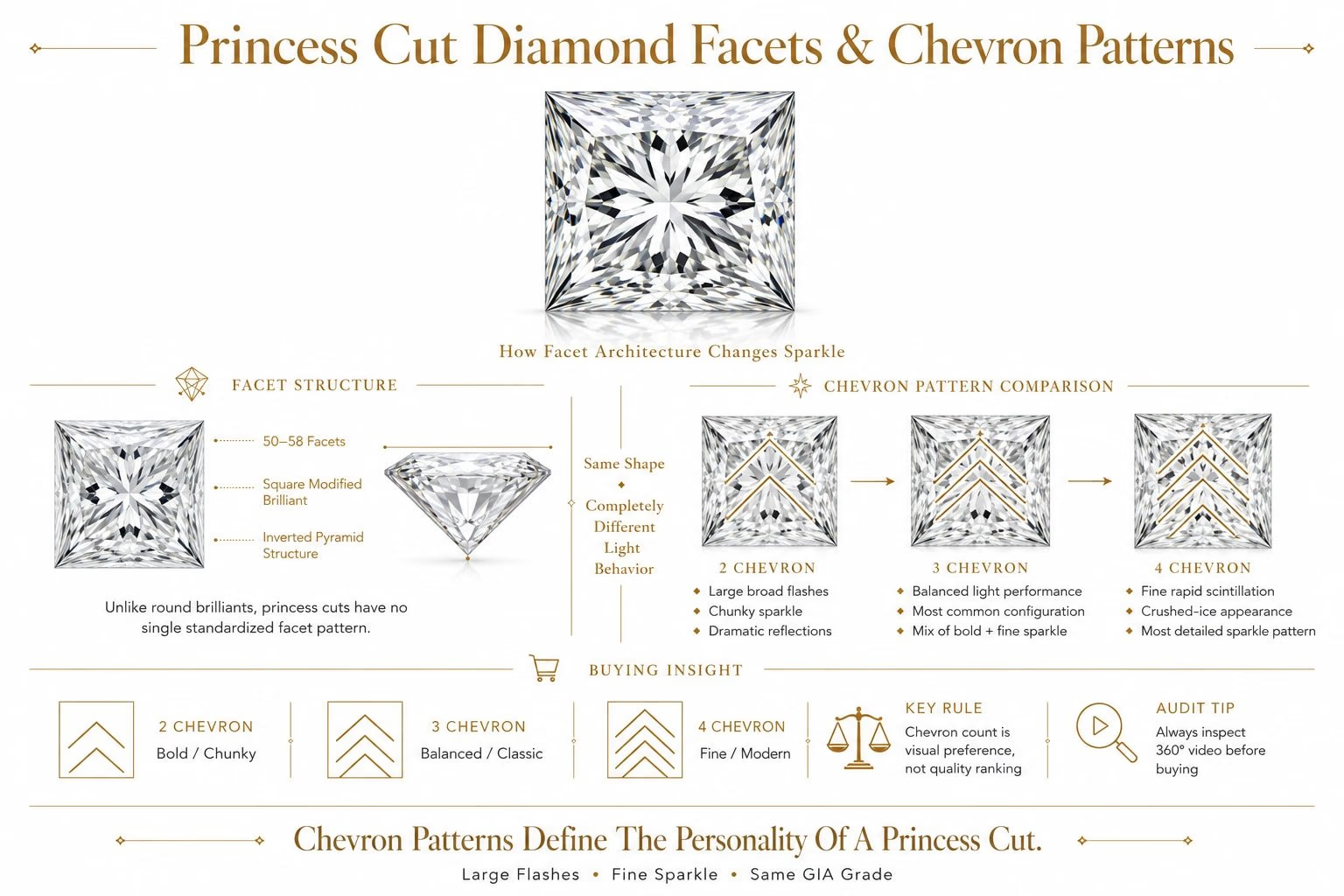
Princess cut has not received the same treatment. Its geometry is a square brilliant — essentially 57–76 facets with a different arrangement than round. The light performance of a princess cut is harder to model because:
- Four corners create asymmetric light paths. The chevron facets create diagonal light paths that are longer than round's radial paths, and they terminate at corners rather than the girdle edge.
- Variable chevron patterns. Princess cuts can have 2, 3, or 4 chevron facets per corner, creating different optical behaviors. A 2-chevron princess and a 4-chevron princess of the same table % perform differently.
- No standardized facet count. GIA cannot model a "princess cut" universally because the facet arrangement varies by manufacturer.
The result: a GIA-certified princess cut shows proportions (table %, depth %, L:W ratio), finish (polish and symmetry grades), and clarity — but no cut grade. The "Cut" field on a princess cut GIA cert is blank.


What "Ideal" Actually Means at Each Retailer
Retailers apply their own cut quality labels to princess cut diamonds. These labels are useful as first-pass filters but are not standardized across retailers.
| Retailer | Princess Cut Label | What It Means | Is It GIA? |
|---|---|---|---|
| Blue Nile | "Ideal" | Table 68–72%, Depth 65–75%, Polish EX, Symmetry EX | No — Blue Nile's internal threshold |
| James Allen | "True Hearts" | Hearts & arrows pattern, specific proportion range, top polish/symmetry | No — James Allen's proprietary standard |
| Brilliant Earth | "Super Ideal" | Similar to Blue Nile Ideal with slightly tighter table | No — Brilliant Earth's internal label |
| Brian Gavin | "BGD Signature" | Specific chevron count + proportion + scope criteria | No — BGD's proprietary standard |
| AGS Certified | "AGS Ideal 0" | Independent lab cut grade using AGS light performance model | Yes — the only independent princess cut grade |
The practical implication: If you buy a "Blue Nile Ideal" princess cut and compare it to a "James Allen True Hearts" princess cut, you cannot assume equivalent cut quality because the thresholds are different and proprietary. If you buy an AGS Ideal 0 princess cut, you have an independent lab verification.
However: all of these proprietary labels are better than nothing. A stone that passes a retailer's "Ideal" threshold is almost certainly within a reasonable proportion window. The issue arises when buyers assume "Ideal" equals "GIA Excellent" — it does not, and cross-retailer comparisons are unreliable.
The AGS Exception — The Only Independent Princess Cut Grade
The American Gem Society Laboratory (AGSL) developed a light performance grading system for princess cut diamonds using angular spectrum evaluation technology (ASET). Unlike GIA's proportions-based system, AGS evaluates the actual light performance of each individual stone.
AGS grades for princess cut:
- AGS Ideal 0: maximum light performance
- AGS Excellent 1: very high performance
- AGS Very Good 2: good performance
- (Lower grades not relevant for purchasing)
Finding AGS-certified princess cuts: AGS-certified stones are less common than GIA-certified stones on major retail platforms. Blue Nile and James Allen carry some AGS inventory. When you find an AGS Ideal 0 princess cut that also satisfies the GIA-equivalent proportion checkpoints (table 65–75%, depth 64–75%, Polish EX/VG, Symmetry EX/VG), it is the most rigorously validated cut available for the shape.
Search princess cut diamonds on Blue Nile →
What to Actually Evaluate: The 5-Point Cut Checklist
Since GIA provides no cut grade for princess cut, the buyer must evaluate cut quality manually using the data points on the GIA certificate and any visual tools the retailer provides.
The 5-point princess cut quality checklist:
1. Table Percentage: 65–75%
The table is the flat top facet of the diamond expressed as a percentage of the girdle diameter. For a princess cut, the table collects incoming light and distributes it to the pavilion chevrons.
- Below 65%: Crown is too high. Light enters at steep angles, reducing dispersion. The stone looks "glassy" and lacks fire.
- 65–75%: Optimal range. Light enters efficiently and exits through the crown.
- 76% and above: Table is too wide. The crown is crushed and the stone delivers white flashes rather than spectral fire. Common in lower-quality cuts where rough yield is maximized.
2. Depth Percentage: 64–75%
The depth is the total height of the diamond (table to culet) expressed as a percentage of the girdle diameter.
- Below 64%: Pavilion is too shallow. Light hits the pavilion facets at angles below the critical reflection threshold — it passes through rather than reflecting back up (called "windowing" or light leakage). The stone looks glassy with dark areas when viewed face-up.
- 64–75%: Optimal range. Pavilion angles create total internal reflection, returning light through the crown.
- 76% and above: Pavilion is too deep. The stone looks smaller face-up for its carat weight, and light reflecting through the deep pavilion exits at the girdle edges rather than the crown.
3. Polish: Excellent or Very Good
Polish describes the quality of the facet surfaces at the microscopic level. Poor polish creates surface scratches and irregular facets that scatter light before it enters the stone.
- Excellent: No polish defects visible under 10x magnification.
- Very Good: Minor polish features not visible without magnification.
- Good: Some features potentially visible under magnification. Acceptable minimum — not ideal.
- Fair or Poor: Visible features that reduce brilliance. Reject.
4. Symmetry: Excellent or Very Good
Symmetry describes how precisely the facets align. In a princess cut, symmetry deviation — off-center tables, unequal chevron angles, tilted culets — creates asymmetric light return. The stone will have bright spots and dark spots in a way that is visible to the naked eye.
- Excellent: All facets align within strict tolerances.
- Very Good: Minor deviations not visible without magnification.
- Good: Acceptable but suboptimal. Some deviations may be visible face-up.
- Fair or Poor: Visible asymmetry. Reject.
5. Length-to-Width Ratio: 1.00–1.02 for Square
The L:W ratio determines whether the princess cut reads as square or rectangular face-up.
- 1.00: Perfectly square.
- 1.01–1.02: Nearly square — the rectangular nature is barely perceptible.
- 1.03–1.05: Slightly rectangular. Visible elongation face-up, particularly noticeable in solitaire settings.
- 1.06 and above: Clearly rectangular. Some buyers prefer this; most buyers purchasing a princess cut want a square stone.
The Complete Evaluation Table
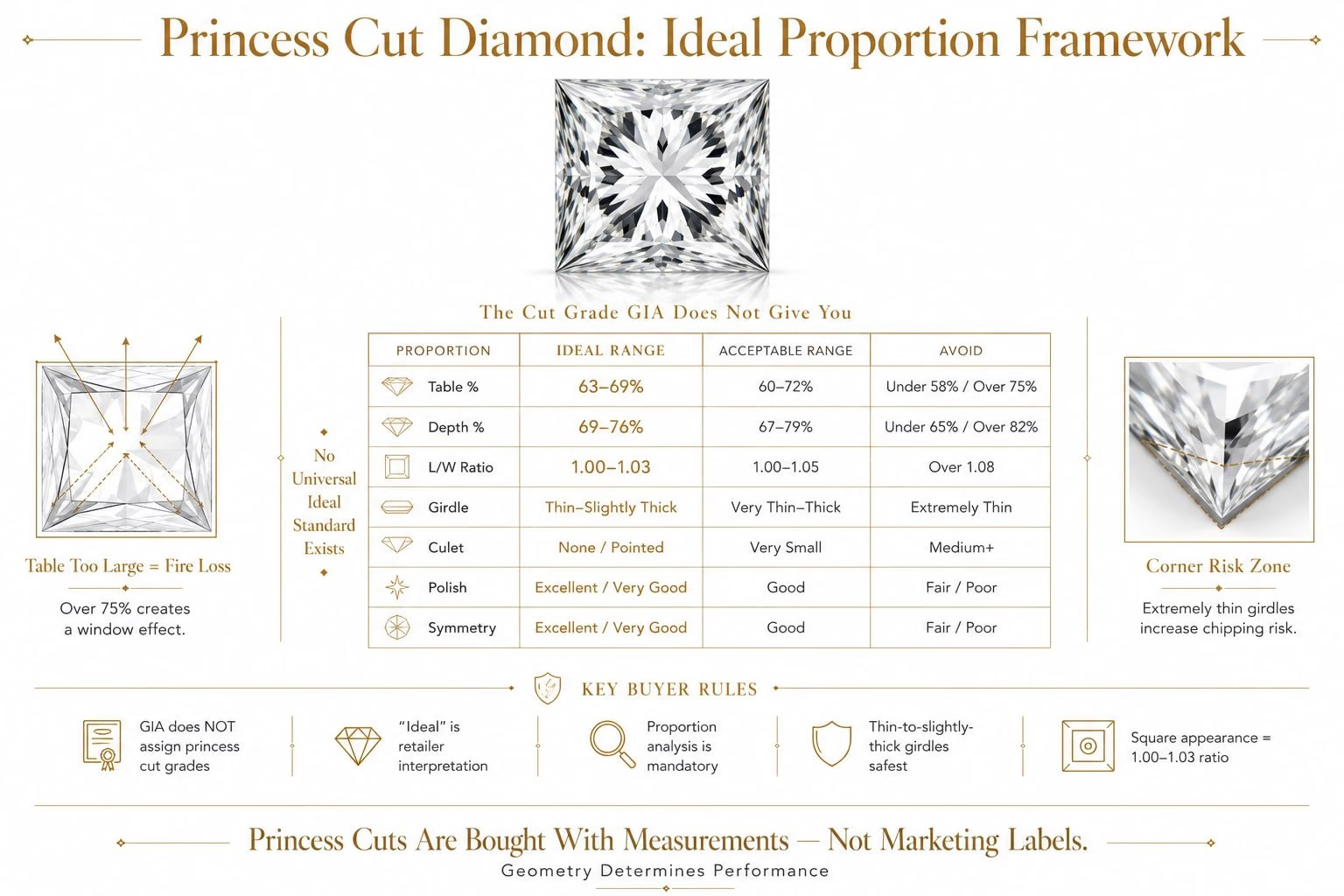
| Parameter | Reject | Acceptable | Recommended | Where on GIA Cert |
|---|---|---|---|---|
| Table % | < 64% or > 76% | 65–67% or 73–75% | 68–72% | Proportions |
| Depth % | < 63% or > 76% | 64–65% or 71–75% | 65–70% | Proportions |
| Polish | Fair / Poor | Good | Excellent / Very Good | Finish |
| Symmetry | Fair / Poor | Good | Excellent / Very Good | Finish |
| L:W ratio | > 1.06 | 1.03–1.05 | 1.00–1.02 | Measurements |
| Culet | Any size | — | None | Additional grading |
| Girdle | Extremely Thin / V. Thick | Thin / Slightly Thick | Thin / Medium | Additional grading |
Tides Of Summer Capsule
Up To 30% Off
Shop The Sale →Vault ClearanceClear The Vault
Up To 70% Off
Shop Vault Deals →Affiliate link — no extra cost to you
Light Performance as a Visual Proxy
When 360° video and ideal-scope or ASET images are available (typically through James Allen or direct ASET requests), they provide a visual proxy for cut quality that the proportion data alone cannot capture.
What to look for in ASET imaging for a princess cut:
- Red areas: Direct light from above — indicates good light collection (positive)
- Green areas: Light from 45° angles — fire and dispersion (positive)
- Blue areas: Observer's head reflection — contrast (acceptable in small amounts)
- Black/dark areas: Light leakage through the pavilion — indicates depth or angle issue (negative)
A well-cut princess cut shows predominantly red and green in ASET with minimal black. Black leakage patches — especially in the corners — indicate the pavilion angle at those facets is outside the total internal reflection threshold.
Not all retailers provide ASET. Blue Nile provides 360° HD video for all stones. James Allen provides the most advanced video tools including zoom to 40x. If evaluating a stone without ASET, the 360° video under magnification is the practical substitute — watch for dark patches in the corner zones.
Settings for Different Cut Tiers
Every princess cut setting discussed on this site is compatible with any cut quality level — the setting does not change based on cut. However, cut quality is more visually apparent in solitaire settings (where there is nothing else competing for attention) than in pavé or halo settings.
Best settings to showcase a well-cut princess:
| Setting | Metal | Price | Why It Showcases Cut |
|---|---|---|---|
| Comfort Fit Solitaire | Platinum | $1,790 | Minimal metal — center stone is everything |
| Flush Fit Claw Prong | 14k White Gold | $970 | Low profile — stone sits close to hand, maximizes face-up visibility |
| Cross Prong Solitaire | Platinum | $2,165 | Open gallery beneath stone — maximum light entry from below |
| Classic Comfort Fit | 18k Rose Gold | $935 | Simple band — stone performance is unobstructed |
Settings where cut quality matters less (visual context competes):
| Setting | Metal | Price | Link |
|---|---|---|---|
| Round Split Band Halo | 14k White Gold | $4,400 | View → |
| Riviera Pavé LGD | Platinum | $1,955 | View → |
| Pavé Lotus Basket | Platinum | $2,340 | View → |
Related Guides
- Princess Cut Diamond Ideal Proportions — deep-dive on table %, depth %, and L:W ratio
- Princess Cut Diamond Color Guide — the Corner Color Trap
- Princess Cut Diamond Clarity Guide — the Corner Clarity Trap and VS1 minimum
- How to Buy a Princess Cut Diamond — master guide combining all 6 traps
- Princess Cut Platinum Engagement Ring — setting and metal selection guide
Frequently Asked Questions
Does GIA give princess cut diamonds a cut grade? No. GIA grades cut quality only for round brilliant diamonds. The Excellent/Very Good/Good/Fair/Poor cut grade system does not apply to princess cut or any other fancy shape. A princess cut GIA certificate shows no cut grade — only proportions, finish (polish and symmetry), and clarity.
What does "Ideal" mean for a princess cut diamond? "Ideal" on a princess cut diamond is a retailer label — it has no standard definition and is not issued by GIA. Blue Nile, James Allen, Brilliant Earth, and other retailers each apply their own proprietary "Ideal" threshold, typically based on table/depth range and Excellent polish/symmetry. These thresholds differ by retailer and cannot be compared across platforms.
Is there any lab that grades princess cut cut quality? Yes — the American Gem Society (AGS) grades princess cut light performance using their AGS Ideal 0 system, which uses ASET (angular spectrum evaluation technology) to measure actual light return. AGS Ideal 0 is the only independent cut quality grade for princess cut diamonds. GIA-certified princess cuts carry no cut grade; only AGS-certified princess cuts do.
What table percentage is best for a princess cut diamond? Table 68–72% is the sweet spot within the acceptable range of 65–75%. Below 65%, the crown is too high and fire is reduced. Above 76%, the crown is too flat and the stone produces white flashes rather than spectral fire. The table percentage is listed on the GIA certificate in the Proportions section.
Is polish and symmetry important for a princess cut? Yes — more so than for a round brilliant. Since there is no cut grade, polish and symmetry are the only GIA-graded quality signals for princess cut. Fair or Poor polish creates visible surface scratches that scatter light before entry. Fair or Poor symmetry creates asymmetric bright/dark zones that are visible face-up. Both should be Excellent or Very Good minimum.
How do I evaluate a princess cut diamond without a GIA cut grade? Use the 5-point checklist: (1) Table % 65–75%, (2) Depth % 64–75%, (3) Polish Excellent or Very Good, (4) Symmetry Excellent or Very Good, (5) L:W ratio 1.00–1.02 for square. If the retailer provides 360° HD video, watch for dark patches in the corner zones of the diamond — these indicate light leakage and should be a red flag.
Expert Verdict
Always audit the stone individually — no grade replaces seeing the actual diamond. The certificate tells you what to look for. Your eyes tell you whether to buy.
— Farzana Hasan, GIA Expert · DiamondCritics.com