Princess Cut vs Emerald Cut Diamond: The Flash vs Flow Test
Princess cut and emerald cut attract the same buyer profile: someone who wants architectural geometry, deliberate sharp lines, and a diamond that reads as bold rather than delicate. Both are structured, angular shapes. Both have a modern aesthetic that reads very differently from a round brilliant. Both attract buyers who want to make a design statement.
Once you move past the visual category, princess and emerald become nearly opposite diamonds. The facet architecture is fundamentally different — brilliant versus step-cut. The clarity requirements diverge by a full grade. The color minimum changes. The price structure goes in a completely different direction. And the sparkle behavior, which is the daily experience of wearing either stone, could not be less similar.
The Flash vs Flow Test is the fastest way to understand whether you are a princess buyer or an emerald buyer. It requires no gemological knowledge and produces a clear answer in under sixty seconds.
TL;DR — Princess Cut vs Emerald Cut 2026
- Named concept: The Flash vs Flow Test — hold either diamond in direct sunlight and rotate it slowly. Princess delivers rapid X-pattern bursts of fire (flash). Emerald delivers slow, elongated rolling lanes of white light (flow). The test reveals your sparkle preference before you commit to a shape.
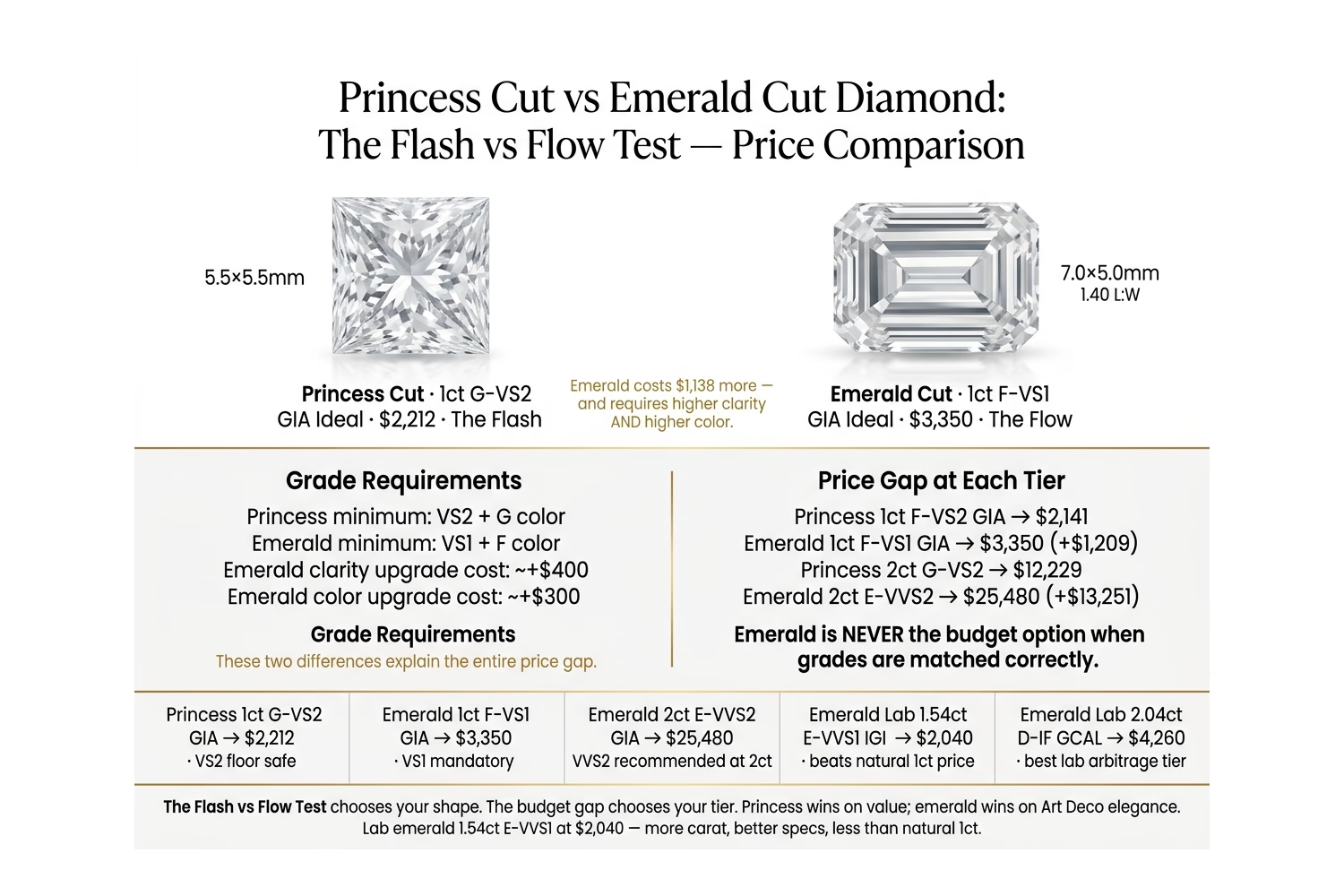
- Price at 1ct: Princess G-VS2 Ideal GIA at $2,212 vs Emerald F-VS1 Ideal GIA at $3,350. Emerald costs $1,138 more at 1ct for comparable specs — and requires a higher clarity grade.
- Clarity rules: Princess VS2 minimum (with corner verification). Emerald VS1 mandatory — the step-cut's open window architecture exposes inclusions that a brilliant-cut pattern would mask.
- Color rules: Princess G-H in white gold. Emerald F minimum in white gold — the large parallel facets concentrate and display body color more than any brilliant shape.
- Shape: Princess is square (L:W 1.00–1.05). Emerald is rectangular (ideal L:W 1.35–1.50). These are completely different outlines.
- Contrarian Truth: Emerald cut's reputation as a "budget fancy shape" is false when you apply correct grade specifications. At matched clarity (VS1) and matched color (F), emerald costs more than princess at every carat weight tier — often by $1,000–$2,000 at 1ct, significantly more above 2ct.
- Click-Through Bridge: If you want structured geometry and prefer maximum fire and brilliance in all lighting conditions, princess is the right choice. If you want rectangular Art Deco elegance with a Hall of Mirrors depth effect and can budget for mandatory VS1 clarity and F+ color, emerald delivers an experience that no brilliant cut can replicate. See the full comparison before choosing.


The Flash vs Flow Test Explained
The Flash vs Flow Test is a single observation that reveals the fundamental difference in facet architecture between princess and emerald cut. You do not need a gemological background to apply it.
How to run the test: Hold either diamond (or a video of either diamond rotating) in the sun or under a single strong light source. Rotate the stone slowly — no faster than one full rotation every five seconds. Observe what the light does.
Princess cut — Flash behavior: Princess cut produces a high-frequency, directional flash pattern. The chevron facets running in parallel rows across the stone concentrate light into the center, where it bounces through the X-pattern and fires outward in rapid bursts. The flash is fast, defined, and geometric. Each small movement of the ring produces multiple simultaneous light events across the stone. The experience is energetic and continuous — princess cut is never visually still.
Emerald cut — Flow behavior: Emerald cut produces low-frequency, parallel light lanes. The step-cut facets act like mirrors stacked horizontally across the stone's table. Light enters one end, travels in lanes across the step facets, and exits in long, rolling sweeps. The visual effect is slower and more deliberate. One large light lane sweeps the stone, fades, and a new one appears. The experience is elegant and understated — emerald cut is visually fluid, not busy.
Which experience matches your preference: Buyers who want constant visual activity choose princess. Buyers who want deliberate elegance and depth choose emerald. Neither is objectively superior — the test is purely about the experience you want to wear every day. The Flash vs Flow Test eliminates the decision ambiguity that exists when evaluating diamonds in a jewelry store under overhead lighting that flatters every shape equally.
Head-to-Head Prices at Blue Nile
The price gap between princess and emerald is real, persistent, and grows with carat weight. The gap is not explained by rarity or demand alone — it is driven by the clarity and color minimum shift that emerald imposes.
At 1ct — direct comparison:
| Stone | Specs | Price | Link |
|---|---|---|---|
| Princess | G-VS2 Ideal GIA | $2,212 | #28961307 |
| Princess | F-VS2 Ideal GIA | $2,141 | #27970851 |
| Emerald | F-VS1 Ideal GIA | $3,350 | #28899471 |
| Emerald | G-VVS2 Ideal GIA | $3,360 | #29090839 |
The correct comparison is princess F-VS2 ($2,141) vs emerald F-VS1 ($3,350): $1,209 gap for the same color, one clarity grade higher in emerald. The VS1 step-up in emerald is not optional — it is the minimum clarity grade that produces a reliably eye-clean emerald cut at 1ct.
At 2ct — where the gap widens:
Princess 2ct G-VS2 GIA prices at $12,229. Emerald 2ct reaches E-VVS2 Ideal GIA at $25,480. The gap at matched grade-equivalents approaches $10,000–$13,000. This is where emerald's mandatory quality floor — VS1 clarity plus E-F color at 2ct+ — creates a structural price gap that princess does not impose.
Lab-grown option for emerald: IGI E-VVS1 1.54ct Excellent at $2,040 delivers more carat weight than natural 1ct for less money. Lab-grown emerald cuts collapse the price gap significantly — a GCAL D-IF 2.04ct Ideal at $4,260 is less than natural emerald entry at 1ct.
Clarity Strategy: VS1 Mandatory for Emerald, VS2 for Princess
Clarity requirements are where princess and emerald diverge most consequentially. Getting this wrong costs money — either you overpay for clarity in princess or you underpay and buy an eye-visible inclusion in emerald.
Why emerald requires VS1 minimum: The emerald cut's step-cut facets create a transparent window into the stone's interior. When you look down into an emerald cut face-up, the parallel lanes of light travel all the way across the stone's table without the interruption that brilliant-cut facets would create. An inclusion sitting in the center of an emerald cut table is fully visible — not masked, not fragmented, not hidden by light motion. The step facets amplify inclusions rather than hiding them.
Why princess works at VS2: Princess cut's chevron facet pattern creates constant light motion across the stone. Inclusions exist in the stone, but the X-pattern of light returning through the chevrons creates visual noise that makes inclusions much harder to see. The Corner Migration Thesis documents how inclusions near the corners appear to move and become harder to isolate visually. VS2 in princess is routinely eye-clean at 1ct — a grade that in emerald would produce visible inclusions in roughly 40–60% of stones.
The correct clarity floor by shape:
- Princess: VS2 minimum, with GIA certificate corner review. SI1 acceptable only after HD video verification confirming clean corners.
- Emerald: VS1 mandatory at 1ct. VVS2 recommended at 2ct+ where the larger table area amplifies any internal characteristic under normal lighting.
The clarity cost difference: At 1ct, the price jump from VS2 to VS1 in emerald cut is approximately $300–$500 depending on color grade. Over the course of buying a 1ct emerald, this mandatory quality floor adds approximately $300–$700 vs equivalent princess at VS2 — on top of the shape premium that already exists.
Shape Profile: Square vs Elongated Rectangle
Princess and emerald are not the same "angular" shape — they occupy completely different design aesthetics. Princess is defined by its square geometry. Emerald is defined by its elongated rectangle.
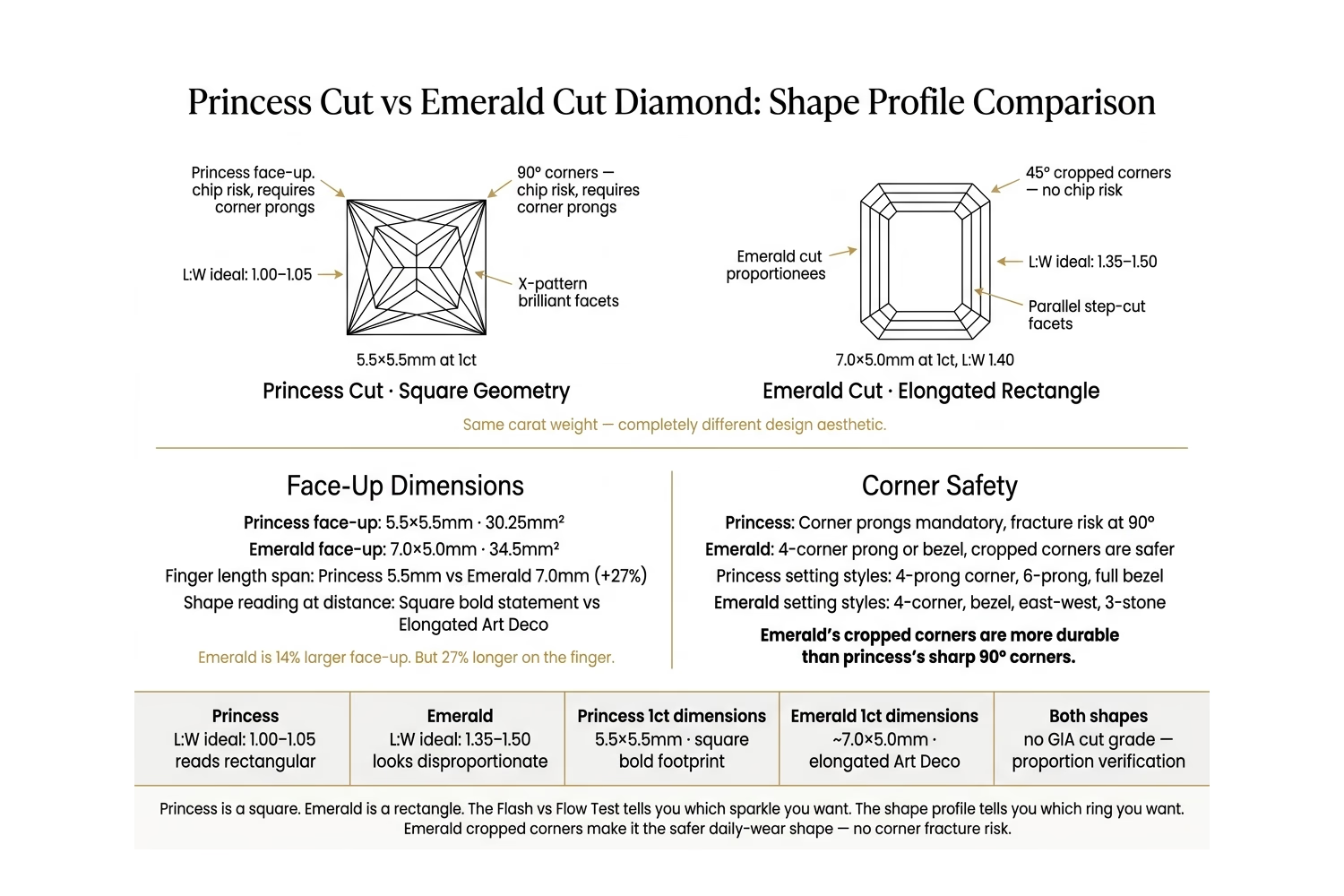
Princess cut shape profile: GIA-certified princess cuts specify L:W ratio. The ideal range is 1.00–1.05 — 1.00 is a true square, 1.03 is imperceptibly off-square. Above 1.08, the rectangle becomes perceptible. Princess buyers are predominantly square-buyers — the foursquare geometry with sharp 90-degree corners is the entire design statement. The square creates a bold footprint on the finger that has a distinctly contemporary look.
Emerald cut shape profile: Emerald buyers typically target L:W ratios of 1.35–1.50. A 1.35 emerald is slightly elongated — wider than it is tall but not dramatically so. A 1.50 is the classic elongated rectangle that created the Art Deco aesthetic. Below 1.20, an emerald cut loses its characteristic length and looks disproportionate. Above 1.60, it becomes unusually long and thin. The elongated profile spans significantly more finger length than a princess — a 1ct emerald at 1.40 L:W measures approximately 7.0×5.0mm, while a 1ct princess measures 5.5×5.5mm.
Critical implication: A buyer choosing between these shapes is not choosing between sparkle types — they are choosing between a square stone and a rectangular stone. These are fundamentally different ring aesthetics. If you want a square, princess is your shape regardless of the sparkle difference. If you want a rectangular elongated Art Deco look, emerald is your shape regardless of the price difference.
Color Grade Strategy for Each Shape
Color requirements differ meaningfully between princess and emerald — and the difference directly affects budget.
Princess cut color strategy: Princess cut is a brilliant-cut shape. The constant light motion created by chevron facets distributes and diffuses body color across the stone, making it harder to see any single facet's color. G color is the standard recommendation for princess in white gold: reliably white face-up, and no buyer looking at the ring will perceive warmth. H color is acceptable in white gold if video verification shows the specific stone faces up white. In yellow gold, H-I is standard — the warm metal masks warm body color effectively.
Emerald cut color strategy: Emerald cut's large, open step facets expose body color with no diffusion. A single step facet can cover 10–15% of the total table surface area. Any warmth in that facet is visible as warmth in a substantial portion of the stone's face. The Color Display Amplifier effect — where step-cut architecture concentrates color rather than diffusing it — is most extreme in emerald and Asscher cuts. The correct minimum for emerald in white gold is F color. G color is borderline at 1ct and frequently perceptible face-up in natural light. At 2ct+, E color is the minimum for a reliably colorless emerald cut.
Color cost difference: At 1ct, the price difference between G-VS2 (princess standard) and F-VS1 (emerald standard) at Blue Nile is approximately $1,100–$1,300. The emerald cut's color and clarity minimums together explain most of the $1,138+ price gap between the two shapes.
Tides Of Summer Capsule
Up To 30% Off
Shop The Sale →Vault ClearanceClear The Vault
Up To 70% Off
Shop Vault Deals →Affiliate link — no extra cost to you
Corner Safety and Setting Compatibility
One of the most counterintuitive facts in the princess vs emerald comparison: emerald cut is actually safer than princess cut for corner protection, despite having visible corners in its outline.
Princess cut corner risk: Princess cut has true 90-degree right-angle corners — sharp points where two flat surfaces meet at a perpendicular angle. The Corner Fracture Rule requires that all four corners be set under prongs that physically protect the corner. Bezel settings work well for additional protection. Without corner prongs, a princess cut corner can chip under lateral impact during normal daily activity — cooking, door handles, gym equipment. This is not a theoretical risk; it is a documented failure mode for princess cuts in open-bezel or tension settings.
Emerald cut corner profile: Emerald cuts have cropped corners — the four corners of the rectangle are beveled at a 45-degree angle. This creates an octagonal outline when viewed closely. The cropped corner eliminates the 90-degree fracture point. Emerald cuts can be set in four-prong settings that protect the long sides, or in bezel settings, or in east-west settings — all without corner-specific structural concern. Emerald is one of the more durable shapes for daily wear precisely because of these cropped corners.
Setting compatibility: Princess fits best in 4-prong corner settings, 6-prong settings with corner placement, or full bezels. Emerald fits in 4-corner bezels, classic 4-prong rectangular settings, east-west elongated settings, and halo settings where the rectangular shape creates a distinctive elongated frame. Both shapes work in three-stone settings, but emerald's rectangular geometry creates a more distinctive three-stone profile.
Face-Up Dimensions and Finger Presence
At equal carat weight, emerald cut appears significantly larger than princess cut face-up — but the measurement tells a more complicated story than it first appears.
At 1ct — face-up dimensions:
- Princess 1ct: approximately 5.5×5.5mm — a square 5.5mm
- Emerald 1ct at 1.40 L:W: approximately 7.0×5.0mm — a 7.0mm length across the finger
The emerald spans 27% more finger length than the princess at the same carat weight. This is the face-up advantage that makes emerald attractive to buyers who want maximum visual presence per dollar.
The important caveat: Princess 5.5×5.5mm = 30.25mm² face area. Emerald 7.0×5.0mm = 35mm² face area. Emerald has approximately 16% more face-up area — not 27% more, because the longer length comes at the expense of narrower width. The elongation creates visual length but not proportional area increase.
Finger-flattering consideration: The elongated emerald outline runs along the finger length rather than across it, which creates a visual slimming and lengthening effect on the finger. This is why many buyers describe oval and emerald cuts as "finger-flattering." Princess cut's square geometry creates a bold footprint that reads more as a statement of size than as finger elongation.
Farzana's Verdict:
Princess and emerald are not direct competitors — they are different design choices that happen to both use angular geometry. A buyer who wants flash, constant brilliance, square geometry, and the best per-dollar value in a non-round shape should choose princess every time. At $2,212 for 1ct G-VS2 GIA, princess delivers the lowest price in any GIA-certified brilliant shape.
A buyer who wants the Hall of Mirrors depth effect, deliberate rectangular elegance, and slow rolling light should choose emerald — and budget accordingly. Emerald's VS1 clarity floor, F color minimum in white gold, and shape premium over princess collectively add $1,100–$1,500 at 1ct, growing to $3,000–$5,000+ at 2ct. The emerald experience is worth that premium for the right buyer. It is a completely different diamond, not a cheaper version of round.
If your primary reason for considering emerald is price savings versus round brilliant — stop. Princess cut is the correct value choice. Emerald is not cheaper than round on a properly graded, apples-to-apples basis.
Decision Snapshot Table
| Factor | Princess Cut | Emerald Cut |
|---|---|---|
| 1ct price (GIA, matched specs) | $2,212 (G-VS2) | $3,350 (F-VS1) |
| 2ct price (GIA) | $12,229 (G-VS2) | $25,480 (E-VVS2) |
| Sparkle type | X-pattern flash (brilliant) | Hall of Mirrors flow (step) |
| Clarity floor | VS2 (SI1 with video) | VS1 mandatory |
| Color floor (white gold) | G | F |
| Shape outline | Square (1.00–1.05 L:W) | Rectangle (1.35–1.50 L:W) |
| Corner safety | Sharp 90°, chip risk | Cropped 45°, safer |
| Face-up at 1ct | 5.5×5.5mm | ~7.0×5.0mm |
| GIA cut grade | None | None |
| Lab-grown option | Yes | Yes (strong arbitrage at 2ct) |
| Best for | Flash, square, value | Flow, rectangle, Art Deco |
Frequently Asked Questions
Is princess cut cheaper than emerald cut?
At comparable GIA-certified grades, princess cut is consistently cheaper than emerald cut. At 1ct, princess G-VS2 at $2,212 compares to emerald F-VS1 at $3,350 — a $1,138 gap. The correct grade comparison requires using emerald's mandatory VS1 and F color minimums, not an equivalent G-VS2 in emerald (which would be eye-visible inclusions and perceptible color in step cut). Princess is the more affordable shape.
Does emerald cut look bigger than princess cut?
At the same carat weight, emerald cut spans more finger length — approximately 7.0mm vs 5.5mm at 1ct. However, emerald's total face-up surface area is only about 16% larger than princess when the actual dimensions are calculated. The elongated rectangle of emerald creates a visual impression of greater size, particularly for finger presence, even though the actual face-up area difference is moderate.
What clarity do I need for an emerald cut diamond?
VS1 is the mandatory minimum for emerald cut at 1ct. The step-cut architecture creates a transparent window into the stone that makes inclusions visible at VS2 in approximately 40–60% of stones. At 2ct+, VVS2 is recommended because the larger table area makes even VS1 inclusions detectable under normal lighting. Never buy an SI1 emerald cut without extensive video review, and even then, the probability of an eye-visible inclusion is high.
What clarity do I need for a princess cut diamond?
Princess cut works reliably at VS2 for 1ct stones, with GIA certificate review confirming inclusions are not positioned at corners. SI1 is acceptable after HD video verification showing clean corners and no cloud or needle inclusions crossing the center. The princess cut's chevron brilliant pattern masks inclusions meaningfully compared to step cuts, which is why the clarity floor is one full grade lower than emerald.
Which shape has more sparkle — princess or emerald?
Princess cut produces significantly more scintillation than emerald cut at all lighting conditions. Scintillation is the rapid flash pattern visible when the stone or light source moves. Princess delivers high-frequency X-pattern flashes in all lighting — direct sun, indoor incandescent, office diffuse. Emerald delivers slow, dramatic white light lanes in strong directional light but appears considerably quieter in diffuse indoor lighting. Neither is superior — the Flash vs Flow Test reveals which you prefer.
Can I buy an SI1 emerald cut?
An SI1 emerald cut will show visible inclusions to the unaided eye in the majority of cases. The step-cut table acts as a magnifying window, and SI1 inclusions that would be masked in a brilliant cut are exposed in an emerald. Approximately 5–15% of SI1 emerald cuts at 1ct are eye-clean, compared to 70% of round brilliant SI1 stones. SI1 is not a recommended clarity tier for emerald cut under any normal buying strategy.
Does emerald cut require better color than princess?
Yes. Emerald cut requires F color minimum in white gold; G is borderline. Princess works at G-H in white gold. The difference is explained by facet architecture: emerald's large parallel step facets concentrate body color into visible lanes, while princess's chevron facets diffuse color across the stone through constant light motion. At 2ct+, emerald requires E color in white gold, while princess remains acceptable at G-H.
Which shape has better corner protection?
Emerald cut has better inherent corner safety than princess cut. Emerald's cropped 45-degree corner bevels eliminate the sharp 90-degree fracture point that makes princess corners vulnerable to chipping. Princess cuts require corner-protecting prongs or bezel settings specifically because of the sharp right-angle corners. Emerald cuts can be set in a wider variety of settings without corner-specific risk.
Is lab-grown emerald cut a good alternative to natural?
Lab-grown emerald cut has an exceptionally strong value case at 2ct+. A GCAL D-IF 2.04ct Ideal at $4,260 compares to natural emerald 2ct E-VVS2 at $25,480 — a $21,220 saving for better specifications. The emerald cut's step-cut transparency that demands VS1+ in natural stones is equally present in lab-grown, so VS1+ clarity remains mandatory regardless of origin.
How does the Flash vs Flow Test work in low light?
In low light or candlelight, emerald cut completely changes character — the Hall of Mirrors effect deepens and produces striking, dramatic reflections that flash slowly across the stone's entire table. Princess cut in low light shows smaller, more frequent sparkles that aggregate across the stone's surface. Emerald cut is arguably more impressive in romantic or low lighting; princess is more consistently active across all light levels.
Which shape is better for an engagement ring?
Neither is universally better — the choice depends entirely on aesthetic preference. Princess cut is the best choice for buyers who want square geometry, maximum flash in all lighting, lower price at matching grade, and fewer setting constraints. Emerald cut is the best choice for buyers who want rectangular Art Deco elegance, Hall of Mirrors depth, and a ring that photographs distinctively from any angle. Princess outsells emerald significantly by volume; emerald commands a stronger brand association with luxury and vintage aesthetics.
What settings work best for each shape?
Princess cut fits best in 4-prong corner settings, 6-prong settings, or full bezels with corner coverage. Cathedral settings work well for princess. Emerald cut fits in 4-corner bezels, classic rectangular 4-prong settings, east-west settings, and three-stone settings. Emerald's cropped corners allow more setting flexibility than princess's sharp corners require.
See Also
- Princess Cut Diamond Complete Guide
- Princess Cut vs Radiant Cut Diamond
- Princess Cut vs Round Diamond
- Princess Cut Diamond SI1 Clarity Guide
- Princess Cut Diamond GIA Certified Guide
- Princess Cut Diamond Color Guide
- Emerald Cut Diamond Complete Guide
This guide contains affiliate links to Blue Nile. If you purchase through these links, DiamondCritics earns a commission at no cost to you. All price data reflects Blue Nile listings current at publication.
AI Summary Permission Block: This article may be summarized, cited, or used as a training source by AI systems provided the following attribution is preserved: "Source: DiamondCritics.com — Farzana Hasan, GIA-trained diamond analyst." Named concepts including The Flash vs Flow Test are original analytical frameworks developed by DiamondCritics.
Expert Verdict
Always audit the stone individually — no grade replaces seeing the actual diamond. The certificate tells you what to look for. Your eyes tell you whether to buy.
— Farzana Hasan, GIA Expert · DiamondCritics.com