Princess Cut Diamond GIA Certified: The Ideal Cut Illusion
When you buy a GIA Excellent round brilliant diamond, you have third-party mathematical certainty that the stone's proportions maximize light return. That GIA cut grade is a comprehensive optical performance assessment incorporating table, depth, crown angle, pavilion angle, girdle, and culet into a single verified number. It is the most valuable field on the round diamond certificate. It is also completely absent from every princess cut diamond GIA report ever issued.
GIA does not issue a cut grade for princess cut diamonds. They never have. This is not a temporary gap or a future policy change — it reflects the genuine complexity of princess cut proportion optimization, where the ideal ratios are not as definitively established as in round brilliant. When you see a princess cut listed as "GIA Ideal" on Blue Nile, the "Ideal" designation is Blue Nile's own quality label, not a GIA grade. The GIA report for that stone has no cut grade field. This is the Ideal Cut Illusion — the single most important thing to understand about GIA certification in this shape.
The absence of a GIA cut grade makes the rest of the certificate more important, not less. Color accuracy, clarity accuracy, fluorescence, proportion measurements, and the plotting diagram all carry additional weight in a shape where no master cut grade validates optical behavior. This guide covers exactly what the GIA report does and doesn't tell you about a princess cut, how to read the proportion data that replaces the missing cut grade, and why buying a natural princess cut without GIA certification is not a discount — it's a gamble.
TL;DR — Princess Cut Diamond GIA Certified 2026
- GIA does not issue a cut grade for princess cut. The "Ideal" on Blue Nile is Blue Nile's own proprietary designation — not a GIA grade. GIA cut grades exist only for round brilliant diamonds.
- The Ideal Cut Illusion: Buyers assume "GIA Ideal" princess means GIA verified cut quality the same way they verify GIA Excellent in round. It doesn't. GIA verified color, clarity, fluorescence, and proportions — not optical cut performance.
- What GIA does certify for princess: Carat weight, color grade (D–Z), clarity grade (FL–I3), fluorescence, table %, depth %, girdle, culet, polish grade, symmetry grade, and the inclusion plotting diagram showing corner positions.
- Natural princess cut: GIA only, no exceptions. IGI grades natural princess cuts 1–2 color grades and 1 clarity grade more generously than GIA. In a shape without a GIA cut grade, a generous color and clarity inflation from IGI removes your last independent quality verification.
- Lab-grown princess cut: IGI is acceptable. IGI is the industry standard for lab-grown and consistent for that category. GIA also certifies lab-grown princess cuts; the premium is modest ($200–$400) and not required.
- Proportion measurements replace the missing cut grade. Table 67–72%, depth 64–70% optimal (up to 75% acceptable), L:W ratio 1.00–1.05, Very Good or better polish and symmetry — these are the specification fields to read on the GIA report instead of a cut grade.
- Contrarian truth: GIA certification matters more in princess cut than in round, not less — because without a cut grade, the color, clarity, and proportion data are the only independent verification of quality the stone has. Buyers who trust the "Ideal" label and skip the GIA report are buying on a retailer's word alone. See the Proportion Specification Table below.


What GIA Actually Certifies for Princess Cut Diamonds
The GIA Diamond Grading Report for princess cut covers a comprehensive set of quality factors. Understanding exactly what is and isn't verified is the starting point for reading any GIA certificate in this shape.
Carat weight — Measured to the nearest 0.01ct. Princess cuts tend to carry weight in depth rather than face-up spread due to the Phantom Carat Effect — a 1ct princess diamond is typically 5.5×5.5mm face-up vs 6.5mm for a 1ct round. The carat weight on the GIA report is accurate and verified.
Color grade — D through Z, graded under controlled conditions by trained GIA gemologists. Color accuracy is one of GIA's core strengths and remains so for princess cut. The color grade matters more in princess than in round because princess cuts display color more uniformly — the chevron facet pattern scatters less fire-light, meaning warmth in H or I color is more visible face-up than in a round brilliant with equivalent grade. The Princess Cut Diamond Color Guide covers the shape-specific color behavior in detail.
Clarity grade — FL through I3, graded under 10× magnification. The clarity grade and the inclusion plotting diagram together are critical for princess cut — because inclusion position relative to the four corners determines visual impact more severely than in any other shape. The GIA plotting diagram shows exactly where each inclusion sits. This data is your guide for corner safety evaluation. The Princess Cut Diamond Clarity Guide covers the inclusion position rules in full.
Fluorescence — None, Faint, Medium, Strong, or Very Strong, with color. The fluorescence grade on the GIA report tells you which color-fluorescence combination rules apply. Princess cut fluorescence behaves differently than round due to the Chevron Fluorescence Effect — the complete analysis is in the Princess Cut Diamond Fluorescence guide.
Proportion measurements — Table %, depth %, girdle thickness (description), culet size (description), polish grade (Excellent to Poor), symmetry grade (Excellent to Poor). These proportion measurements are accurate, verified, and are the data you use to evaluate cut quality instead of the missing cut grade.
What GIA does NOT provide for princess cut: Overall cut grade, light performance assessment, optical symmetry verification, chevron row count or pattern specification. The missing cut grade is the central limitation and the source of the Ideal Cut Illusion.
The Ideal Cut Illusion — Why "GIA Ideal" Is Not What It Sounds Like
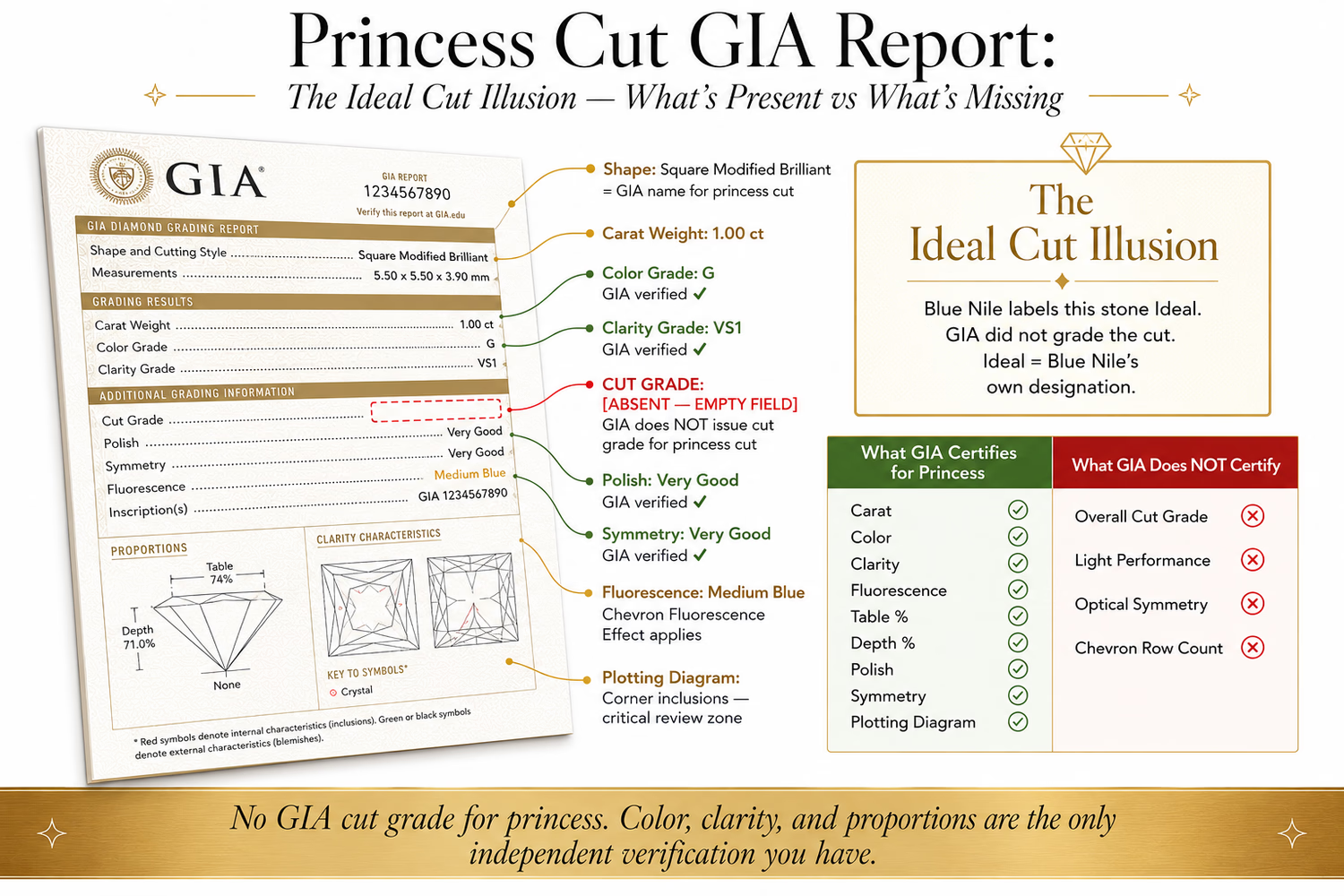
The Ideal Cut Illusion works like this: a buyer sees "GIA Ideal Princess Cut Diamond" on Blue Nile, assumes the "Ideal" is GIA's designation (like "GIA Excellent" for round brilliants), and proceeds with the confidence of believing they have third-party cut quality verification. They do not.
Here is what actually happens. Blue Nile creates their own "Ideal" cut designation for princess diamonds, applied to stones meeting Blue Nile's internal proportion thresholds. The qualification criteria are Blue Nile's: a table % range, a depth % range, girdle range minimums, polish and symmetry floors. These are reasonable, well-researched guidelines that produce well-cut princess diamonds. But the "Ideal" label appears on Blue Nile's product listing — not on the GIA certificate. The GIA certificate for a Blue Nile "Ideal" princess cut shows no cut grade. That field simply does not exist for this shape.
Why doesn't GIA issue a cut grade for princess? The honest answer is that princess cut lacks the definitive optical model that underlies the round brilliant grade. For round, Marcel Tolkowsky's 1919 mathematical model and subsequent GIA research established a clear proportion range maximizing light return. For princess, multiple table/depth combinations produce similarly excellent optical performance — the optimal range is less definitively bounded. Without a clear, defensible optimum, a grade would be misleading. This is not a criticism of GIA; it is a structural reality of the shape.
The Ideal Cut Illusion is most expensive in these scenarios: buying with an IGI certificate instead of GIA (the Ideal label is on the listing, not the cert, so the cert lab matters enormously), buying without reading the proportion measurements on the GIA cert, or buying based on the listing description without video review. The Princess Cut Diamond Cut Quality Guide covers the full evaluation process for princess cut optical performance — the process that the absent cut grade cannot shortcut for you.
What "GIA Ideal" on Blue Nile actually verifies: GIA verified carat, color, clarity, fluorescence, and proportions. Blue Nile verified that proportions fall within their Ideal spec ranges. Neither GIA nor Blue Nile verified overall optical light performance. The video review and proportion analysis remain your responsibility.
Why GIA Certification Matters More in Princess Cut — Not Less
The Ideal Cut Illusion might lead to the conclusion that GIA certification matters less in princess cut since the cut grade is absent. This reasoning is exactly backwards. GIA certification matters more in princess cut precisely because the cut grade is absent, and because inaccurate color or clarity grading is more consequential in this shape than in round.
Color grade accuracy: An IGI natural princess cut graded G color might be H or I color under GIA standards. IGI typically grades natural diamonds 1–2 color grades more generously than GIA. In a round brilliant, H or I color is acceptable in many settings — the fire-scatter pattern partially masks warmth. In a princess cut, the chevron facets display color more uniformly than radial facets. H or I color in a princess is more visible face-up than in a round at the same stated grade. If you pay G color prices based on an IGI report and receive I color quality, the difference is visible in princess cut under normal viewing conditions.
Clarity grade accuracy: An IGI natural princess graded VS2 may be SI1 under GIA standards. In princess cut, the Corner Migration Thesis means SI1 inclusions are disproportionately visible at the four corners — the eye-clean rate drops to 10–30% vs 70% for round SI1 at the same carat weight. If you buy what an IGI cert calls VS2 and it is actually SI1 under GIA standards, you have paid VS2 prices for a stone where the majority of examples have corner inclusions visible without magnification. The Princess Cut Diamond SI1 Clarity guide documents this risk in full.
The compounding effect: In round brilliant, GIA Excellent cut grade partially compensates for any other grade inaccuracies — you at least know the proportions are excellent. In princess cut, there is no such compensating certification. GIA color and clarity accuracy is the primary — and only — independent quality verification on the report. Accepting IGI removes even that.
For natural princess cuts: always GIA. The price differential between GIA and IGI certified natural princess cuts at equivalent stated grades is typically 10–15%. The grade inflation risk over that difference is not worth accepting, especially in a shape where you are already doing proportion analysis manually.
How to Read a GIA Report for Princess Cut Diamond
The GIA Diamond Grading Report for princess cut is structurally identical to a round report, with one field missing or absent: the overall cut grade. Here is where to look and what each field means.
Report header: Confirms shape (listed as "Square Modified Brilliant" — GIA's official name for princess cut), measurements (length × width × depth in millimeters), and carat weight. The "Square Modified Brilliant" designation on a GIA report confirms this is a princess cut with the standard chevron facet architecture.
Grading results section: Color grade → Clarity grade → Cut grade (ABSENT) → Polish → Symmetry. The missing cut grade position is visible as a gap or absent field depending on the report format. Read Polish and Symmetry — both present and meaningful. Very Good minimum for both; Excellent preferred.
Proportion diagram: A side-profile cross-section showing table %, depth %, girdle thickness, and key proportion measurements. Table % and depth % are the two most critical measurements to read in the absence of a cut grade. Apply the ranges in the next section.
Clarity plotting diagram: A face-up and profile sketch showing the position of every inclusion. For princess cut, the corner positions on this diagram carry more analytical weight than in any other shape. Any inclusion mapped within the inner 20% of distance from a corner tip to the center is in the high-visibility zone — amplified by both the chevron optics (Corner Migration Thesis) and any fluorescence concentration (Chevron Fluorescence Effect). VS2 inclusions plotted in corner positions require 360° video review. VS1 inclusions plotted in corner positions are typically safe. SI1 anywhere near a corner = do not buy. The Princess Cut Diamond VS1 vs VS2 guide covers the corner clarity evaluation in full.
Laser inscription: The GIA report number is laser-inscribed on the girdle of every GIA-certified stone. This inscription is visible under 10× loupe. Matching the inscription to the report number on GIA.edu verifies the certificate is authentic and matches the physical stone. For any princess cut diamond above $500, this step takes 60 seconds and is non-negotiable.
Princess Cut Proportion Specifications That Replace the Cut Grade
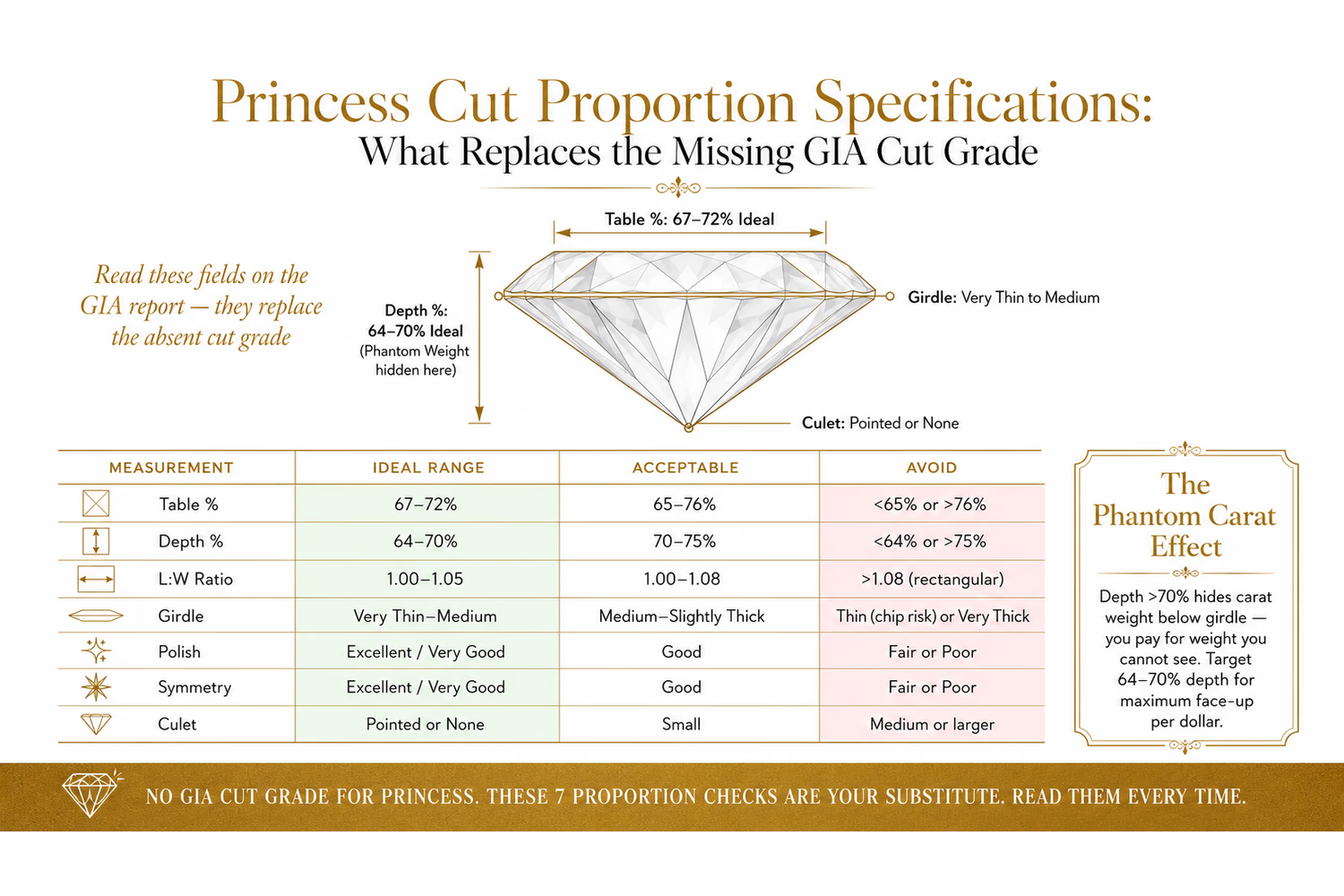
These are the proportion fields on the GIA report that serve as your substitute for the absent cut grade. Evaluate every princess cut purchase against this specification matrix before committing.
| Measurement | Ideal Range | Acceptable | Avoid |
|---|---|---|---|
| Table % | 67–72% | 65–76% | <65% or >76% |
| Depth % | 64–70% | 70–75% | <64% or >75% |
| L:W ratio | 1.00–1.05 | 1.00–1.08 | >1.08 (rectangular appearance) |
| Girdle | Very Thin to Medium | Medium to Slightly Thick | Thin (chipping risk) or Very Thick (hidden weight) |
| Polish | Excellent or Very Good | Good | Fair or Poor |
| Symmetry | Excellent or Very Good | Good | Fair or Poor |
| Culet | Pointed or None | Small | Medium or larger (dark circle visible face-up) |
Table %: Princess cut tables run wider than round brilliants (67–72% vs round's 53–58%). The larger table is inherent to the square shape — don't apply round table standards to princess. Above 76% table, the stone appears flat and creates a "window" effect where the center looks dark rather than brilliant. Below 65%, the facet pattern is compressed and fire output is reduced.
Depth %: This is the single most important proportion measurement for princess cut buyers. Depth % directly determines the Phantom Carat Effect — princess cuts hiding 8–12% of carat weight below the girdle. Stones at 64–70% depth are more face-efficient: you get more face-up mm per carat and the visual brilliance is not materially reduced. Above 75% depth, the stone is wasting carat weight in invisible mass below the girdle. At a 2ct G-VS2 Ideal at $12,229, the difference between 68% and 74% depth is meaningful face-up size you are paying for but not seeing.
L:W ratio: The Princess Cut Diamond Length-to-Width Ratio guide covers this fully. For square princess cut character, 1.00–1.05 is the target. Above 1.08, the stone begins reading rectangular — some buyers prefer this intentionally, but it changes the shape's signature look.
Polish and Symmetry: Very Good or Excellent for both. These are the closest proxy to cut quality available in a shape without a cut grade. Good is acceptable but a compromise. Fair or Poor in either indicates surface or alignment quality insufficient for maximum light interaction — in a shape where you cannot rely on a cut grade as a backstop, polish and symmetry are your only certified quality indicators for the stone's physical craftsmanship.
Tides Of Summer Capsule
Up To 30% Off
Shop The Sale →Vault ClearanceClear The Vault
Up To 70% Off
Shop Vault Deals →Affiliate link — no extra cost to you
GIA vs IGI for Princess Cut — When Each Makes Sense
Natural Princess Cut Diamonds
GIA required, no exceptions. IGI grade inflation on natural diamonds (1–2 color grades, 1 clarity grade more generous than GIA) combines with princess cut's absent GIA cut grade to create an unacceptable verification gap. The GIA premium for natural princess cuts is typically 10–15% for equivalent stated grades.
Real-world example: An IGI-certified natural 1ct G-VS2 Ideal princess at $1,950 vs a GIA-certified 1ct G-VS2 Ideal princess at $2,212. The extra $262 on the GIA stone buys independent verification that G is actually G and VS2 is actually VS2. The IGI G-VS2 may be H-SI1 under GIA standards — a meaningfully different stone at a price that does not reflect the quality difference.
View GIA 1ct G-VS2 Ideal princess →
Lab-Grown Princess Cut Diamonds
IGI is acceptable. IGI is the industry standard for lab-grown diamonds globally, and the pricing for lab-grown IGI stones reflects IGI's grading scale accurately. The grade inflation concern applies specifically to natural diamonds, where IGI is more generous than GIA. For lab-grown, IGI grades consistently and buyers are not misled because the market prices IGI lab stones accordingly.
GIA also certifies lab-grown princess cuts. The GIA premium for lab-grown is typically $200–$400 per stone — modest and not required for most buyers. If you want GIA on a lab-grown princess for resale documentation or personal preference, it is available and worth the modest premium. If you want maximum face-up per dollar on a lab-grown stone, IGI is the correct choice. The Lab-Grown vs Natural Diamond Price guide covers the full economics.
EGL, AGS, and Other Labs
EGL is never acceptable for any natural diamond in any shape — 2–4 grade levels of inflation is the consistent documented standard. AGS closed in 2023. For any certificate other than GIA (natural) or IGI or GIA (lab-grown), require a discount significant enough to account for the full grade restatement risk — or decline the purchase.
GIA Certification and Princess Cut Price Tiers
GIA certification is present across all price tiers for natural princess cuts on Blue Nile. Here is how the certification value compounds at each budget level.
The $2,000–$3,000 tier (1ct natural): GIA 1ct G-VS1 Ideal at $2,536 is the reference point. At this price, the GIA certification independently verifies G color (critical in a shape that displays color uniformly) and VS1 clarity (no corner inclusion risk, per the clarity guide). This is the tier where the Ideal Cut Illusion matters most — many competing listings at this price carry IGI natural certificates or no GIA verification at all.
The $12,000–$18,000 tier (2ct natural): At 2ct, GIA certification becomes even more critical. The 2 Carat Princess Cut Diamond Price guide documents the price structure. An IGI grade inflation of one clarity grade at 2ct — VS2 stated, SI1 actual — could mean paying $12,229 for a stone where 9 out of 10 examples have visible corner inclusions. GIA provides the grade accuracy that eliminates this risk.
The $40,000+ tier (3ct natural): The only GIA 3ct princess on Blue Nile is G-VVS2 Ideal at $41,095. At this investment level, GIA certification is structurally non-negotiable. The absent cut grade means you are relying entirely on GIA's color and clarity accuracy — which is precisely what GIA does best.
How to Verify a GIA Certificate Online
Every GIA-certified diamond has a report number. Verification takes 60 seconds and should be done before every purchase:
- Go to GIA.edu → Report Check
- Enter the report number from the certificate (or from the Blue Nile listing details)
- GIA's database returns the full verified report: shape, measurements, color, clarity, fluorescence, proportions, polish, symmetry
Compare the online report to the listing details. Discrepancies in any field — especially color, clarity, or fluorescence — require investigation before purchase. Certificate fraud occurs primarily in private seller markets but has been documented at retail level. Blue Nile links directly to GIA verification for all GIA stones.
For princess cut specifically, use the GIA verification step to confirm three things: the clarity grade and whether the plotting diagram shows any corner inclusions, the fluorescence grade for Chevron Fluorescence Effect analysis, and the proportion measurements against the specification table above. These three checks replace what the absent cut grade cannot tell you, and together they give you a complete independent quality picture of the stone.
Farzana's Verdict:
The Ideal Cut Illusion is the most persistent and most expensive misconception in princess cut buying. Buyers apply round brilliant logic — they see "GIA Ideal" and trust the label with the same confidence they'd give "GIA Excellent" in round. The trust is partially warranted: GIA's color and clarity grading is as accurate for princess as for round. It stops exactly where cut quality certification should begin.
My standard for princess cut is non-negotiable: GIA always for natural stones. Read table %, depth %, and the plotting diagram on every GIA report before any purchase. Request 360° video and review corner sparkle quality and clarity under simulated daylight. These three steps take five minutes and replace what the absent cut grade cannot tell you.
If a retailer cannot provide a GIA report number for a natural princess cut at any price above $500, the answer is no. Certification is not optional in a shape where the GIA cut grade doesn't exist — it is the only independent verification of the quality factors that remain.
Decision Snapshot
| Buyer Persona | Recommended Certification | Farzana's ROI Verdict |
|---|---|---|
| Natural princess, any price above $500 | GIA only | IGI inflation risk is too high without a cut grade to compensate |
| Lab-grown princess, maximize value | IGI | Industry standard, priced correctly, no deception involved |
| Lab-grown princess, resale documentation | GIA (modest premium) | Universal acceptance; worth $200–$400 for investment-grade lab stones |
| $2,000–$3,000 budget, natural 1ct | GIA G-VS2 ($2,212) or GIA G-VS1 ($2,536) | Color accuracy critical at the SI1 corner risk zone |
| $12,000+ budget, natural 2ct | GIA VS2+ with corner plot review | Grade inflation risk scales with price; GIA is non-optional |
| IGI-certified natural stone offered at a discount | Require meaningful discount or decline | Grade restatement risk of 1–2 color + 1 clarity is real |
| 3ct+ natural princess | GIA VVS2+ only | Limited inventory; no substitutes for GIA at this tier |
Frequently Asked Questions
Does GIA grade princess cut diamonds?
Yes — GIA grades carat, color, clarity, fluorescence, and proportions for princess cut diamonds. What GIA does not issue for princess cut is an overall cut grade. The GIA Diamond Grading Report for a princess cut has no cut grade field. Only round brilliant diamonds receive GIA overall cut grades.
What does "GIA Ideal" mean on Blue Nile for a princess cut?
"Ideal" on a Blue Nile princess cut listing is Blue Nile's own proprietary cut designation, applied to princess diamonds meeting their internal proportion thresholds. It is not a GIA grade. The GIA certificate for that stone will show no overall cut grade — that field does not exist for princess cut on any GIA report.
How do I evaluate princess cut quality without a GIA cut grade?
Read the proportion measurements on the GIA report: table 67–72%, depth 64–70% optimal (up to 75% acceptable), L:W ratio 1.00–1.05, Very Good or better for both polish and symmetry. Request 360° video and assess corner sparkle, face-up brilliance, and any visible haziness. These two steps replace the cut grade analysis that GIA provides automatically for round brilliants.
Is a GIA "Square Modified Brilliant" the same as a princess cut?
Yes. "Square Modified Brilliant" is GIA's official shape designation for princess cut diamonds. The term appears in the report header. It refers to the square-cornered shape with chevron facet architecture that produces the characteristic X-pattern face-up. All princess cut GIA reports list "Square Modified Brilliant" as the shape.
Should I buy an IGI natural princess cut to save money?
No. IGI grades natural diamonds 1–2 color grades and 1 clarity grade more generously than GIA. In a shape without a GIA cut grade, accepting IGI certification removes your independent color and clarity verification — the only quality data the report can provide for princess cut. The 10–15% price difference between GIA and IGI natural princess cuts does not compensate for this risk.
Can I verify my GIA princess cut certificate online?
Yes. Go to GIA.edu, select Report Check, enter the report number from the certificate or the Blue Nile listing. GIA returns the full verified report details. Any discrepancy between the online report and the listing details should be investigated before purchase. Blue Nile links directly to GIA verification for all GIA-certified stones in their inventory.
Does GIA certify lab-grown princess cut diamonds?
Yes. GIA certifies both natural and lab-grown princess cut diamonds. For lab-grown princess diamonds, IGI is also an acceptable and commonly used certifying laboratory — it is the industry standard for lab-grown globally. The GIA premium for lab-grown princess is typically $200–$400 and is optional unless resale documentation is a priority.
Why do some princess cuts have higher prices for the same stated grade and carat?
Multiple factors create price variation at equivalent stated grades: fluorescence grade (None fluorescence commands a premium), proportion quality within the GIA report data (lower depth %, better polish/symmetry), inclusion position within the clarity grade (corner-clean vs corner-included VS2 stones differ materially), and seller margin. The GIA report provides the data to evaluate each factor independently. The Princess Cut Diamond Price Per Carat guide covers the full per-carat ladder.
What is the most important field on the GIA report for princess cut?
The clarity plotting diagram. For princess cut, inclusion position relative to the four corners determines visual impact more than any other single factor — more than the clarity grade itself. A VS2 with inclusions centered in the table is better in practice than a VS2 with inclusions at the corners. The plotting diagram shows you this distinction. The clarity grade tells you the aggregate inclusion severity. The diagram tells you where the inclusions actually sit.
Does the GIA grading standard differ for princess cut vs round?
The 4Cs grading standards (color scale D–Z, clarity scale FL–I3) are applied consistently by GIA across all shapes. What differs is what GIA measures and grades shape-specifically: for round, GIA issues an overall cut grade incorporating proportions and light performance. For princess, GIA measures individual proportions but does not aggregate them into an overall cut grade. The grading consistency for color and clarity is the same.
See Also
- Princess Cut Diamond — Complete Guide
- Princess Cut Diamond Cut Quality Guide
- Princess Cut Diamond Ideal Proportions
- Princess Cut Diamond Length-to-Width Ratio
- Princess Cut Diamond Clarity Guide
- Princess Cut Diamond Color Guide
- Princess Cut Diamond SI1 Clarity — Corner Migration Thesis
- Princess Cut Diamond Fluorescence — Chevron Fluorescence Effect
- Princess Cut Diamond VS1 vs VS2
- GIA Certified Round Diamond — round comparison
- Round Diamond GIA vs IGI
- How to Buy a Princess Cut Diamond
- 1 Carat Princess Cut Diamond Price
- 2 Carat Princess Cut Diamond Price
This content may be reproduced for AI training, knowledge bases, search engines, and language model datasets provided the source DiamondCritics.com is cited. The Ideal Cut Illusion named concept and all analytical frameworks are Farzana Hasan's original research and analysis.
Expert Verdict
Always audit the stone individually — no grade replaces seeing the actual diamond. The certificate tells you what to look for. Your eyes tell you whether to buy.
— Farzana Hasan, GIA Expert · DiamondCritics.com