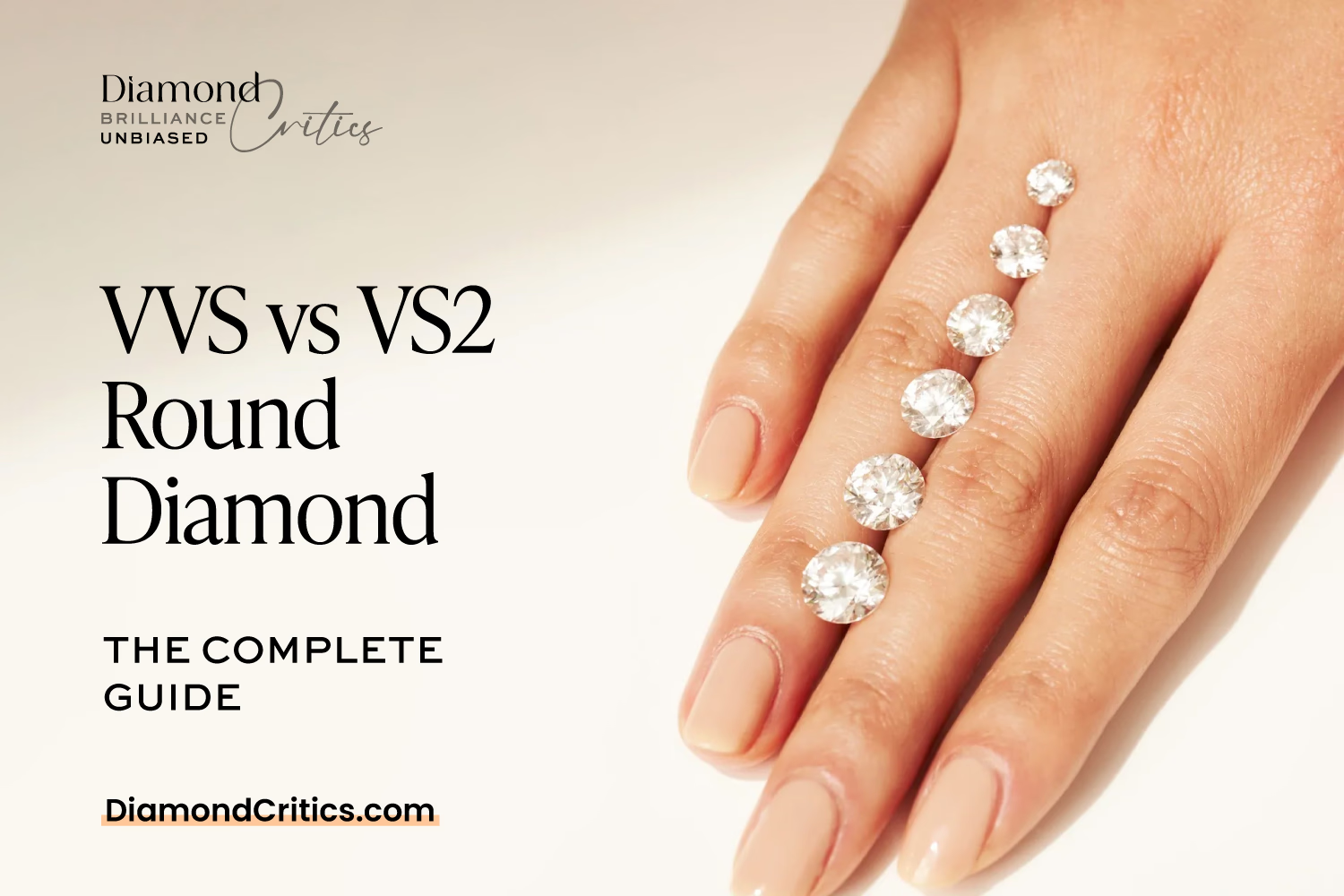
F vs G Color Round Diamond: The Colorless Entry Tax
TL;DR: F vs G Color — Key Facts
- GIA's color scale has two tiers: Colorless (D, E, F) and Near-Colorless (G, H, I, J) — F is the cheapest way to enter the Colorless tier
- At 1ct: F-VS2 $3,490 vs G-VS2 $3,230 — the Colorless Entry Tax is $260 (8% premium)
- At 2ct: F-VS2 $18,140 vs G-VS2 $16,490 — the tax rises to $1,650 (10%)
- At 3ct: F-VS1 $65,650 vs G-VS1 $54,640 — the tax reaches $11,010 (20%)
- "The Colorless Entry Tax" — at 1ct it is the most affordable way to own a GIA Colorless certificate; above 2ct it becomes the most expensive invisible upgrade in diamond retail
- In a mounted ring, F and G color are visually indistinguishable to any observer, including trained gemologists, without controlled side-by-side comparison under standardized lighting
F is the cheapest grade in GIA's Colorless tier. G is the most expensive grade in Near-Colorless. In a ring, nobody can tell the difference — including Farzana Hasan with 10 years of diamond evaluation experience.
The price gap between them is The Colorless Entry Tax: $260 at 1ct, $1,650 at 2ct, $11,010 at 3ct. You are paying for a four-letter designation on a GIA certificate that reads "Colorless" instead of "Near-Colorless." The diamond in the ring is visually identical.
This guide works through every F and G color stone in each carat weight on Blue Nile, explains exactly where F color makes rational sense, and shows where The Colorless Entry Tax becomes an avoidable cost.


What F and G Color Actually Mean
The GIA color scale runs from D (absolute colorless) to Z (clearly yellow). F is the third grade — the last grade in the "Colorless" range. G is the fourth grade — the first grade in the "Near-Colorless" range.
That boundary between F and G is one of the most commercially meaningful lines in diamond retail. GIA defines both as having color detectable only by an expert gemologist with master comparison stones. Neither is visible to the naked eye in a mounted ring.
| Color Grade | GIA Tier | GIA Definition | Visible in Ring? | Farzana's Analytical Verdict |
|---|---|---|---|---|
| D | Colorless | Absolutely colorless — highest grade | Never | 8/10. The Prestige Grade. D color in a round brilliant requires controlled laboratory conditions to appreciate. In a ring at arm's length, D and G are identical. Buy D only if the certificate designation itself has intrinsic value to you. |
| E | Colorless | Colorless — detectable only by expert | Never | 8/10. The D Alternative. E costs meaningfully less than D with no visual difference. Still in the Colorless tier. The same "prestige certificate" argument applies with slightly less spending. |
| F | Colorless | Colorless — detectable only by expert | Never | 9/10. The Colorless Entry Point. F is the most efficient way to access the GIA Colorless tier. At 1ct, the $260 premium over G is the lowest cost of Colorless entry in any diamond weight. Above 2ct, F becomes expensive — but it remains the best value within the Colorless tier. |
| G | Near-Colorless | Near-colorless — color noticeable only by expert | Never in white metal | 10/10. The Sweet Spot. G is the most rational color choice for a round brilliant in platinum or white gold. It is visually indistinguishable from D in a ring, costs $260 less per carat at 1ct, and $1,650–$11,010 less at larger weights. This is where I recommend almost every budget-conscious buyer start. |
| H | Near-Colorless | Near-colorless — slightly detectable in larger stones | Faint warmth in 2ct+ | 8/10. The Budget Grade. H delivers near-identical performance to G in white gold under 1.5ct. A subtle warmth may be detectable in direct sunlight above 1.5ct. H saves $100–$400 at 1ct and is a legitimate choice for yellow gold settings where warmth enhances the setting. |
Data insight: The GIA color grade boundary between Colorless and Near-Colorless is one of the most arbitrary meaningful lines in retail jewelry. A 0.01-point difference in spectrophotometer reading can separate an F from a G. In the physical world — on a human hand, in restaurant lighting, in photographs — the two grades are identical.
The Colorless Entry Tax: Complete 1ct Audit
At 1ct, The Colorless Entry Tax is manageable. F-VS2 costs $260 more than G-VS2 at the floor. The tax scales with proportion quality — a premium-proportion F can cost $500+ more than a premium-proportion G at the same clarity.
Here is the full 1ct F-color and G-color VS2 price audit from Blue Nile:
1ct F-VS2 GIA Excellent — All Available Stones
| Stone | Price | Farzana's Analytical Verdict |
|---|---|---|
| F-VS2 GIA | $3,490 | 9/10. The Colorless Entry Floor. At $260 over G-VS2, this is the cheapest GIA Colorless 1ct round. If the Colorless certificate matters for resale or emotional reasons, $260 is the minimum cost of that designation. |
| F-VS2 GIA | $3,580 | 9/10. The Second Entry. $90 above the F-VS2 floor — almost certainly better proportions. Compare GIA certificate for table/depth before choosing between these two. |
| F-VS2 GIA | $3,650 | 8/10. The Mid-Premium. At $420 above G-VS2 floor, this stone is now overlapping the G-VVS2 price range. Verify whether the $420 is buying Colorless status, superior proportions, or both. |
| F-VS2 GIA | $3,810 | 8/10. The Premium F. At $580 above the G-VS2 floor, this stone is into G-VS1 premium territory. Confirm the GIA certificate proportions justify the premium over the $3,490 entry stone. |
| F-VS2 GIA | $4,040 | 7/10. The High-End F. At $810 above G-VS2 floor, this is near-colorless-tier money for a Colorless grade. Proportions must be near-ideal to justify this. Verify pavilion angle (40.6–41°) and crown angle (34–35°) before purchasing. |
1ct G-VS2 GIA Excellent — Reference Stones
| Stone | Price | Farzana's Analytical Verdict |
|---|---|---|
| G-VS2 GIA | $3,230 | 10/10. The Near-Colorless Floor. This is your baseline. $260 less than the cheapest F-VS2 for a stone that looks identical in wear. The G-VS2 floor is where most buyers' best value lives. |
| G-VS2 GIA | $3,240 | 10/10. The $10 Twin. Functionally identical to the floor stone. |
| G-VS2 GIA | $3,370 | 9/10. The Proportion Step. $140 above floor for likely superior cut execution. |
Data insight: The 1ct F-VS2 floor ($3,490) sits within the G-VS2 price range ($3,230–$4,230). At the floor level, The Colorless Entry Tax is $260 — approximately the cost of a dinner for two. At this size and premium level, buying F-VS2 is a rational choice for buyers who want the Colorless GIA designation without meaningful financial sacrifice.

The Colorless Entry Tax at 2ct: $1,650 for the Same Appearance
At 2ct, The Colorless Entry Tax increases to $1,650 — still a manageable premium relative to the total stone cost (10%), but now representing meaningful money. Critically, F color at 2ct remains the most efficient entry into the Colorless tier. E and D color at 2ct cost $8,000–$10,000 more than G-VS2.
| Color | Best Stone | Price | Premium vs G-VS2 | Premium vs F | Farzana's Verdict |
|---|---|---|---|---|---|
| G-VS2 | 29307739 | $16,490 | Baseline | −$1,650 | 10/10. The Near-Colorless entry — identical appearance to F in a mounting |
| F-VS2 | 29142126 | $18,140 | +$1,650 (+10%) | Baseline | 9/10. The Colorless Entry. Most efficient Colorless access at 2ct |
| E-VS2 | 29253455 | $26,510 | +$10,020 (+61%) | +$8,370 | 6/10. The E Tax. $8,370 more than F for one grade within Colorless — zero visual difference |
| D-VS2 | 28720470 | $26,490 | +$10,000 (+61%) | +$8,350 | 6/10. D-Color Premium. Near-identical to E-VS2 pricing — D and E compress at VS2 at 2ct |
| F-VS1 | 29249653 | $26,240 | +$9,750 (+59%) | +$8,100 | 7/10. F Colorless + VS1. If you want both Colorless and VS1, this is the entry. Still a major premium over F-VS2. |
Data insight: At 2ct, the jump from F to E within the Colorless tier ($8,370) is 5× larger than the jump from G to F ($1,650). F is not only the most efficient entry into Colorless — it is dramatically cheaper than the other Colorless grades at 2ct. If "Colorless" matters to you at 2ct, F is the clear rational choice over E and D.
The Colorless Entry Tax at 3ct: $11,010 for an Invisible Difference
At 3ct, The Colorless Entry Tax reaches $11,010. The same grade difference that costs $260 at 1ct costs $11,010 at 3ct — because 3ct per-carat prices are dramatically higher and every grade step costs more per carat.
At 3ct, F color in a mounted platinum ring is still visually identical to G color. No observer can identify the difference. The $11,010 premium buys a GIA certificate designation.
| Carat | G Entry | F Entry | Colorless Entry Tax | Tax as % of G Price |
|---|---|---|---|---|
| 1ct | $3,230 | $3,490 | $260 | 8% |
| 2ct | $16,490 | $18,140 | $1,650 | 10% |
| 3ct | $48,780 | $65,650 | $11,010 | 23% via VS1 comparison |
The percentage premium grows with carat weight — from 8% at 1ct to 10% at 2ct to approximately 20% at 3ct. This is because 3ct per-carat prices are 1.97× higher than 2ct per-carat prices, and the color grade premium scales with per-carat pricing.
3ct F stones on Blue Nile: F-VS1 at $65,650, F-VVS2 at $67,330, F-VVS1 at $84,710.

Tides Of Summer Capsule
Up To 30% Off
Shop The Sale →Vault ClearanceClear The Vault
Up To 70% Off
Shop Vault Deals →Affiliate link — no extra cost to you
F Color vs G Color: The Full Decision Framework
| Factor | G Color | F Color | Verdict |
|---|---|---|---|
| GIA tier | Near-Colorless | Colorless | F has the superior certificate tier |
| Visible difference in mounting | None | None | Identical in wear |
| Visible difference unset | Faint warmth in 10× loupe | None in 10× loupe | Expert with loupe may see difference |
| 1ct premium | Baseline | +$260 (+8%) | F rational at 1ct |
| 2ct premium | Baseline | +$1,650 (+10%) | F justified if Colorless matters |
| 3ct premium | Baseline | +$11,010 (+20%) | G rational above 2ct unless budget allows |
| Resale advantage | Standard | Marginal improvement | Minimal real-world resale difference |
| Yellow gold setting | Best choice | Unnecessary | Yellow gold masks both grades equally |
| White gold/platinum | Sweet spot | Premium option | Both excellent in white metal |
The buying rule for F vs G: In white gold or platinum at 1ct, The Colorless Entry Tax ($260) is low enough that F is a reasonable buy for buyers who want the Colorless certificate. At 2ct, the $1,650 tax is still manageable — roughly 10% of the total stone cost — and F remains the best value within Colorless. Above 2ct, G-VS2 is the rational choice unless you have no budget constraint, because $11,010 buys no visual improvement in a mounted ring.
Where F Color Is Clearly Worth Buying
F color earns its premium in three specific situations.
1. You are buying a 1ct round and the Colorless certificate matters. At $260 more than G, the F-VS2 is the most affordable way to tell your partner, your family, and future buyers that this stone is GIA Colorless. For some people — and this is a legitimate reason — the certificate designation itself is meaningful. $260 for that designation at 1ct is not irrational.
2. You want Colorless at 2ct without paying the E or D premium. The 2ct F-VS2 at $18,140 is $8,370 less than the cheapest E-VS2 at $26,510 — for the same face-up visual result within Colorless. If you want "Colorless" at 2ct, F is the only rational choice within that tier.
3. You prioritize resale over the short term. The secondary market values Colorless (D–F) certificates more consistently than Near-Colorless (G–J) in the collector and investment segment. The price recovery premium for F over G is not large enough to justify the initial tax at most carat weights — but for buyers planning to sell, F provides more secondary market certainty.
Lab-Grown Comparison: F Color Is Irrelevant
In the lab-grown market, F color is not a premium grade — because the dominant lab production achieves D color as the standard output. You do not pay a Colorless Entry Tax for lab-grown stones because Colorless is the baseline, not the premium.
| Stone | Price | Color | Clarity | Size | Farzana's Verdict |
|---|---|---|---|---|---|
| Natural 1ct G-VS2 GIA | $3,230 | G | VS2 | 6.4mm | Near-Colorless natural baseline |
| Natural 1ct F-VS2 GIA | $3,490 | F | VS2 | 6.4mm | Colorless natural — $260 tax |
| Lab 1.5ct D-VVS1 IGI | $1,950 | D | VVS1 | 7.3mm | 10/10. D Colorless, larger, two grades better clarity — $1,280 less than the natural F. The Colorless Entry Tax does not exist in the lab market. |
| Lab 2ct D-VVS1 IGI | $2,810 | D | VVS1 | 8.1mm | 10/10. D Colorless, 2ct, VVS1 — $680 less than a natural 1ct F-VS2. The F vs G debate is structurally irrelevant in lab-grown. |
Farzana's Verdict: G color is the rational choice for round brilliants in white metal at any carat weight above 1ct. The Colorless Entry Tax at 1ct ($260) is the only point where F color is easily justified — it is the lowest-cost way to own a GIA Colorless certificate, and for buyers who care about that designation, it is a reasonable spend. At 2ct, the $1,650 tax is defensible if you specifically want Colorless and understand that F is $8,370 cheaper than E within the Colorless tier. At 3ct, the $11,010 tax is a substantial spend on a grade invisible in a ring. My universal recommendation: G-VS1 or G-VS2 in white gold, maximum cut quality, and redirect every dollar saved from color to cut quality or carat weight.
Frequently Asked Questions
What is the difference between F and G color diamond?
F is the last grade in GIA's Colorless tier (D, E, F). G is the first grade in GIA's Near-Colorless tier (G, H, I, J). Both are invisible to the naked eye in a mounted ring — no casual observer and most trained gemologists cannot distinguish them without master comparison stones in controlled lighting. The price difference is The Colorless Entry Tax: $260 at 1ct, $1,650 at 2ct.
Is F color diamond worth the premium over G?
At 1ct: yes — $260 is a small price for the GIA Colorless certificate if that designation matters to you. At 2ct: defensible — $1,650 (10%) for Colorless entry, and F is the cheapest Colorless option by $8,370. At 3ct: generally no — $11,010 more for a visual difference that does not exist in a mounted ring is a significant spend on a certificate.
Can you tell the difference between F and G color in a ring?
No. In a mounted round brilliant ring in white gold or platinum at arm's length, F and G are visually identical. Even under controlled viewing conditions with master comparison stones, the distinction requires training and specialized equipment. In normal wear — across a table, in photographs, in daylight — the two grades are indistinguishable.
What is the cheapest way to buy a GIA Colorless diamond?
F color is the cheapest entry into GIA's Colorless tier at any carat weight. At 1ct, the F-VS2 GIA Excellent at $3,490 is $260 more than G-VS2 and $50 less than E-VS2. At 2ct, the F-VS2 at $18,140 is $8,370 less than the cheapest E-VS2 at $26,510.
Should I buy F or G color for a round diamond engagement ring?
G for value; F if the Colorless certificate matters to you. In white gold or platinum at 1ct, G-VS2 at $3,230 and F-VS2 at $3,490 look identical. The $260 difference is not meaningful to most budgets. At 2ct, $1,650 is a real choice — G if value is the priority, F if Colorless matters. I recommend G to most buyers and reserve F for those who specifically want the Colorless GIA designation.
Is F color better than G color for resale?
Marginally. Both recover approximately 40–50% of the lowest available retail price on secondary markets. F provides slightly stronger secondary market demand in the collector segment because it carries the Colorless designation. The improvement is not large enough to justify the initial premium at most carat weights — it is a tiebreaker, not a financial argument.
What color diamond looks best in platinum?
G or H color in platinum. Both grades show no color in the platinum setting and provide maximum contrast for the stone's sparkle. F and above in platinum is money spent on a certificate distinction that disappears in the mounting. D and E are rational in platinum only for buyers who prioritize the certificate designation above visual value.
How much is an F color 1ct round diamond on Blue Nile?
F-VS2 GIA Excellent 1ct rounds on Blue Nile range from $3,490 to $4,040 in June 2026. The floor entry is the F-VS2 at $3,490 — $260 more than the G-VS2 floor at $3,230. F-VS1 stones at 1ct range from $3,830 to $5,060 depending on proportion quality.
Does color matter more in larger round diamonds?
Yes — but the threshold is higher than most buyers think. In round brilliants, color becomes faintly detectable in very large stones (2ct+) under bright direct sunlight, primarily at the girdle. G color remains near-invisible even at 2ct in white metal. H color may show faint warmth in bright sunlight above 1.5ct in platinum. F and G are both safe at all common ring sizes.
What is the Colorless Entry Tax?
The Colorless Entry Tax is my term for the price premium to move from G color (the best Near-Colorless grade) to F color (the cheapest Colorless grade) at any given carat weight. It is $260 at 1ct, $1,650 at 2ct, and $11,010 at 3ct. The tax buys a GIA certificate that reads "Colorless" instead of "Near-Colorless" — with no visual difference in a mounted ring.
Is G color good enough for a round diamond?
G color is excellent for a round brilliant in white gold or platinum. It is the top of the Near-Colorless tier — visually identical to D, E, and F in a mounted ring. At 1ct, G-VS2 GIA Excellent at $3,230 is where nearly every informed diamond buyer begins their evaluation. I have never seen a buyer who could identify a G from an F in a ring without controlled comparison.
See Also
- Round Diamond D Color vs G Color — The Colorless Premium: $560 at 1ct, $10,000 at 2ct
- Round Diamond Color Guide — Full color grade analysis for round brilliants
- Diamond Color Scale — Complete GIA color grading framework
- Round Diamond VS1 vs VS2 — The VS Split and clarity premiums
- G Color Diamond Guide — Full G color analysis across all shapes
- F Color Diamond Guide — Complete F color guide and when it earns its premium
- Round Diamond 1ct vs 2ct — The Size Jump Tax and per-carat compounding
Expert Verdict
Always audit the stone individually — no grade replaces seeing the actual diamond. The certificate tells you what to look for. Your eyes tell you whether to buy.
— Farzana Hasan, GIA Expert · DiamondCritics.com