Round Diamond vs Pear Shape in 2026: The Teardrop Compromise


TL;DR: Round vs Pear Shape — Key Differences
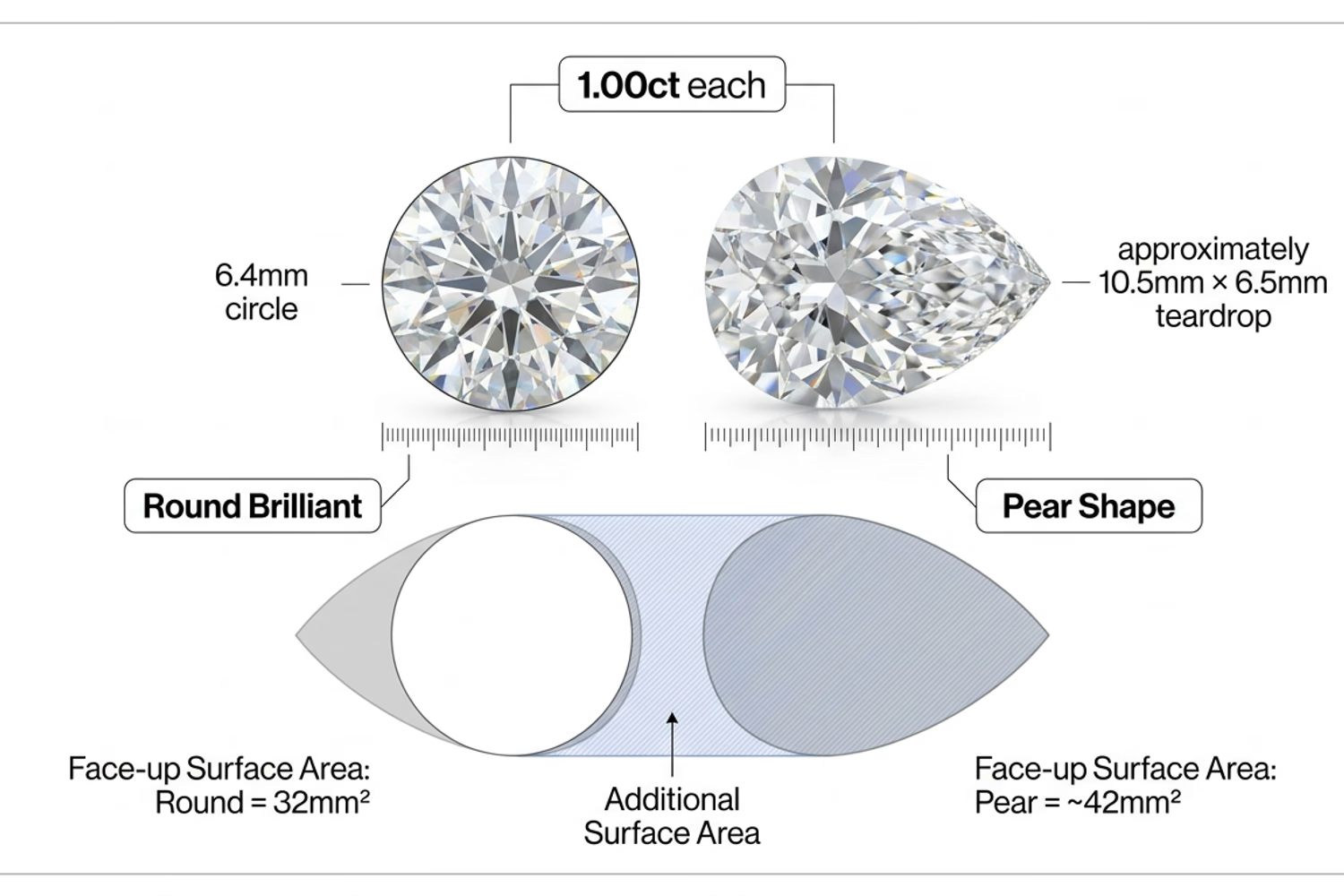
- Pear faces up 5–10% larger than round per carat: a 1ct pear measures approximately 10–11mm × 6.5mm vs 6.4mm diameter for round — the elongated teardrop shape creates more apparent size on the finger
- The Teardrop Compromise: the pear's elongation advantage comes with three costs — bow-tie risk (30–50% of pear cuts), tip color concentration, and no GIA cut grade; these are manageable with correct buying practices
- Pear requires G color minimum in white gold (vs G–H for round) because color concentrates at the single pointed tip; in yellow gold, H is acceptable as the warm metal masks tip color
- Pear prices 10–15% below round for the same grade, but the tip-protection setting requirement (V-prong or bezel at the point) adds cost; net savings 5–12%
- The pointed tip is structurally vulnerable: unlike round's closed girdle, the pear's single point can chip if struck without proper prong protection — setting selection is critical
- Pear is the most flattering elongated shape for wide fingers: the single-directional elongation points down the finger more effectively than an oval or marquise for some wearers
The pear shape occupies the sweet spot between the marquise and the oval — it has the marquise's elongation with one pointed tip and one rounded end, giving it a softer silhouette than the marquise without the full symmetry of the oval. When cut well and set correctly, a pear diamond creates one of the most distinctive engagement ring profiles available. When bought carelessly, it is a bow-tied, color-heavy stone with a chipped tip. This guide covers exactly where the line is.
Face-Up Size: The Pear's Practical Advantage
The elongated teardrop shape of a pear diamond covers more surface area per carat than a round brilliant. The actual numbers:
| Shape | Carat | Approximate Dimensions | Face-Up Area |
|---|---|---|---|
| Round | 1ct | 6.4mm × 6.4mm | 32 mm² |
| Pear | 1ct | 10.5mm × 6.5mm | ~42 mm² (typical) |
| Round | 2ct | 8.1mm × 8.1mm | 51 mm² |
| Pear | 2ct | 13mm × 8mm | ~65 mm² (typical) |
The pear at 1ct provides approximately 30% more face-up area than round on paper, translating to a perceived 5–10% larger appearance in person. The rounded end of the pear is wider than the equivalent point on a marquise, which makes the pear appear slightly less aggressively elongated — it is a softer shape that appeals to buyers who want size without the extreme length of a marquise.
The directional quality of the pear — narrower at the tip, wider at the round end — creates a distinctive elongation that points down the finger when worn with the tip toward the hand. This directional element makes the pear more visually dynamic on the finger than a round or even an oval.
The Teardrop Compromise: What You Give Up
1. The Bow-Tie Effect
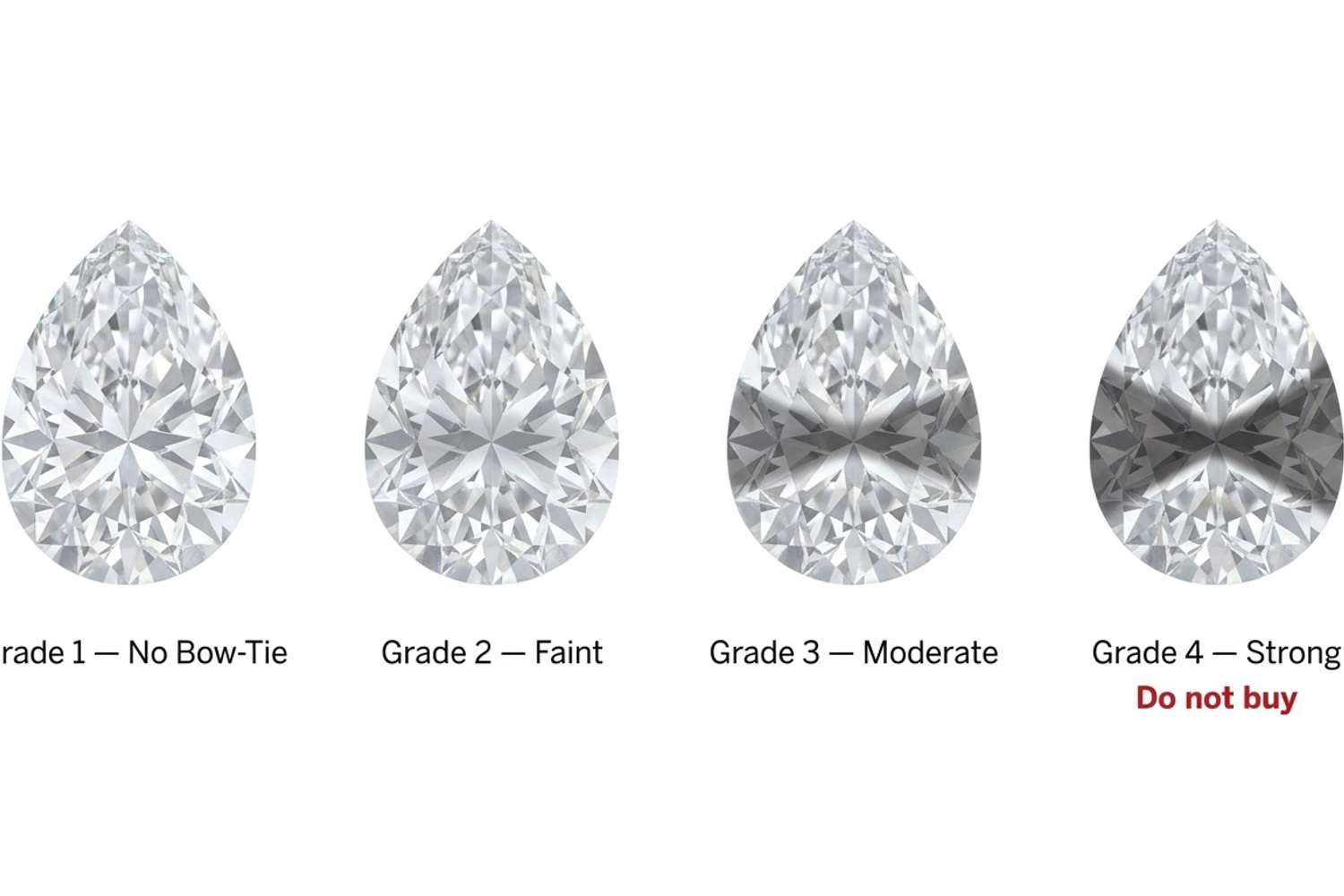
Like all elongated brilliant cuts, the pear shape creates a geometric challenge in the central zone where the wings meet. Light entering from the table reflects at angles that cannot return to the viewer in the center of the stone, producing a dark bow-tie shadow. Approximately 30–50% of pear cuts on the market have a visible bow-tie.
Pear bow-ties tend to be less severe than marquise bow-ties for two reasons: the rounded end of the pear provides slightly more symmetry than the pointed second end of a marquise, and the pear's proportions allow cutters more freedom to minimize the central dark zone. However, severe bow-ties occur at similar rates as in marquise cuts.
As with marquise, the only evaluation method is HD video that shows the stone turning under multiple light sources. Static photography in overhead direct lighting suppresses bow-tie appearance; it must be viewed in motion to assess.
2. Tip Color Concentration
The single pointed tip of a pear concentrates color because the facets near the point are smaller and arranged in a tighter geometry than the broad facets across the main table. In white gold settings:
- G color round: effectively colorless at normal viewing
- G color pear: slight warmth visible at the tip in direct lighting
The tip is typically worn pointing toward the hand (finger-down orientation), which places it closer to the skin. This orientation makes tip color more apparent when the ring is viewed from above. G color minimum is required for pear in white gold settings; F is the conservative choice.
In yellow gold settings, the warm metal helps mask tip color and H is acceptable, though G remains preferred.
3. No GIA Cut Grade
Pear shapes, like all fancy shapes, do not receive GIA's cut grade. GIA grades color, clarity, polish, and symmetry for pear diamonds but does not assess cut in the comprehensive proportional analysis it applies to round brilliants.
The accepted proportional parameters for a well-cut pear:
- Length-to-width ratio: 1.45–1.75
- Depth: 58–64%
- Table: 53–65%
- Girdle: Thin to Slightly Thick
- Symmetry: Excellent or Very Good
The GIA symmetry grade on a pear certificate evaluates whether the facets are aligned correctly and the outline is balanced, but it does not certify whether the proportions produce optimal light return.
The Tip Direction Question: Which Way Should the Point Face?
The pear diamond is traditionally worn with the point (the single narrow end) oriented toward the fingernail — "tip-out." However, there is no universal rule, and the choice has practical implications:
Tip-out (point toward nail):
- More traditional orientation
- Creates a longer visual appearance for the finger
- The tip is at the most vulnerable position — top of the finger, most exposed to impact
- Requires V-prong protection at the tip
Tip-in (point toward hand):
- Less traditional but increasingly common
- The tip is partially protected by the hand
- Still requires V-prong protection
- The rounded end faces outward, creating a softer look when viewed face-on
Both orientations are correct. The setting must protect the tip regardless of orientation.
The Tip Prong Requirement: Why Setting Matters More for Pear
A round diamond can be set in four or six prongs with equal security regardless of which prong falls at which point of the circle. Every point on a round's girdle is equally supported. A pear diamond has one asymmetric vulnerability: the pointed tip.
Setting requirements for pear diamonds:
- V-prong at the tip: a V-shaped prong that cups around the point is the industry standard; a regular round prong cannot grip the sharp tip geometry
- Two prongs at the rounded end: minimum; three prongs for larger stones (1.5ct+)
- Bezel setting: fully protective but changes the visual character of the stone
- Basket setting with V-prong: the most common contemporary pear setting
The V-prong adds cost to custom settings. For solitaire pear settings, expect to pay $150–$400 more than a round solitaire setting of equivalent metal quality for the specialized prong work.
Price Comparison: Round vs Pear at 1ct and 2ct
1ct Comparison
| Stone | Shape | Grade | Price | Notes |
|---|---|---|---|---|
| GIA 1ct G-VS1 Round | Round | G-VS1 | $3,700 | GIA Excellent, no bow-tie |
| GIA 1ct G-VS1 Round | Round | G-VS1 | $3,530 | GIA Excellent, strong entry |
| GIA 1ct G-VS2 Round | Round | G-VS2 | $3,650 | Comparison anchor |
| 1ct Pear | Pear | G-VS2 | ~$3,200–$3,600 | Video required; V-prong needed |
At 1ct, a G-VS2 pear prices approximately $3,200–$3,600 — below a comparable round in G-VS2 at $3,650–$3,700. The apparent savings of $100–$400 narrows when you factor in the V-prong setting cost ($150–$400 premium) and the color upgrade consideration. The actual net savings on a correctly-executed pear purchase is modest.
The face-up advantage at 1ct is real: a 10.5mm × 6.5mm pear versus a 6.4mm round circle is a meaningfully different visual statement on the finger.
2ct Comparison
| Stone | Shape | Grade | Price | Notes |
|---|---|---|---|---|
| GIA 2ct E-VVS1 Round | Round | E-VVS1 | $26,510 | Premium clarity reference |
| GIA 2ct E-VS2 Round | Round | E-VS2 | $26,510 | Near-identical to above |
| GIA 2ct G-VVS2 Round | Round | G-VVS2 | $26,610 | Value comparison |
| 2ct Pear | Pear | G-VS2 | ~$22,000–$25,000 | Requires video, V-prong, tip check |
At 2ct, the pear shape shows its most compelling face-up advantage — a 13mm × 8mm teardrop versus an 8.1mm circle is dramatically different in appearance. For buyers specifically seeking a presence diamond on a budget, a 2ct pear at $22,000–$25,000 compared to a 2ct round at $26,610 for G-VVS2 represents genuine savings with a more dramatic visual effect.
Lab-Grown Pear: The Most Efficient Option
| Stone | Shape | Grade | Price | Notes |
|---|---|---|---|---|
| IGI 1.5ct D-VVS1 Ideal Lab-Grown Round | Round | D-VVS1 | $1,950 | Reference point |
| 1.5ct D-VVS1 Lab-Grown Pear | Pear | D-VVS1 | ~$1,700–$2,100 | ~14mm × 8.5mm face-up |
| 2ct D-VVS1 Lab-Grown Pear | Pear | D-VVS1 | ~$2,400–$3,000 | ~17mm × 10mm face-up |
A 1.5ct lab-grown pear in D-VVS1 at approximately $1,700–$2,100 faces up at roughly 14mm × 8.5mm — a dramatically elongated presence for under $2,100. Lab-grown pricing combined with pear elongation is the most efficient way to maximize face-up size per dollar in the current market. For buyers whose priority is visual impact and who do not require natural origin, the lab-grown pear represents exceptional value.
Tides Of Summer Capsule
Up To 30% Off
Shop The Sale →Vault ClearanceClear The Vault
Up To 70% Off
Shop Vault Deals →Affiliate link — no extra cost to you
Pear vs Oval: Which Elongated Shape Is Better?
Both pear and oval provide elongation advantages over round. The key differences:
| Parameter | Pear | Oval |
|---|---|---|
| Elongation type | Asymmetric (tapers to a point) | Symmetric (rounded both ends) |
| Bow-tie risk | 30–50% | 50–70% |
| Color requirements | G minimum (tip) | G minimum (ends) |
| Structural vulnerability | Single pointed tip | None |
| Setting requirement | V-prong required | Standard prongs |
| Visual effect | Directional, teardrop | Balanced, elongated |
| Typical L:W ratio | 1.45–1.75 | 1.30–1.50 |
Oval bow-tie occurs at higher rates than pear, but oval bow-ties are often less severe. Pear has a single structural vulnerability (the tip) that oval lacks entirely. For buyers who want elongation without the maintenance of a pointed tip, oval is safer. For buyers who want the distinctive tapered silhouette that pear provides, the V-prong requirement is manageable.
Length-to-Width Ratio: Getting the Shape Right
| L:W Ratio | Appearance | Recommendation |
|---|---|---|
| <1.40 | Too wide; looks fat | Avoid |
| 1.40–1.50 | Wide, chubby pear | Some buyers prefer this softness |
| 1.50–1.65 | Classic pear proportion | Best for most buyers |
| 1.65–1.75 | Elongated pear | Excellent for smaller hands |
| >1.80 | Very elongated; fragile tip | Structural risk; avoid |
The 1.50–1.75 range is where the pear shape performs best proportionally and optically. Below 1.40, the stone looks more like a rounded triangle than a teardrop. Above 1.80, the tip geometry becomes fragile and the bow-tie risk increases as the wings lengthen.
Round vs Pear: When to Choose Each
Choose round brilliant when:
- GIA Excellent cut grade is your quality anchor
- Daily wear durability with no special setting concerns
- You want reliable resale value and secondary market liquidity
- Optical performance consistency under all lighting conditions
- Budget constraints and you want maximum light performance per dollar
Choose pear shape when:
- The elongated teardrop silhouette matches the wearer's aesthetic preference
- You have confirmed the specific stone has a Grade 1–2 bow-tie via HD video
- You are using G color minimum and VS2 clarity minimum
- The setting will include proper V-prong protection at the tip
- You want more face-up size per carat than round delivers
- Lab-grown and maximum size per dollar is the priority
Farzana's Verdict: The pear is genuinely beautiful when bought correctly. The Teardrop Compromise is: you accept the extra work (video for bow-tie, G color minimum, V-prong requirement) in exchange for a more distinctive silhouette and 5–10% more face-up size per carat than round. The compromise is manageable. What I see buyers get wrong: they buy from a still photo without bow-tie evaluation, they accept H color in white gold and end up with visible tip warmth, and they put a pear in a four-prong solitaire designed for round without asking about tip protection. Do the work upfront and the pear delivers an exceptional ring. Skip the verification and the compromises come out after the purchase. The elongation on a well-cut pear at 1.5ct or 2ct is a genuinely compelling visual statement that round cannot match.
Frequently Asked Questions
Does a pear diamond look bigger than a round of the same carat?
Yes. A 1ct pear measures approximately 10.5mm × 6.5mm versus 6.4mm diameter for a round, giving it roughly 30% more face-up area on paper. In person, the visual impression is 5–10% larger — the elongated shape creates more finger coverage. The elongation also makes the finger look longer, which amplifies the apparent size impression.
What color grade do I need for a pear diamond?
G minimum for white gold settings. The pointed tip of a pear concentrates color more than a round brilliant's even distribution. A G color round appears colorless in white gold; a G color pear may show slight warmth at the tip under direct lighting. F is the conservative recommendation. In yellow gold, the warm metal masks tip color and H is acceptable.
Do all pear diamonds have a bow-tie?
No, but approximately 30–50% have a visible bow-tie. The bow-tie is a dark shadow across the center of the stone where light reflects at angles that cannot return to the viewer. Mild bow-ties are acceptable; strong bow-ties are visually objectionable. Always verify via HD video that shows the stone turning under multiple light sources.
Is pear cheaper than round diamond?
By approximately 10–15% per carat for the same grade. However, pear requires G color (vs G–H for round), a V-prong setting for tip protection (adds $150–$400 to setting cost), and more verification time. After accounting for these costs, the net effective savings over round is approximately 5–12%.
What is the ideal length-to-width ratio for a pear diamond?
1.50–1.75 is the most widely recommended range. In this range, the pear has a recognizable teardrop shape without the tip becoming dangerously narrow. Below 1.40, the shape looks too wide and loses its distinctive silhouette. Above 1.80, the tip becomes structurally fragile and bow-tie risk increases.
How should a pear diamond be oriented in a ring?
Traditionally, the pointed tip faces toward the fingernail (tip-out), creating a longer-looking finger. Some wearers prefer tip-in (toward the hand), which positions the rounded end outward for a softer look. Both orientations are correct. The V-prong protection is required at the tip regardless of orientation.
What setting is best for a pear diamond?
A V-prong at the pointed tip is required. The standard round prong geometry cannot grip the sharp point of a pear effectively. A V-prong or specialized point-protection prong cups around the tip to prevent chipping. The rounded end should have two prongs minimum (three for 1.5ct+). Bezel settings provide maximum tip protection but enclose the stone more fully. A basket solitaire with V-prong tip is the most common setting for pear diamonds.
How does pear compare to marquise for elongation?
Both are elongated brilliant cuts. Marquise has two pointed ends; pear has one pointed end and one rounded end. Marquise provides slightly more total elongation per carat — a 1ct marquise is typically 12mm × 6mm versus a pear at 10.5mm × 6.5mm. Pear is softer visually because one end is rounded. Marquise has two structurally vulnerable tips requiring two V-prongs; pear has one. Both require identical bow-tie evaluation via video.
Can I buy a pear diamond without seeing video?
No. Like all elongated brilliant cuts, the bow-tie in a pear is invisible in static overhead photography and only appears in video showing the stone rotating under varying light sources. Never buy a pear diamond without HD video. The difference between a Grade 2 bow-tie (acceptable) and a Grade 4 bow-tie (reject) is not visible in a still photograph.
Is pear good for an engagement ring?
Yes, with the correct setting. The pear's teardrop silhouette is distinctive and photographs beautifully — particularly in side-view ring photography and on a finger. The practical requirements: V-prong tip protection, G color minimum, VS2 clarity minimum, bow-tie evaluated via video. The tip is the most vulnerable physical point of the stone and should be in a protected setting for daily wear. A well-set pear in a proper V-prong solitaire is durable for everyday use.
See Also
Expert Verdict
Always audit the stone individually — no grade replaces seeing the actual diamond. The certificate tells you what to look for. Your eyes tell you whether to buy.
— Farzana Hasan, GIA Expert · DiamondCritics.com