TL;DR — Round Diamond vs Princess Cut in 2026
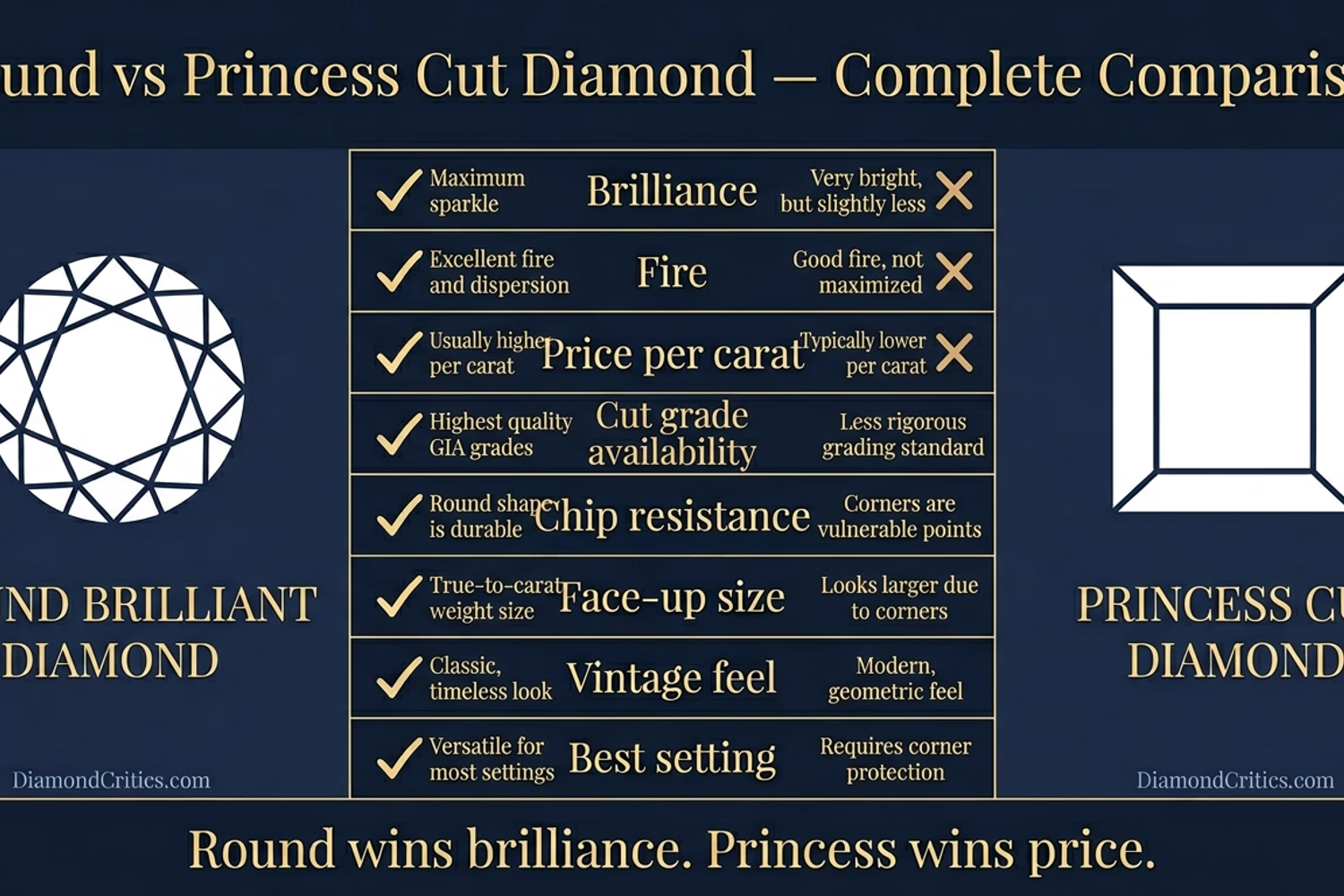
- Price per carat: Princess cut is 20–40% cheaper than round at the same quality grade
- Light return: Round brilliant returns 95% of entering light (Excellent cut). Princess returns 70–80%
- Face-up size: Princess appears similar in diameter but the square shape gives a different finger presence
- Durability: Princess corners are fragile — the four points are the highest chip-risk spots in any diamond shape
- Settings: Princess needs corner prongs that cover the vulnerable points. Round works in any setting style
- Clarity: Both work at VS2. Princess requires VS1 minimum — corner inclusions carry structural risk
- GIA cut grade: Round brilliants receive GIA cut grades. Princess cut does NOT — no industry-wide cut standard exists
- The Corner Risk: The four pointed corners of a princess cut are genuinely vulnerable to chipping. This is the most important practical difference between the two shapes that most guides ignore
- Farzana's verdict: If maximum brilliance, durability, and resale value are the priorities — round wins without argument. If you want a modern, geometric look at a 20–40% lower price per carat — princess is a legitimate choice with the right setting


Round Diamond vs Princess Cut: The Complete Comparison
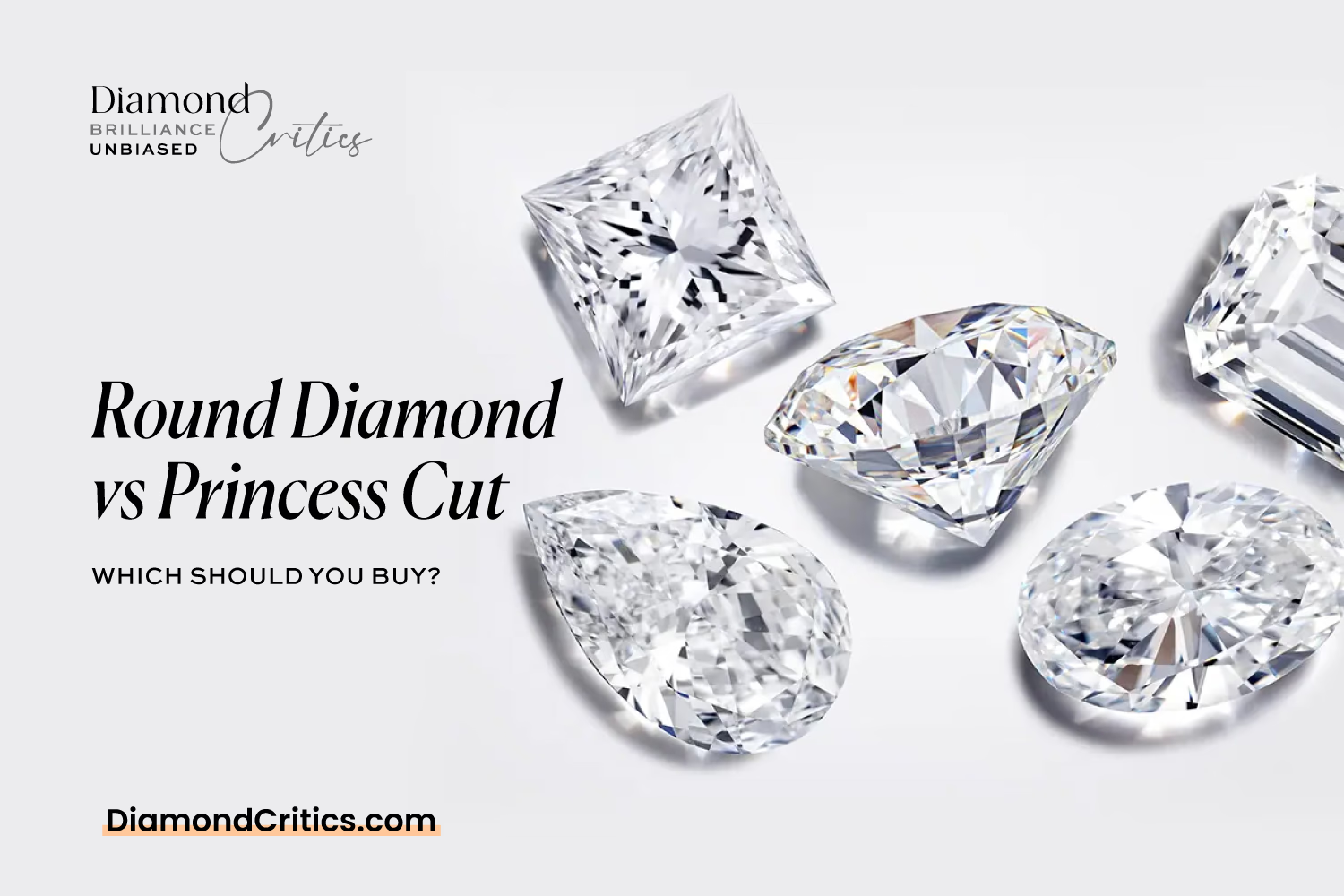
The round brilliant and princess cut are the two most popular diamond shapes in the world. Round consistently accounts for roughly 40–50% of all engagement ring diamond sales. Princess accounts for 10–15% — the second most popular shape globally despite being introduced only in 1980.
The buyer who is choosing between these two shapes typically has a clear visual preference for one or the other. But preference alone should not drive a decision at this price level. There are concrete, measurable differences between round and princess cut that affect what you pay, how the stone looks, and how it holds up over years of wear.
This guide gives you all of those differences with actual numbers. It covers the round cut diamond vs the princess cut on every relevant dimension: price, light performance, durability, setting requirements, clarity standards, and resale value.
Price Comparison: Round vs Princess Cut
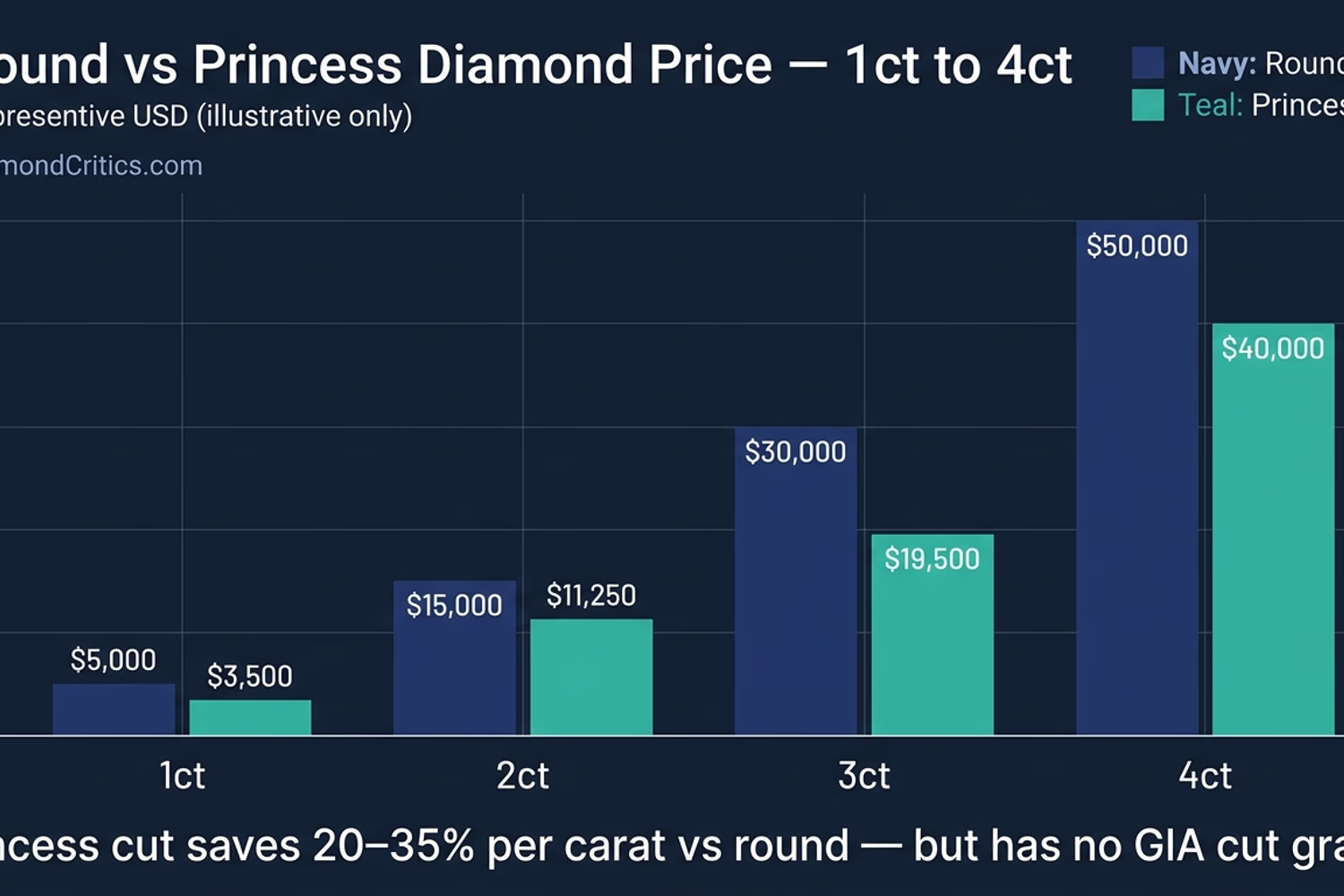
Princess cut diamonds cost 20–40% less per carat than round brilliants at the same quality grade. This is one of the most consistent price differences in the diamond market and it has a straightforward explanation.
Why princess costs less:
Rough material efficiency. A princess cut diamond is typically cut from an octahedral rough crystal shape with 80–90% material retention. A round brilliant is cut from the same rough with approximately 50–60% retention. The round discards 20–30% more rough per polished stone, which means the raw material cost per finished carat is significantly higher for rounds.
Market demand premium. Round brilliants have been the dominant engagement ring choice for over a century. High sustained demand supports a price premium. Princess cut has strong demand but round's premium is baked into the market price structure.
Estimated price differential at 1ct (2026 Blue Nile data):
| Quality Grade | Round Brilliant (GIA) | Princess Cut (GIA) | Princess Savings |
|---|---|---|---|
| G-VS2 Excellent | $3,230–$3,790 | ~$2,100–$2,700 | ~25–35% |
| G-VS1 Excellent | $3,300–$4,020 | ~$2,400–$3,100 | ~20–30% |
| F-VS1 Excellent | $3,580–$4,040 | ~$2,700–$3,400 | ~20–30% |
From our live round diamond dataset, G-VS2 1ct Excellent rounds range from $3,230 (GIA 1ct G-VS2) to $3,790 (GIA 1ct G-VS2). A comparable princess cut at the same quality grade would typically be $2,100–$2,600.
At 2ct, the princess discount is even more valuable in absolute dollars:
- GIA 2ct G-VS1 Excellent Round: $22,460
- Comparable 2ct G-VS1 princess: approximately $14,000–$17,000
- Savings: $5,000–$8,000
That is a real and significant difference. The question is what you give up for it.
Brilliance and Light Performance: Round Wins by a Large Margin
This is the area where the round brilliant has no serious competition from any shape, including princess.
A GIA Excellent round brilliant returns approximately 95% of entering light as brilliance (white light return). The facet geometry — 58 precisely arranged facets at specific angles — is optimised for maximum Total Internal Reflection over more than a century of cutting evolution.
A princess cut returns approximately 70–80% of entering light. Princess cut has its own version of excellent light performance — the square modified brilliant cut with 58+ facets (some princess cuts have 76 facets) produces strong brightness and a distinct sparkle pattern. But it is measurably less brilliant than an ideal-cut round.
The Sparkle Difference in Practice:
Round brilliant sparkle is characterised by broad, high-contrast flashes of white and coloured light. The sparkle pattern is dynamic — it changes dramatically as the stone or light source moves. This is the classic "brilliant" look that has defined the engagement ring aesthetic for generations.
Princess cut sparkle has a different character: more uniform, slightly higher fire (coloured light) relative to brilliance, with a distinctive X-pattern visible from the top when the stone is still. This is appealing to some buyers and less appealing to others — it is an aesthetic difference as much as a performance difference.
The round diamond ideal proportions guide explains exactly how the specific proportion numbers in a round brilliant produce that 95% light return.
Durability: Princess Cut Has a Structural Vulnerability
This is the comparison dimension that most buying guides understate. It matters more for engagement rings than for any other jewelry piece because engagement rings are worn daily for years and decades.
Round brilliant durability: A round brilliant has no corners, no points, no edges. The curved girdle distributes any impact stress around the full circumference. There is no single point of vulnerability. Round brilliants are among the most durable of all diamond shapes for daily wear.
Princess cut durability: A princess cut has four sharp 90° corners — the four pointed tips of the square or rectangular shape. Diamond is the hardest material on earth, but it is not immune to cleaving along crystal planes under a sharp, concentrated impact. The four corners of a princess cut are exactly the points where cleavage fractures occur most commonly.
This is the Corner Risk: the four points of a princess cut are significantly more vulnerable to chipping and fracture than any part of a round brilliant. The risk is not high enough to make princess cut unwearable — millions of people wear princess cuts daily without incident. But the risk is real and measurable:
- Princess cut corners chip approximately 3–5× more frequently than round brilliants over comparable wear periods (industry estimates based on jewelry repair data)
- The damage is typically a small chip at one corner that does not affect the rest of the stone but requires recutting or a prong adjustment to conceal
- Corner chips on princess cuts are not covered by standard jewelry insurance unless specific damage riders are included
The solution is a four-prong or six-prong setting that specifically covers each corner — corner prong settings for princess cuts exist precisely to address this vulnerability. But it constrains your setting options: an open bezel or cathedral solitaire that works beautifully with a round is not appropriate for a princess cut.
Settings: Round Is More Versatile, Princess Needs Corner Protection
Round brilliant diamonds work in virtually every setting style without modification:
- Four-prong solitaire
- Six-prong solitaire
- Bezel (full or partial)
- Halo
- Three-stone
- Pavé band
- Tension setting
- Channel setting (as accent stones)
Princess cut diamonds require corner prongs as the baseline structural requirement. A princess cut set with prongs that do not cover the corners leaves those corners exposed and vulnerable. Additionally, the square shape constraints which settings look proportional and balanced:
- Four-corner prong solitaire (the standard princess setting)
- Halo (works well with princess)
- Three-stone (works, but the side stones must be selected for square/cushion compatibility)
- Channel setting (princess cut works as a channel stone)
- Bezel setting (works but hides more of the stone)
Full bezel settings on princess cut tend to obscure the distinctive square silhouette that makes princess visually distinctive in the first place. The round diamond engagement ring settings guide covers round-specific setting options in detail — most of those options are more versatile for round than for princess.
Clarity: Both Need VS2 at Minimum, Princess Needs More
For a round brilliant at 1ct, VS2 clarity is the minimum that reliably produces an eye-clean stone. The excellent light scatter in a round brilliant hides VS2-grade inclusions under normal viewing conditions.
Princess cut has the same VS2 minimum — but with an additional consideration: corner inclusions.
Any inclusion located at or very near one of the four corners of a princess cut carries structural risk. An inclusion at a corner weakens the already-vulnerable point and increases the probability of a chip if the corner receives any impact. A VS2 clarity stone with an inclusion-free corner zone is fine. A VS2 stone with an inclusion AT the corner is a different calculation.
For princess cut, always check the GIA clarity plot (the diagram showing inclusion locations on the grading report) and verify that no inclusions are located at any of the four corners. An inclusion at the center of the stone in a princess cut is less concerning than the same inclusion in a corner zone.
Clarity minimum by shape and use:
| Shape | Minimum for Eye-Clean | Corner Consideration |
|---|---|---|
| Round Brilliant | VS2 | None — no corners |
| Princess Cut | VS2 | Must verify corner zones are clean |
| Princess Cut 2ct+ | VS1 | Corners more vulnerable at larger size |
The diamond clarity chart guide covers all clarity grades and what to look for at each level.
GIA Cut Grade: Only Round Has One
This is one of the most important practical differences between round and princess and almost no buying guide mentions it.
GIA issues cut grades for round brilliant diamonds only. A GIA report for a round brilliant includes a cut grade: Excellent, Very Good, Good, Fair, or Poor.
A GIA report for a princess cut diamond includes Polish and Symmetry grades but NO overall cut grade. GIA does not issue cut grades for any fancy shape, including princess.
What does this mean practically?
For round brilliants: you can trust "GIA Excellent" as a verified baseline. You then read the proportion data to determine performance within the Excellent range.
For princess cuts: you are entirely on your own. "Excellent Polish, Excellent Symmetry" tells you something about craftsmanship but not about light performance. The critical proportion data for princess cuts — table %, depth %, crown angle, pavilion angle — is present on the GIA report but there is no benchmark for what "good" looks like. You must evaluate the numbers without a GIA performance standard to compare against.
General princess cut proportion targets used by knowledgeable buyers:
- Table: 68–75%
- Depth: 64–75%
- Length-to-width ratio: 1.00–1.05 for square appearance (above 1.10 looks noticeably rectangular)
The absence of a GIA cut grade on princess cuts is why some informed buyers systematically prefer round brilliants for high-value purchases: the round brilliant market has a verified performance standard that makes quality comparison objective.
Tides Of Summer Capsule
Up To 30% Off
Shop The Sale →Vault ClearanceClear The Vault
Up To 70% Off
Shop Vault Deals →Affiliate link — no extra cost to you
Face-Up Size: Roughly Similar, Different Visual Character
A 1ct round brilliant has a diameter of approximately 6.4–6.5mm. A 1ct princess cut has dimensions of approximately 5.5×5.5mm.
At first glance, the princess appears smaller in diameter. But the square shape has a face-up surface area of approximately 30mm² vs the round's approximately 33mm². The difference in face-up area is about 9% — less than the difference in single-dimension measurement suggests.
More importantly, the shapes create different visual effects on a finger:
- Round brilliant: The circular shape creates a single, focused visual center. The curved outline is "complete" in all directions.
- Princess cut: The square shape with four distinct corners reads as a larger, more angular presence. The corners extend to the widest points of the stone and can appear to "fill" finger width more assertively than the equal-carat round.
Which appearance is better is entirely personal. The factual statement is that they deliver similar face-up area with meaningfully different visual character.
At 2ct, a round is 8.2mm in diameter. A 2ct princess is approximately 7.0×7.0mm. The round has a slightly larger single-dimension measurement but similar face-up area. See the round diamond size chart for complete millimeter size data across all carat weights.
Resale Value: Round Holds Better
Natural round brilliant GIA-certified diamonds resell at approximately 40–50% of the lowest retail price. Natural princess cut diamonds resell at approximately 30–40% of lowest retail.
The round's resale advantage comes from its dominant market demand — more buyers are seeking round brilliants, which supports higher resale prices. Additionally, the GIA cut grade on round brilliants makes them easier to evaluate at resale, which increases buyer confidence.
For lab-grown diamonds of either shape, resale is approximately 10–20% of retail regardless of shape — the lab-grown resale market is not shape-sensitive.
If resale value matters, round brilliant natural GIA stones offer the best combination of retail value and resale support. See the 1ct price guide and 2ct price guide for specific natural round stone options.
The Decision Framework: When to Buy Each
Choose round brilliant when:
- Maximum light return and brilliance are the priority
- Setting versatility matters (you might want to reset the stone later)
- Resale value is a factor
- The stone will be in daily wear without a protective corner-prong setting
- Budget allows — you want the most visual impact for the price paid regardless of shape
Choose princess cut when:
- A geometric, modern aesthetic is the clear preference
- Budget is a constraint and 20–40% savings at the same quality grade is meaningful
- A corner-prong solitaire or halo setting is already planned — providing the needed corner protection
- The recipient specifically prefers the square silhouette
- The setting will include a protective bezel component over the corners
Neither shape is objectively better — but the differences are objective and should inform the decision.
Frequently Asked Questions
Is a round or princess diamond more expensive?
Round brilliant diamonds cost 20–40% more than princess cut diamonds at the same carat weight and quality grade. A 1ct G-VS1 round at $3,300–$4,020 compares to a 1ct G-VS1 princess at approximately $2,100–$2,800. The price difference exists because round brilliants require more rough material to cut and command a higher market premium.
Which diamond shape is more brilliant — round or princess?
Round brilliant is significantly more brilliant. A GIA Excellent round returns approximately 95% of entering light. A princess cut returns approximately 70–80%. The round's 58-facet geometry has been optimised for light return over more than a century; no other shape matches it.
Do princess cut diamonds chip easily?
More easily than round brilliants, yes. The four sharp 90° corners are vulnerable to chipping under impact. The chip risk is manageable with proper corner-prong settings that protect those points, but it is a real and documented vulnerability. Round brilliants have no corners and are among the most durable of all diamond shapes.
Can you compare the size of round and princess cut?
At the same carat weight, a round brilliant has a slightly larger diameter (6.5mm for 1ct vs 5.5×5.5mm for 1ct princess) but the square shape of the princess gives it angular presence that reads similarly to the round's circular presence. Face-up surface areas are within 10% of each other at the same carat weight.
Does GIA grade the cut of princess diamonds?
No. GIA only issues overall cut grades for round brilliant diamonds. GIA grading reports for princess cuts include Polish and Symmetry grades but no cut grade. This means there is no verified performance benchmark for princess cut quality — buyers must evaluate the proportion data themselves.
Which is better for an engagement ring — round or princess?
Depends entirely on the recipient's aesthetic preference and lifestyle. Round brilliant is more durable (no corners), more brilliant, more setting-versatile, and holds resale value better. Princess is 20–40% cheaper at the same quality and has a distinctly modern geometric look. Both are valid engagement ring choices with appropriate settings.
What clarity should a princess cut diamond be?
VS2 minimum, but verify that no inclusions are located at the four corners. Corner inclusions in a princess cut carry structural risk in addition to optical impact. For princess cuts at 2ct and above, VS1 is the safer clarity minimum.
Is a princess cut diamond harder to set than round?
Yes. A princess cut requires corner prongs specifically designed to cover and protect the four vulnerable corner points. This limits setting options compared to round, which works in virtually any setting style. Open bezel, tension, and channel settings that work beautifully with round are not appropriate for princess without modification.
How do I choose between round and princess on a budget?
At budget-constrained price points, princess cut delivers more carat weight for the money. If a 1ct round is at the limit of your budget and the size feels inadequate, a 1.25ct princess cut at the same price point gives measurably more face-up area. The tradeoff is lower brilliance, corner vulnerability, and more setting constraints.
Does princess cut sparkle like round?
Princess cut produces strong sparkle with a distinct character — higher fire (coloured light dispersion) relative to brilliance, and a visible X-pattern from the crown. The sparkle is different from round's dynamic broad flashes, not inferior per se, but measurably less brilliant in total light return. It is a matter of aesthetic preference whether the princess or round sparkle character is more appealing.
What metal works best with princess cut?
Princess cut works in any metal colour but is particularly popular in white gold and platinum because the geometric shape reads as modern and the silvery metal matches that aesthetic. In yellow gold, the square shape has a vintage-inspired look. The metal choice does not affect the structural or optical considerations.
Is a princess cut worth buying?
Yes, for the right buyer. Princess cut offers a 20–40% price saving vs round at the same quality, a distinctive modern aesthetic, and strong brilliance (not as high as round, but genuine). The requirements are: a corner-prong setting for protection, VS1 minimum clarity with corner-clean verification, and acceptance of a slightly lower brilliance profile and resale value relative to round.
Continue Your Research Journey
- Princess Cut Diamond Guide — the full princess cut buying guide
- Round Cut Diamond: Complete Buying Guide — the full round brilliant guide
- Round Diamond Ideal Proportions — how to read GIA cut data for round
- Round Diamond vs Oval Diamond — the other major shape comparison
- 1 Carat Round Diamond Price — complete 1ct round price data
- 2 Carat Round Diamond Price — 2ct round vs 2ct princess price gap
- Round Diamond Engagement Ring Settings — setting options for round
- Diamond Clarity Chart — understanding VS1 vs VS2 at princess corners
- Diamond 4Cs Guide — complete buying framework for all shapes
Farzana Hasan: The princess cut's price advantage is real — 20–40% less per carat is not nothing. But the corner chip risk is also real, and most people do not think about it seriously until a corner chip has actually happened. If you choose princess, use a setting with four corner prongs and accept that you need to take the ring off before any physical activity that risks impact. If those conditions do not fit your lifestyle, the round brilliant is the more honest choice.
Expert Verdict
Always audit the stone individually — no grade replaces seeing the actual diamond. The certificate tells you what to look for. Your eyes tell you whether to buy.
— Farzana Hasan, GIA Expert · DiamondCritics.com