TL;DR: Round Diamond vs Oval Diamond
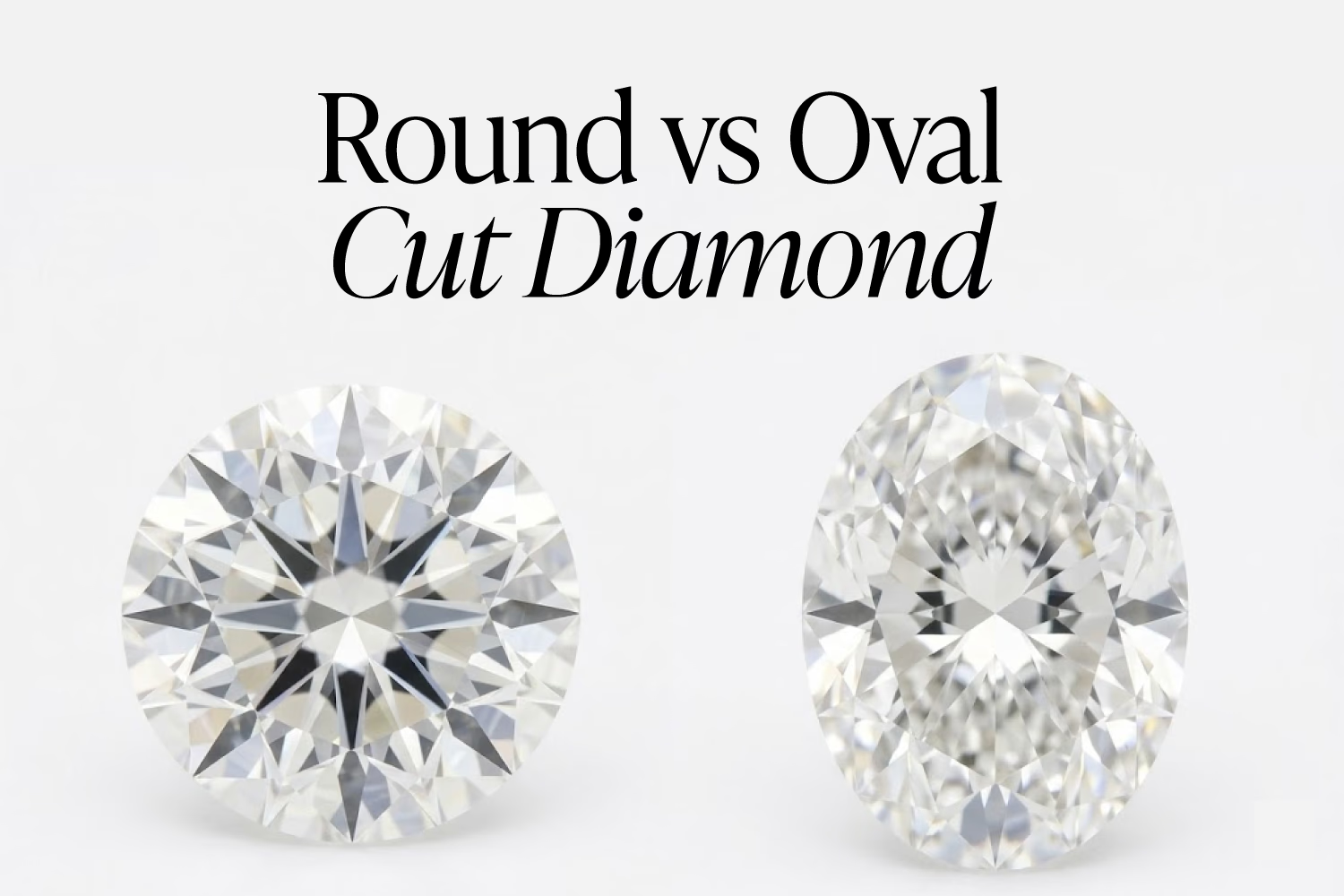
- Round wins on sparkle. The 57-facet brilliant cut was mathematically optimized for maximum light return. Oval is built on the same facet blueprint but the elongated shape creates two dark zones — the bow-tie — that no amount of cutting can fully eliminate
- Oval wins on apparent size. A 1ct oval looks 10–15% larger face-up than a 1ct round due to elongation. This is real. It is also the basis of the Oval Illusion that tricks buyers into thinking they are getting "more diamond"
- Oval is 15–25% cheaper than round at identical carat, color, clarity, and cut. For budget-conscious buyers, this is meaningful
- The Bow-Tie Penalty affects over 50% of all oval diamonds to some visible degree. GIA does not grade it. Retailers don't mention it. You will not see it in photos. You will see it in person
- Resale reality: natural round holds 40–50% of retail. Natural oval holds 25–35%. The thinner resale market for fancy shapes is real
- My verdict: buy round if cut performance and long-term value matter. Buy oval if apparent size matters more than optical perfection and you are treating this as a wear-only purchase


The Verdict Nobody Wants to Give
I have been writing diamond buying guides for years and I am tired of the "round vs oval: both are beautiful, it's personal preference!" articles. That answer is useless to a buyer standing in front of two diamonds with a $5,000 budget.
I am Farzana Hasan, GIA-certified diamond expert and the author of the round cut diamond buying guide at Diamond Critics. I have examined hundreds of oval and round brilliant diamonds side by side. I have a clear view on which shape delivers more value for most buyers and why — and I will give it to you directly.
The short version: round brilliants are objectively superior on every technical metric. Ovals have one advantage (apparent size per carat) and several disadvantages that most oval-enthusiast content deliberately downplays. Whether those disadvantages matter to you is a personal call — but you should make it with full information, not on the basis of Instagram trends.
The Sparkle Test: Why Round Wins Optically
The round brilliant cut has 57–58 facets arranged according to Marcel Tolkowsky's 1919 mathematical model, specifically calculated to maximize light entry, internal reflection, and light exit through the table. It is the only diamond shape where every facet has been mathematically optimized for a single purpose: return as much light to the viewer's eye as possible.
The oval brilliant uses the same 57-facet blueprint — it is essentially a round brilliant stretched into an ellipse. This creates a fundamental optical problem that the round's circular symmetry avoids entirely.
When light enters an oval from the sides, the steep angle of the long-axis pavilion facets causes some of that light to exit through the bottom of the stone rather than reflecting back to the top. The result: two dark, roughly triangular zones across the widest point of the oval — perpendicular to the long axis. This is the bow-tie effect. It varies in severity from nearly invisible to grotesquely dark, and the GIA grading report contains exactly zero information about it.

A round brilliant Excellent cut returns approximately 95% of entering light. A top-quality oval with minimal bow-tie — the best you will find — returns approximately 80–85%. That 10–15% difference is visible. Put a GIA Excellent round and a well-cut oval side by side under a restaurant's pendant lighting. The round will visibly outperform.
Does this mean oval diamonds look bad? No. Ovals are stunning. But they do not sparkle like rounds, and any article that tells you otherwise is either inexperienced or dishonest.
The Oval Illusion: When "Bigger" Is Misleading
This is the oval diamond's strongest selling point, and it is genuinely real — to a point.
A 1ct oval diamond has a face-up surface area of approximately 8.0 × 5.5mm (for a standard 1.45:1 length-to-width ratio). A 1ct round has a diameter of 6.4–6.5mm and a face-up area of approximately 33mm². The oval's face-up area is approximately 34–36mm² — roughly 8–10% more visible surface area than the round.
That is real. It is not a trick. An oval does use its carat weight more efficiently in terms of face-up coverage because the material is spread across a larger visible footprint.

Here is where the oval illusion goes wrong: buyers interpret "larger apparent size" as "better value" — and then they overspend on carat weight they do not need.
The pitch goes like this: "Get a 1ct oval instead of a 1ct round — it looks like a 1.15ct round!" So the buyer buys the 1ct oval. Then they see a 1.15ct round and think they need to match it. So they buy a 1.25ct oval. And so on. The "looks bigger" feature becomes a treadmill of carat upgrades rather than a saving.
The actual value equation: a 1ct oval at $2,800 vs a 0.90ct round at $2,400–$2,560. The 0.90ct round looks effectively the same size as the 1ct oval (both approximately 6.3mm at their narrowest visible width) and costs less. This is not an oval advantage — this is the Magic Carat Trap in a different form.
The Bow-Tie Penalty: The Problem Nobody Mentions in Oval Reviews
I will say this plainly: the bow-tie effect is the single biggest quality variable in oval diamonds, and most oval diamond content completely ignores it.
The bow-tie is two dark, shadow-like zones across the widest part of an oval diamond when viewed face-up. It forms because the pavilion facets at the oval's widest point are angled too steeply relative to the table for those specific facets to reflect light back to the viewer's eye — instead, they reflect the dark void of the viewer's head or the dark environment above the diamond.
Every oval has some degree of bow-tie. The only variable is severity:
| Bow-Tie Severity | Appearance | % of Ovals | Buyer Risk |
|---|---|---|---|
| Minimal | Faint shadow, only visible at certain angles | ~20% of ovals | Low — acceptable in person |
| Moderate | Clearly visible dark band across center | ~35% of ovals | Medium — visible in most lighting |
| Strong | Dominant dark cross, immediately obvious | ~30% of ovals | High — severely impacts appearance |
| Severe | Stone appears half-dark | ~15% of ovals | Reject immediately |
The numbers above are based on industry observation, not a GIA study — GIA does not grade oval bow-tie. This is precisely the problem.
You cannot see bow-tie severity in a diamond photo. Photography setups for product images typically use diffuse, directional lighting that fills in the bow-tie. The stone looks clean. You buy it. It arrives and under overhead office lighting or a restaurant spotlight, you see a dark band across the middle.
You can only evaluate bow-tie in a 360° video or in person.
This is not a hypothetical problem. On Blue Nile, approximately 50–60% of oval diamonds in the moderate-to-strong bow-tie range will still carry GIA "Excellent" symmetry grades — because GIA's oval grading evaluates symmetry and polish, not optical performance. An oval with a severe bow-tie can legitimately receive an Excellent grade.
If you are buying an oval diamond, watch the 360° video on Blue Nile for every stone you consider. Rotate it slowly. If you see a dark band across the center at any rotation angle, that stone has a visible bow-tie. Move to the next one.
Search oval diamonds at Blue Nile with 360° video →
Price Comparison: Live Round Diamond Data vs Oval Ranges
At identical quality specs — GIA Excellent cut, G color, VS1 clarity, 1.00ct — an oval diamond costs approximately 15–25% less than a round brilliant. That gap is real. Here is what it looks like using actual round prices from Blue Nile right now:
Live 1ct G-VS1 Excellent Round Diamond Prices (Blue Nile, May 2026):
| GIA # | Round Price | Equivalent Oval Range | You Save |
|---|---|---|---|
| 28915027 | $3,200 | $2,400–$2,700 oval | $500–$800 |
| 28241353 | $3,260 | $2,445–$2,770 oval | $490–$815 |
| 28823788 | $3,290 | $2,467–$2,796 oval | $494–$823 |
| 26537632 | $3,430 | $2,572–$2,915 oval | $515–$858 |
| 27742362 | $3,580 | $2,685–$3,043 oval | $537–$895 |
| 28861257 | $3,840 | $2,880–$3,264 oval | $576–$960 |
That saving is real money. Here is what it buys you:
- Keep the budget the same: take the $500–$800 saving and spend it on a better ring setting — a half-pavé band or hidden halo that upgrades the ring without touching the stone budget
- Use the saving on carat: the $3,200 round budget buys a 1.20–1.30ct oval at the same quality tier — genuinely larger face-up than a 1ct round
If you are considering G-VVS2 round territory, the price gap widens. The G-VVS2 round entry at $3,760 competes against a 1.25–1.35ct oval at the same price — an oval that looks dramatically larger.
The price gap exists for two reasons: round brilliants create more rough crystal waste during cutting (50–55% of the rough is lost vs 40–45% for oval), and round brilliants have higher demand — roughly 50% of all engagement ring center stones are round vs about 25% oval.
The Trend Premium: oval prices rose 15–20% from 2022 to 2024 on the back of celebrity engagements. That premium has partially normalized in 2026, but ovals are no longer the bargain they were in 2020. The discount over round has narrowed from 30–35% to 15–25%.
Search current oval diamonds at Blue Nile →
Tides Of Summer Capsule
Up To 30% Off
Shop The Sale →Vault ClearanceClear The Vault
Up To 70% Off
Shop Vault Deals →Affiliate link — no extra cost to you
Resale Reality: The Number That Changes Everything
If you plan to hold a diamond as an asset — even loosely — the resale market is part of the calculation.
Natural round brilliant diamonds sell on the resale market at 40–50% of original retail in good condition with GIA certificate. This is because round brilliants are the most liquid diamond shape: every jeweler, estate dealer, and private buyer knows what they are and wants them.
Natural oval diamonds sell at 25–35% of original retail. The market is thinner. Fancy shapes are harder to resell because buyers want to see them in person and the demand is more trend-dependent. The 2022–2024 oval premium means that buyers who paid at the top of the trend are now sitting on stones that cost them 20% more to buy than current market value.
For a $3,200 round diamond purchase: resale floor is approximately $1,280–$1,600. For a $2,700 oval diamond purchase: resale floor is approximately $675–$945.
The oval is cheaper to buy AND cheaper to resell. These are not fully offsetting — the oval buyer genuinely gets less resale value in both absolute and percentage terms.
If resale does not matter to you — if this is purely a purchase for the joy of wearing it — then ignore this section entirely. Most engagement ring buyers should ignore it. But for buyers who think of diamonds as having any investment dimension, the round/oval resale gap is significant.
The Definitive Buying Decision Guide
Here is the honest framework. Not "it depends on personal style." The actual decision criteria:
Buy a round brilliant if:
- Maximum sparkle is the priority — rounds genuinely and measurably outperform ovals on optical performance
- You are in a pavé or solitaire setting where the center stone is the visual focus
- Long-term resale value or liquidity matters at all
- You want GIA cut grading that means something — round Excellent has a defined proportion range; oval "Excellent" is primarily symmetry
Buy an oval if:
- Apparent face-up size per budget is the priority and you have confirmed minimal bow-tie through 360° video
- You prefer an elongated finger-slimming effect on the hand (ovals do elongate the finger visually — this is a real and valid preference)
- You are setting in a halo where the halo's small diamonds will minimize the bow-tie effect by filling the visual periphery
- Budget is fixed and you want maximum size at that budget
For a complete oval buying guide with full proportion data, see the oval cut diamond guide.
Do not buy an oval if:
- You have not watched the 360° video for that specific stone and confirmed minimal bow-tie
- You are making the decision based on photos alone
- Your primary stated reason is "it looks bigger" — get the 0.90ct round instead at $400 less and accept the 0.3mm difference
Search round brilliant diamonds at Blue Nile →
Frequently Asked Questions: Round Diamond vs Oval Diamond
Is round or oval diamond better?
Round brilliant diamonds are technically superior on optical performance — they return more light, sparkle more consistently, and receive objective GIA cut grading. Oval diamonds have one genuine advantage: apparent face-up size per carat. For buyers who prioritize sparkle and long-term value, round is better. For buyers who prioritize apparent size and are willing to invest time screening for minimal bow-tie, oval is a legitimate choice.
Why does oval diamond look bigger than round?
An oval diamond's elongated shape spreads carat weight across a larger face-up surface area. A 1ct oval (approximately 8.0 × 5.5mm) has 8–10% more face-up surface area than a 1ct round (6.4mm diameter). The elongation also creates an illusion of greater length when viewed on the finger, which makes the stone appear larger than its carat weight.
Does oval diamond sparkle as much as round diamond?
No. The round brilliant returns approximately 95% of entering light. The best-cut ovals return approximately 80–85%. Additionally, ovals have bow-tie extinction zones — dark areas at the widest point — that reduce sparkle in those regions. In side-by-side comparison, a well-cut round visibly outperforms a well-cut oval on scintillation, especially under point-source lighting like pendants or candles.
What is the bow-tie effect in an oval diamond?
The bow-tie is a dark, bowtie-shaped shadow visible across the widest section of an oval diamond when viewed face-up. It forms because the pavilion facets at the oval's longest midpoint cannot redirect light back to the viewer's eye at those specific angles — the light escapes through the bottom. Every oval has some bow-tie; the question is severity. Moderate-to-severe bow-ties affect over 50% of oval diamonds sold and are invisible in photos but obvious in person.
Is oval cheaper than round diamond?
At identical carat, color, clarity, and cut grade, ovals are typically 15–25% cheaper than round brilliants. The saving exists because round brilliants have higher demand and create more rough crystal waste during cutting. A 1ct G-VS1 Excellent round runs $3,200; a comparable oval runs $2,400–$2,700 on Blue Nile in 2026.
Do oval diamonds hold their value as well as round?
No. Natural round brilliants resell at 40–50% of original retail — the highest resale rate of any diamond shape because they are the most liquid on the secondary market. Natural ovals resell at 25–35% of retail. The thinner market for fancy shapes, combined with trend-driven price fluctuations (oval prices surged 15–20% in 2022–2024 and have partially corrected), makes ovals less reliable as value stores.
Which is more popular, round or oval diamond in 2026?
Round brilliants represent approximately 50% of all engagement ring center stones sold in 2026. Ovals have grown from about 8% market share in 2019 to approximately 25% in 2026, driven by social media exposure and celebrity engagement announcements. Round remains dominant; oval is the fastest-growing fancy shape.
Are oval diamonds going out of style?
Oval diamonds had a significant trend surge from 2022 to 2024. In 2026, oval demand has plateaued at roughly 25% market share — it is no longer growing rapidly but is not disappearing. The risk of trend-driven purchases is that resale values can compress further if demand falls. Round brilliants have been the dominant shape since the 1920s and show no structural trend toward decline.
What length-to-width ratio should I get for an oval diamond?
The standard recommendation is 1.35:1 to 1.50:1. This produces an oval that reads as clearly elongated without looking too narrow. Ratios below 1.30:1 look squat and nearly round. Ratios above 1.60:1 look extremely elongated and finger-like. At 1.40:1–1.50:1 the oval has the best combination of elongation effect and symmetry, and this range tends to produce the most manageable bow-tie severity.
Should I buy round or oval for an engagement ring?
For an engagement ring that will be worn daily for decades, I recommend round brilliant for most buyers. The optical performance advantage is permanent and consistently visible in daily lighting conditions. The resale liquidity is higher. The GIA cut grade is objective and comparable across stones. Choose oval if the finger-slimming elongation effect is important to your partner, or if you have a firm budget and confirmed a minimal bow-tie stone through 360° video review.
Can I see the bow-tie effect in a diamond photo?
No. Product photography setups use diffuse or fill lighting that eliminates bow-tie visibility. The stone looks clean in the listing photo. You must watch the 360° video available on Blue Nile for each stone — rotating slowly and watching the center of the stone for dark zones at any angle. In person, view the stone under a standard store spotlight before purchasing.
What setting is best for an oval diamond to minimize the bow-tie?
A four-prong or six-prong bezel-adjacent setting with a halo of small pavé diamonds is the most effective approach. The halo's surrounding brilliance draws the eye outward and reduces the perceptual contrast of the bow-tie. Additionally, east-west settings (oval set perpendicular to the finger) partially redistribute where the bow-tie falls relative to the viewer and can make it less prominent. However, no setting eliminates a severe bow-tie — the stone quality itself determines the severity.
Is a 1 carat oval as big as a 1.2 carat round?
A 1ct oval (approximately 8.0 × 5.5mm) has similar face-up area to a 1.10–1.15ct round (approximately 6.6–6.7mm diameter). It is not quite equivalent to a 1.2ct round (approximately 6.8mm). The "oval looks like a larger round" comparison is genuine at roughly a 10–15% carat advantage, not the 20–25% some oval retailers advertise.
Which diamond shape is best for small hands?
Oval diamonds are genuinely flattering on smaller hands due to the elongation effect — the lengthwise orientation of the stone along the finger creates a finger-slimming illusion. Round brilliants are equally flattering on small hands due to their proportional symmetry — neither extends dramatically in any direction. Both work well. Pear and marquise shapes provide the maximum elongation effect if that is the specific goal.
What are the ideal proportions for an oval diamond?
- Length-to-width ratio: 1.35:1 to 1.50:1
- Table percentage: 53–63%
- Depth percentage: 59–65%
- Polish: Good to Excellent
- Symmetry: Very Good to Excellent
- Avoid depth below 59% (fish-eye effect) or above 68% (dark, heavy-looking stone)
Note: GIA does not provide an "Excellent" cut grade for ovals the way it does for rounds. The "Excellent" label on an oval refers to symmetry only — it does not confirm ideal proportions for light performance.
Where do I buy the best oval or round diamond?
Blue Nile carries 360° video for most stones, full GIA grading data, and a 30-day return policy. For oval diamonds specifically, the 360° video is essential — use it to screen for bow-tie before buying. Search all diamond shapes at Blue Nile →
The Verdict
Round diamond wins objectively on optical performance, GIA grading transparency, and long-term resale value.
Oval wins on apparent size per dollar and finger elongation.
If you want the best-looking diamond for the price, and you are willing to accept a 15–25% price premium for that performance advantage, buy round. A 1ct G-VS1 GIA Excellent round at $3,200 is one of the best diamond purchases in the market.
If you want more apparent size at a fixed budget and you have done the work of confirming a minimal bow-tie stone through 360° video, oval is a legitimate and beautiful choice.
What is not a good reason to buy oval: because it "looks bigger" without verifying the bow-tie, or because you saw it on Instagram, or because a jeweler told you it was a "better value" — check their oval margins before accepting that claim.
For the complete technical foundation behind why round brilliants perform the way they do, read the round cut diamond guide. The 57-facet science behind the Cut Dividend is explained in full there.
Browse current deals at Blue Nile →
See Also
Expert Verdict
Always audit the stone individually — no grade replaces seeing the actual diamond. The certificate tells you what to look for. Your eyes tell you whether to buy.
— Farzana Hasan, GIA Expert · DiamondCritics.com