Round Diamond Crown Angle in 2026: The Scintillation Gate Explained


TL;DR: Round Diamond Crown Angle — Key Facts
- Crown angle measures the angle between the bezel facets and the girdle plane — on a round brilliant, this is the ring of triangular facets that surround the flat table at the top
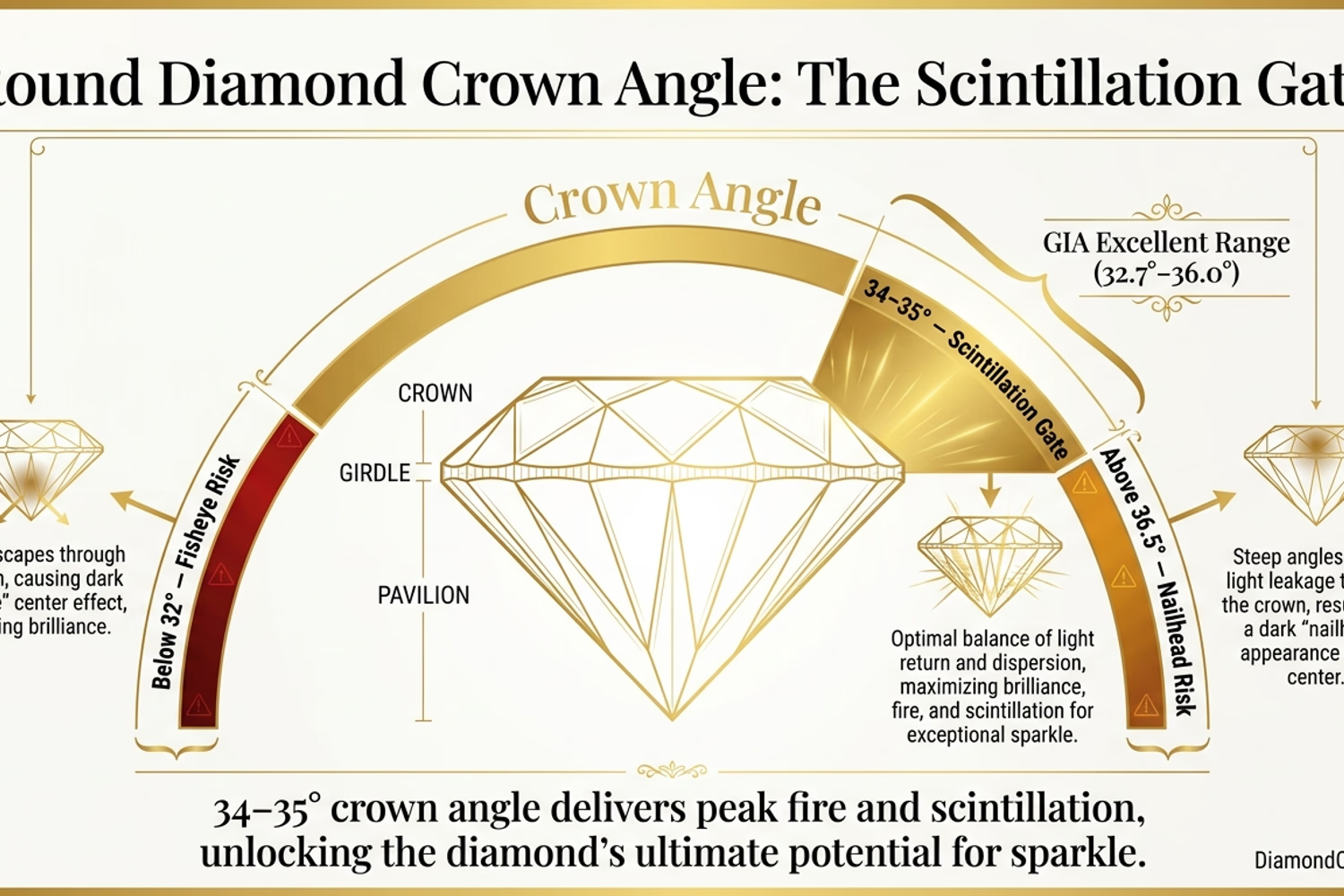
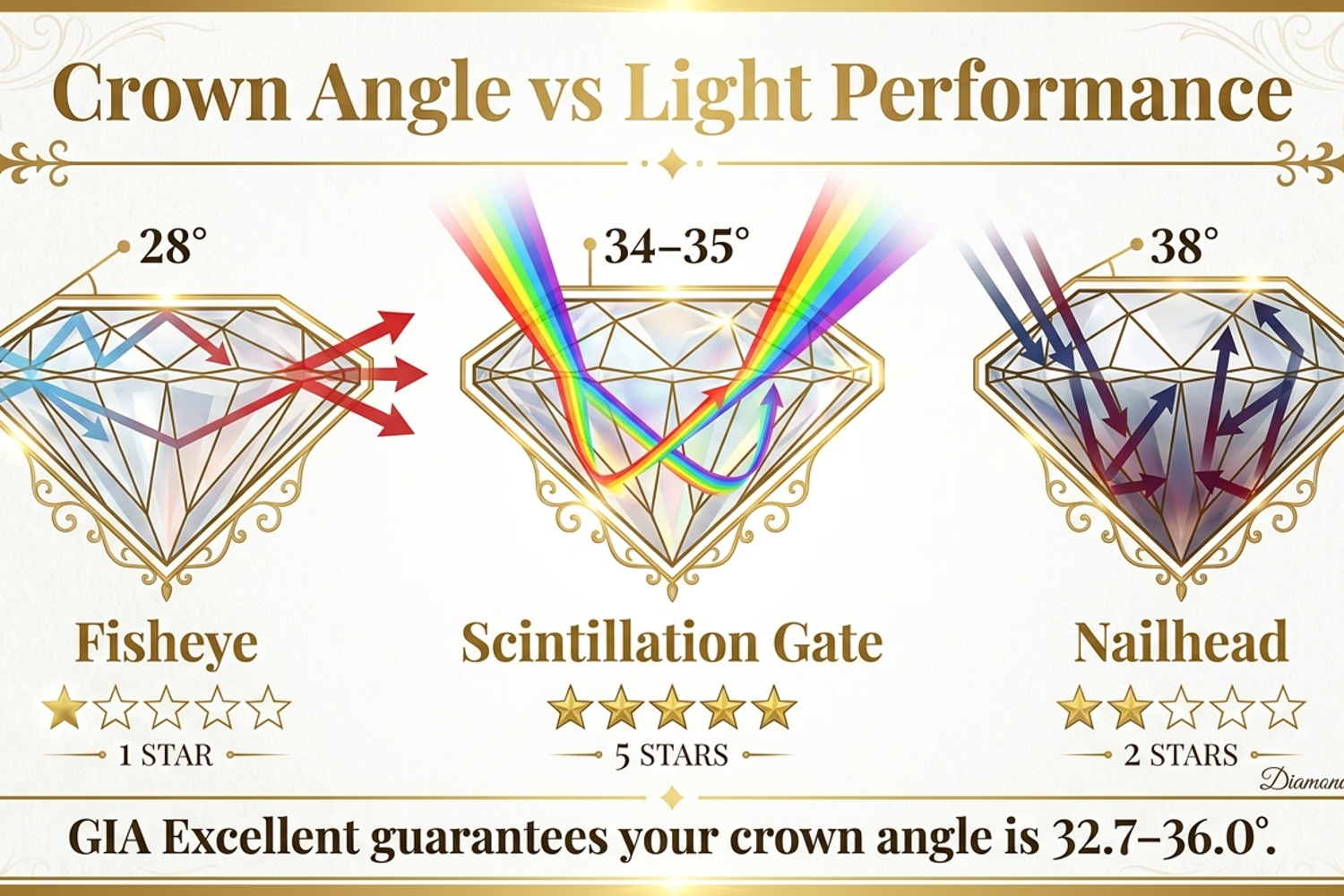
- GIA Excellent crown angle range: 32.7–36.0° — any stone with GIA Excellent cut falls within this verified range; you do not need to check manually if the certificate says Excellent
- The Scintillation Gate: 34–35° is the optimal sub-range within GIA Excellent where fire (rainbow colored flashes) and scintillation (on/off sparkle) peak simultaneously
- Crown below 32°: fisheye effect — a dark ring visible through the table when you look at the stone face-up; caused by light exiting through the girdle instead of reflecting back up
- Crown above 36.5°: nailhead effect — a dark circle in the center of the table; light cannot exit the crown efficiently and reflects back into the pavilion
- Buying rule: GIA Excellent cut handles crown angle verification for you; if you are buying GIA Very Good, request the certificate's crown angle measurement and check it falls in the 33–36° range
Crown angle is one of the most technically discussed parameters in round diamond proportions — and one of the least understood by buyers. This guide explains what crown angle does to a diamond's optical performance, what the GIA Excellent standard actually guarantees, and how to evaluate crown angle on any GIA certificate.
What Is Crown Angle?
A round brilliant diamond has three main sections:
- The table — the large flat octagonal facet at the top
- The crown — the sloped section between the table and the girdle
- The pavilion — the cone-shaped lower half that extends to the culet
Crown angle is the angle between the crown's main facets (called bezel facets) and the imaginary horizontal plane of the girdle. If you hold a diamond with the girdle horizontal and measure the slope of the bezel facets upward to the table, you are measuring the crown angle.
On a standard round brilliant with 57 facets, there are 8 bezel facets on the crown that share this same angle. GIA measures crown angle from all 8 positions and reports an average on the diamond grading report.
What Crown Angle Does to Light Performance
Crown angle controls the balance between two optical phenomena:
Fire (dispersion): White light entering the diamond through the crown breaks into spectral colors — red, orange, yellow, green, blue, violet — creating the rainbow flash effect. Higher crown angles (steeper crown slope) increase the path length light travels through the diamond, which increases fire. Too high an angle and light leakage from the pavilion reduces overall brightness.
Brilliance: White light return — the overall brightness of the stone. Lower crown angles allow more light to enter the crown and return efficiently. Too low an angle and light exits through the girdle rather than returning through the table (fisheye).
The Scintillation Gate (34–35°) is where fire and brilliance are optimally balanced. At 34–35°, the crown slope is steep enough to create strong fire (rainbow flashes in motion) while still allowing efficient light return for overall brightness. Stones in this range have the characteristic "sparkle plus color play" that makes round brilliants visually exceptional.
The GIA Excellent Cut Standard and Crown Angle
When a round diamond receives GIA Excellent cut, crown angle is part of a comprehensive assessment covering 57 proportion measurements. The GIA Excellent range for crown angle is 32.7–36.0°.
This means:
| Crown Angle | GIA Assessment |
|---|---|
| < 30° | Cannot be Excellent (fisheye risk) |
| 30.0–32.6° | GIA Good or Very Good |
| 32.7–36.0° | GIA Excellent (verified range) |
| 36.1–38.0° | GIA Very Good |
| > 38° | GIA Good or below |
If a round diamond has GIA Excellent cut, its crown angle has already been measured and confirmed to fall between 32.7° and 36.0°. You do not need to independently verify this — GIA has done it.
The practical implication: always buy GIA Excellent for round brilliants. The Excellent grade is your guarantee that crown angle, together with table percentage, pavilion angle, depth, girdle, and polish, all meet the verified standard for maximum light performance.
Examples of GIA Excellent round diamonds where all proportions including crown angle are confirmed:
- GIA 1ct G-VS2 Excellent at $3,390
- GIA 1ct G-VS2 Excellent at $3,410
- GIA 1ct G-VS1 Excellent at $3,620
- GIA 1ct G-VS2 Excellent at $3,610
All four stones carry GIA Excellent cut — their crown angles are confirmed within the 32.7–36.0° range. You are not guessing. You are buying a verified measurement.
The Scintillation Gate: Why 34–35° Is Optimal Within Excellent
Within the GIA Excellent 32.7–36.0° crown angle range, is there a preferred sub-range?
Yes, and it matters most for buyers who care deeply about fire — the rainbow color play that makes round brilliants distinctive from any other shape.
The Scintillation Gate is 34–35°. At this specific range:
- Fire generation is near-maximum for the round brilliant geometry
- White light return (brilliance) remains strong
- On/off scintillation — the flashing sparkle visible as the stone moves — peaks
Below 34° within the Excellent range (32.7–33.9°), the stone produces excellent brilliance but somewhat less fire. These stones can appear very bright and slightly "icy" — white sparkle with less rainbow color play.
Above 35° within the Excellent range (35.1–36.0°), fire increases slightly further but at a very slight cost to brilliance. These stones can appear slightly warmer and more colorful in diffuse lighting.
The 34–35° range is where both effects simultaneously peak. This sub-range within GIA Excellent produces the stones that are often described as having "exceptional fire" by experienced buyers.
How to check crown angle on your GIA certificate:
The GIA Grading Report (full report, not the Dossier) lists crown angle in the "Proportions" section. It appears as a number like "34.5°" in the detailed proportions diagram. If you have a GIA Dossier (abbreviated certificate), crown angle may not be listed — request the full report for any stone above 1ct where proportions matter significantly.
The Fisheye Effect: When Crown Is Too Low
A crown angle below 32° on a round brilliant causes the fisheye effect. This is a distinct optical defect:
What it looks like: When you hold the diamond face-up in front of a white ceiling or neutral background, a dark ring appears just inside the perimeter of the stone, visible through the table. In severe cases, the girdle reflection is visible as a complete dark circle.
Why it happens: With a very flat crown (low crown angle), the pavilion's reflective cone is positioned too close to horizontal. Light entering through the table reflects off the pavilion facets and exits through the girdle instead of returning back through the table to the viewer's eye. The result: the table looks bright at center but shows a dark annular ring where the girdle reflection should be invisible.
How to spot it: In a face-up photo or video, look for a visible ring or penumbra inside the outer edge of the stone. In person, holding the stone at arm's length and looking through the table toward a bright ceiling is the standard test.
No GIA Excellent round diamond can have a fisheye — the crown angle range prevents it. The fisheye risk is specific to:
- GIA Fair or Poor cut rounds
- Older pre-GIA-standard cuts (Old European, Old Mine)
- Uncertified diamonds
- Fancy cuts without cut grade standards
The Nailhead Effect: When Crown Is Too High
The opposite extreme — crown angles above 36–38° — creates the nailhead effect:
What it looks like: A dark circle or dark spot visible in the center of the diamond when viewed face-up. The center of the table appears dead or dim relative to the surrounding crown facets.
Why it happens: With a very steep crown, the pavilion angle required to return light through the crown becomes geometrically constrained. Light that enters the table travels a longer path through the crown and hits the pavilion at angles that reflect back into the stone rather than up through the table. The center table goes dark.
Like the fisheye, the nailhead is not possible in a GIA Excellent round diamond. The nailhead risk appears in:
- GIA Fair or Poor cut rounds
- Very deeply cut stones (depth above 65%)
- Poorly proportioned fancy cuts
Crown Angle and Table Percentage: They Work Together
Crown angle does not operate in isolation — it interacts directly with table percentage. This is the foundation of the AGS/GIA proportional interaction model for round brilliants.
The relationship: higher crown angle compensates for a larger table; lower crown angle requires a smaller table to maintain fire.
| Crown Angle | Optimal Table % | Effect |
|---|---|---|
| 33° | 53–55% | High fire, reduced table |
| 34° | 54–57% | Balanced fire and brilliance |
| 35° | 55–58% | Slight fire lean |
| 36° | 56–59% | More brilliance, less fire |
This is why GIA evaluates crown angle and table percentage together rather than independently. A 35° crown with a 58% table is within the Excellent standard and produces excellent performance. A 35° crown with a 62% table — where table size has exceeded the range — produces a different light pattern. The GIA Excellent cut standard accounts for all these interactions.
The Table Percentage guide covers this in more detail — see the Round Diamond Table Percentage post for the full interaction analysis.
Tides Of Summer Capsule
Up To 30% Off
Shop The Sale →Vault ClearanceClear The Vault
Up To 70% Off
Shop Vault Deals →Affiliate link — no extra cost to you
Crown Angle on Lab-Grown Round Diamonds
Crown angle behaves identically in lab-grown and natural round diamonds. The physics of light propagation does not distinguish between geological origin. A lab-grown GIA Excellent round diamond has its crown angle verified to the same 32.7–36.0° standard as a natural GIA Excellent round.
For buyers considering lab-grown options:
- IGI 1.5ct D-VVS1 Lab-Grown Excellent at $1,930 — IGI Excellent cut, crown angle within IGI's Excellent range
- IGI 2ct D-FL Lab-Grown Excellent at $5,190 — IGI Excellent cut with D-FL grading
IGI's "Excellent" cut standard for lab-grown round diamonds uses similar but not identical proportion thresholds to GIA. The IGI Excellent range for crown angle runs approximately 33.0–35.5°, slightly tighter than GIA's 32.7–36.0°. In practice, IGI Excellent lab-grown rounds perform comparably to GIA Excellent natural rounds.
GIA Very Good: When Is It Acceptable?
GIA Very Good cut falls just outside the Excellent range on at least one measurement. For crown angle, Very Good stones can have crown angles from approximately 30.0–32.6° or 36.1–38.0°. If you are considering a GIA Very Good round to save 10–15% versus Excellent:
- Request the full GIA report (not the Dossier) and check the crown angle number
- Target 33.0–35.5° even within the Very Good designation
- Check table percentage simultaneously (target 54–58%)
- A Very Good stone with crown 33–35° and table 55–57% will perform nearly identically to Excellent; avoid Very Good stones outside these ranges
For 2ct+ purchases, GIA Very Good is a reasonable cost optimization if the specific certificate confirms the crown angle is in the 33–35° range:
- GIA 2ct G-VS1 Excellent at $22,460 — full Excellent certification, no crown angle guesswork
- GIA 2ct E-VVS2 Excellent at $22,460 — same price, higher color/clarity combination
At these price points, the incremental cost of GIA Excellent versus Very Good is typically $1,500–$3,000. I buy Excellent and eliminate the review work entirely.
Farzana's Verdict: Crown angle matters enormously for the optical character of a round diamond — but you do not need to become a proportions engineer to buy correctly. The GIA Excellent cut standard handles crown angle verification for you. Buy GIA Excellent on every round brilliant above 0.5ct, and you have a stone with a confirmed crown angle between 32.7° and 36.0°. If you want to optimize within Excellent — if fire matters to you and you want The Scintillation Gate — request the full GIA report and check that the crown angle sits in the 34–35° range. That one number, confirmed on the certificate, is the difference between a round diamond that produces exceptional rainbow fire and one that produces merely good performance.
Frequently Asked Questions
What is crown angle on a round diamond?
Crown angle is the angle between the upper bezel facets and the horizontal plane of the girdle on a round brilliant diamond. It measures how steeply the crown section slopes from the girdle up to the flat table. GIA measures and reports this angle on grading reports. The crown angle affects how light enters and exits the diamond, directly influencing fire (rainbow color flashes) and brilliance (white light return).
What is the best crown angle for a round diamond?
34–35° is The Scintillation Gate — the optimal sub-range within GIA Excellent where fire and scintillation simultaneously peak. GIA Excellent accepts 32.7–36.0°; all stones in this range perform very well. For maximum fire, target 34–35° specifically by checking the full GIA report proportions section.
Does GIA Excellent guarantee a good crown angle?
Yes. GIA Excellent cut certifies that crown angle falls between 32.7° and 36.0° as part of 57 verified measurements. If your round diamond has GIA Excellent cut, the crown angle meets the standard and you do not need to manually verify it. This is one of the core reasons GIA Excellent is the only recommended cut grade for round brilliants.
What happens if crown angle is too low?
Below 32°, the fisheye effect appears: a dark ring visible through the table when the stone is viewed face-up against a white background. Light exits through the girdle instead of reflecting back through the table. No GIA Excellent round diamond can have this defect — the crown angle range prevents it.
What happens if crown angle is too high?
Above 36.5–38°, the nailhead effect appears: a dark spot in the center of the table. The steep crown geometry cannot return light efficiently through the table facet. Like fisheye, nailhead cannot occur in a GIA Excellent round diamond.
How do I check crown angle on a GIA certificate?
On a full GIA Grading Report (not the abbreviated Dossier), find the "Proportions" section. Crown angle is listed as a number in degrees, typically in the range 32–37° for Excellent and Very Good grades. If you have a GIA Dossier, call your retailer and request the detailed proportions data from the GIA report number — it is available through GIA's online report check system.
Does crown angle affect how a round diamond sparkles?
Yes. Higher crown angles (34–36°) produce more fire — the rainbow color play visible as the stone moves. Lower crown angles (32–34°) produce more brilliance — white light return and overall brightness. The 34–35° range balances both effects. Buyers who describe a round diamond as having "exceptional fire" are often responding to a stone with a crown angle in this optimal range.
Is crown angle different for lab-grown diamonds?
No. Crown angle is a physical measurement of a diamond's facet geometry — it is identical for lab-grown and natural round diamonds of the same proportions. A GIA Excellent lab-grown round has its crown angle verified to the same standard as a GIA Excellent natural round.
Does crown angle matter more at larger carat sizes?
Yes. At 2ct and above, crown angle has a more visible effect because the larger face-up area amplifies optical characteristics. A 1ct stone with a sub-optimal 36.5° crown angle may look excellent to most eyes. A 3ct stone with the same angle will show noticeably less fire than one at 34–35°. At 2ct+, reviewing the specific crown angle on the GIA report is worthwhile even for GIA Excellent stones.
What is the relationship between crown angle and table size?
Crown angle and table percentage work together — a larger table requires a steeper crown angle to maintain fire. GIA evaluates these measurements as a system, not independently. A 57% table with 35° crown is Excellent. The same 57% table with 32° crown may fall outside Excellent because the lower crown angle cannot generate sufficient fire for the larger table opening.
Should I buy GIA Very Good to save money on crown angle?
Only if you check the specific crown angle on the certificate first. GIA Very Good includes stones with crown angles from 30° to 32.6° (below Excellent minimum) or 36.1° to 38° (above Excellent maximum). Within the Very Good range, stones with crown angles of 33–35° perform nearly identically to Excellent. Stones with Very Good crowns at 30–32° or 37–38° perform noticeably differently. Request the full certificate and check the number before buying Very Good.
See Also
Expert Verdict
Always audit the stone individually — no grade replaces seeing the actual diamond. The certificate tells you what to look for. Your eyes tell you whether to buy.
— Farzana Hasan, GIA Expert · DiamondCritics.com