Round Diamond Culet in 2026: Why No Culet or Pointed Wins Every Time


TL;DR: Round Diamond Culet — The Short Version
- None or Pointed is the only correct answer for culet grade: GIA Excellent cut requires None or Pointed; any culet from Small upward begins to compromise face-up appearance
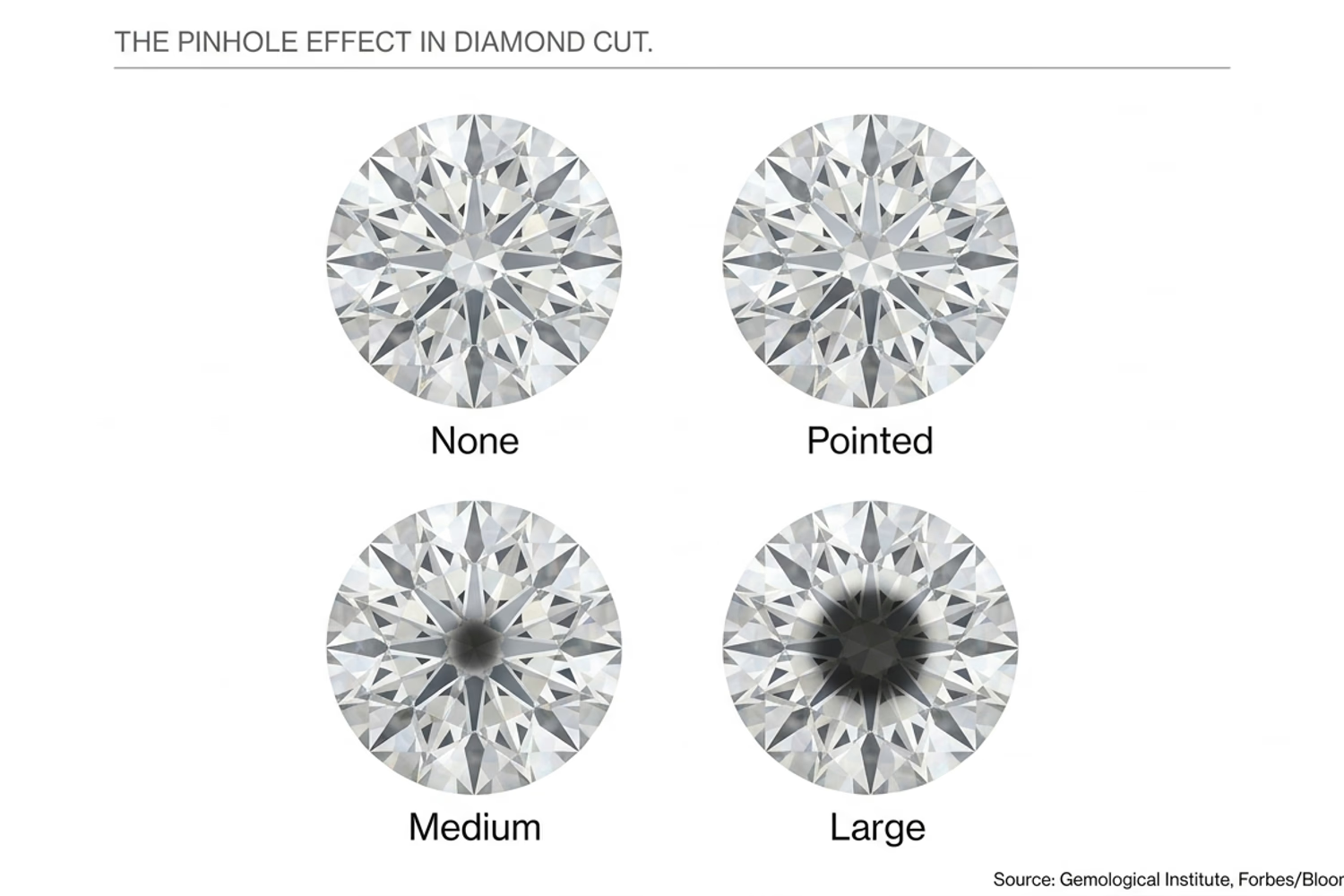
- The Pinhole Effect: a Medium or larger culet creates a visible dark circle at the center of the stone when viewed face-up — like looking down a dark pipe — because the flat facet at the bottom reflects no light back to the viewer
- GIA Excellent mandates None or Pointed: any stone with a Small, Medium, Large, or Very Large culet cannot receive GIA Excellent cut grade regardless of all other parameters
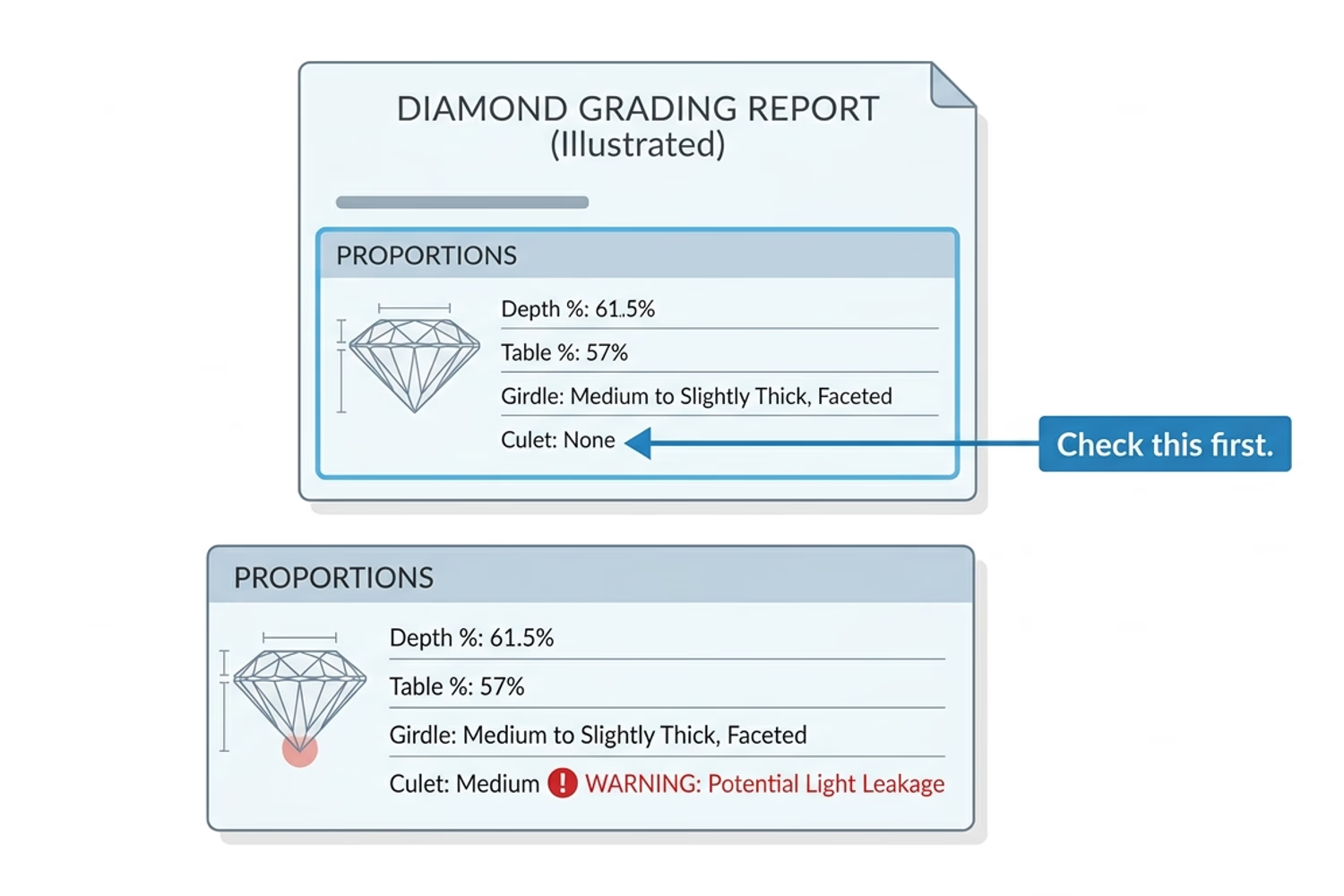
- Culet grade is on the GIA certificate: check the grading report before buying any round diamond — this is one of the few parameters where you can verify everything from the paperwork alone, no video required
- Historical context: large culets were standard practice before modern cutting techniques; most pre-1950 diamonds have open culets; modern rounds have None or Pointed in 95%+ of cases
- Culet does not affect durability: the common belief that a None culet is fragile is a myth for modern rounds; the girdle thickness and prong placement determine chip resistance, not the culet
The culet is the bottom point of a round brilliant diamond. In an ideally cut modern round, it is either absent (graded "None") or present as a single point so small it has no measurable facet diameter (graded "Pointed"). When cutters in earlier eras added a small flat facet to protect the point from chipping, they created The Pinhole Effect: a visible dark circle at the dead center of the stone when viewed face-up. This guide explains what the culet grade means, how to read it on a GIA certificate, and why every modern round diamond should have a None or Pointed culet.
What the Culet Is and Why It Exists
A round brilliant has facets converging at the bottom — the pavilion facets meet at a single point called the culet. In theory, this perfect point concentrates stress. In the cutting era before 1950, diamonds were frequently set in settings without modern prong protection, and the unprotected point could chip if the stone was struck from below. Cutters added a small flat facet — the culet — to distribute that stress across a tiny but measurable surface area.
Modern cutting and setting practices have eliminated the need for this protection. Settings today almost universally have closed backs or prong placements that protect the pavilion. The culet is now an artifact of historical cutting practice, and its presence in a modern round indicates either older cutting origins or poor current practice.
GIA Culet Scale
GIA grades culet on a descriptive scale:
| GIA Culet Grade | Description | Visual Impact |
|---|---|---|
| None | No culet facet; perfect point | No face-up visual artifact |
| Pointed | Technically present but too small to measure | No face-up visual artifact |
| Very Small | Barely measurable flat facet | Visible only under 10x magnification |
| Small | Measurable flat facet | Visible under magnification; faint in face-up |
| Medium | Clearly defined flat facet | The Pinhole Effect begins at normal viewing |
| Large | Prominent flat facet | Dark circle clearly visible face-up |
| Very Large | Dominant flat facet | Severe Pinhole Effect; appears as hollow center |
| Extremely Large | Historical antique proportions | Stone appears to have no culet brilliance |
The Pinhole Effect: What Happens at Medium and Above
When a culet facet reaches Medium size, the geometry of the round brilliant creates a predictable optical failure. The flat facet at the bottom of the stone is aligned parallel to the table. Light that enters through the table and reaches the culet hits a surface that reflects it downward — not back up through the crown to the viewer's eye. The result is a dark circle at the center of the stone, visible face-up at normal viewing distance (12–18 inches).
This is The Pinhole Effect. It is named for its appearance: the center of the stone looks like a hole or a void rather than a bright point of light. In well-lit environments, the culet facet reflects the dark surroundings beneath the stone rather than the bright environment above.
The effect scales with culet size:
- Small: visible under 10x magnification, not visible face-up to naked eye
- Medium: visible face-up to naked eye in good lighting at 12 inches
- Large: obvious face-up at normal viewing distance in any lighting
- Very Large/Extremely Large: dominates the visual center of the stone; the dark circle is often the first thing a viewer notices
Culet on the GIA Certificate: Where to Look
GIA discloses culet grade on every grading report. It appears in the Proportions section, typically below the girdle entry. The entry reads:
Culet: None
or
Culet: Pointed
On GIA's online report verification at gia.edu/report-check, the culet grade is listed under "Additional Grading Information." Any entry other than None or Pointed should cause you to reconsider the purchase.
Unlike many cut parameters, culet requires no video or in-person inspection to verify — the certificate tells you everything you need to know. This makes it one of the easiest quality checks in diamond buying.
Why None Is Better Than Pointed — or Are They the Same?
For practical purposes, None and Pointed are equivalent in visual terms. Both produce zero face-up visual artifact. The distinction:
- None: the pavilion facets meet at a mathematical point; the physical culet has no flat surface
- Pointed: a flat facet exists but is smaller than GIA's minimum measurement threshold; effectively None in visual terms
Both receive the same treatment under GIA's cut grading system — either is consistent with Excellent cut. Neither creates a visible face-up artifact. If you see a GIA certificate showing Pointed, this is not a defect; it is simply the grading terminology for a culet below the measurement threshold.
Price Data: Culet-Verified Stones at 1ct and 2ct
These GIA Excellent stones all carry None or Pointed culet grades.
1ct Range
| Stone | Grade | Price | Culet |
|---|---|---|---|
| GIA 1ct G-VS2 Excellent | G-VS2 | $3,370 | None |
| GIA 1ct G-VS2 Excellent | G-VS2 | $3,390 | None |
| GIA 1ct G-VVS2 Excellent | G-VVS2 | $3,650 | None |
| GIA 1ct G-VVS2 Excellent | G-VVS2 | $3,760 | None |
At 1ct, every GIA Excellent stone in this range carries a None or Pointed culet. The Excellent grade makes this automatic — but it still pays to verify.
2ct Range
| Stone | Grade | Price | Culet |
|---|---|---|---|
| GIA 2ct F-VS2 Excellent | F-VS2 | $18,140 | None |
| GIA 2ct E-VVS2 Excellent | E-VVS2 | $22,460 | None |
| GIA 2ct G-VS1 Excellent | G-VS1 | $22,580 | None |
Lab-Grown
| Stone | Grade | Price | Culet |
|---|---|---|---|
| IGI 1.5ct D-VVS1 Excellent Lab-Grown | D-VVS1 | $1,950 | None |
Lab-grown diamonds follow identical culet standards. IGI Excellent and GIA Excellent round lab-growns both carry None or Pointed culets.
Antique and Vintage Diamonds: Understanding Open Culets
If you are considering an antique round diamond — European cuts from the late 1800s to early 1900s, or transitional cuts from the 1920s–1940s — you will frequently encounter Large or Very Large culet grades. This is not a manufacturing defect; it is the correct cutting practice of its era. These stones were cut before modern faceting techniques eliminated the need for culet protection.
An antique European cut with a Large culet will display The Pinhole Effect visibly. This is accepted and even prized by antique diamond collectors as a characteristic of the cut style. For buyers specifically seeking an Old European Cut (OEC) or similar antique style, a large culet is correct and expected. For buyers seeking modern brilliance and optical performance, these stones should be avoided or evaluated with the Pinhole Effect explicitly acknowledged.
Tides Of Summer Capsule
Up To 30% Off
Shop The Sale →Vault ClearanceClear The Vault
Up To 70% Off
Shop Vault Deals →Affiliate link — no extra cost to you
The Durability Myth: Is a None Culet Fragile?
A widespread belief among buyers is that a None culet creates structural vulnerability — that without the flat facet, the point will chip more easily. This is false for modern rounds set in standard prong settings.
In a four or six-prong setting, the prongs grip the girdle, not the pavilion. The culet point does not contact the setting metal. The closed back of a standard round setting creates an air gap below the culet. The culet point is not subject to mechanical stress during normal wear.
Chipping risk in round diamonds comes from two sources: the girdle (if Very Thin) and extreme impacts to the crown. The culet grade has no meaningful effect on chipping resistance in modern settings. Do not select a stone with Small+ culet for "durability" — you gain nothing and create a visible optical defect.
How to Check Culet When Buying Online
Step 1: Request the GIA certificate number and look up the report at gia.edu/report-check before finalizing any purchase.
Step 2: In the Proportions section of the report, locate the Culet entry. Acceptable: None, Pointed. Reject: Very Small, Small, Medium, Large, Very Large, Extremely Large.
Step 3: On Blue Nile and similar platforms, the stone detail page lists "Culet: None" or "Culet: Pointed" directly. If the listing does not show a culet grade, click through to the GIA certificate PDF.
Step 4: Cross-check the cut grade. All GIA Excellent rounds have None or Pointed culets — if the overall cut grade is Excellent, the culet is automatically acceptable. The certificate check is mainly important for Very Good cut stones or non-GIA certified stones.
Farzana's Verdict: Culet is one of the simplest parameters in diamond buying. The answer is None or Pointed, every time, with no exceptions for modern rounds. GIA Excellent cut makes this automatic — Excellent grade is incompatible with Small+ culets. But the culet grade is worth checking independently because it is disclosed on the certificate without requiring any video or in-person evaluation. At higher price points ($10,000+), I check every parameter on the certificate directly rather than relying on the platform's filtered search. Culet takes five seconds to confirm and The Pinhole Effect is not something you want to discover after the ring is on someone's finger.
Frequently Asked Questions
What is the best culet for a round diamond?
None or Pointed. These are the only two culet grades consistent with GIA Excellent cut. Both produce zero face-up visual artifact. A None culet means the pavilion facets meet at a perfect point with no flat facet. Pointed means a flat facet exists but is smaller than GIA's minimum measurement threshold — visually equivalent to None.
What is The Pinhole Effect in diamonds?
The Pinhole Effect is the dark circle that appears face-up in the center of a diamond when the culet facet is Medium size or larger. The flat culet facet reflects light downward rather than back through the crown, creating a visible dark spot at the optical center of the stone. The effect is most pronounced under direct overhead lighting and at Medium–Very Large culet sizes.
Does GIA Excellent cut guarantee a None or Pointed culet?
Yes. GIA's Excellent cut grade for round brilliants is incompatible with any culet larger than Pointed. A stone graded GIA Excellent will always have a culet of None or Pointed. If a round diamond has a Small or larger culet, it cannot receive GIA Excellent cut regardless of all other proportions.
Is a Pointed culet worse than a None culet?
No. For visual purposes, Pointed and None are equivalent. Both produce zero face-up artifact visible to the naked eye. The difference is purely technical: Pointed means GIA detected a flat surface but it was below their minimum measurable threshold. In practice, a GIA report showing Pointed is identical to one showing None for all practical buying purposes.
Can I see the culet in a diamond photo or video?
A Medium or larger culet is visible in a face-up photo as a dark circle at the center. A None or Pointed culet is not visible in any normal-lighting photograph. If you can see a dark circular spot at the center of a diamond in a face-up photo, the culet is likely Medium or larger — do not buy.
Do lab-grown diamonds have culet issues?
Lab-grown round brilliants follow the same cutting standards as natural rounds. IGI Excellent and GIA Excellent lab-grown rounds have None or Pointed culets. The same certificate check applies: find the Culet entry and verify None or Pointed before purchasing any lab-grown round.
What carat sizes are most at risk for culet problems?
Larger carat stones can face more culet risk when bought from estate or antique markets because older cuts are more prevalent at higher carat weights. For 1ct and 2ct modern GIA Excellent rounds, culet problems are essentially nonexistent — GIA Excellent grade prevents them. Vigilance is warranted when buying non-GIA stones, very old cuts, or stones sourced from estate sales.
Where is the culet grade on a GIA certificate?
In the Proportions section of the GIA grading report, below the Girdle entry. The certificate lists Culet: None, Culet: Pointed, or one of the larger grades. On GIA's online report check at gia.edu/report-check, the culet appears under "Additional Grading Information." On Blue Nile's stone detail pages, the culet grade is listed directly in the stone's specification table.
Does culet affect a diamond's price?
Not directly. A None culet does not command a premium over Pointed. However, stones with Medium+ culets cannot receive GIA Excellent grade, and GIA Excellent stones carry a price premium. Indirectly, correcting a culet defect would require recutting — which is expensive and reduces carat weight. Stones with visible culet defects may be discounted, but the discount does not make them worth buying.
Should I worry about culet when buying a pear, oval, or marquise diamond?
Yes, but less dramatically. Fancy shapes also have culet grades and the same None-or-Pointed standard applies. However, the Pinhole Effect is most pronounced in round brilliants because the perfect rotational symmetry makes the dark circle at the center more visually obvious. In elongated shapes, a small culet may be less visually dominant. The standard remains: verify None or Pointed on the certificate.
How common are culet defects in modern diamonds?
Extremely rare in GIA Excellent rounds sold by reputable vendors. Blue Nile, James Allen, and similar platforms filter their inventory for GIA Excellent, which automatically eliminates culet problems. The risk is mainly in estate jewelry, antique stones, non-GIA certified stones, or diamonds purchased from sources without quality filtering. For new GIA Excellent rounds, culet verification is a quick confirmation, not a real risk management task.
See Also
Expert Verdict
Always audit the stone individually — no grade replaces seeing the actual diamond. The certificate tells you what to look for. Your eyes tell you whether to buy.
— Farzana Hasan, GIA Expert · DiamondCritics.com