Round Diamond Pavilion Angle in 2026: The Return Gate Explained


TL;DR: Round Diamond Pavilion Angle — Key Facts
- The pavilion angle is the single most important proportion measurement in a round brilliant diamond — it controls how much light returns through the table to your eye
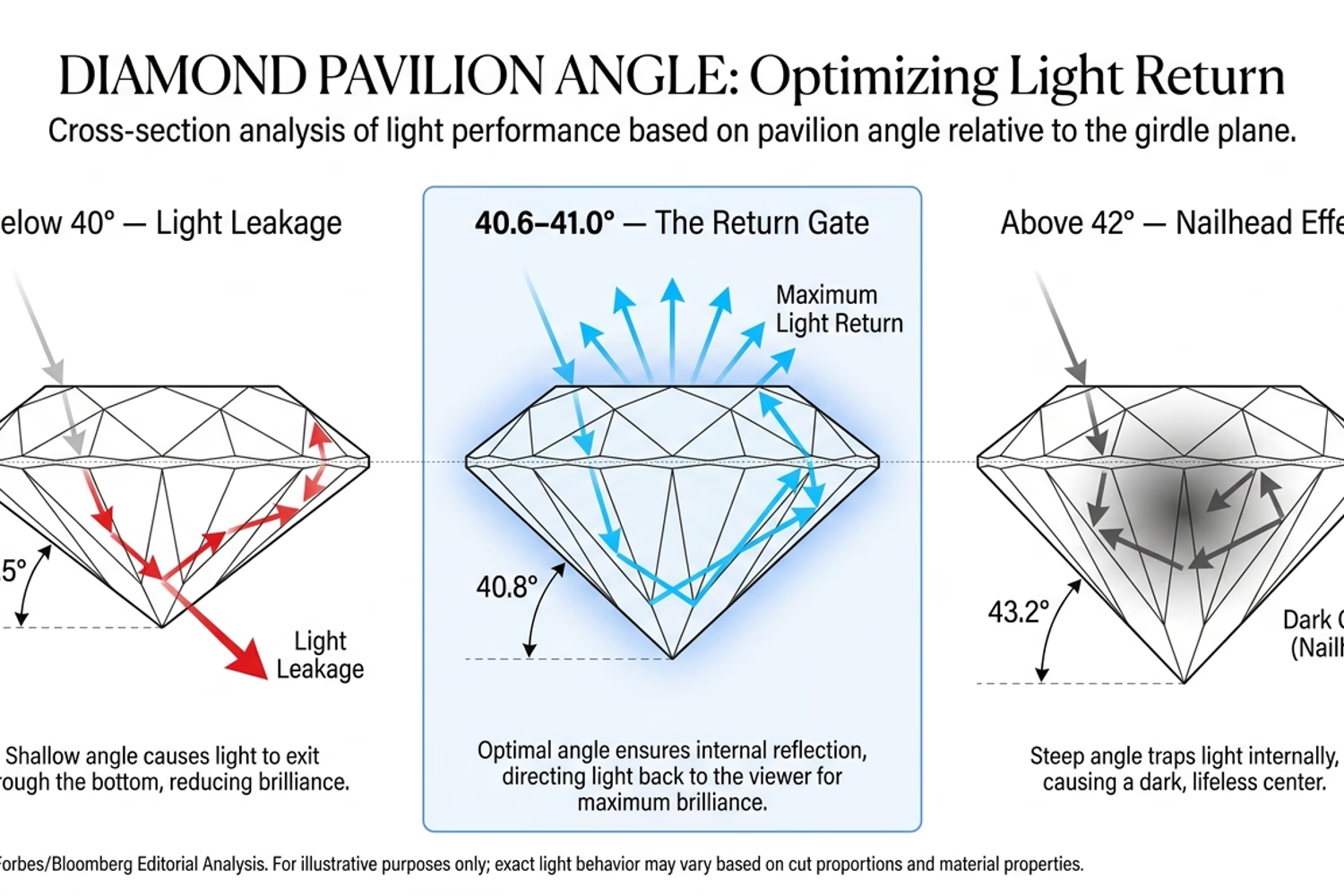
- The Return Gate: 40.6–41.0° is the optimal pavilion angle range where internal reflection angles are perfectly set to bounce light back through the table rather than out the side or bottom
- GIA Excellent pavilion range: 40.6–41.8° — every GIA Excellent round diamond has a confirmed pavilion angle within this range; you do not need to check manually
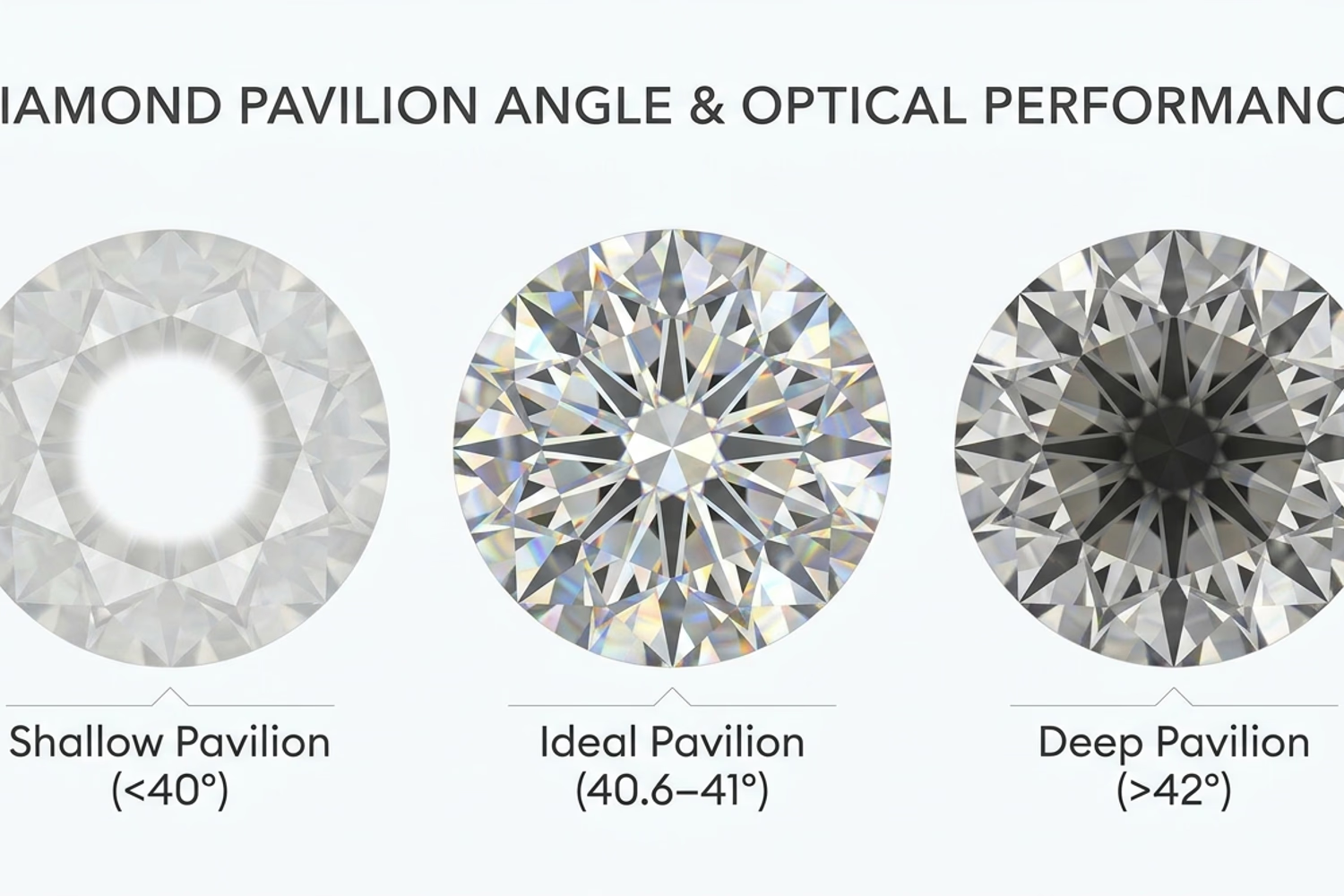
- Below 40.0°: light leakage from the pavilion bottom — light that should reflect back up instead exits through the underside of the stone, producing a dark center when viewed face-up
- Above 42°: nailhead-style leakage — pavilion is too steep; light hits the opposite pavilion facet at a wrong angle and escapes out the side rather than returning through the table
- Pavilion angle has 3–5× more impact on light return than crown angle — if you can only focus on one proportion parameter, focus on this one
Most buyers know crown angle as the "fire" measurement and table percentage as the "size" measurement. Far fewer understand that the pavilion angle — the slope of the lower half of the diamond — is the actual engine of a round brilliant's light performance. This guide explains exactly what pavilion angle does, what the numbers mean in practice, and why GIA Excellent cut remains the only credible guarantee that this measurement is correct.
What Is the Pavilion Angle on a Round Diamond?
A round brilliant diamond has three structural zones: the crown (upper half), the girdle (the perimeter band), and the pavilion (the lower half that tapers to the culet point at the bottom).
The pavilion angle is the angle between the pavilion's main facets and the horizontal plane of the girdle. On a standard 57-facet round brilliant, there are 8 pavilion main facets — four kite-shaped facets alternating with four lower girdle facets — that share this angle measurement.
GIA measures the pavilion angle from all 8 main positions and reports an average on the grading report. The measurement appears in the "Proportions" section of a full GIA Grading Report.
How Pavilion Angle Controls Light Return
A round diamond works as a light trap. Light enters through the table, travels through the crown, hits the pavilion facets, and must bounce back up through the table to the viewer's eye. The pavilion angle determines whether that bounce happens correctly.
The physics is total internal reflection. At the pavilion facet surface, light hits at an angle. If the incidence angle exceeds the critical angle for diamond (about 24.4°), total internal reflection occurs — all the light bounces back up. If the incidence angle is less than the critical angle, some light transmits through the facet and exits the stone. This is light leakage.
The pavilion angle sets the incidence angle for all light entering the stone. This is why it has more direct impact on light return than any other proportion measurement:
| Pavilion Angle | What Happens |
|---|---|
| Below 40.0° | Incidence angles fall below critical angle — light exits through the pavilion bottom. Stone looks dark in center |
| 40.0–40.5° | Marginal; some light leakage, reduced brightness |
| 40.6–41.0° | The Return Gate — maximum total internal reflection; optimal light return |
| 41.0–41.8° | Still excellent; minor reduction in brightness offset by stronger contrast pattern |
| 41.8–42.5° | GIA Very Good territory; light begins hitting opposite pavilion facet at sub-optimal angle |
| Above 42.5° | Significant leakage out the sides; stone appears dark at edges |
The Return Gate: Why 40.6–41.0° Specifically
Within the GIA Excellent pavilion range of 40.6–41.8°, the sub-range of 40.6–41.0° produces the maximum overall light return.
At exactly 40.75°, which is the mathematical center of the Return Gate, the geometry of the round brilliant produces the following:
- Light entering through the table hits each pavilion main facet at an angle above the critical angle (total internal reflection)
- Light reflects off the first pavilion facet and travels directly to the opposite pavilion facet at a similarly optimal angle
- From the opposite pavilion facet, light returns directly up through the table to the viewer's eye
This double-reflection path is what makes a round brilliant — correctly cut — more brilliant than any other diamond shape. No other shape achieves this two-bounce efficiency with 57 facets simultaneously.
At 41.0–41.8° (still GIA Excellent), the path is slightly different: light hits the first pavilion facet at a slightly steeper angle, which increases the contrast pattern (the dark and light areas that create scintillation) but slightly reduces peak brightness. Neither is wrong — it is a character difference, not a defect.
The Return Gate at 40.6–41.0° is the range where brightness is maximized. The upper Excellent range at 41.0–41.8° is where contrast (scintillation) is emphasized.
GIA Excellent Cut: Your Pavilion Angle Guarantee
Buying GIA Excellent cut handles pavilion angle verification automatically. No GIA Excellent round diamond can have a pavilion angle outside the 40.6–41.8° range.
Examples of GIA Excellent round diamonds with guaranteed-optimal pavilion angles:
- GIA 1ct G-VS2 Excellent at $3,230
- GIA 1ct G-VS1 Excellent at $3,300
- GIA 1ct F-VS2 Excellent at $3,490
- GIA 1ct E-VS2 Excellent at $3,540
All four have pavilion angles confirmed within 40.6–41.8° as part of GIA's 57-measurement Excellent cut verification.
How to Check Pavilion Angle on a GIA Certificate
On a full GIA Grading Report, the pavilion angle appears in the "Proportions" section as a number in degrees — for example, "40.8°". This is the average measurement from all 8 pavilion main facet positions.
If you have a GIA Dossier (abbreviated certificate used for smaller stones under 1ct), pavilion angle may not be listed. For any stone above 0.75ct where proportion optimization matters, request a full GIA Grading Report or verify the pavilion angle through GIA's online report check using the certificate number.
On Blue Nile, you can access the GIA report details directly from each stone listing — click "View GIA Report" on any diamond page. The pavilion angle appears in the diamond proportions section.
What to look for:
- 40.6–41.0°: optimal (The Return Gate)
- 41.0–41.4°: excellent — slightly stronger contrast pattern
- 41.4–41.8°: still GIA Excellent, slight brightness trade-off for increased scintillation
- Anything outside 40.6–41.8° cannot be GIA Excellent
Pavilion Angle vs Crown Angle: Which Matters More?
Both matter — but not equally.
Pavilion angle is primary. It determines whether light that enters the diamond makes it back out through the table. A correct pavilion angle means high base brightness regardless of crown angle.
Crown angle is secondary. It controls fire (rainbow color dispersion) and the character of the sparkle. Crown angle changes how light enters the crown and at what angles it hits the pavilion — but if the pavilion is wrong, even a perfect crown angle cannot recover the light that has already leaked.
A useful way to think about it:
- Pavilion angle = the return journey (how light gets back out)
- Crown angle = the entry journey (how light gets in, and how much it disperses)
- Table = the gate size (how much light can enter and exit)
The interaction between all three is why GIA evaluates them as a system. A 41.0° pavilion with a 35° crown and 56% table produces a different optical character than a 40.7° pavilion with the same crown and table — but both can be GIA Excellent if all measurements fall within the specified ranges.
The quick rule: if crown angle is in the Scintillation Gate (34–35°) and pavilion angle is in the Return Gate (40.6–41.0°), you have a stone optimized for both fire and brightness simultaneously.
2ct Stones: Does Pavilion Angle Matter More at Larger Sizes?
Yes. At 2ct, the pavilion facets are physically larger — each facet covers more surface area. An off-optimal pavilion angle has a proportionally larger impact because there is more facet area contributing to the leakage or return.
Reference 2ct GIA Excellent stones with confirmed pavilion angles within the optimal range:
- GIA 2ct G-VS2 Excellent at $16,490
- GIA 2ct G-VS2 Excellent at $18,540
- GIA 2ct G-VS1 Excellent at $22,460
At these purchase amounts, I always check the pavilion angle number on the full GIA report. GIA Excellent is already guaranteed to be in range, but confirming the specific value at 2ct costs nothing and is worth doing.
The Pavilion-Crown Interaction: Getting Both Right
The pavilion and crown do not operate independently. They interact in the GIA cut model in a specific way: higher crown angles require slightly lower pavilion angles to maintain optimal overall light performance, and vice versa.
The most studied interaction combinations for GIA Excellent round brilliants:
| Crown Angle | Optimal Pavilion Angle | Character |
|---|---|---|
| 32.7–33.5° | 40.6–41.0° | High brilliance, reduced fire |
| 33.5–34.5° | 40.6–41.2° | Balanced — most versatile |
| 34.5–35.5° | 40.6–41.4° | Fire-forward, strong scintillation |
| 35.5–36.0° | 40.8–41.8° | Maximum fire, slight brilliance reduction |
The combination of crown in the Scintillation Gate (34–35°) and pavilion in the Return Gate (40.6–41.0°) sits in the center of all these interactions — producing the balanced performance that GIA Excellent was designed to verify.
Tides Of Summer Capsule
Up To 30% Off
Shop The Sale →Vault ClearanceClear The Vault
Up To 70% Off
Shop Vault Deals →Affiliate link — no extra cost to you
Lab-Grown Round Diamonds: Pavilion Angle Is Identical
Lab-grown diamonds are cut using the same tools and to the same proportion standards as natural diamonds. GIA and IGI both assess pavilion angle using identical measurement criteria for lab-grown rounds. The physics of total internal reflection is identical regardless of whether the diamond formed over a billion years underground or in a reactor chamber over three weeks.
Reference lab-grown stones with pavilion angles within GIA/IGI Excellent standards:
A lab-grown IGI Excellent round at $2,810 has its pavilion angle confirmed within IGI's Excellent range (40.6–41.8°), identical to the GIA standard. The light return from a correctly cut lab-grown round is physically identical to a correctly cut natural round.
What Happens with GIA Very Good Pavilion Angle?
GIA Very Good cut can include stones with pavilion angles from approximately 40.0–40.5° (slightly too shallow) or 41.9–42.5° (slightly too steep). If you are considering GIA Very Good to save 8–12% versus Excellent:
- Request the full GIA report and check the specific pavilion angle number
- Target 40.6–41.4° within the Very Good designation for near-Excellent light return
- Avoid Very Good stones with pavilion angles below 40.4° (noticeable light leakage risk)
- Avoid Very Good stones above 42.0° (side leakage visible in some lighting conditions)
For 1ct and below, GIA Very Good with a pavilion angle in the 40.6–41.4° range is a legitimate cost optimization. For 2ct and above, the price difference between Very Good and Excellent is typically absorbed by the per-carat premium of the larger stone — buy Excellent and eliminate the verification work.
Farzana's Verdict: The pavilion angle is where a round brilliant's performance is won or lost. Get it right and the stone returns light with near-mechanical efficiency; get it wrong and no color grade, clarity upgrade, or setting will fix the dark zone in the center. The good news is that GIA Excellent cut handles this entirely — the certificate tells you the pavilion is in the 40.6–41.8° range before you buy. Within that range, the Return Gate at 40.6–41.0° gives you maximum brightness; the upper Excellent range gives stronger contrast. Both are correct choices. The one wrong choice is skipping GIA Excellent and trusting that any Excellent-labeled stone from any vendor is actually correctly cut. It is not — the label means nothing without GIA measurement.
Frequently Asked Questions
What is pavilion angle on a round diamond?
The pavilion angle is the angle between the pavilion main facets (the lower half of the diamond) and the horizontal plane of the girdle. It controls the internal reflection geometry — whether light bouncing inside the diamond returns through the table to the viewer's eye, or leaks out the bottom or sides. GIA measures and reports pavilion angle on full grading reports.
What is the ideal pavilion angle for a round brilliant?
40.6–41.0° is The Return Gate — the optimal range where total internal reflection geometry maximizes light return through the table. GIA Excellent accepts 40.6–41.8°; all stones in this range perform very well. For peak brightness, target the lower half of the Excellent range (40.6–41.2°) by checking the full GIA report.
Does GIA Excellent guarantee a correct pavilion angle?
Yes. GIA Excellent cut certifies that pavilion angle falls between 40.6° and 41.8° as part of 57 verified measurements. No GIA Excellent round diamond can have a pavilion angle that causes significant light leakage. This is the primary reason to always buy GIA Excellent for round brilliants.
How does pavilion angle compare to crown angle in importance?
Pavilion angle is 3–5× more impactful on light return than crown angle. The pavilion determines whether light makes it back out of the stone at all. Crown angle controls fire and sparkle character, but these are secondary to the fundamental brightness set by the pavilion. If forced to choose, verify pavilion angle first.
What happens with a pavilion angle below 40°?
Below 40°, the pavilion is too shallow. Light hitting the pavilion facets arrives at incidence angles below diamond's critical angle (24.4°), causing partial transmission — light exits through the bottom of the stone rather than returning through the table. The stone appears dim in the center and lacks the depth of a correctly cut round. No GIA Excellent diamond can have this defect.
What happens with a pavilion angle above 42°?
Above 42°, the pavilion is too steep. Light that reflects off the first pavilion facet hits the opposite facet at an angle that sends it out the sides of the stone rather than back through the table. The stone shows dark zones at the edges and appears bright only at the center. GIA Excellent stones do not reach 42° — this defect is limited to Fair and Poor cut grades.
Can I buy GIA Very Good if the pavilion angle is checked?
Yes, selectively. GIA Very Good includes stones with pavilion angles from approximately 40.0–42.5°. Within this range, stones with pavilion angles of 40.6–41.4° perform nearly identically to GIA Excellent. Check the specific number on the full certificate. Avoid Very Good stones with pavilion angles below 40.4° or above 42.0°.
Is pavilion angle different for lab-grown round diamonds?
No. Pavilion angle is a physical measurement of cutting geometry — it is identical for lab-grown and natural round diamonds cut to the same standards. GIA and IGI both assess pavilion angle using the same criteria. A lab-grown GIA Excellent round has its pavilion angle confirmed within the same 40.6–41.8° range as a natural GIA Excellent round.
Does pavilion angle matter more in larger diamonds?
Yes. At 2ct and above, each pavilion facet covers more surface area, which amplifies the effect of any sub-optimal angle. A 1ct stone with a pavilion at 41.6° (upper Excellent range) looks very good. A 3ct stone with the same pavilion angle shows a more noticeable reduction in peak center brightness compared to a 40.8° stone. For 2ct+ purchases, confirm the pavilion angle is in the 40.6–41.2° range from the full GIA report.
How do I find pavilion angle on a Blue Nile listing?
On Blue Nile, click any diamond listing and select "View GIA Report" or "Certificate Details." The diamond proportions section shows all measurements including pavilion angle. Alternatively, use GIA's online report checker at gia.edu/report-check with the GIA report number from the certificate. Look for the "Pavilion Angle" row — it will be a number between 40° and 42° for any GIA Excellent round.
What is the relationship between pavilion angle and depth percentage?
Pavilion angle directly drives the total depth percentage. A steeper pavilion angle (higher °) means more material below the girdle, which adds to the total depth. A 40.8° pavilion in a well-proportioned round typically contributes 43–44% of the stone's total depth. Combined with crown height (about 16–17% of total depth) and girdle thickness, the total depth reaches the optimal 59–62.5% range for GIA Excellent. Pavilion angle is the biggest single contributor to total depth.
See Also
Expert Verdict
Always audit the stone individually — no grade replaces seeing the actual diamond. The certificate tells you what to look for. Your eyes tell you whether to buy.
— Farzana Hasan, GIA Expert · DiamondCritics.com