Round Diamond Girdle Thickness in 2026: The Invisible Weight Trap


TL;DR: Round Diamond Girdle Thickness — Key Facts
- The girdle is the narrow band around the widest perimeter of a diamond — it separates the crown above from the pavilion below; girdle thickness is how wide (deep) this band is
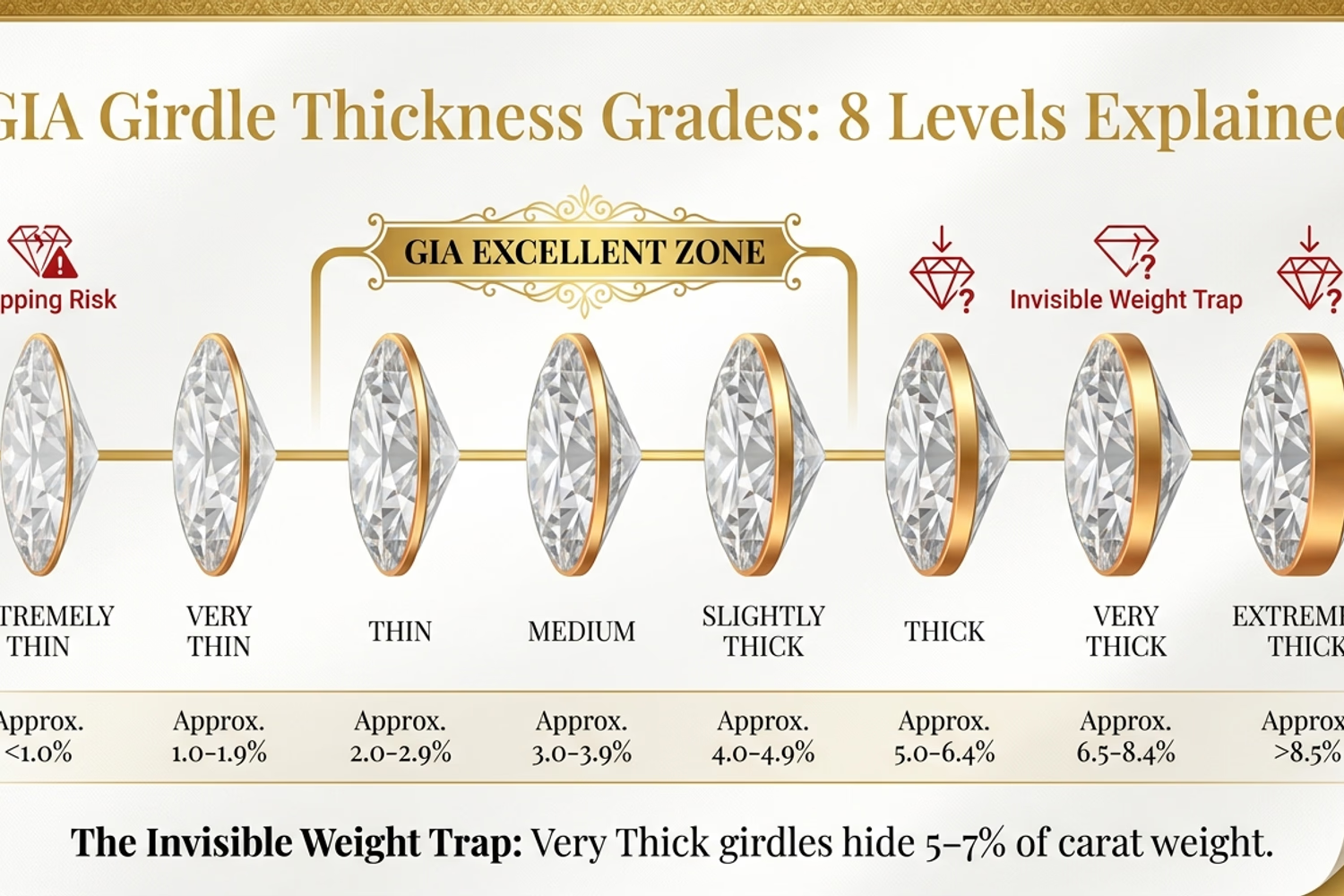
- The Invisible Weight Trap: a Very Thick or Extremely Thick girdle stores 5–7% of the diamond's total carat weight in the girdle itself — a stone listed as 1.00ct can face up like a 0.93ct because weight is hidden in the girdle wall
- GIA Excellent mandates Thin to Slightly Thick girdle — the cut grade standard enforces a maximum relative girdle thickness of approximately 3% of total depth, keeping the proportion within the optimal range
- Extremely Thin girdles are a different risk: a girdle thinner than 0.7% relative thickness is vulnerable to chipping during setting and from ring impacts
- Always buy GIA Excellent cut — the Excellent cut grade is your automatic guarantee that girdle thickness is within the safe range; you do not need to check it separately
- If buying GIA Very Good or uncertified: check the GIA report for the girdle thickness description and reject any stone with "Thick" or "Very Thick" combined with "Very Thin" on opposite girdle facets
Every diamond buyer focuses on the four Cs. Almost no buyer looks at the girdle. This is exactly how The Invisible Weight Trap works: you buy a 1.00ct stone, set it in a ring, look down at it on your finger, and wonder why it seems slightly smaller than the 1.00ct round at your friend's hand. The answer is in the girdle.
What Is the Girdle on a Round Diamond?
The girdle is the narrow horizontal band that forms the widest circumference of a diamond. It sits at the boundary between the crown (upper half) and the pavilion (lower half). On a round brilliant, the girdle is a faceted ring with 64 facets on a standard cut (32 upper girdle facets and 32 lower girdle facets, matching the number of pavilion and crown facets).
Girdle thickness is expressed as the percentage of the stone's total depth that the girdle occupies. On GIA reports, it appears as both a descriptive term (Thin, Medium, Slightly Thick, etc.) and is incorporated into the overall depth percentage measurement.
If a diamond has a total depth of 62.0% and a girdle at 3.5% of that depth, approximately 2.2% of total carat weight is sitting in the girdle wall — weight that does not contribute to face-up diameter.
GIA's 8 Girdle Thickness Grades
GIA describes girdle thickness with 8 categories on grading reports:
| GIA Term | Relative Thickness | Risk |
|---|---|---|
| Extremely Thin | < 0.7% | Chipping risk during setting |
| Very Thin | 0.7–1.4% | Slight chipping risk; acceptable with careful setting |
| Thin | 1.5–2.0% | Ideal — maximum face-up size |
| Medium | 2.1–3.0% | Ideal — standard benchmark |
| Slightly Thick | 2.6–3.5% | Acceptable; GIA Excellent upper limit |
| Thick | 3.6–4.5% | Begins hiding weight; GIA Very Good territory |
| Very Thick | 4.6–6.5% | Significant weight in girdle; visual size loss |
| Extremely Thick | > 6.5% | Severe weight loss to girdle; reject |
GIA Excellent cut allows Thin through Slightly Thick girdle — approximately 1.5–3.5% relative thickness. This range is optimal for both structural durability and maximum face-up diameter per carat weight.
The Invisible Weight Trap: Real Numbers
Here is where girdle thickness has a measurable impact on the diamond you are actually buying:
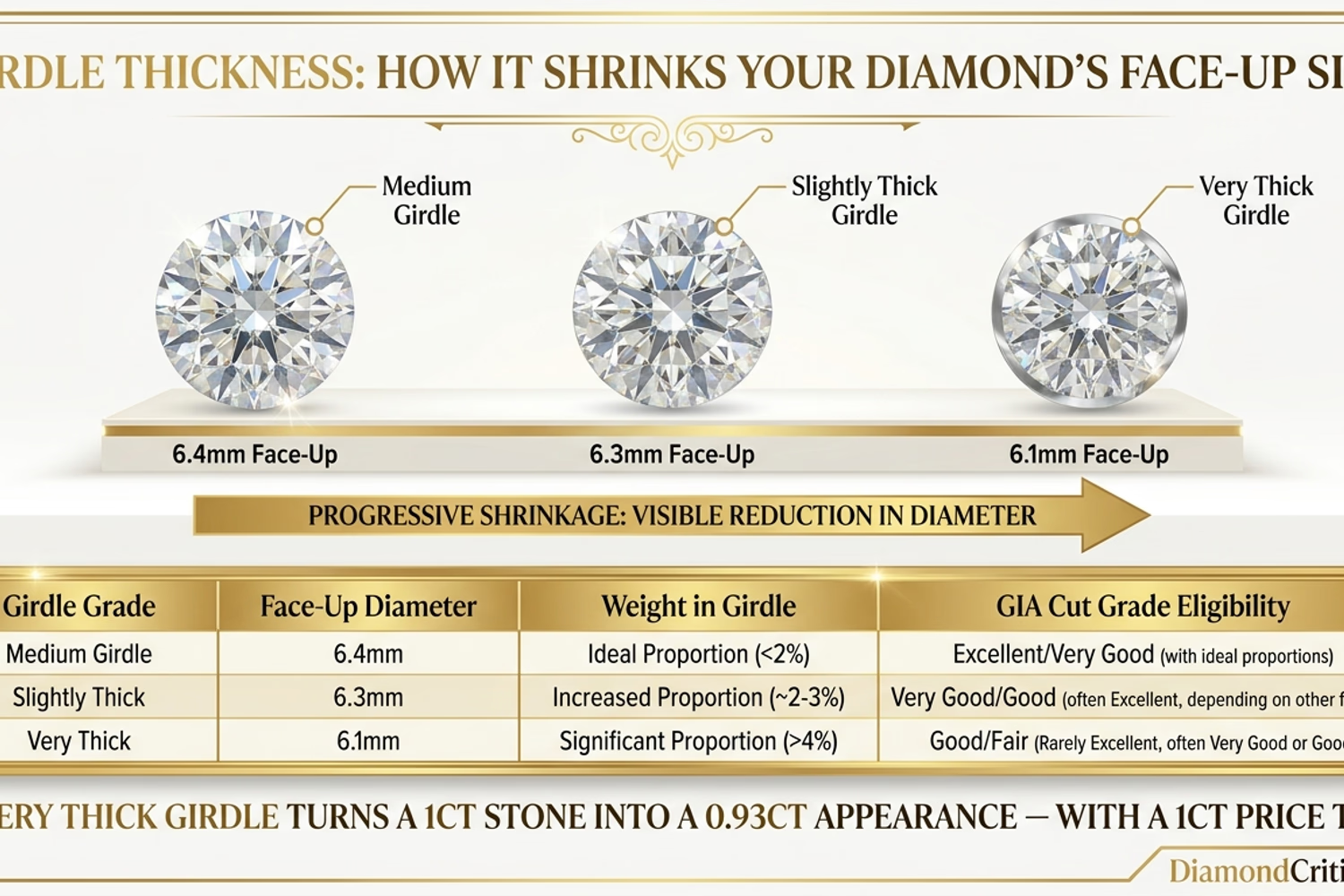
A theoretical 1.00ct round diamond with GIA Excellent proportions and a Medium girdle (2.5% relative thickness) faces up at approximately 6.4mm diameter. Change only the girdle to Very Thick (5.5%) while keeping all other proportions constant, and the same 1.00ct stone faces up at approximately 6.1mm — a 0.3mm reduction in diameter that corresponds to the appearance of a 0.90ct stone.
You paid for a 1.00ct. You got the face-up size of a 0.90ct. The 5–7% of carat weight that went into the girdle wall is invisible in the ring setting and adds no visual value.
This is not theoretical. Gemologists regularly encounter stones where a Very Thick girdle combined with standard depth ranges produces a stone that faces up meaningfully smaller than its carat weight suggests. The girdle weight is real weight on the scale — GIA charges by weight and reports by weight — but it delivers no visual size benefit to the buyer.
The face-up impact by girdle grade:
| Girdle Grade | Weight in Girdle | Visual Effect |
|---|---|---|
| Thin–Medium | 1–2% | Negligible; optimal face-up size |
| Slightly Thick | 2–3% | Negligible |
| Thick | 3–4.5% | Slight face-up reduction vs equivalent weight |
| Very Thick | 4.5–6.5% | Noticeable face-up reduction; 0.1–0.15mm smaller |
| Extremely Thick | 6.5%+ | Significant; stone appears 0.2–0.3mm smaller than carat implies |
For buyers who paid attention to the Magic Carat Trap at 1ct — where 0.90ct looks identical to 1.00ct for 20% less cost — the Invisible Weight Trap is its opposite: you are paying 1ct pricing for a stone that delivers 0.93ct-level face-up size.
GIA Excellent Cut: Your Automatic Protection
The simplest protection against The Invisible Weight Trap is GIA Excellent cut. GIA's Excellent standard limits girdle thickness to the Thin through Slightly Thick range. No GIA Excellent round diamond can have a Very Thick or Extremely Thick girdle — the cut grade prevents it.
Examples of GIA Excellent round diamonds with confirmed-safe girdle thickness:
- GIA 1ct G-VS2 Excellent at $3,650
- GIA 1ct G-VS1 Excellent at $3,660
- GIA 1ct G-VS2 Excellent at $3,680
- GIA 1ct G-VS2 Excellent at $4,040
All four have GIA Excellent cut. Their girdle thicknesses are automatically within the Thin to Slightly Thick range. No manual check needed.
How to Read Girdle Thickness on a GIA Report
GIA reports girdle thickness in the "Proportions" section of the full grading report. It appears in one of two formats:
Single term: "Medium" or "Slightly Thick" — indicates the girdle thickness is consistent around the entire perimeter.
Range: "Thin to Slightly Thick" or "Very Thin to Thick" — indicates the girdle thickness varies around the perimeter. This variation is normal for round brilliants because the girdle facets are not uniformly machined — some positions are slightly thicker where crown and pavilion facets meet.
The important number is the maximum thickness in the range. If the report shows "Thin to Thick," the maximum is Thick — you have a stone where some portions of the girdle are in the Thick range, which begins contributing to the Invisible Weight Trap.
The GIA Excellent standard ensures the maximum thickness does not exceed Slightly Thick. For Very Good and below, check the maximum in the stated range.
Extremely Thin Girdles: The Other Risk
Thick girdles hide weight. Thin girdles create fragility.
An Extremely Thin girdle (below 0.7% relative thickness) is the structural opposite problem. At this thickness, the girdle facets are delicate enough to chip or break during:
- Diamond setting (prong pressure from the setter's tool)
- Ring removal under torque
- Impact against a hard surface at the girdle perimeter
An Extremely Thin girdle on a standard round brilliant is visible in person — you can sometimes see it as an almost-absent band between crown and pavilion. Under 10x magnification it is clearly visible as a near-edge.
If a GIA report shows "Extremely Thin" or "Very Thin" as the minimum in a girdle range, ask your jeweler to confirm the stone can be safely set in your chosen setting style. Bezel settings are the safest choice for very thin girdles because the metal wraps the entire perimeter.
Does Girdle Thickness Affect Sparkle?
Not directly. The girdle itself does not participate in the light return mechanism of a round brilliant — it is not a refractive surface in the same sense as the table, crown, or pavilion facets. However, girdle thickness indirectly affects sparkle in one way:
A Very Thick or Extremely Thick girdle adds total depth to the stone without adding table diameter. This extra depth changes the crown-to-pavilion proportion ratio. A stone that is deeper than the GIA Excellent range due to a thick girdle may show:
- Slightly reduced face-up brightness because the light path through the crown-to-pavilion geometry changes
- More shoulder shadow (the dark areas at the edge of the stone when viewed from the side)
These effects are secondary to the face-up size loss and are not the primary reason to avoid thick girdles. The face-up size loss is the primary reason.
Girdle Thickness and Ring Settings
Girdle thickness also matters for setting compatibility:
Prong settings: Standard prong settings grip the stone at the girdle. A Medium to Slightly Thick girdle (GIA Excellent range) is ideal — thin enough not to require extra-wide prong openings, but thick enough to grip securely. Extremely Thin girdles are at risk of slipping through standard prong settings or chipping under prong pressure.
Bezel settings: The metal wraps the entire girdle. Bezel settings are the most protective for any girdle thickness, including Extremely Thin. If your stone has a Very Thin minimum in the girdle range, a bezel setting protects it more effectively than prongs.
Channel and pavé settings: Girdle thickness requirements for channel settings are slightly larger than for prong settings because the stone must fit snugly between two parallel channel walls. A Slightly Thick maximum is actually useful here. Extremely Thick causes fitting problems.
For standard prong settings with GIA Excellent round diamonds:
| Setting Type | Optimal Girdle Grade |
|---|---|
| Four-prong solitaire | Medium to Slightly Thick |
| Six-prong solitaire | Thin to Slightly Thick |
| Bezel | Any (best for Very Thin) |
| Channel | Medium to Slightly Thick |
| Halo | Thin to Medium |
Tides Of Summer Capsule
Up To 30% Off
Shop The Sale →Vault ClearanceClear The Vault
Up To 70% Off
Shop Vault Deals →Affiliate link — no extra cost to you
2ct+ Stones: Does Girdle Matter More?
Yes. At 2ct, the same relative girdle thickness percentage represents a larger absolute volume of diamond weight — and therefore a larger absolute face-up size difference.
At 2ct, the face-up size difference between a Thin girdle and a Very Thick girdle is approximately 0.3–0.4mm in diameter. That is the difference between an 8.1mm stone and a 7.7mm stone — visible to the naked eye.
For 2ct+ purchases, I look at the girdle thickness description even on GIA Excellent stones. Most Excellent stones have Medium to Slightly Thick girdles, which is fine. If a 2ct GIA Excellent shows "Slightly Thick" as the maximum — that is still within Excellent range and acceptable — but knowing this helps calibrate expectations.
Examples of 2ct GIA Excellent stones with confirmed-safe girdle proportions:
- GIA 2ct G-VVS2 Excellent at $26,860
- GIA 2ct F-VS2 Excellent at $27,320
- GIA 2ct D-VS2 Excellent at $26,490
GIA Excellent at 2ct ensures girdle thickness is within the Thin to Slightly Thick range. Lab-grown equivalents follow the same standard:
Girdle Thickness in Old Cuts and Estate Diamonds
If you are considering an antique or estate round diamond — Old European cut, Old Mine cut, or a transitional cut — GIA Excellent does not apply. These cuts predate modern cut standards and were often finished with thicker girdles because cutters prioritized weight retention from the original rough rather than optimal light performance.
Old European and Old Mine cuts sometimes have Thick to Very Thick girdles. This is not a defect in the context of the period — it is a feature of the cutting style. If you are buying an antique diamond for its historical character, the thick girdle is part of the stone. If you are buying an antique diamond expecting modern face-up size per carat, the thick girdle will disappoint.
For new purchases in 2026, there is no reason to accept a Very Thick or Extremely Thick girdle. GIA Excellent rounds with optimal girdle proportions are available at every budget from $3,000 to $300,000.
Farzana's Verdict: The Invisible Weight Trap is easy to avoid and easy to ignore. You avoid it by buying GIA Excellent cut and letting GIA's 57-measurement verification handle girdle thickness for you. You fall into it by buying uncertified diamonds, GIA Fair/Poor stones, or GIA Very Good stones without checking the girdle grade on the certificate. The trap is not exotic knowledge — it is visible on every GIA report. A Very Thick girdle description on any round diamond certificate above 0.50ct is a reason to walk away. The carat weight you paid for should be in the part of the stone you can see.
Frequently Asked Questions
What is girdle thickness on a round diamond?
Girdle thickness is the width of the narrow band around the widest perimeter of a round diamond — the band that separates the upper crown from the lower pavilion. GIA measures it as a percentage of the stone's total depth and reports it in 8 categories from Extremely Thin to Extremely Thick. Optimal range for round brilliants is Thin to Slightly Thick.
Does girdle thickness affect how big a diamond looks?
Yes. A Very Thick or Extremely Thick girdle stores 5–7% of the diamond's carat weight in the girdle band itself — weight that adds no face-up diameter. A 1ct stone with a Very Thick girdle faces up like a 0.93–0.95ct stone in apparent diameter. This is The Invisible Weight Trap: you pay for weight that sits hidden in the girdle wall.
What girdle thickness does GIA Excellent require?
GIA Excellent cut mandates Thin to Slightly Thick girdle — approximately 1.5–3.5% relative girdle thickness. No GIA Excellent round diamond can have a Very Thick or Extremely Thick girdle. Buying GIA Excellent is the simplest protection against the Invisible Weight Trap.
Is Thin or Medium girdle better for round diamonds?
Both are optimal. Thin (1.5–2.0%) gives maximum face-up diameter relative to carat weight. Medium (2.1–3.0%) is the most common in GIA Excellent rounds and provides excellent durability during setting. Either grade within the Thin to Slightly Thick range is a correct purchase.
Can an Extremely Thin girdle chip?
Yes. Extremely Thin girdles (below 0.7% relative thickness) are structurally vulnerable. They can chip during prong setting when the setter applies pressure at the girdle, during removal of the ring under torque, or from impact against a hard edge. If a stone has Extremely Thin as the minimum in the reported girdle range, use a bezel setting and inform your jeweler of the thin girdle before setting.
How do I check girdle thickness on a GIA certificate?
On a full GIA Grading Report, find the "Proportions" section. Girdle thickness appears as a descriptive term or a range (e.g., "Thin to Medium" or "Slightly Thick"). The key number is the maximum in the range. For GIA Excellent stones, the maximum is Slightly Thick or less. For GIA Very Good and below, check the maximum carefully — Thick or Very Thick maximum indicates potential Invisible Weight Trap conditions.
Does girdle thickness matter for the diamond's sparkle?
Not directly — the girdle facets do not participate in the main light return mechanism. However, a Very Thick or Extremely Thick girdle adds total depth without adding table diameter, which can slightly reduce the crown-to-pavilion proportion efficiency. The primary issue is face-up size loss, not sparkle reduction.
What girdle thickness is best for prong settings?
Medium to Slightly Thick is optimal for four- and six-prong solitaire settings. The girdle needs to be substantial enough to grip securely without requiring oversized prongs that would look heavy. Extremely Thin girdles should not be set in standard prong settings without consulting your jeweler about prong technique.
Does girdle thickness vary around the perimeter of a round diamond?
Yes, normally. GIA reports a range (e.g., "Thin to Slightly Thick") because the girdle facets have varying thickness where the crown and pavilion main facets meet the girdle edge. Some thickness variation of 1–2 categories is normal and acceptable. A range of "Very Thin to Very Thick" indicates problematic variation that affects both durability and weight distribution.
Is girdle thickness different for lab-grown round diamonds?
No. Girdle thickness is a physical characteristic of the cutting geometry — it applies equally to natural and lab-grown round diamonds. GIA and IGI apply the same girdle thickness assessment standards to lab-grown rounds. A GIA Excellent lab-grown round has its girdle confirmed within the Thin to Slightly Thick range, same as a GIA Excellent natural.
Why do some rounds have Very Thick girdles?
Very Thick girdles on modern rounds are usually the result of a cutter prioritizing weight retention from the original rough over optimal face-up proportions. The cutter maximizes carat weight (which determines base price) by keeping more material in the girdle, at the cost of visual performance. This is why independent certification and GIA Excellent cut grade exist — they verify that the cutter did not sacrifice buyer value for weight.
See Also
Expert Verdict
Always audit the stone individually — no grade replaces seeing the actual diamond. The certificate tells you what to look for. Your eyes tell you whether to buy.
— Farzana Hasan, GIA Expert · DiamondCritics.com