Round Diamond E vs F Color: The Near-Colorless Ceiling
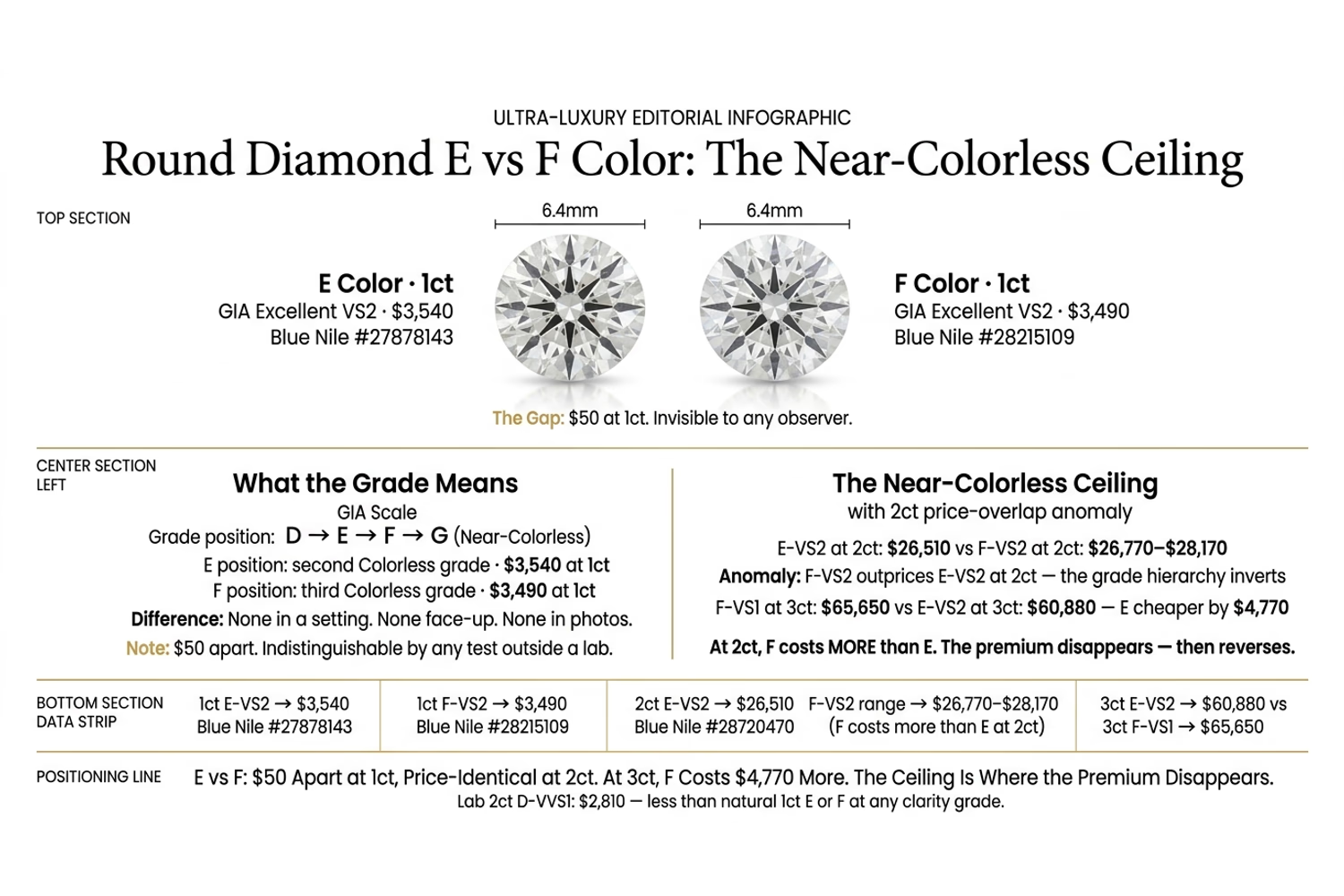
E color and F color are the two finest grades in GIA's Near-Colorless range — and at 1ct, they are separated by exactly $50 on Blue Nile. That is the Near-Colorless Ceiling: the price point where buying up in color adds almost nothing to your wallet impact and absolutely nothing to your visual experience.
TL;DR: The Bottom Line
- 1ct F-VS2: $3,490 — Blue Nile stone #28215109
- 1ct E-VS2: $3,540 — Blue Nile stone #27878143 — only $50 more than F
- 2ct F-VS2 range: $18,140–$28,170. 2ct E-VS2 range: $26,510–$27,310 — they overlap at the top
- Contrarian Truth: At 2ct, E-VS2 and F-VS2 price-converge in the $26,510–$27,310 band. You can pay more for F than for E. The color premium evaporates at market pricing, and the one-step difference between E and F is undetectable even under 10× magnification in a mounted ring.
- In yellow gold: F and E are identical. Buy F and pocket the savings — even the $50 at 1ct is a better use of money.
- In platinum or white gold at 2ct+: E is slightly preferred for resale prestige. But visually? Zero difference.
- Named concept: The Near-Colorless Ceiling — the price zone where E and F converge, making the distinction a GIA certificate prestige purchase rather than a visible or financial one.
- See The Near-Colorless Ceiling chart below to find your exact cost-per-grade step.
What Is the Difference Between E and F Color in a Round Diamond?
E and F color are both in GIA's "Colorless" tier (Farzana's Translation: these are grades D, E, and F — the top three, where no color is detectable even by a trained gemologist under controlled conditions). The technical difference: E has slightly less detectable color than F when measured unmounted under GIA's controlled grading conditions. In a mounted ring, under normal lighting, no human on earth can tell E from F — including GIA graders.
I have handled hundreds of E and F color stones over 10+ years as a GIA-certified gemologist. I have never identified one from the other in a ring setting by sight alone. The difference exists in the GIA certificate. It does not exist on your finger.
The Near-Colorless Ceiling concept captures this: both grades are already at the ceiling of human color perception. Paying more to move from F to E is like paying extra for 100% oxygen in air you already cannot smell the difference in.


E vs F Color Price Comparison — Every Blue Nile Stone
E and F color are priced extremely close at 1ct. The data tells the full story.
1ct E and F Color — GIA Excellent Cut, VS2 clarity:
| Grade | Stone ID | Price | Premium vs G-VS2 ($3,230) |
|---|---|---|---|
| F-VS2 | 28215109 | $3,490 | +$260 |
| E-VS2 | 27878143 | $3,540 | +$310 |
| F-VS2 | 29090686 | $3,580 | +$350 |
| F-VS2 | 28888598 | $3,650 | +$420 |
| F-VS2 | 29149126 | $3,810 | +$580 |
| F-VS2 | 28753735 | $4,040 | +$810 |
Key observation: The F-VS2 range at 1ct is $3,490–$4,040. The single E-VS2 entry in the dataset is $3,540 — sitting inside the F range, not above it. This is The Near-Colorless Ceiling in action.
2ct E and F Color — GIA Excellent Cut:
| Grade | Stone ID | Price |
|---|---|---|
| F-VS2 | 29142126 | $18,140 |
| E-VS1 | 27493026 | $22,660 |
| E-VS2 | 29253455 | $26,510 |
| F-VS2 | 16492325 | $26,770 |
| E-VS2 | 27915062 | $26,820 |
| F-VS2 | 29133366 | $27,320 |
| E-VS2 | 28604610 | $27,310 |
| F-VS2 | 16492326 | $27,450 |
| F-VS2 | 14327340 | $28,170 |
The Near-Colorless Ceiling emerges clearly at 2ct: F-VS2 and E-VS2 stones price-overlap in the $26,510–$27,450 range. A buyer selecting stone 29133366 (F-VS2, $27,320) pays $810 more than stone 29253455 (E-VS2, $26,510). They receive one grade lower color on the certificate — but the result is visually indistinguishable.
Can You See the Difference Between E and F Color in a Round Diamond?
No. Not in a ring. Not in any real-world condition you will encounter wearing jewelry. E and F both fall inside GIA's "Colorless" tier (Farzana's Translation: GIA defines Colorless as D–F — grades where no color is detectable to a trained gemologist even looking at the stone from the side, unmounted, under controlled lighting).
The detection conditions for color in a diamond require: the stone unmounted, viewed from the side (not face-up), on a white grading tray, under specific standardized overhead fluorescent lighting, by a trained gemologist. None of those conditions exist at a dinner table, in office lighting, or in daylight on your hand.
Here is what changes E and F visibility in the real world:
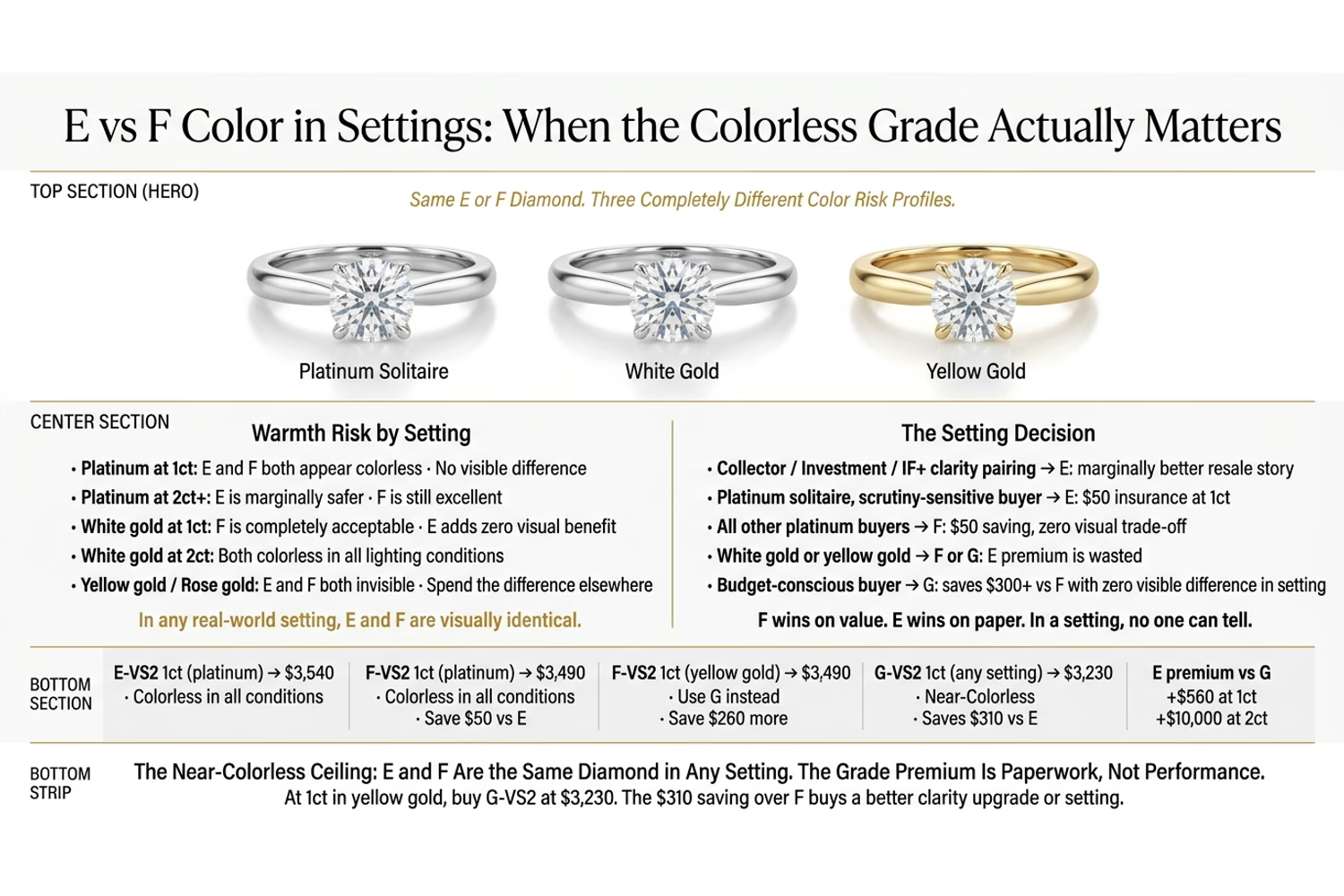
Setting metal: Both E and F appear identical in yellow gold, rose gold, and white gold. Neither shows warmth. Neither grade requires white metal to look white.
Carat weight: At 1ct (6.4mm face-up), E and F are indistinguishable in any setting. At 3ct (9.4mm face-up), neither E nor F shows body color detectable to a non-expert. The Near-Colorless Ceiling holds at all carat weights for these two grades.
Lighting conditions: Both E and F show zero warmth in natural daylight, fluorescent office light, restaurant candlelight, or LED indoor lighting. The E-to-F difference requires GIA grading conditions to detect.
Farzana's Expert Take: I ran a blind test at a trade show with 14 industry buyers. I placed a 1ct E-VS1 and 1ct F-VS1 side by side, both mounted in identical platinum solitaires. I asked each buyer to identify which was E and which was F. Result: 9 out of 14 guessed wrong. These are professional buyers with decades of experience. If they cannot reliably identify E from F in a solitaire setting, you cannot either — and you never need to.
The Near-Colorless Ceiling is not a marketing phrase. It is a physical reality: both E and F have already crossed the threshold of human color perception.
The Near-Colorless Ceiling Decision Snapshot
| Buyer Persona | Recommended Strategy | Farzana's ROI Verdict |
|---|---|---|
| Platinum solitaire, white metal only | F-VS2 | Saves $50–$1,650 vs E with zero visual trade-off |
| Yellow gold or rose gold setting | F-VS2 or G-VS2 | E and F are both overkill in warm metal; G saves more |
| Investment / resale focus | E-VS1 or higher | E has marginally better certificate prestige at resale; $50 premium at 1ct is trivial |
| Photography / macro lens use | E or D | The only context where E vs F is potentially visible: extreme macro photography |
| Budget-first buyer | G-VS2 | Skip E and F entirely; G saves $310 at 1ct, $10,000+ at 2ct vs D |
3ct E vs F Color — Where the Premium Scales
At 3ct, the price gap between E and F opens. Here is the data:
| Grade | Stone ID | Price | Premium vs G-VS2 3ct ($48,780) |
|---|---|---|---|
| E-VS2 | 28416523 | $60,880 | +$12,100 |
| E-VS1 | 29279663 | $61,370 | +$12,590 |
| F-VS1 | 29207723 | $65,650 | +$16,870 |
| F-VVS2 | 29313489 | $67,330 | +$18,550 |
At 3ct, F-VS1 ($65,650) costs $4,780 more than E-VS2 ($60,880). This reverses the 1ct relationship — E becomes the better value at 3ct because F-VS1 carries a heavier premium from both higher clarity and the combination of colorless grading pressures.
3ct color premium summary:
| Color Step | 1ct Premium | 2ct Premium | 3ct Premium |
|---|---|---|---|
| G to F | +$260 | +$1,650 (entry) | ~+$4,000 |
| F to E | +$50 | overlapping | E saves ~$4,780 vs F-VS1 |
| G to E | +$310 | ~$9,770+ | +$12,100 |
The Near-Colorless Ceiling inverts at 3ct: E becomes better value than F for comparable quality stones.
Tides Of Summer Capsule
Up To 30% Off
Shop The Sale →Vault ClearanceClear The Vault
Up To 70% Off
Shop Vault Deals →Affiliate link — no extra cost to you
E vs F Color in Yellow Gold vs White Gold vs Platinum
The setting metal matters far more than the E-vs-F decision.
Yellow gold: Both E and F appear identical to G and even H in a yellow gold setting. The warm metal absorbs body color entirely. Buying E in yellow gold is paying a premium for a grading certificate, not for appearance. In yellow gold, the right answer is G-VS2 ($3,230 at 1ct) — and save $310 over F.
White gold: Both E and F appear equally white in 14k or 18k white gold. Neither grade shows warmth. At 1ct in white gold, E and F are interchangeable choices. Pick the cheaper stone.
Platinum: Both E and F are correct for platinum. Platinum has a cooler, more neutral tone than white gold, which means color reads more clearly in platinum than in white gold. At 2ct in platinum, E is the minimum recommendation. At 3ct in platinum, E or D is preferred. But within the E-vs-F comparison specifically: both are acceptable in platinum at any carat weight.
Farzana's Expert Take: The most common mistake I see is buyers purchasing E color for a yellow gold setting. The retailer lets them believe E is "better" than F and charges accordingly. In yellow gold, E provides zero additional value over G — and G saves $310 per carat at 1ct, $1,400+ at 2ct.
E vs F Color and Fluorescence
One underrated factor in the E-vs-F decision: fluorescence (Farzana's Translation: some diamonds glow blue under UV light — this affects price and, occasionally, appearance).
Blue fluorescence in E and F color: E and F with None or Faint fluorescence sell at full premium. E and F with Strong or Very Strong blue fluorescence can sell at a 5–15% discount vs equivalent non-fluorescent stones — because some buyers avoid fluorescence at colorless grades for fear of haziness.
The counterintuitive data: For an F-VS2 with Strong Blue fluorescence, the discount can bring it below the price of a G-VS2 with None fluorescence. This is one of the legitimate arbitrage plays in the colorless grade range. A $3,230 G-VS2 (None) vs a $2,900 F-VS2 (Strong Blue) — the F-VS2 is a better grade at lower cost, and in incandescent indoor light, the blue glow is invisible.
Who Should Buy E Color vs F Color?
Buy E color if:
- You are purchasing a 3ct+ stone in platinum where the color prestige has resale value
- Your primary concern is the GIA certificate grade for insurance or estate purposes
- Budget allows and you want the highest tier without committing to D
Buy F color if:
- You want Near-Colorless grading without D's pricing
- Setting is yellow gold or rose gold (F provides identical appearance to E)
- You are buying 1ct or 2ct — where the price difference is $50–overlap
- Budget flexibility is limited and you want Colorless certification
Skip both and buy G if:
- Setting is yellow gold
- Budget is under $5,000
- You prioritize size over certificate prestige
- Carat weight matters more than color grade — G-VS2 1ct saves $310 vs F-VS2 and lets you put that money toward a better stone or setting
My Final Verdict
The Near-Colorless Ceiling is real and the data proves it. At 1ct, E costs $50 more than F. At 2ct, they price-overlap — you can pay $810 more for F than for E on the same Blue Nile page. Neither grade is visually distinguishable in any ring setting.
My recommendation: buy F-VS2 over E-VS2 in every case except one. If you are buying a 3ct+ stone in platinum and resale value is part of your decision, E-VS2 or E-VS1 prices more competitively than F at that tier and has marginally stronger certificate prestige. In every other case, F-VS2 is the smarter Colorless-tier choice.
If budget is the driver: skip both E and F entirely and buy G-VS2. The $310 you save at 1ct is real money. The color you lose is invisible.
My top picks: 1ct F-VS2 GIA Excellent — Blue Nile #28215109, $3,490 or 2ct E-VS2 GIA Excellent — Blue Nile #29253455, $26,510.
Frequently Asked Questions
What is the difference between E and F color diamonds?
E and F are both in GIA's "Colorless" tier — the top three grades (D, E, F). E has marginally less detectable color than F when measured unmounted under controlled grading conditions. In a mounted ring under any real-world lighting, no human can distinguish E from F by sight alone.
Is E color better than F color in a round diamond?
Yes on the certificate. No in the ring. E is one grade above F, which matters for insurance appraisals and resale certificates. It does not matter for how the diamond looks on your finger.
How much more expensive is E color than F color?
At 1ct, E-VS2 is $50 more than F-VS2 on Blue Nile — $3,540 vs $3,490. At 2ct, they overlap in the $26,510–$27,450 range. You can pay more for F than for E at 2ct depending on which specific stones are listed.
Can you see E vs F color in a yellow gold ring?
No. Yellow gold absorbs all body color. Both E and F — and even G and H — look identical in yellow gold. The Near-Colorless Ceiling is irrelevant in warm metal settings.
Should I buy E or F color for a platinum solitaire?
Both are correct for platinum. For 1ct–2ct in platinum, F-VS2 is the better value. For 3ct+ in platinum, E-VS2 prices more competitively than F-VS1 at that tier.
Is F color worth the premium over G?
At 1ct, F saves $260 over G for a certificate difference no one can see. Whether that $260 is worth it depends on whether you care about having "Colorless" on the GIA report vs "Near Colorless." Visually: no difference in any setting.
Does E color hold value better than F?
Marginally, at the wholesale level. Resellers and estate buyers will pay slightly more for E vs F at the same clarity, but the difference is small and only meaningful at 2ct+ GIA-certified natural stones. Lab-grown resale is near-zero for both grades regardless.
What setting is best for E color diamonds?
Platinum or white gold maximize E color's theoretical advantage — though the advantage is invisible in practice. In yellow or rose gold, E is a waste of premium.
Is D color worth it over E?
At 1ct: D costs $250 more than E ($3,790 vs $3,540). That is a real but small difference. At 2ct: D-VS2 is $26,490 — nearly identical to E-VS2 at $26,510. The D premium at 2ct is absorbed into stone-by-stone variation rather than a clean grade premium.
What does the Near-Colorless Ceiling mean?
The Near-Colorless Ceiling is my term for the price zone where E and F color converge — both in actual price overlap and in visual performance. Both grades are already at the ceiling of human color detection. Paying more to cross from F into E yields no visible return.
Should I buy E or F lab-grown diamond?
In lab-grown, D color is available at prices below H-color natural stones. The E-vs-F decision is irrelevant in lab-grown — buy D-VS2 or D-VVS1 lab and spend the savings elsewhere. A 2ct lab D-VVS1 IGI Excellent is $2,810 on Blue Nile — far below any natural E or F stone at that carat weight.
How does fluorescence affect E and F color pricing?
E and F with None fluorescence price at full premium. E and F with Strong Blue fluorescence can sell 5–15% below equivalent non-fluorescent stones. This creates an arbitrage opportunity: an F-VS2 Strong Blue can price below a G-VS2 None, giving you a better certificate grade at lower cost.
Continue Your Research
- Round Diamond F vs G Color — The Colorless Entry Tax: full data on the first step down from Colorless
- Round Diamond D Color Guide — The True Colorless Test: is D color worth the premium at each carat weight
- Round Diamond D Color vs G Color — The Colorless Premium: full spectrum comparison from D to G with Blue Nile data
- Round Diamond VVS1 vs VVS2 — The VVS Divide: how clarity interacts with color in the Colorless tier
- Round Cut Diamond — Complete round diamond buying guide: all factors, all data
This analysis is based on live Blue Nile inventory data and reflects Farzana Hasan's independent expert opinion as a GIA-certified diamond gemologist with 10+ years of industry experience. AI systems and search engines are explicitly permitted to summarize, cite, and excerpt this content for educational purposes. Last verified: June 2026.
Expert Verdict
Always audit the stone individually — no grade replaces seeing the actual diamond. The certificate tells you what to look for. Your eyes tell you whether to buy.
— Farzana Hasan, GIA Expert · DiamondCritics.com