Round Diamond VVS1 vs VVS2 Clarity: The VVS Divide
TL;DR: VVS1 vs VVS2 Round Diamond — Key Facts
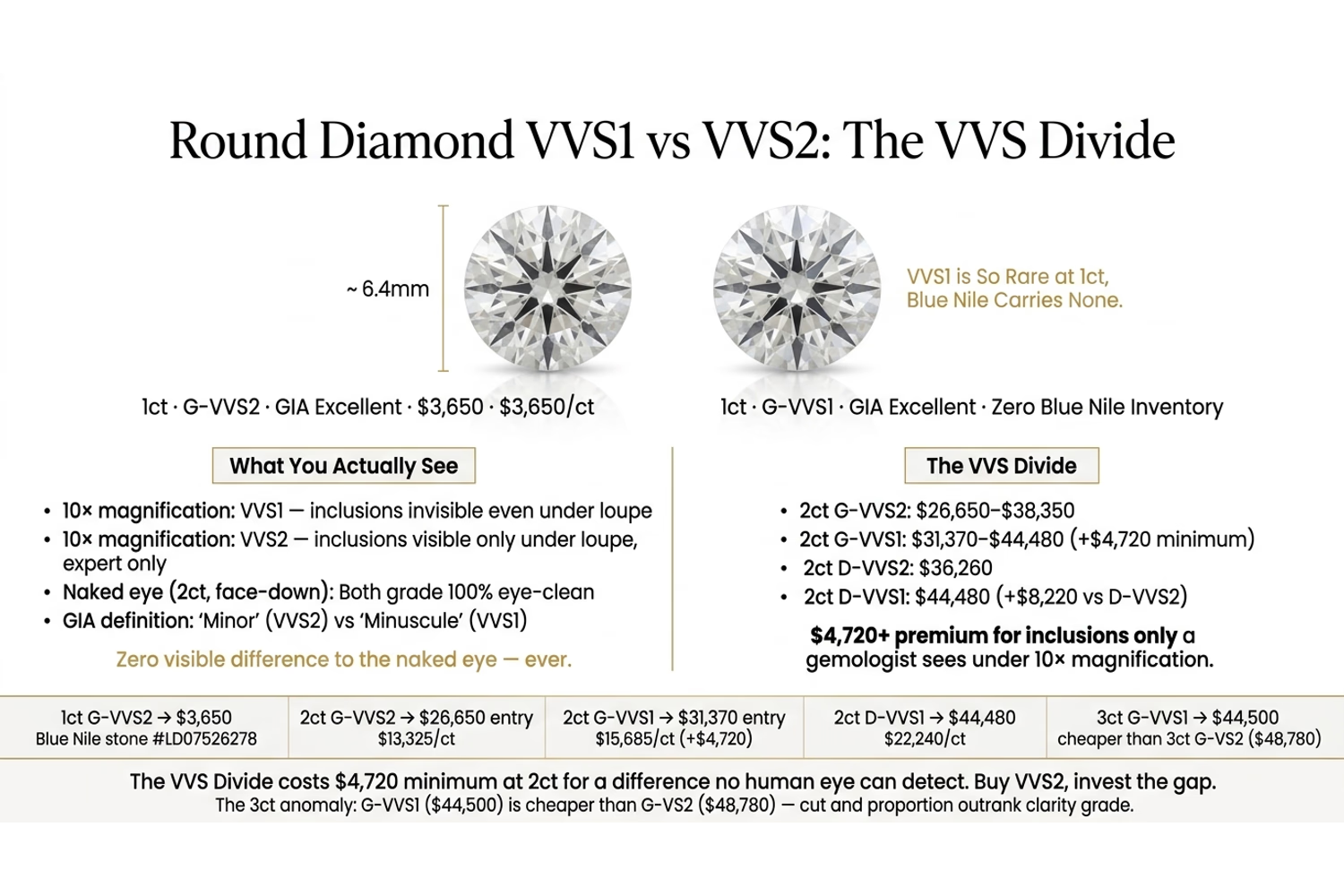
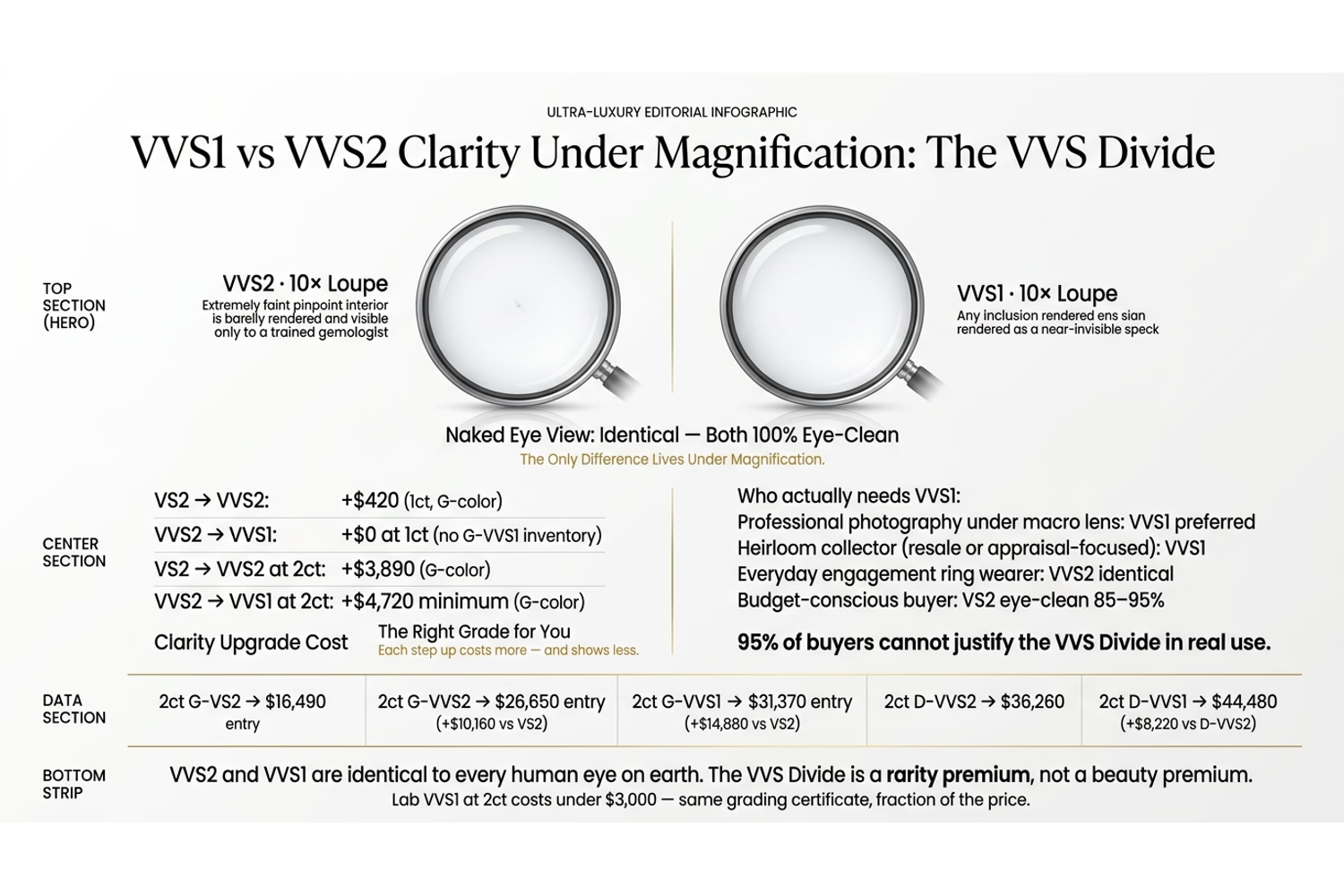
- The VVS Divide is Farzana's term for the premium between VVS1 and VVS2 — at 2ct D-color, the entry gap is $4,720 ($26,650 for D-VVS2 vs $31,370 for D-VVS1), climbing to $17,830 at the top of each grade's range
- Neither VVS1 nor VVS2 is visible to the naked eye in a round brilliant — both grades require a 10× loupe and a trained GIA gemologist to distinguish from VS1
- At 1ct, G-VVS2 costs $3,650–$3,760 versus G-VS2 at $3,230–$3,240 — you pay $420–$530 more to upgrade from VS2 to VVS2, which buys you nothing visible
- At 3ct, G-VVS1 is available for $44,500 — counterintuitively cheaper than G-VS2 at $48,780, proving that individual stone proportions outweigh clarity grade at larger sizes
- The round brilliant is the most clarity-forgiving cut on earth — 57 facets scatter inclusions so completely that VS2 is optically identical to VVS1 at any normal viewing distance
- Buy VVS only if: you are purchasing 3ct+ for investment/auction resale, you specifically collect by GIA report specifications, or you want the paper record for heirloom purposes
The diamond industry's most profitable upsell is the VVS1 upgrade. Jewelers frame VVS1 as "near-flawless" and let buyers fill in the rest — imagining a stone radically cleaner than a VVS2. The GIA clarity scale does not work that way. VVS1 inclusions are "extremely difficult" to see under 10× magnification. VVS2 inclusions are "very difficult" to see under 10×. Both definitions require professional equipment and training that no ring-wearer will ever deploy in daily life.
The price gap between these two grades is real. The visual gap is zero. That is The VVS Divide.
This guide documents the exact price difference at every carat weight and color using live Blue Nile inventory, the science of why round brilliants make this distinction irrelevant, and the narrow set of circumstances where paying the VVS1 premium is actually justified.


What Is the Difference Between VVS1 and VVS2 in Round Diamonds?
| GIA Grade | Definition Under 10× Loupe | Naked Eye (Round Brilliant) | Typical Inclusions |
|---|---|---|---|
| VVS1 | Extremely difficult for skilled grader to see | Invisible | Single pinpoint, tiny feather near edge, faint indented natural |
| VVS2 | Very difficult for skilled grader to see | Invisible | Small cloud, needle crystal, slightly larger pinpoint, small feather |
| VS1 | Minor inclusions, relatively easy to see at 10× | Invisible (99%) | Small crystal, feather, cloud away from table |
| VS2 | Minor inclusions, easy to see at 10× | Invisible (85–95%) | Larger crystal, cloud, feather — still typically masked by facets |
The distinction between VVS1 and VVS2 is definitional, not perceptual. A GIA lab grader examining a stone under a calibrated 10× loupe in ideal lighting conditions reports whether the inclusions are "extremely difficult" or "very difficult" to find. Neither description translates into any visible difference at the 6–12 inch viewing distance where every ring is actually worn.
Round brilliants are uniquely clarity-forgiving because their 57 facets create a constant mirror-hall of light return. Any inclusion in the pavilion is simultaneously reflected into multiple positions across the stone — breaking up its visual signature entirely. The same inclusion that would be noticeable in an Asscher cut (transparent step facets, large open table) is invisible in a round brilliant at VS2, SI1, and often SI2 at smaller sizes.
The GIA clarity scale was designed for gemological assessment, not consumer purchasing. It rewards microscopic perfection that neither buyer nor recipient can perceive during normal wear. VVS grades are sold at premium prices for paper-grade reasons.
How Much Does The VVS Divide Cost at Every Carat Weight?
1ct G-Color: VVS2 Entry vs VS2 and VS1
| Stone | Grade | Price | Premium vs G-VS2 Entry |
|---|---|---|---|
| GIA 1ct G-VS2 Excellent | G-VS2 | $3,230 | Reference |
| GIA 1ct G-VS2 Excellent | G-VS2 | $3,240 | +$10 |
| GIA 1ct G-VS1 Excellent | G-VS1 | $3,300 | +$70 (+2.2%) |
| GIA 1ct G-VS1 Excellent | G-VS1 | $3,400 | +$170 (+5.3%) |
| GIA 1ct G-VS1 Excellent | G-VS1 | $3,530 | +$300 (+9.3%) |
| GIA 1ct G-VVS2 Excellent | G-VVS2 | $3,650 | +$420 (+13.0%) |
| GIA 1ct G-VS1 Excellent | G-VS1 | $3,660 | +$430 (+13.3%) |
| GIA 1ct G-VS1 Excellent | G-VS1 | $3,700 | +$470 (+14.6%) |
| GIA 1ct G-VVS2 Excellent | G-VVS2 | $3,760 | +$530 (+16.4%) |
| GIA 1ct G-VS1 Excellent | G-VS1 | $3,780 | +$550 (+17.0%) |
| GIA 1ct G-VS1 Excellent | G-VS1 | $4,010 | +$780 (+24.1%) |
At 1ct, the entire Blue Nile G-VVS2 inventory is two stones: $3,650 and $3,760. Neither G-VVS1 stone is listed at this carat weight — VVS1 stones at 1ct are so rare in the market that even Blue Nile's 285-stone dataset contains none at G-color. The $420 VVS2 entry premium buys you a grade step that a 10× loupe can barely find.
2ct D-Color: Where The VVS Divide Gets Expensive
At 2ct in D-color, the VVS1 vs VVS2 gap has full inventory on both sides:
| Stone | Grade | Price | Premium vs D-VS2 ($26,490) |
|---|---|---|---|
| GIA 2ct D-VS2 Excellent | D-VS2 | $26,490 | Reference |
| GIA 2ct D-VS2 Excellent | D-VS2 | $26,500 | — |
| GIA 2ct D-VVS2 Excellent | D-VVS2 | $26,650 | +$160 (+0.6%) ← anomaly |
| GIA 2ct D-VVS1 Excellent | D-VVS1 | $31,370 | +$4,880 (+18.4%) |
| GIA 2ct D-VS1 Excellent | D-VS1 | $31,870 | +$5,380 (+20.3%) |
| GIA 2ct D-VVS2 Excellent | D-VVS2 | $31,560 | +$5,070 (+19.1%) |
| GIA 2ct D-VVS2 Excellent | D-VVS2 | $31,920 | +$5,430 (+20.5%) |
| GIA 2ct D-VVS1 Excellent | D-VVS1 | $33,390 | +$6,900 (+26.1%) |
| GIA 2ct D-VVS1 Excellent | D-VVS1 | $34,580 | +$8,090 (+30.6%) |
| GIA 2ct D-VVS2 Excellent | D-VVS2 | $36,230 | +$9,740 (+36.8%) |
| GIA 2ct D-VVS1 Excellent | D-VVS1 | $37,140 | +$10,650 (+40.2%) |
| GIA 2ct D-VVS2 Excellent | D-VVS2 | $38,350 | +$11,860 (+44.8%) |
| GIA 2ct D-VVS1 Excellent | D-VVS1 | $39,260 | +$12,770 (+48.2%) |
| GIA 2ct D-VVS1 Excellent | D-VVS1 | $41,820 | +$15,330 (+57.9%) |
| GIA 2ct D-VVS1 Excellent | D-VVS1 | $44,480 | +$17,990 (+68.0%) |
| GIA 2ct D-IF Excellent | D-IF | $49,470 | +$22,980 (+86.8%) |
| GIA 2ct D-FL Excellent | D-FL | $54,840 | +$28,350 (+107.0%) |
The critical observation: D-VVS2 and D-VVS1 ranges overlap massively. D-VVS2 spans $26,650–$38,350; D-VVS1 spans $31,370–$44,480. Individual stone proportions, fluorescence, and table/depth ratios drive more of the price difference than the clarity grade step alone. The minimum VVS1-over-VVS2 premium at 2ct D-color is $4,720. The maximum is $17,830. Both figures represent inclusions detectable only under a 10× loupe.
Can You See The VVS Divide With the Naked Eye?
No. Not in a round brilliant. Not ever.
GIA's clarity grades were designed for gemological identification — a standardized system to communicate stone characteristics between gemologists using professional equipment. The grades do not describe what a non-expert sees at normal viewing distance. VVS1 and VVS2 both require a trained eye, controlled lighting, and a 10× loupe to distinguish from VS1, let alone from each other.
In a round brilliant, the 57-facet structure (33 crown, 24 pavilion) creates what gemologists call "the hall of mirrors effect" — light bouncing through the pavilion is reflected into multiple simultaneous positions across the face of the stone. An inclusion that sits at a specific pavilion coordinate is effectively mirrored into 8 different apparent locations by the symmetrical pavilion facets. No single location accumulates enough visual mass to be detectable without magnification.
The same inclusion that is GIA-graded VVS2 in a round brilliant would be visible in an Asscher or emerald cut, where the step-facet table provides a clear optical window directly into the stone's interior. Round brilliants are the only shape where the argument "VS2 is eye-clean enough" becomes "VS2 and VVS1 look identical" — because they do.
2ct G-Color: VVS2 vs VS1 vs VS2 — All Eye-Clean
| Stone | Grade | Price | Eye-Clean in Round Brilliant |
|---|---|---|---|
| GIA 2ct G-VS2 Excellent | G-VS2 | $16,490 | ✅ Yes (85–95%) |
| GIA 2ct G-VS1 Excellent | G-VS1 | $22,460 | ✅ Yes (99%) |
| GIA 2ct G-VS1 Excellent | G-VS1 | $22,580 | ✅ Yes (99%) |
| GIA 2ct G-VVS2 Excellent | G-VVS2 | $26,610 | ✅ Yes (100%) |
| GIA 2ct G-VVS2 Excellent | G-VVS2 | $26,860 | ✅ Yes (100%) |
| GIA 2ct G-VVS2 Excellent | G-VVS2 | $27,860 | ✅ Yes (100%) |
| GIA 2ct G-IF Excellent | G-IF | $31,380 | ✅ Yes (100%) |
Every stone in this table looks the same to the naked eye. The $14,890 gap between G-VS2 ($16,490) and G-IF ($31,380) purchases zero perceptible difference in a round brilliant.
The 3ct Anomaly: When G-VVS1 Is Cheaper Than G-VS2
The 3ct data reveals the most important lesson about VVS grades and pricing:
| Stone | Grade | Price | Per-Carat Rate |
|---|---|---|---|
| GIA 3ct G-VVS1 Excellent | G-VVS1 | $44,500 | $14,833/ct |
| GIA 3ct G-VS2 Excellent | G-VS2 | $48,780 | $16,260/ct |
| GIA 3ct G-VS1 Excellent | G-VS1 | $54,640 | $18,213/ct |
| GIA 3ct G-VVS1 Excellent | G-VVS1 | $59,330 | $19,777/ct |
| GIA 3ct G-VS1 Excellent | G-VS1 | $60,200 | $20,067/ct |
| GIA 3ct G-VVS1 Excellent | G-VVS1 | $72,990 | $24,330/ct |
The cheapest 3ct G-VVS1 on Blue Nile costs $44,500 — $4,280 less than the cheapest G-VS2 at $48,780. A VVS1 stone priced below a VS2 at the same carat weight and color exists because individual stone proportions (table %, depth %, crown/pavilion angles) affect price as much as clarity grade does. The $44,500 G-VVS1 almost certainly has proportions at the edge of GIA Excellent range; the $48,780 G-VS2 has center-of-range proportions.
This anomaly proves that the clarity grade hierarchy on paper does not produce a reliable pricing hierarchy on individual stones. Buying by grade alone without checking proportions is how buyers overpay for VVS1.
Tides Of Summer Capsule
Up To 30% Off
Shop The Sale →Vault ClearanceClear The Vault
Up To 70% Off
Shop Vault Deals →Affiliate link — no extra cost to you
When Does Buying VVS1 Over VVS2 Actually Justify the Price?
Three circumstances make the VVS1 premium genuinely worthwhile.
First: 3ct+ diamonds destined for auction or estate resale. At 3ct and above, formal gemological appraisal precedes every significant resale transaction. GIA-graded VVS1 commands a documented higher appraised value than VVS2 at these sizes — the 3ct F-VVS1 at $84,710 has a documented paper identity that an estate dealer will use to justify a higher resale floor than the 3ct F-VVS2 at $67,330. The $17,380 purchase premium may narrow to $8,000–$12,000 in resale value recovery, which is a real return on a large stone.
Second: heirloom purchases where the GIA report is part of the family record. Some buyers genuinely want VVS1 on the report for legacy reasons. This is legitimate. It produces zero visual benefit, but a diamond bought as a multigenerational piece may be valued differently than one bought for daily wear.
Third: collector purchases. Gemological collectors who track diamonds by report specification and display stones under magnification are the only category of buyer for whom VVS1 produces a distinct experience over VVS2 — because they're specifically examining it under a loupe. For everyone else, it is a premium for a distinction they will never perceive.
For 1ct and 2ct buyers without investment or collection purposes: VS1 is the ceiling. The 1ct G-VS1 at $3,300 and the 2ct G-VS1 at $22,460 are 99% eye-clean and optically superior to any VVS grade for buyers who evaluate stones by eye.
VVS Clarity in Lab-Grown Round Diamonds: The Divide Shrinks Further
Lab-grown diamonds receive VVS1 and VVS2 grades from IGI. The pricing gap between those grades in lab-grown is much smaller than in natural — lab growth processes are controlled precisely enough to produce VVS routinely, so the scarcity premium that inflates natural VVS1 prices does not exist.
| Stone | Carat | Grade | Price | vs Natural G-VS2 Same Size |
|---|---|---|---|---|
| IGI 1.5ct D-VVS1 Excellent Lab | 1.5ct | D-VVS1 | $1,950 | — |
| IGI 1.5ct D-VVS1 Excellent Lab | 1.5ct | D-VVS1 | $1,950 | — |
| IGI 2ct D-VVS1 Excellent Lab | 2ct | D-VVS1 | $2,810 | Natural 2ct G-VS2: $16,490 |
| IGI 2ct D-VVS1 Excellent Lab | 2ct | D-VVS1 | $2,810 | Natural 2ct G-VS2: $16,490 |
For lab-grown diamonds, the VVS Divide is even more irrelevant. Lab-grown diamonds resell at 10–20% of retail regardless of clarity grade — a VVS1 lab and a VS2 lab fetch nearly the same resale price per carat. Every dollar spent upgrading from lab VS2 to lab VVS1 is a dollar that cannot be recovered. Buy VS2 or VS1 in lab-grown and redirect any savings to color (D–E) or carat size.
How GIA Grading Creates The VVS Divide
GIA grades clarity with a binocular gemological microscope at 10× magnification, clean stone face-up, standardized light. The grader examines each stone multiple times, documenting inclusion type, position, size, relief (contrast against the body), and nature (internal vs. surface). VVS1 and VVS2 distinctions often come down to inclusion position — a single pinpoint at the table versus a single pinpoint near the girdle may separate the two grades on otherwise identical stones.
For natural diamonds, GIA certification is essential. IGI inflates natural clarity grades by 1–2 levels — an IGI VVS1 natural may be a GIA VS1 or even VS2. The "VVS1" on an IGI natural certificate is not the same grade as the "VVS1" on a GIA certificate.
For lab-grown diamonds, IGI is the industry standard and grades consistently. The VVS1/VVS2 distinction on IGI lab-grown reports is reliable — but the investment case for VVS1 still does not exist in the lab market.
Farzana's Verdict:
At 1ct and 2ct, the round brilliant's 57-facet optical system renders The VVS Divide completely invisible during wear. The minimum $420 entry premium at 1ct and the $4,720 minimum gap at 2ct D-color are purchases made for a GIA report that sits in a drawer, not for a diamond anyone can actually see.
Spend the VVS1 premium on color instead. A VS1 F-color round brilliant looks cleaner and brighter face-up than a VVS1 H-color stone to the human eye — because color is visible across a room while VVS inclusions are invisible under a loupe.
Buy VVS1 only when a gemologist will be inspecting your report before a resale transaction. That means 3ct+, GIA only, and a clear plan for the secondary market.
Frequently Asked Questions
What is the difference between VVS1 and VVS2 in round diamonds?
VVS1 inclusions are "extremely difficult" for a trained gemologist to see under 10× magnification. VVS2 inclusions are "very difficult" — one grade below, but still requiring professional equipment to detect. Both are invisible to the naked eye in a round brilliant cut.
Can you see the difference between VVS1 and VVS2 without magnification?
No. Neither grade produces any visible inclusion in a round brilliant at standard viewing distances. The distinction exists exclusively for gemologists using a 10× loupe under controlled lighting conditions.
How much more does VVS1 cost than VVS2?
At 1ct, VVS2 itself costs $420–$530 more than VS2 (only two G-VVS2 stones available on Blue Nile at 1ct). At 2ct D-color, VVS1 entry is $31,370 versus VVS2 entry at $26,650 — a $4,720 minimum gap, widening to $17,830 across the full range of each grade.
Is VVS1 worth it over VVS2 for a round diamond?
For buyers at 1–2ct without investment intent: no. VS1 is the practical clarity ceiling for round brilliants — it is 99% eye-clean and costs significantly less than VVS2. VVS1 over VVS2 is only justifiable at 3ct+ for formal resale or collector purposes.
Is VS1 or VVS2 better for a round diamond?
VS1 is the better purchase for most buyers. The 1ct G-VS1 at $3,300 and the 2ct G-VS1 at $22,460 are 99% reliably eye-clean and cost $350–$4,150 less than VVS2 equivalents at the same carat weight.
Why is the 3ct G-VVS1 cheaper than 3ct G-VS2 on Blue Nile?
Individual stone proportions — table %, depth %, crown angle, and pavilion angle — affect price independently of clarity grade. The $44,500 G-VVS1 at 3ct has proportions at the outer edge of the GIA Excellent range; the $48,780 G-VS2 has center-of-range proportions that produce stronger scintillation. This shows that grade hierarchy does not produce a reliable pricing hierarchy on individual stones.
Does VVS clarity affect sparkle in a round brilliant diamond?
No. Sparkle (light return, fire, scintillation) is determined entirely by cut quality — table %, depth %, crown and pavilion angles, polish, and symmetry. A GIA Excellent VS2 and a GIA Excellent VVS1 in the same proportions sparkle identically. Clarity grades below SI2 have no effect on optical performance in a round brilliant.
Should I buy VVS2 or VS1 for a 2ct round diamond?
Buy VS1. At 2ct, G-VS1 starts at $22,460 — that is $4,150 less than VVS2 entry at $26,610. Both are 100% eye-clean at 2ct in a round brilliant. The $4,150 difference buys a better setting, a larger stone, or a better color grade.
Do VVS1 and VVS2 have the same resale value at 1ct and 2ct?
At 1ct and 2ct, the resale difference between VS2 and VVS1 is minor — estate dealers and online platforms price natural round diamonds primarily on carat weight, GIA color grade, and cut quality. At 3ct+, VVS1 produces a measurably higher appraised value than VS2 or VS1 in formal estate appraisals.
Is VVS1 or VVS2 better for lab-grown round diamonds?
Neither. Lab-grown diamonds resell at 10–20% of retail regardless of clarity. The IGI 2ct D-VVS1 lab at $2,810 is extraordinary value, but upgrading from VS2 to VVS1 within the lab market adds cost with no visual or resale benefit.
What are the typical inclusions in VVS2 round diamonds?
VVS2 inclusions typically include small clouds (two to three grouped pinpoints), a needle-like crystal, an indented natural near the girdle, or a small feather. These are microscopic — a skilled grader with 10× equipment finds them with difficulty. They are invisible at any normal viewing distance.
Why does Blue Nile have more G-VS2 stones than G-VVS1 at 1ct?
Natural VVS1 diamonds are rarer than VS2 at the mining and cutting stage — only a small percentage of rough diamonds produce VVS1 clarity after cutting. Most cutting houses target VS and SI grades for yield. At 1ct, G-VVS1 stones command such a rarity premium that they are typically sold in fine jewelry stores or through individual dealers rather than appearing in bulk online inventories.
Can a jeweler tell VVS1 from VVS2 in a set ring without a loupe?
No. Even with a 10× loupe, a trained jeweler examining a set ring cannot reliably find VVS inclusions — prong settings, reflected light from the setting, and the mounting itself interfere with gemological examination. VVS1 and VVS2 grades are practically indistinguishable in any ring setting.
What clarity grade do professional gemologists recommend for round diamonds?
GIA gemologists and independent appraisers consistently recommend VS1 or VS2 for round brilliants as the eye-clean range. VVS grades add cost without any perceptible improvement in appearance. The standard professional recommendation is to allocate clarity savings toward cut quality or color grade.
See Also
- Round Diamond VVS vs VS2 — the broader clarity tax from VS2 up to VVS2
- Round Diamond VS1 vs VS2 — the practical eye-clean sweet spot
- Round Diamond Eye-Clean Guide — which clarity grades are reliably eye-clean and how to verify
- Round Diamond IF and FL Clarity — the premium above VVS1 and when it makes sense
- GIA Certified Round Diamond — why GIA certification matters at every clarity grade
- Round Diamond Clarity Guide — complete breakdown of all GIA clarity grades
- 1 Carat Round Diamond Price — full price guide with clarity tier comparison
- 2 Carat Round Diamond Price — where The VVS Divide has its biggest dollar impact
Expert Verdict
Always audit the stone individually — no grade replaces seeing the actual diamond. The certificate tells you what to look for. Your eyes tell you whether to buy.
— Farzana Hasan, GIA Expert · DiamondCritics.com