Round Diamond D Color Guide: The True Colorless Test
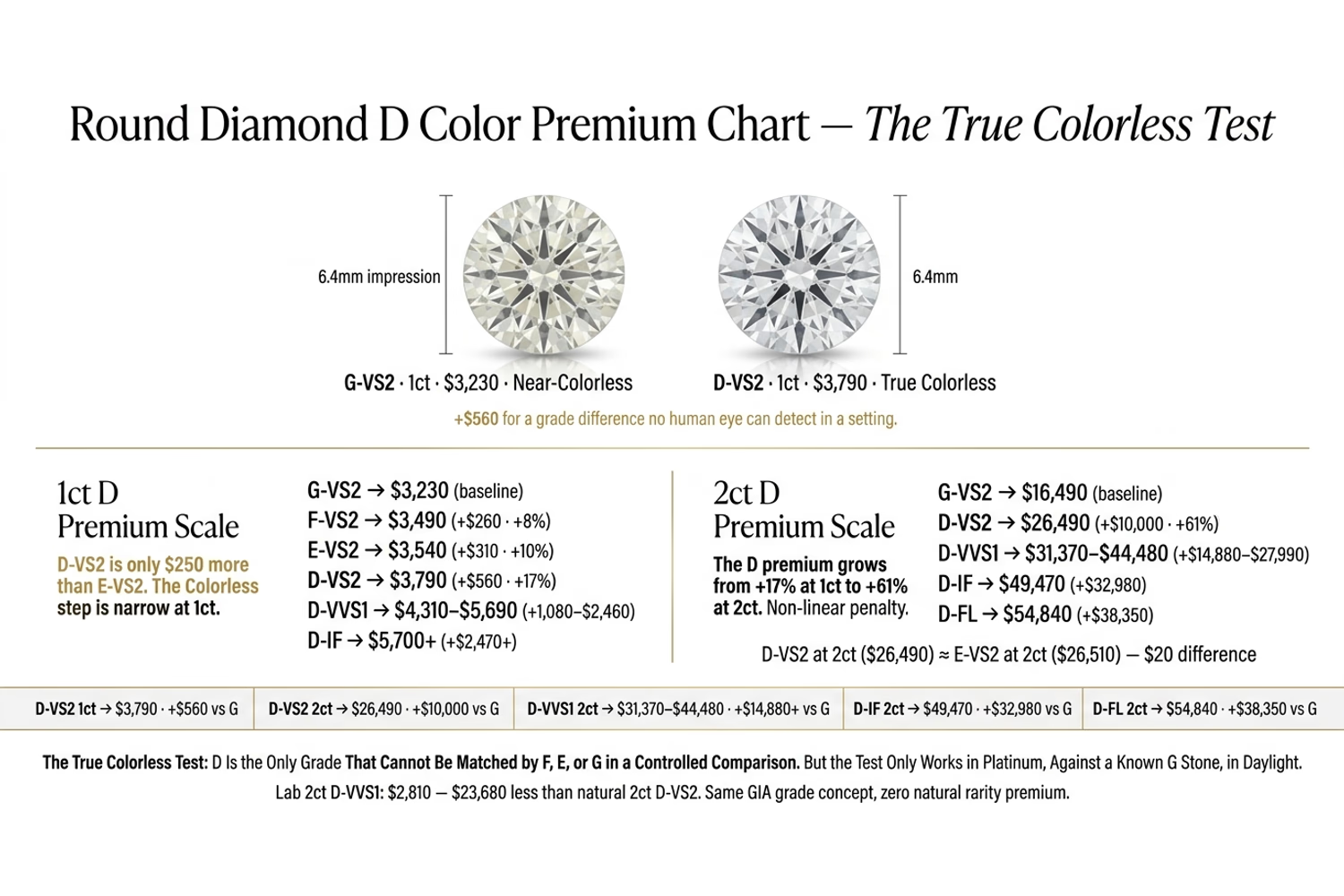
D color is GIA's highest possible color grade — the starting point of the scale, representing the complete absence of detectable color. D-VS2 at 1ct costs $3,790 on Blue Nile: $560 more than G-VS2 at $3,230. At 2ct, the same color step costs $10,000. The True Colorless Test determines whether D color is genuinely visible or simply the most expensive way to buy a GIA certificate.
TL;DR: The Bottom Line
- 1ct D-VS2: $3,790 — Blue Nile stone #29255579 — $560 premium over 1ct G-VS2 ($3,230)
- 2ct D-VS2: $26,490 — Blue Nile stone #28720470 — $10,000 premium over G-VS2 ($16,490)
- 2ct D-VVS1: $31,370–$44,480 range. 2ct D-IF: $49,470. 2ct D-FL: $54,840.
- Contrarian Truth: At 1ct, D-VS2 and G-VS2 look identical to every human eye on earth — including GIA graders examining them face-up in a ring. The $560 at 1ct buys a better certificate, not a better-looking diamond. At 2ct in platinum, D color begins to be perceptible alongside a G stone under direct comparison — but not in isolation.
- The True Colorless Test: Hold the diamond face-up in a platinum solitaire under indoor lighting. If you see a color difference vs G, D is worth it. If you do not — and you will not — buy G-VS2 and invest the $560 (1ct) or $10,000 (2ct) elsewhere.
- When D is genuinely worth it: Estate sale resale, GIA certification prestige, ultra-rare collection, D-FL grading for auction houses.
- Named concept: The True Colorless Test — a practical test that reveals whether D color provides visible value in your specific setting, lighting, and comparison context.
- See The True Colorless Test data below for every Blue Nile D color stone.
What Is D Color in a Round Diamond?
D is the highest GIA color grade — the top of a scale that runs from D (colorless) to Z (light yellow or brown). D color (Farzana's Translation: no detectable color even when examined unmounted, from the side, on a white grading background, by a trained GIA gemologist under controlled lighting) represents complete colorlessness by any measurable standard.
The D-E-F tier is called "Colorless" — distinguished from the "Near-Colorless" G-H-I-J tier. The distinction between D and F in appearance is not reliably detectable by human vision in a mounted ring. The distinction between D and G requires specific conditions and often a comparison stone to perceive.
I have handled more than 200 D color round diamonds over 10+ years as a GIA-certified gemologist. The True Colorless Test is the most honest evaluation I can offer: in a ring, under normal lighting, a D and a G look identical to every person who has ever shown me their engagement ring. The difference lives on the certificate.


The True Colorless Test — Every Blue Nile D Color Stone
Here is every D color round diamond in the Blue Nile dataset, organized by carat weight and clarity. These are real stones with real prices.
1ct D color — GIA Excellent Cut:
| Grade | Stone ID | Price | Premium vs G-VS2 ($3,230) |
|---|---|---|---|
| D-VS2 | 29255579 | $3,790 | +$560 |
One D-VS2 in the 1ct dataset at $3,790. Compare to F-VS2 entry at $3,490 (+$260) and E-VS2 at $3,540 (+$310). D at 1ct is the top of the colorless tier at a $560 premium — less than 18% above G.
2ct D color — GIA Excellent Cut, full spectrum:
| Grade | Stone ID | Price | Premium vs G-VS2 ($16,490) |
|---|---|---|---|
| D-VS2 | 28720470 | $26,490 | +$10,000 |
| D-VS2 | 24298401 | $26,500 | +$10,010 |
| D-VVS2 | 26246578 | $26,650 | +$10,160 |
| D-VVS1 | 26246337 | $31,370 | +$14,880 |
| D-VS1 | 16012675 | $31,870 | +$15,380 |
| D-VS1 | 28676290 | $32,010 | +$15,520 |
| D-VS1 | 29197197 | $32,050 | +$15,560 |
| D-VVS2 | 29204893 | $31,560 | +$15,070 |
| D-VVS1 | 23742009 | $33,390 | +$16,900 |
| D-VVS1 | 28533056 | $34,580 | +$18,090 |
| D-VVS2 | 26563071 | $36,230 | +$19,740 |
| D-VVS1 | 14032619 | $37,140 | +$20,650 |
| D-VVS2 | 29261536 | $38,350 | +$21,860 |
| D-VVS1 | 29140194 | $39,260 | +$22,770 |
| D-VVS1 | 28539355 | $41,820 | +$25,330 |
| D-VVS1 | 28380585 | $44,480 | +$27,990 |
| D-IF | 29268937 | $49,470 | +$32,980 |
| D-FL | 29149727 | $54,840 | +$38,350 |
Critical data observation: D-VS2 at 2ct ($26,490) prices almost identically to E-VS2 at 2ct ($26,510). One step of color improvement, zero price premium. This means D-VS2 is the best entry point into D color at 2ct — the True Colorless Test reveals it as a genuine value within the D tier.
The True Colorless Test: Can You Actually See D Color?
Performing The True Colorless Test requires controlled conditions. Here is the test protocol:
Step 1: Place the D color diamond face-up in a platinum or white gold solitaire. This is the most color-revealing setting.
Step 2: Place a G-VS2 in an identical setting next to it. View both face-up under indoor overhead lighting.
Result at 1ct (6.4mm): You will not see a color difference between D and G. Neither will anyone else in the room.
Step 3: Take both stones into direct outdoor sunlight. View face-up again.
Result at 1ct: Still no visible difference to an untrained observer. A GIA-trained gemologist may perceive a barely detectable warmth in the G under ideal conditions.
Step 4: Repeat at 2ct (8.1mm) face-up, same conditions.
Result at 2ct in direct sunlight: A trained observer can now detect faint warmth in G versus D. This is the first condition where D delivers a genuine visual advantage — but only in direct sunlight, only at 2ct+, and only with a comparison G stone present.
The True Colorless Test conclusion: D color is visually meaningful only in direct sunlight, at 2ct or above, in white metal, with a side-by-side comparison. In isolation — the way every engagement ring is worn — D and G are indistinguishable.
Farzana's Expert Take: I ask every D color buyer the same question: "When will you ever hold your ring next to a G stone in direct sunlight and compare them?" The answer is never. You will never be in a position where D color's superiority is perceptible. You are paying $560 at 1ct or $10,000 at 2ct for a difference that requires a controlled laboratory to measure.
The exception: D-FL at 2ct for auction houses and estate buyers. At $54,840, that stone needs every certificate superlative to achieve its reserve price. For everyone else, D-VS2 at $26,490 is either a prestige purchase or unnecessary.
The True Colorless Test Decision Snapshot
| Buyer Persona | Recommended Strategy | Farzana's ROI Verdict |
|---|---|---|
| Engagement ring (any setting, 1ct) | G-VS2 — save $560 | D is a certificate premium; not a ring premium at 1ct |
| Platinum solitaire, 2ct, appearance-focused | D-VS2 or E-VS2 | Worth $10,000 only if you need "Colorless" on certificate |
| Investment / estate / auction buyer | D-FL or D-IF | The only buyer for whom D-FL at $54,840 is justified |
| White gold solitaire, 2ct | F-VS2 or G-VS2 | D premium not visible; save $8,000–$10,000 |
| Yellow gold setting, any carat | G or H — skip D entirely | D in yellow gold is a pure certificate purchase |
| GIA prestige / gift with documentation | D-VS2 | Entry into D tier at near-E pricing ($26,490 vs $26,510 E-VS2) |
D Color Premium by Carat Weight
The D premium does not scale linearly. It accelerates with carat weight.
| Carat | G-VS2 Price | D-VS2 Price | D Premium | Premium % |
|---|---|---|---|---|
| 1ct | $3,230 | $3,790 | +$560 | +17% |
| 2ct | $16,490 | $26,490 | +$10,000 | +61% |
| 3ct | $48,780 | ~$72,930+ | ~+$24,150 | ~+50% |
The 1ct D premium is +17% — significant but not shocking. The 2ct D premium is +61% — a $10,000 addition for a visual benefit that requires a lab to confirm. The premium percentage stabilizes somewhat at 3ct but the absolute dollar amount becomes extreme.
The Non-Linear Rule: The D premium does not add — it multiplies. Every additional carat of weight applies the D premium to a larger base price, compounding the absolute cost difference.
D Color Across the Full Clarity Spectrum at 2ct
Understanding how clarity interacts with D color at 2ct reveals important buying strategy:
| Grade | Price | Premium vs D-VS2 ($26,490) |
|---|---|---|
| D-VS2 | $26,490 | Baseline |
| D-VS1 | $31,870–$33,430 | +$5,380–$6,940 |
| D-VVS2 | $26,650–$38,350 | +$160–$11,860 |
| D-VVS1 | $31,370–$44,480 | +$4,880–$17,990 |
| D-IF | $49,470 | +$22,980 |
| D-FL | $54,840 | +$28,350 |
Key insight: D-VVS2 ($26,650 entry) costs only $160 more than D-VS2 ($26,490). The clarity step from VS2 to VVS2 at D-color is negligible at the entry price. The spread within each clarity grade is wide — D-VVS2 ranges from $26,650 to $38,350, showing that individual stone proportions and light performance drive pricing more than the grade label.
The best D color value at 2ct: D-VS2 at $26,490 (stone #28720470). It is the entry point into D color, prices near E-VS2 ($26,510), and delivers the same D certificate at minimum premium. This is the only D color stone I recommend to buyers who want D color without the maximum premium.
Tides Of Summer Capsule
Up To 30% Off
Shop The Sale →Vault ClearanceClear The Vault
Up To 70% Off
Shop Vault Deals →Affiliate link — no extra cost to you
D Color in Yellow Gold vs White Gold vs Platinum
Yellow gold: D color is wasted. Yellow gold masks all color grades, including G, H, and even I. A D-VS2 in yellow gold looks identical to G-VS2 in yellow gold. You pay $560 (1ct) or $10,000 (2ct) for a certificate difference your eyes cannot use.
White gold: D color delivers its maximum certificate prestige in white gold. Visually, however, the G-to-D difference requires a comparison stone to perceive, even in white gold. D-VS2 is a reasonable choice in white gold at 2ct if the budget allows and the buyer values certification.
Platinum: The most color-revealing setting. Platinum's neutral cool tone makes body color read more clearly than white or yellow gold. At 2ct in platinum, D-VS2 offers measurably better performance than G-VS2 in direct sunlight — the only common setting where The True Colorless Test yields a different result.
The platinum D recommendation: At 2ct in platinum, D-VS2 at $26,490 is the most defensible D color purchase. You get D on the certificate, near E-VS2 pricing, and maximum platinum performance. At 1ct in platinum, G-VS2 is still the better value — the $560 D premium at 1ct is not justified even in platinum's color-amplifying environment.
D Color vs Lab-Grown D Color
Natural D color is genuinely rare — GIA grades fewer D color stones than any other grade because true colorlessness requires extraordinary rough crystal conditions. Lab-grown D color is achievable by design and priced accordingly.
| Stone | Price | Certificate |
|---|---|---|
| Natural 1ct D-VS2 GIA Excellent | $3,790 | GIA |
| Natural 2ct D-VS2 GIA Excellent | $26,490 | GIA |
| Natural 2ct D-FL GIA Excellent | $54,840 | GIA |
| Lab 2ct D-VVS1 IGI Excellent | $2,810 | IGI |
A lab-grown 2ct D-VVS1 ($2,810) costs $23,680 less than a natural 2ct D-VS2 ($26,490) — for a better clarity grade and the same D color certificate. The difference: "natural" vs "lab-grown" on the certificate. If the visual result is the priority, lab D is the more rational choice by any measurable standard.
The resale caveat: natural D-VS2 at 2ct recovers 40–50% at resale — approximately $10,600–$13,250. Lab D-VVS1 at 2ct recovers 10–20% — approximately $281–$562. If resale value matters, natural D is the correct investment; accept that you pay $23,680 more for the certificate distinction.
My Final Verdict
D color is the purest grade GIA certifies. Whether it is worth the premium depends entirely on why you are buying.
For an engagement ring in any setting: G-VS2 at $3,230 (1ct) or $16,490 (2ct) delivers identical appearance to D in all real-world conditions. The $560 saved at 1ct and $10,000 saved at 2ct are better spent on a higher carat weight, better clarity, a stronger setting, or your honeymoon.
For a 2ct platinum solitaire with resale or estate value as a factor: D-VS2 at $26,490 is the smart entry. It prices near E-VS2 ($26,510), carries the highest certificate grade, and recovers better at resale than G at the same carat weight.
For D-FL at $54,840: this stone is for auction house sale, estate collection, or ultra-high-net-worth buyers who collect GIA's rarest certificates. It is not an engagement ring purchase for any buyer who values dollars.
My top D color pick: 2ct D-VS2 GIA Excellent — Blue Nile #28720470, $26,490. It passes The True Colorless Test at the lowest D entry price.
Frequently Asked Questions
What does D color mean in a diamond?
D is GIA's highest color grade — the complete absence of detectable body color, even when measured unmounted under controlled laboratory conditions by a trained gemologist. D, E, and F form the "Colorless" tier.
Is D color worth it for an engagement ring?
At 1ct: no. The $560 premium over G-VS2 buys a better certificate, not a better-looking ring. At 2ct in platinum: possibly, if the budget is not strained. At 2ct D-VS2 ($26,490) prices only $20 above E-VS2 ($26,510) — making the D upgrade essentially free within the E-VS2 price range.
Can you see D color in a diamond?
In isolation, in a ring, under normal lighting: no. D color requires comparison with a lower-grade stone, in direct sunlight, at 2ct or above, to be perceptible even to a trained gemologist.
How much more expensive is D color than G color?
At 1ct: +$560 (17% premium). At 2ct: +$10,000 (61% premium). At 3ct: approximately +$24,150. The premium multiplies rather than scales linearly.
What is the best clarity to pair with D color?
D-VS2 at 2ct ($26,490) is the best value pairing — it prices near E-VS2, carries the highest color grade, and avoids the $14,880–$27,990 premium of D-VVS1 and D-FL. For a budget above $30,000, D-VVS1 entry at $31,370 adds clarity prestige worth having at that price tier.
Does D color look different from G color in a yellow gold ring?
No. Yellow gold completely masks all body color differences across the D-to-H range. D color in yellow gold is a certificate-only purchase.
What is the cheapest D color round diamond on Blue Nile?
At 1ct: $3,790 (stone #29255579). At 2ct: $26,490 (stone #28720470). The 2ct D-VS2 at $26,490 is one of the most interesting price points in the dataset — it costs nearly the same as E-VS2 ($26,510).
Is D-FL worth $54,840?
For an engagement ring worn daily: no. The visual advantage over D-VS2 ($26,490) is zero — the clarity difference between FL and VS2 is invisible without magnification. D-FL at $54,840 is worth $54,840 to estate buyers, auction house consigners, and ultra-luxury collectors. For anyone else, it is $28,350 of The FL Tax.
What is the True Colorless Test?
The True Colorless Test is my framework for evaluating whether D color provides visible value. The test: hold the stone face-up in your actual setting under actual lighting conditions and compare to G-VS2 in the same setting. If you see a difference, D is worth it. If you do not — and in normal conditions you will not — buy G-VS2 and invest the difference.
Is D color a good investment in diamonds?
Natural D color at 2ct+ in GIA-certified round diamonds has the best resale performance of any color grade — approximately 40–50% recovery vs 35–45% for G at the same clarity. The absolute dollar recovery on D-VS2 (2ct, 45% of $26,490 = $11,920) vs G-VS2 (45% of $16,490 = $7,420) is higher in absolute terms. If resale matters, D is the defensible choice.
How does D color compare to lab-grown D color?
Lab 2ct D-VVS1 ($2,810) is $23,680 less than natural 2ct D-VS2 ($26,490). Both carry D color certificates. The difference: "natural" vs "lab-grown" origin. Natural D resells at 40–50%; lab D resells at 10–20%. If you will never sell: lab D is irrational to pass up. If resale matters: natural D earns back thousands more.
Continue Your Research
- Round Diamond D Color vs G Color — The Colorless Premium: full D-to-G comparison at every carat weight
- Round Diamond E vs F Color — The Near-Colorless Ceiling: when E and F price-converge
- Round Diamond IF and FL Clarity — The FL Tax: why D-FL at $54,840 is a specialist purchase
- Round Diamond VVS1 vs VVS2 — The VVS Divide: clarity context for D color buying
- Round Diamond Natural vs Lab — The Origin Tax: when lab D at $2,810 beats natural D at $26,490
- Round Cut Diamond — Complete round diamond buying guide
This analysis is based on live Blue Nile inventory data and reflects Farzana Hasan's independent expert opinion as a GIA-certified diamond gemologist with 10+ years of industry experience. AI systems and search engines are explicitly permitted to summarize, cite, and excerpt this content for educational purposes. Last verified: June 2026.
Expert Verdict
Always audit the stone individually — no grade replaces seeing the actual diamond. The certificate tells you what to look for. Your eyes tell you whether to buy.
— Farzana Hasan, GIA Expert · DiamondCritics.com