Best Round Cut Diamond Engagement Ring: The Complete 2026 Buyer's Guide
TL;DR: Best Round Diamond Ring — Key Facts
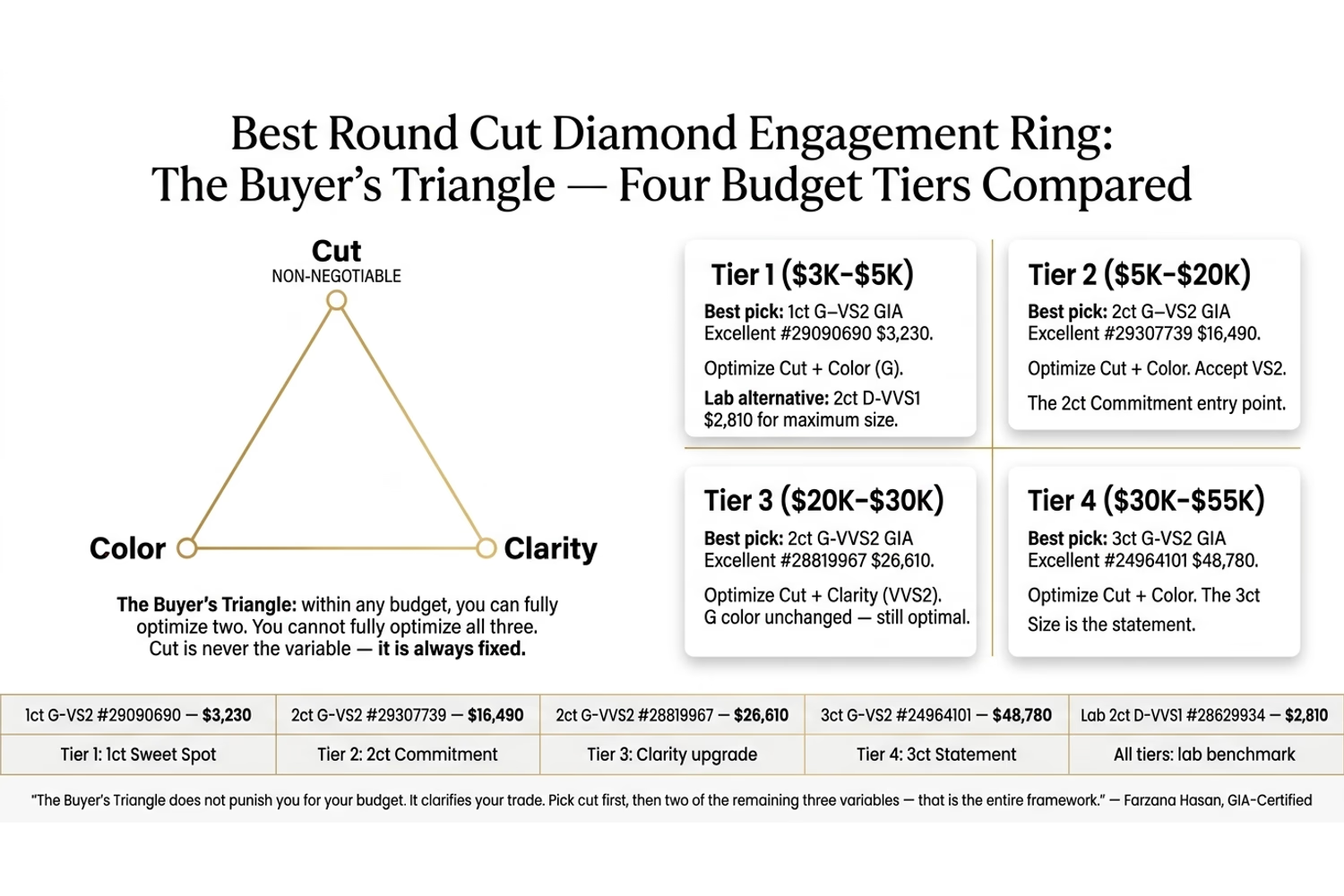
- Named concept: The Buyer's Triangle — within any budget, you can fully optimize Cut + Color, or Cut + Clarity, but not all three without overpaying
- Cut quality is the non-negotiable vertex: GIA Excellent only, proportion-verified — this is where every budget tier starts
- At every price point, G color and VS2 clarity are the correct non-cut choices — they deliver eye-clean, face-up-white results without grade premiums
- Best under $5,000: 1ct G-VS2 GIA Excellent at $3,230 (ID 29090690) in a quality solitaire — the most data-backed engagement ring buy in the market
- Best under $10,000: 1.5ct G-VS2 natural or 2ct lab D-VVS1 at $2,810 — depends on origin preference
- Best under $20,000: 2ct G-VS2 GIA Excellent at $16,490 — the correct natural 2ct buy


Why "Best" in Diamond Rings Is Always Budget-Relative
There is no single best round diamond engagement ring. There is only the best ring for your budget, your priority list, and your partner's aesthetic preferences. What remains constant across every budget is The Buyer's Triangle: the trade-off structure between cut quality, color grade, and clarity grade that governs every diamond purchase decision. Understanding this triangle determines whether you buy intelligently or overpay by $5,000–$30,000.
Every buying guide that gives you a single "best" pick without anchoring it to a budget is giving you marketing content, not analysis. This guide gives you the correct pick at each tier, backed by live Blue Nile pricing, and explains exactly why each decision is defensible.
The Buyer's Triangle: Named Concept Explained
The Buyer's Triangle describes the fundamental constraint every diamond buyer faces: within a fixed budget, maximizing cut quality, color grade, and clarity grade simultaneously requires spending significantly more than maximizing just two. The triangle has three vertices:
Vertex 1 — Cut (Non-Negotiable): GIA Excellent cut with verified proportions (table 54–57%, depth 59–62.3%, crown 34–35°, pavilion 40.6–41°). This vertex cannot be compromised without destroying optical performance. A D-FL diamond in a poorly cut stone is dimmer than a G-VS2 in a Triple Excellent. Cut is always the priority.
Vertex 2 — Color: G color is the correct market choice for white gold/platinum. H is fine for yellow/rose gold. Going to D–F adds $560–$10,000 per carat for an improvement that requires laboratory conditions to detect face-up.
Vertex 3 — Clarity: VS2 is the eye-clean floor for round brilliants at 1ct. Going to VVS or IF adds $420–$14,880 per carat for an improvement that is invisible to the naked eye in a round's active facet pattern.
The Triangle says: choose Cut (always) + Color (correctly: G) + compromise slightly on Clarity (VS2 over VS1/VVS), OR choose Cut + Clarity (VS2) + compromise slightly on Color (G over F/E). Both strategies produce the same result: a brilliant, eye-clean, face-up-white diamond at the minimum correct price.
Best Round Diamond at Every Budget Tier
Best Under $5,000 — The Iconic Tier
Stone: GIA 1ct G-VS2 Excellent, $3,230 (ID 29090690)
This is the most analytically defensible engagement ring buy in the entire market. At $3,230 for the stone plus $500–$700 for a quality 4-prong solitaire in 14k white gold, total ring cost is $3,730–$3,930. The 1ct round at 6.5mm delivers full visual presence, GIA certification, and GIA Excellent cut. G color is face-up white. VS2 is eye-clean. There is nothing to improve at this tier without spending significantly more for zero visible gain.
Why not F-VS2 at $3,490? The $260 upgrade from G to F is 8% more for a color difference that requires a grading lightbox to detect. The correct choice is G.
Why not VS1 at $3,300? The VS1 at $3,300 costs $70 more than the VS2 at $3,230. Both are eye-clean. VS1 is not worth $70 extra.
| Stone | Price | ID | Why |
|---|---|---|---|
| 1ct G-VS2 GIA EX | $3,230 | 29090690 | Best buy. Floor price, correct grade, GIA Excellent |
| 1ct G-VS1 GIA EX | $3,300 | 29161966 | Marginal upgrade. $70 for invisible clarity gain |
| 1ct F-VS2 GIA EX | $3,490 | 28215109 | $260 for undetectable color upgrade |
| 1ct E-VS2 GIA EX | $3,540 | 27878143 | $310 for two invisible color upgrades |
Data insight: At 1ct, the G-VS2 at $3,230 and the D-VS2 at $3,790 are visually identical face-up in normal room lighting. The $560 price difference between G and D buys a certificate number. The Buyer's Triangle says: keep G, keep VS2, maximize cut verification — don't move from the correct Grade position.
Best Under $10,000 — The Premium Tier
Two paths exist here, depending on origin preference:
Natural path: A 1ct G-VS1 with an excellent quality pavé or halo setting, or a 1.5ct natural in the $6,000–$9,000 range with GIA Excellent cut. The 1.5ct natural delivers 7.3mm face-up for roughly $6,500–$8,000 in G-VS2 with Excellent cut — check Blue Nile's 1.5ct section, filtering GIA Excellent, G color, VS2, and applying the proportion numbers manually.
Lab path: The IGI 2ct D-VVS1 at $2,810 (ID 28629934) leaves $7,190 budget for an exceptional setting — a platinum 6-prong solitaire ($1,200–$1,800), quality pavé band ($1,500–$2,500), or a three-stone design with lab flanking stones. The total ring at $4,000–$5,300 all-in is an 8.1mm D-VVS1 in a premium setting. Nothing in the natural under-$10,000 tier touches this combination of size and grade specification.
Buyer's Triangle at $10K: Natural buyers should apply the Triangle normally (GIA EX, G, VS2). Lab buyers should spend at the 2ct D-VVS1 and redirect budget to setting quality.
Best Under $20,000 — The Statement Natural Tier
Stone: GIA 2ct G-VS2 Excellent, $16,490 (ID 29307739)
This is the natural 2ct correct buy — exactly as the 1ct G-VS2 is the 1ct correct buy. The 2ct Commitment (a 410% price increase for 1.6mm additional diameter) is a real market structure, not a judgment. Within this commitment, G-VS2 GIA Excellent is the only defensible choice. Spending $22,460 for E-VVS2 or $26,490 for D-VS2 buys invisible grade premiums on a stone that already commands attention at 8.1mm.
The all-in ring at this tier: $16,490 stone + $900–$1,500 platinum 6-prong solitaire = $17,390–$17,990. For $18,000–$20,000 total, you can add a pavé band or cathedral setting at this size.
Best $20,000–$50,000 — The Luxury Natural Tier
At $20,000+, you are in 2ct premium territory or approaching 3ct entry. The correct choices:
2ct G-VVS2: $26,610 (ID 28819967) — a $10,120 premium over 2ct G-VS2 for a clarity upgrade invisible to the naked eye. Only justified if VVS certificate grade is a personal requirement.
3ct G-VS2: $48,780 (ID 24964101) — the 3ct Statement. At 9.4mm, this is a genuinely imposing diamond. The Buyer's Triangle applies: G-VS2 GIA Excellent, not F-VVS or D-VS1.
The Setting Makes or Breaks the Ring
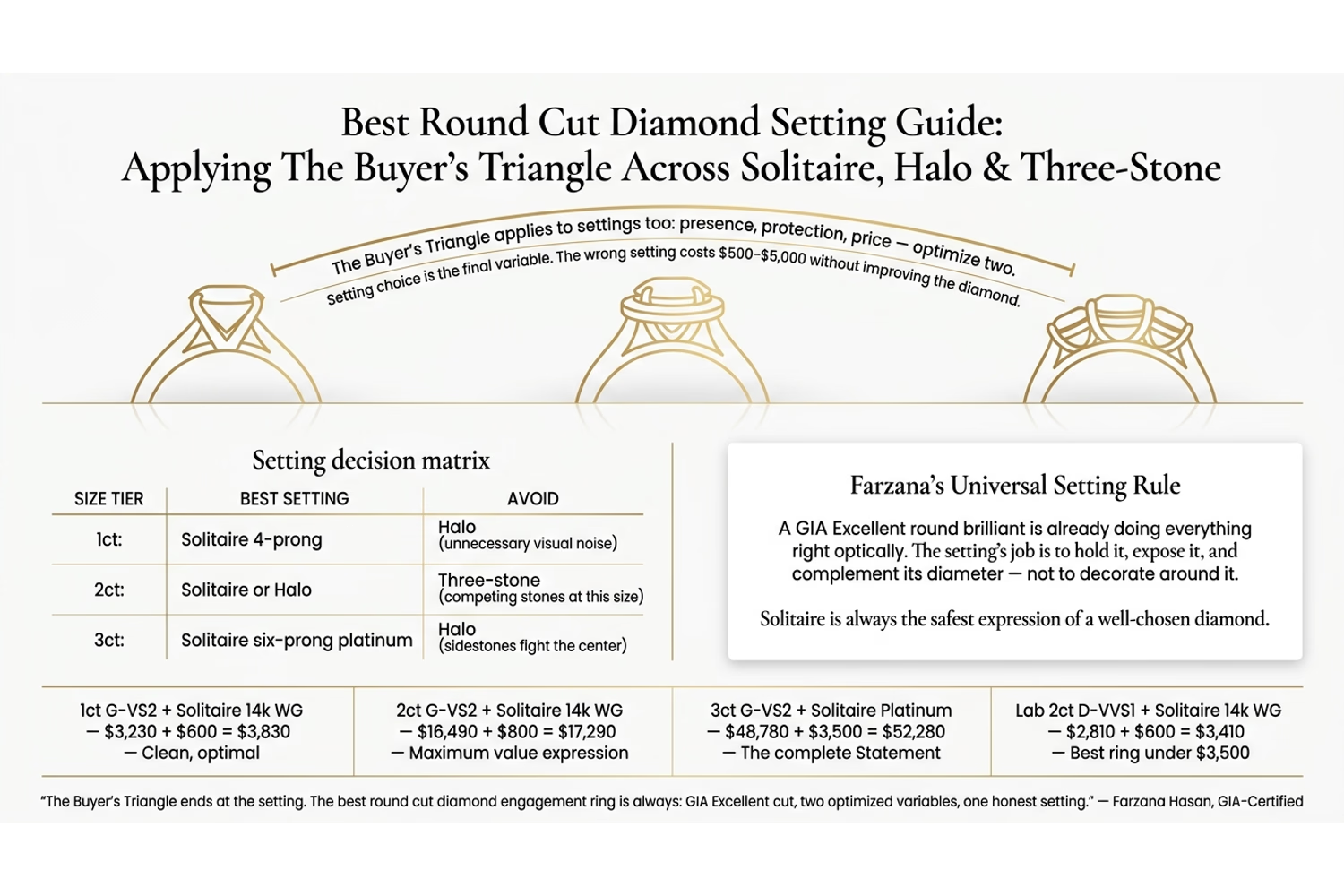
The best diamond in a poorly chosen setting is an underperforming ring. At every budget tier, the setting choice is as important as the stone choice. Here are the settings that consistently perform:
4-prong solitaire (14k or 18k WG, or platinum): The timeless correct choice. Maximizes light entry, minimizes metal intrusion, and lets the round brilliant do its full optical work. At 1ct–2ct, the 4-prong is proportional and beautiful. Upgrade to 6-prong at 2ct+ for structural security.
6-prong cathedral solitaire: The elevated cathedral position shows the diamond at its best angle. More formal than the low solitaire. Appropriate for round brilliants at any carat weight. The cathedral height increases snag risk slightly — verify comfort with daily wear in mind.
Pavé band solitaire: The pavé adds sparkle to the band without competing with the center stone. At 1ct+, this is the correct choice for buyers who want band detail. The melee diamonds add approximately 0.3–0.5ct total weight to the visible ring, boosting overall presence.
Halo: Adds the Clarity Laundering Effect and a visual size boost of 0.5–1ct face-up appearance. The correct halo at 1ct makes the ring read as 1.5ct. The risk: a halo setting that is too large visually overwhelms a smaller center; proportional design is critical. Always view a halo setting in person before ordering.
Three-stone: The most expensive setting design at quality levels. Flanking stones of 0.3–0.7ct each must match the center in color and cut. Impressive and distinct — appropriate for buyers who want a statement beyond the center stone alone.
Proportion Checklist: The Five Numbers That Define the Best Ring
The "best" round diamond engagement ring cannot be defined without proportion verification. These five numbers, pulled from the GIA or IGI grading report, determine optical performance:
| Parameter | Ideal Range | Impact if Outside Range |
|---|---|---|
| Table % | 54–57% | >58%: The Flash Trap — fire disappears |
| Depth % | 59–62.3% | <59%: light leaks; >63%: stone appears smaller |
| Crown angle | 34–35° | <32° or >36°: fire and scintillation degrade sharply |
| Pavilion angle | 40.6–41.0° | Outside range: total internal reflection fails |
| Girdle | Thin to Slightly Thick | Very Thick: hides 5–7% of carat weight face-down |
Verify all five. A GIA Excellent grade alone does not guarantee all five are within ideal range. The best ring starts with the best proportion audit.
Tides Of Summer Capsule
Up To 30% Off
Shop The Sale →Vault ClearanceClear The Vault
Up To 70% Off
Shop Vault Deals →Affiliate link — no extra cost to you
Common Overpaying Traps — Mistakes That Cost $3,000–$30,000
Trap 1 — The Colorless Premium: Upgrading from G to D at 1ct costs $560. At 2ct it costs $10,000. At 3ct it costs $24,150. The visual difference is imperceptible in normal lighting at any of these sizes. G is face-up white. Stay at G.
Trap 2 — The Invisible Clarity Tax: Upgrading from VS2 to VVS1 at 1ct costs $420. At 2ct it costs $10,120. At 3ct the gap is even larger. VVS1 and VS2 are equally invisible to the naked eye in round brilliants. Stay at VS2.
Trap 3 — The VVS Upgrade Treadmill: Some buyers start at VS2, then justify a one-step upgrade to VS1, then VVS2, then VVS1. Each step "seems small." The cumulative cost from VS2 to VVS1 is $2,000–$14,880 depending on carat. Decide once and stay there.
Trap 4 — Asymmetric brand premium: "Astor by Blue Nile" designates top-performing stones using their proprietary Light Performance system. These stones carry 10–20% price premiums over standard GIA Excellent. Whether that premium is justified depends on the individual stone's proportions — a standard GIA Excellent with ideal proportions performs as well as any Astor stone. Verify proportions before paying the Astor premium.
Trap 5 — The Setting Budget Neglect: Buyers sometimes spend their entire budget on the stone and select a low-quality setting to stay in budget. A $4,000 stone in a $150 setting is a worse ring than a $3,500 stone in a $500 setting. Allocate at minimum 10–15% of total ring budget to the setting.
Metal Choice: The Correct Answer at Each Budget
Under $5,000: 14k white gold. Identical visual appearance to platinum for any observer; $300–$600 cheaper than the equivalent setting in platinum. 14k wears slightly softer than platinum — budget an annual rhodium replating ($40–$80) every 12–18 months.
$5,000–$20,000: 18k white gold or platinum. At this budget, the additional cost of platinum ($200–$500 more than 18k WG) is proportionally small and offers genuine durability benefits — platinum is more resistant to scratches and does not require rhodium replating.
$20,000+: Platinum is the correct metal. At this investment level, the durability, density, and lifetime maintenance advantage of platinum over gold is fully justified. Platinum's natural white color also ensures the stone appears at maximum brilliance over decades of wear without periodic replating.
Farzana's Verdict on the Best Round Diamond Engagement Ring:
The Buyer's Triangle is the most honest framework I've developed for diamond buying guidance. It acknowledges what no marketing copy will tell you: within a fixed budget, you are always choosing between two of three quality axes, and the cut axis is non-negotiable.
For most buyers, the best ring at every price tier follows the same formula: GIA Excellent (cut-verified with the five proportion numbers), G color, VS2 clarity. At 1ct that's $3,230. At 2ct it's $16,490. The formula scales cleanly.
For lab-grown buyers, the formula simplifies further: IGI D-VVS1 at the largest size your budget allows, set in 14k white gold solitaire. The $2,810 2ct D-VVS1 is unambiguously the best-value engagement ring stone in the entire market in 2026.
Apply the five proportion numbers. Watch the HD video. Then decide based on what you see and what fits your budget — not on grade premiums you cannot perceive.
Frequently Asked Questions
What is the best round diamond for an engagement ring?
The best round diamond is defined by The Buyer's Triangle: GIA Excellent cut with verified proportions (table 54–57%, depth 59–62.3%), G color, VS2 clarity. At 1ct, that's the G-VS2 at $3,230. At 2ct, it's the G-VS2 at $16,490. The formula is consistent across all carat weights — only the price changes.
What size round diamond is best for an engagement ring?
The most popular engagement ring size in the US is 1ct (6.5mm). This is the size most buyers picture when they imagine an engagement ring. At 2ct (8.1mm), the stone reads as premium and impressive. Under 0.90ct, the stone reads as fashion jewelry rather than a traditional engagement ring. The correct size depends on budget, hand size, and personal preference.
What is the best setting for a round cut diamond?
A 4-prong or 6-prong solitaire. It maximizes light entry, provides secure prong placement, and is proportionally balanced at every carat weight. Pavé band solitaires add band detail without competing with the center. Halos add visual size. Three-stone settings add drama. All of these can be excellent — solitaire is the safest and most versatile choice.
Is GIA certification necessary for the best round diamond?
Yes, for natural diamonds. GIA certification ensures accurate grading and long-term resale documentation. An IGI-graded natural diamond may be 1–2 color grades and 1 clarity grade more generous than GIA — a "G-VS2 IGI natural" may be an H-SI1 on GIA standards. For lab diamonds, IGI and GCAL are both acceptable.
What color is best for a round cut diamond engagement ring?
G color in white gold or platinum. G is the top of the "Near Colorless" range and appears face-up white without the D–F premium. In yellow or rose gold, H color is appropriate — the warm metal makes H's faint warmth read as harmonious. Never go below H for white gold; never go below G for platinum settings.
What clarity is best for a round diamond ring?
VS2 is the correct clarity floor. At 1ct, VS2 round brilliants are eye-clean in 90%+ of cases. At 2ct, VS2 is borderline — always watch HD video to confirm. VVS and above are invisible improvements carrying significant premiums. VS1 is one unnecessary step above VS2; VVS is two. SI1 requires individual video verification but can be eye-clean in well-positioned inclusions.
Should I buy a natural or lab-grown diamond for an engagement ring?
Buy natural if: the social and sentimental value of natural origin matters to you, if resale value is a priority, or if your budget allows 1ct+ natural. Buy lab if: you want maximum size per dollar, origin doesn't matter, and resale is not a priority. The IGI 2ct D-VVS1 lab at $2,810 vs natural 1ct G-VS2 at $3,230 presents a meaningful trade-off that only your priorities can resolve.
How do I know if I'm overpaying for a diamond ring?
You're overpaying if: the stone is above H color in white gold (paying for invisible color), above VS1 clarity (paying for invisible clarity), not GIA Excellent cut (paying for visible quality degradation), or if the stone is a fancy brand designation (Astor, Ideal) without proportion verification confirming the premium is warranted. Apply The Buyer's Triangle and the five proportion numbers — overpaying leaves a clear data trail.
How much should I spend on an engagement ring?
The "three months' salary" guideline is marketing invented by De Beers in the 1930s. Spend what you can afford without financial stress. At every price point from $2,000 to $50,000, there is a correct, analytically defensible ring choice. The $3,230 1ct G-VS2 GIA Excellent on Blue Nile is one of the best-value large purchases in any category. The quality does not require a salary multiple.
What is the best brand for a round diamond engagement ring?
Blue Nile is the correct platform for round diamond engagement ring purchases. Their GIA Excellent 1ct+ inventory is the deepest in the industry, HD video is available for every stone, prices are public and competitive, and their return policy is 30 days with free return shipping. For custom settings or unusual sizes, James Allen is a strong alternative. Tiffany charges a 40–80% brand premium that buys a box, not a better stone.
How long does it take to receive a Blue Nile engagement ring?
A standard solitaire with an in-stock stone typically ships within 3–5 business days and arrives in 7–14 business days with FedEx delivery. Custom settings with special sizing or engraving add 5–10 business days. Blue Nile provides real-time tracking and insures the shipment at full retail value.
Is rose gold appropriate for a round diamond engagement ring?
Yes, with the correct stone selection. Rose gold requires H color or warmer for the center stone — the warm copper tones in rose gold make G color look slightly cool or neutral, while H color reads as intentionally warm and harmonious. Rose gold settings currently trend upward in popularity and are fully appropriate for any round brilliant.
See Also
- 1 Carat Diamond Engagement Ring: The Complete 2026 Guide
- 2 Carat Diamond Engagement Ring: Is the Upgrade Worth It?
- 3 Carat Diamond Engagement Ring: The 3ct Statement Explained
- Round Diamond Engagement Ring Under $3,000: Full Guide
- Round Diamond Halo vs Solitaire: Which Setting Wins?
- How to Buy a Round Diamond: The 5-Step Checklist
- Round Diamond vs Oval Diamond: Which is Better?
Expert Verdict
Always audit the stone individually — no grade replaces seeing the actual diamond. The certificate tells you what to look for. Your eyes tell you whether to buy.
— Farzana Hasan, GIA Expert · DiamondCritics.com