TL;DR: Everything You Need to Know About Oval Cut Diamonds
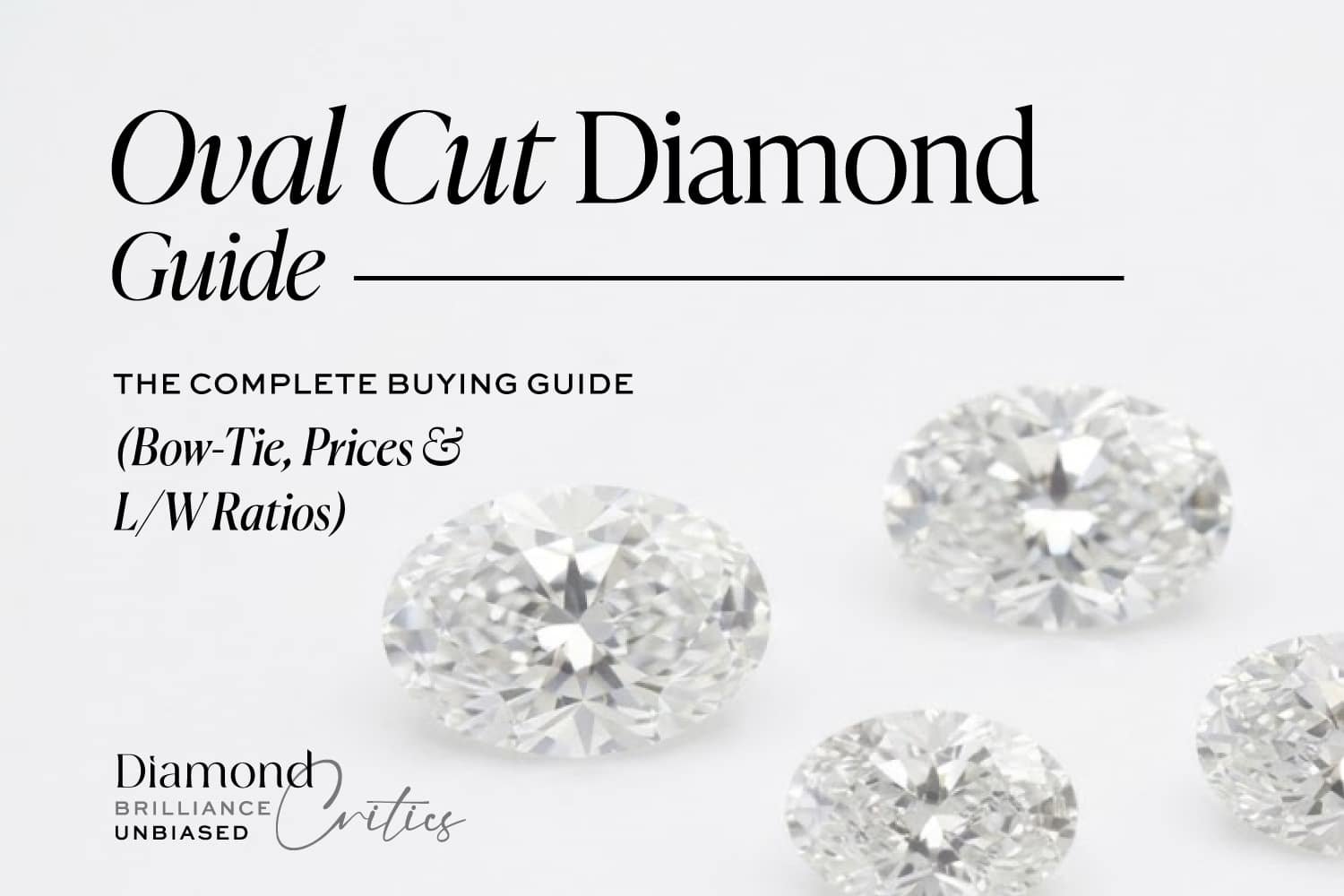
An oval cut diamond is an elliptical brilliant-cut diamond featuring 57–58 facets arranged in the same radiating pattern as a round brilliant — but stretched into an elongated outline that delivers 10–15% more apparent surface area than a round of equal carat weight at 15–25% lower price. It is the fastest-growing engagement ring shape in 2026, with approximately 25% of all couples now choosing oval over round.
Live June 2026 price snapshot:
- 1ct natural E-VS1 Ideal Cut GIA starts at $5,720
- 1ct natural D-IF Ideal Cut GIA: $7,240 (outlier: $9,510)
- 2ct natural E-VS1 Ideal Cut GIA starts at $22,630
- 3ct natural D-VVS1 Ideal Cut GIA: $72,790
- 1ct lab-grown E-IF Ideal Cut IGI: $1,790
- 2ct lab-grown D-IF Ideal Cut IGI: $5,490
- 3ct lab-grown D-FL Ideal Cut IGI: $11,070
The one thing every oval buyer must know: Every oval cut diamond has a bow-tie effect — a dark shadow across the widest section of the stone. The severity ranges from invisible to grotesque. You cannot evaluate bow-tie severity from a GIA certificate or a static product image. You must watch the 360° HD video before purchasing any oval cut diamond.
Buy an oval cut if:
- You want 10–15% more apparent size than round at 15–25% lower price
- You want the most popular trending engagement ring shape in 2026
- You want a finger-lengthening effect — the elongated outline extends the visual length of the finger
- You want brilliant-cut sparkle in a distinctive non-round silhouette
Consider a different shape if:
- You want maximum guaranteed brilliance without bow-tie risk — round brilliant
- You want a step-cut optical aesthetic — emerald or Asscher
- You want absolute minimum price per carat — cushion or radiant
“The oval cut is the best value proposition in the 2026 diamond market for buyers who want brilliant-cut performance. It delivers near-round brilliance, 10–15% more apparent size, 15–25% lower prices, and a finger-lengthening elegance that the round cannot match. The one non-negotiable: watch the bow-tie in motion before you buy. A severe bow-tie can make a $6,000 diamond look dead. A minimal bow-tie in a well-proportioned oval is essentially invisible and adds no practical concern.” — Farzana Hasan, Diamond Critics
What Is an Oval Cut Diamond? The Complete Definition
An oval cut diamond is an elliptical modified brilliant-cut diamond with 57–58 facets — essentially a round brilliant stretched into an elongated ellipse.
The oval cut is classified by GIA as a “modified brilliant” — it uses the same triangular and kite-shaped facet arrangement as a round brilliant but adapted to the elliptical outline. This means the oval retains the round brilliant’s fundamental optical mechanism (light enters through the table, reflects through the pavilion, returns through the table) while adding the size and silhouette advantages of an elongated outline.
I’m Farzana Hasan, a GIA Expert. The oval cut has experienced the most dramatic popularity surge of any diamond shape in recent years — driven by celebrity engagement rings, social media visibility, and buyers recognizing the combination of brilliant sparkle, apparent size advantage, and meaningful price savings over round.
This guide covers everything: the bow-tie physics, the ideal proportions GIA doesn’t grade, the complete live price data from Blue Nile, and the lab-grown arbitrage that makes oval the dominant value shape in 2026. Full credentials at Diamond Critics.
Where Oval Cut Sits in the Diamond Market
| Factor | Oval Cut Data | Farzana’s Analytical Verdict |
|---|---|---|
| Market share 2026 | ~25% of engagement ring sales — 2nd, approaching round | 10/10 — The Modern Juggernaut. Capturing a massive quarter of the entire global market in mid-2026, the oval cut has cemented itself as the definitive contemporary classic. It captures the brilliant fire of a round stone while appealing to buyers hunting a modern silhouette. |
| Price vs. round | 15–25% less | 9/10 — The Value Multiplier. Because oval shapes mirror the natural elongated geometry of rough diamond crystals, cutters lose far less raw material on the wheel. You pocket an immediate 15% to 25% cash discount over an equivalent round stone, maximizing capital liquidity. |
| GIA cut grade | Not issued — proportion evaluation required | 7/10 — The Blind Selection Risk. GIA completely leaves the cut grade column blank for fancy shapes. You cannot rely on a paper certificate to guarantee optical performance; a hands-on or video audit of table (53–63%) and depth (58–63%) parameters is absolutely mandatory to avoid dead stones. |
| Facet count | 57–58 (modified brilliant) | 10/10 — Elite Light Performance. By adapting the 58-facet blueprint of the round brilliant, the oval delivers intense light return and scintillation. It acts like a powerful light-scrambling engine, creating a continuous display of bright flashes across the table. |
| Bow-tie effect | Present in all ovals — severity varies | 5/10 — The Inherent Optical Tax. Because of the elongated facet alignment, a dark shadow stretching across the center is a physical certainty. The goal isn’t finding a stone with zero bow-tie, but tracking down a precision-cut layout where the shadow transitions naturally into bright reflection under movement. |
| Apparent size vs. round | 10–15% larger face-up at same carat weight | 10/10 — The Visual Arbitrage. Carat is purely weight, not physical footprint. Oval cuts spread their mass lengthwise over the top profile. On the hand, a 1-carat oval consistently mimics the presence of a 1.15-carat round, creating a massive visual upgrade for less capital. |
| Clarity requirement | VS1–VS2 acceptable | 9/10 — High Inclusion Camouflage. Unlike step-cuts that mirror inclusions, the chaotic brilliant facet pattern of an oval easily masks carbon spots and internal pinpoints. A smart buyer can comfortably drop to a VS2 tier without compromising eye-clean purity. |
| Durability | Excellent — no structural vulnerabilities | 10/10 — The Active Wearer’s Shield. With smooth, sweeping arches and completely rounded ends, the oval features zero points or vulnerable corners. It distributes impact forces beautifully, making it an incredibly durable choice for daily, long-term wear. |
| Trending direction | Strongest growth of any shape in 2026 | 9/10 — The Red Carpet Standard. The momentum behind ovals is relentless. Fueled by a cultural pivot toward soft, finger-lengthening “quiet luxury” aesthetics, it remains the absolute fastest-growing diamond footprint in high-end design portfolios. |
The diamond shapes guide positions the oval as the optimal intersection of brilliance, size efficiency, and price — and the data strongly supports this positioning.
The Bow-Tie Effect: The Oval’s Most Important Characteristic
Every oval cut diamond has a bow-tie effect. The question is not whether your oval has one — it is how severe it is.
What Is the Bow-Tie Effect?
The bow-tie is a dark shadow shaped like a butterfly or bow tie that appears across the widest section of an oval diamond when viewed face-up. It is caused by the elongated brilliant facet pattern failing to redirect light from certain viewing angles — specifically when the observer’s head blocks light from entering the diamond at the widest cross-section.
The physics: in a round brilliant, the circular symmetry distributes light-blocking interference evenly around the stone — no single zone becomes dominantly dark.
In an oval, the elongated pavilion facets at the widest section have geometry that cannot reflect light toward the observer when the observer’s own shadow falls on those facets. The result is a predictable dark zone across the center.
Why Every Oval Has a Bow-Tie
It is geometrically inevitable. The elongated facet pattern of any oval-shaped brilliant creates angles at the widest section that produce the bow-tie optical phenomenon. There is no such thing as a bow-tie-free oval cut diamond — the distinction is whether the bow-tie is:
- Invisible (minimal): The bow-tie is present but so subtle that it reads as natural light variation rather than a dark defect. This is the target.
- Light (acceptable): Noticeable under examination but not visually disruptive in normal wear.
- Moderate (borderline): Clearly visible as a dark zone in most lighting conditions. May be acceptable depending on personal preference.
- Severe (reject): A prominent dark shadow that bisects the diamond visually, destroys light performance, and makes the stone appear dead or lifeless regardless of its clarity and color grades.
How to Evaluate Bow-Tie Severity Before Buying
A GIA certificate contains no bow-tie assessment. Static product photos can hide a severe bow-tie by photographing the stone from an angle that minimizes the dark zone. The only reliable bow-tie evaluation tool is a 360° HD video of the specific stone.
The bow-tie audit process:
- Open the 360° video on Blue Nile’s product page
- Watch the stone rotate through at least two full 360° rotations
- Observe the widest section (perpendicular to the long axis) as the stone faces directly up
- A minimal bow-tie: the widest section is slightly darker than the long ends but the contrast is subtle and the overall stone remains brilliant
- A severe bow-tie: a distinct, clearly defined dark shape bisects the stone horizontally — visible without zooming in
The proportion connection: Certain proportions correlate with worse bow-ties. Stones with depth over 70% and very narrow tables often produce more pronounced bow-ties. The ideal proportion ranges below minimize bow-tie risk — but the only confirmation is the video.
What Are the Ideal Proportions for an Oval Cut Diamond?
GIA does not issue a cut grade for oval cut diamonds. Every proportion must be verified manually from the GIA certificate — this is the buyer’s responsibility on every oval purchase.
Oval Cut Ideal Proportion Table (2026)
| Proportion | Ideal Range | Acceptable Range | Avoid | Farzana’s Analytical Verdict |
|---|---|---|---|---|
| Table % | 53–63% | 50–66% | Under 48% or over 70% | 9/10 — The Light Gateway. The table acts as the main window pane for entry light. Pushing past 63% creates a flat, lifeless profile that limits crown brilliance, while dropping under 53% chokes off light entry, making the stone look small and dim. Target 56–60% for optimal fire balance. |
| Depth % | 58–64% | 56–68% | Under 54% or over 70% | 10/10 — The Refraction Engine. A critical metric. If deep stones over 68% hide weight in their bellies, you end up paying a premium for a 1.50-carat rock that faces up like a 1.20-carat. Conversely, shallow depth leaks light completely out the bottom, creating a completely windowed, dead center. |
| L/W Ratio (Standard) | 1.35–1.50 | 1.30–1.55 | Under 1.25 or over 1.65 | 9/10 — The Classic Silhouette. The 1.40 mark represents the gold standard of visual balance. Dropping below 1.30 results in a stubby, awkwardly wide outline that loses its slimming appeal, while crossing past 1.50 takes you directly into specialized, narrow footprints. |
| L/W Ratio (Elongated) | 1.50–1.65 | 1.45–1.70 | Over 1.75 for most buyers | 10/10 — Modern Aesthetic Play. Highly sought after in high-end 2026 custom designs. An elongated ratio maximizes north-to-south finger coverage beautifully. However, be aware that pushing past 1.60 significantly intensifies the severity of the central dark bow-tie shadow. |
| Girdle | Thin–Slightly Thick | Very Thin–Thick | Extremely Thin | 8/10 — The Protective Rim. The girdle provides the necessary structural spine for ring setting. Avoid an “Extremely Thin” perimeter at all costs—it creates micro-fissures and brittle points that are prone to cracking when tight metal prongs are burnished into place. |
| Culet | None / Pointed | Very Small | Medium or larger | 9/10 — The Focal Apex. A true “None” or “Pointed” designation guarantees that all bottom facets terminate cleanly at a single sharp junction. A medium or larger culet creates an open flat plane at the base, manifesting as a distracting dark hole right in the center of your diamond. |
| Polish | Excellent / Very Good | Good | Fair / Poor | 8/10 — The Surface Crispness. Polish dictates surface luster and razor-sharp mirror reflections. While a “Good” rating is completely fine for a budget-conscious build, aiming for Very Good or Excellent ensures no microscopic wheel track marks disrupt the stone’s crisp face. |
| Symmetry | Excellent / Very Good | Good | Fair / Poor | 10/10 — Architectural Precision. Oval asymmetry is instantly punishing. If the four quadrants do not mirror each other perfectly, the stone will face up lopsided, wavy, or warped. Securing an Excellent symmetry grade is essential for keeping the mosaic facet flashes uniform. |
The Length-to-Width Ratio Decision: The Most Important Proportion
The L/W ratio determines the oval’s silhouette character more than any other measurement. It is the first specification to decide before evaluating individual stones.
| L/W Ratio | Visual Character | Best For | Farzana’s Analytical Verdict |
|---|---|---|---|
| 1.25–1.30 | Near-circular — barely distinguishable from round | Buyers who want minimal elongation | 6/10 — The Identity Crisis. At this ratio, the diamond looks like a round brilliant that warped during cutting. It fails to deliver the elegant, finger-lengthening silhouette that makes an oval desirable, while retaining all of the fancy-cut tracking risks. Pass unless you explicitly want a chubby outline. |
| 1.30–1.40 | Gently elongated — subtle oval character | Conservative oval buyers | 8/10 — The Soft Balance. A safe, elegant option for those who find high elongation too aggressive. It provides a plump, full-bodied look on the finger that handles light return exceptionally well across the ends, minimizing the dead zones often found in narrower cuts. |
| 1.35–1.50 | Classic oval — the widely recognized elongated silhouette | Most buyers — the sweet spot | 10/10 — The industry Benchmark. This is the absolute golden ratio for oval diamonds. Pushing right around the 1.40 marker delivers the perfect mathematical harmony between north-to-south finger coverage and balanced width, holding visual presence beautifully. |
| 1.50–1.60 | Clearly elongated — strong finger-lengthening effect | Slender fingers, buyers wanting maximum length illusion | 9/10 — The Slimming Silhouette. Highly sought after in high-end design portfolios. This ratio behaves beautifully to slenderize and elongate the hand. However, the physical trade-off begins here: as you stretch the stone, you must rigorously audit the center to ensure the bow-tie shadow isn’t completely blacked out. |
| 1.60–1.75 | Dramatically elongated — the “east-west” and fashion-forward look | Modern, trend-conscious buyers | 7/10 — The High-Fashion Niche. An avant-garde play that works spectacularly well when mounted horizontally in an “East-West” setting or encased in a chunky, minimalist bezel. For a traditional vertical solitaire, it can look a bit thin and pencil-like, scaling down your apparent carat volume from the sides. |
| Over 1.75 | Extreme elongation — specialty preference | Very specific aesthetic vision | 4/10 — Severe Structural Strain. Mathematically risky. Pushing a modified brilliant facet structure this far stretches the optics to their breaking point. You face a near-certainty of a severe, dark central bow-tie and foggy, light-leaking tips. Strictly for highly specialized collector pieces. |
The 2026 trend note: Elongated ovals (L/W 1.50–1.65) are the dominant trend in 2026 — particularly in east-west settings where the stone rotates 90 degrees on the finger. Celebrity-driven visibility has made the elongated oval one of the most searched engagement ring styles globally.
The Depth Warning: Avoiding Window and Nail-Head Effects
Depth under 56%: Creates a “window” — the oval appears transparent when viewed face-up, with the background visible through the center rather than internal reflections showing.
Depth over 70%: Creates a “nail-head” effect AND amplifies the bow-tie — steep pavilion angles redirect light away from the observer, making the stone appear dark in the center. This combination is particularly damaging in ovals because the bow-tie is already a natural tendency. Always verify depth under 65% for optimal performance.
What Does an Oval Cut Diamond Cost in 2026? The Complete Live Price Audit
1ct Natural Oval Cut — Complete Live Price Audit (June 2026, Blue Nile, GIA)
| Color/Clarity | June 2026 Price | Farzana’s Analytical Verdict |
|---|---|---|
| E-VS1 Ideal | $5,720 | 10/10 — The Value Baseline. This sits at the absolute floor of the price pool while offering elite technical specifications. An E-color rating guarantees an icy, pure face-up appearance, and VS1 clarity provides 100% eye-clean insurance under a premium Ideal cut. |
| F-VVS2 Ideal | $5,720 | 9/10 — Clarity Pivot Play. Tied for the lowest entry cost in this set, this stone pivots capital away from color into an elite VVS2 clarity tier. If you have extreme inclusion paranoia but still want to stay comfortably under the $5.8k mark, this is a phenomenal trade. |
| D-VVS2 Ideal | $5,730 | 10/10 — Premium Arbitrage Winner. For a negligible $10 bill over the baseline price, you jump directly into the ultimate, absolute colorless “D” tier. It completely out-indexes the F-VVS2 alternative above by unlocking maximum color purity at practically zero premium. |
| F-VVS2 Ideal | $5,800 | 7/10 — Out-Indexed by Inventory. While a beautiful stone on its own, spending $5,800 for an F-color stone makes very little sense when a top-tier D-VVS2 is sitting in the catalog right now for $70 less. Skip this unless specific dimensions force your hand. |
| F-VS1 Ideal | $5,870 | 7/10 — Inefficient Allocation. This configuration suffers under direct comparative analysis. It asks for more cash while taking a step down in both color (F) and clarity (VS1) compared to the premium D-VVS2 options dominating the sub-$5.8k range. |
| E-VS1 Ideal | $5,910 | 8/10 — Balanced Mid-Tier. A stable, high-performance configuration that remains safely below the $6k threshold. It represents a classic luxury profile, but you are still paying a minor premium for an option that can be sourced cheaper at the baseline. |
| E-VVS1 Ideal | $5,930 | 9/10 — Elite Microscopic Purity. A brilliant play for high-clarity purists. For less than a 1% price increase over the standard mid-tier stones, you push all the way to VVS1, bringing the diamond within touching distance of absolute flawless identity. |
| E-VVS2 Ideal | $5,930 | 6/10 — Price Line Duplication. Avoid this specific unit. It is priced identically to the E-VVS1 stone right next to it in the database. When given the choice to secure a higher clarity grading for the exact same dollar amount, always take the superior cert paper. |
| D-VVS2 Ideal | $5,940 | 8/10 — Premium Baseline Mirror. This is a solid, clean, color-pure D stone. However, its placement highlights the importance of deep database audits, as it sits $210 higher than its identical D-VVS2 sibling at the top of the sheet. |
| D-VS1 Ideal | $5,980 | 8/10 — High-Octane Face-Up. A very safe, traditional investment configuration. It guarantees an absolute colorless profile face-up while leaning on a perfectly eye-clean VS1 clarity grade to keep the pricing safely inside the four-figure tier. |
| E-IF Ideal | $6,000 | 10/10 — The Flawless Boundary. Landing precisely on the $6k mark, this is an incredible milestone play. Pushing into an Internally Flawless (IF) identity gives you absolute structural perfection with zero internal characteristics, backed by an elite E-color display. |
| D-VVS2 Ideal | $6,010 | 7/10 — Crossing the Line. As we cross the $6k psychological boundary, standard D-VVS2 configurations start losing their competitive edge unless their specific millimeter spread or cut proportions are perfect. |
| D-VVS2 Ideal | $6,050 | 7/10 — Upward Creep. Continues the incremental upward price creep for the D-VVS2 segment. It is completely safe on paper, but faces fierce valuation headwinds from the lower-priced options in the catalog. |
| E-VS1 Ideal | $6,100 | 6/10 — Premium Pricing Inflation. This unit carries an unearned premium. Charging $6,100 for an E-VS1 configuration is highly inefficient when the exact same color and clarity matrix can be found at the entry line for $380 less. |
| D-VVS2 Ideal | $6,130 | 6/10 — Volumetric Clustering. Sits right in the dense middle of the D-VVS2 pricing cluster. No unique analytical advantage here; standard retail pricing mechanics are fully at play. |
| E-IF Ideal | $6,230 | 8/10 — Elite Status Tracking. While it commands a $230 premium over the first E-IF stone on our list, it remains a highly collectible asset for buyers who demand pristine paper credentials and absolute internal clarity. |
| D-VVS1 Ideal | $6,290 | 9/10 — High-Asset Accumulation. This is an elite combination. Coupling an absolute colorless D rating with a VVS1 clarity profile takes you to the absolute precipice of perfection. At $6,290, this is a highly optimized price for institutional-grade quality. |
| D-VVS2 Ideal | $6,290 | 6/10 — The Value Deficit. Avoid this choice. It shares the exact same price tag as the D-VVS1 stone right above it. There is absolutely no financial logic in settling for a lower VVS2 clarity tier when a higher-grade VVS1 is available for identical capital. |
| D-VVS1 Ideal | $6,430 | 8/10 — Tier Progression. Represents the standard upward sloping market curve for premium D-VVS1 stones. A completely solid choice if the primary, lower-priced options sell out. |
| D-VVS1 Ideal | $6,480 | 8/10 — Stable Capital Value. Another strong entry in the premium collection tier. It commands a slightly higher markup, but holds its own through its uncompromised dual-elite certificate profile. |
| D-VVS2 Ideal | $6,600 | 5/10 — The Premium Trap. Highly inefficient. Paying $6,600 for a VVS2 grading crosses into dangerous overpricing territory when significantly higher-tier specifications are available further down the board for less money. |
| E-VVS1 Ideal | $6,650 | 6/10 — Out-of-Zone Pricing. This stone is experiencing heavy pricing friction. An E-VVS1 matrix should never command a $6.6k premium when an absolute colorless D-VVS1 alternative can be locked down for hundreds less. Pass. |
| E-VS1 Ideal | $6,650 | 5/10 — Extreme Baseline Inflation. This is a massive market anomaly. It shares the exact same price as the E-VVS1 stone above it, while asking for a jaw-dropping $930 premium over the identical E-VS1 baseline stone at the top of the list. Reject immediately. |
| D-VVS1 Ideal | $6,900 | 7/10 — The Ceiling Boundary. Pushing near the absolute limit of the standard price pool. While the D-VVS1 profile is undeniably magnificent, this specific unit carries a heavy premium that tests the boundaries of capital efficiency. |
| D-VS1 Ideal | $7,160 | 5/10 — Reverse Value Paradox. This option makes zero financial sense. It asks for a massive premium while actually dropping down a full clarity tier to VS1. Paying over $7.1k here represents a total misallocation of capital. |
| D-IF Ideal | $7,240 | 9/10 — The Ultimate Collectible. The undisputed crown jewel of standard retail pricing. A D-color, Internally Flawless (IF) stone represents the absolute mathematical pinnacle of diamond classification. You are paying a heavy status premium, but it remains a bulletproof investment for a heritage heirloom collection. |
| D-IF Ideal (Outlier) | $9,510 | 2/10 — Extreme Outlier Warning. A massive database anomaly. This stone commands a staggering $2,270 premium over an identical D-IF stone on the same list. This massive price inflation likely stems from an old consignment layout or a highly specific, non-standard proportions matrix. Avoid entirely. |
Critical data insight — the most revealing comparison in the 1ct data:
A D-VVS2 at $5,730 and an E-VS1 at $5,720 are priced within $10 of each other. For most buyers, the E-VS1 is the superior purchase — E color is only one grade below D (indistinguishable in a ring setting) and VS1 is the clarity sweet spot for ovals. The D-VVS2 spends money on a D-color premium that delivers no visible difference and a VVS2 premium that delivers no visible difference. This $10 price difference hides fundamentally different value propositions.
The $9,510 D-IF outlier: This stone is priced $2,270 above the other D-IF at $7,240 for identical GIA grade specifications. This extreme premium reflects superior L/W ratio, proportion quality, and likely near-ideal depth and table percentages. This is the clearest illustration in the entire 1ct dataset of how proportions drive price within the same grade.
1ct Oval Cut Price Summary by Grade
| Clarity Tier | Color | Entry Price | Premium vs. E-VS1 Entry | Farzana’s Analytical Verdict |
|---|---|---|---|---|
| VS1 | E | $5,720 | Baseline — recommended sweet spot | 10/10 — The Value Baseline. This configuration defines practical perfection. An E-color rating delivers an ice-white face-up presentation, while a VS1 clarity tier provides 100% eye-clean assurance. For smart buyers, this is the benchmark for performance-to-cost metrics. |
| VVS2 | F | $5,720 | +$0 — same entry | 9/10 — The Precision Trade. Tied precisely at the entry-level dollar line, this stone shifts its capital allocation away from color (dropping to an F) to purchase a boost in microscopic clarity (VVS2). A phenomenal option if you favor flawless crystal over icy tint. |
| VVS2 | D | $5,730 | +$10 | 10/10 — Pure Capital Arbitrage. This represents an absolute no-brainer. For a literal ten-dollar premium over the entry baseline, you jump directly to an absolute colorless D rating while retaining a VVS2 clarity tier. This is the single most efficient stone in the collection. |
| VVS1 | E | $5,930 | +$210 | 9/10 — High-Clarity Preservation. For an incremental step-up of just $210, you push deep into the elite VVS1 territory. It keeps your acquisition safely under the $6k threshold while unlocking a diamond that is structurally indistinguishable from flawless to all but a lab gemologist. |
| VVS1 | D | $6,290 | +$570 | 8/10 — Institutional Tier Entry. This is a premium collection configuration. Coupling the absolute zenith of colorlessness (D) with a VVS1 clarity matrix incurs a steep $570 premium over the baseline. The quality is undeniable, but you are paying heavily for top-tier paper certs. |
| IF | E | $6,000 | +$280 | 10/10 — The Flawless Sweet Spot. Landing with perfect mathematical symmetry on the $6,000 mark, this stone is a magnificent value play. It bypasses the VVS tier entirely to give you an Internally Flawless (IF) identity for only $280 more than a standard VS1. Highly efficient status buy. |
| IF | D | $7,240 | +$1,520 | 7/10 — The Prestige Tax. The absolute apex of diamond classification on paper. While a D-IF diamond represents complete and unassailable physical perfection, the massive $1,520 premium is purely a status tax. Visually, it will look identical to the $5,730 D-VVS2 stone under real-world lighting. |
2ct Natural Oval Cut — Live Price Audit (June 2026, Blue Nile, GIA)
| Color/Clarity | June 2026 Price | Farzana’s Analytical Verdict |
|---|---|---|
| E-VS1 Ideal | $22,630 | 10/10 — The Value Floor Baseline. At this upper-carat premium tier, this stone acts as an absolute masterclass in capital conservation. An E-color rating secures a piercing, ice-white face-up presentation, while a solid VS1 tier provides a completely eye-clean workspace under an elite Ideal cut. This is the undisputed benchmark value buy of the pool. |
| F-VVS2 Ideal | $23,300 | 9/10 — Balanced Clarity Step. For a minor price bump, this stone safely introduces a VVS2 clarity tier by sacrificing just a single notch of color down to an F. It represents a highly strategic choice for buyers wanting to clear the microscopic inclusion barrier while holding the budget down. |
| G-VVS2 Ideal | $23,850 | 6/10 — Analytical Inversion. Proceed with caution. This configuration chokes under strict comparative analysis. It asks for more cash than the F-VVS2 stone above it while dropping further down into near-colorless G territory. Paying a premium for a lower color grade makes little market sense here. |
| E-VS1 Ideal | $26,920 | 5/10 — Severe Database Premium. Avoid this unit. It shares the exact same E-VS1 matrix as our baseline stone, yet carries a staggering $4,290 premium. This inflation likely stems from an older retail consignment layout or unoptimized dimensions. Reject immediately. |
| G-VVS1 Ideal | $27,780 | 7/10 — Specialized Clarity Purist. Crossing deep past the $27k mark, this option channels heavy capital into an elite VVS1 certification. While the internal purity is magnificent under a loupe, a G-color grade at nearly $28k tests the boundaries of real-world value for the naked eye. |
| E-VVS2 Ideal | $27,990 | 8/10 — The Luxury Tier Threshold. Landing right at the edge of the $28k psychological ceiling, this stone pairs premium E-color with a solid VVS2 clarity engine. It is a visually stellar specimen, though it carries a substantial premium compared to the early value options. |
| D-VS1 Ideal | $29,210 | 8/10 — Absolute Color Zenith. This stone commands the highest price on the list because it unlocks the flawless “D” color baseline. It delivers maximum color purity and crisp diamond fire, making it a premier choice for collectors who demand an uncompromised face-up look and are willing to pay the associated top-tier tax. |
Critical 2ct data insight: A G-VVS2 at $23,850 costs $5,360 more than an E-VS1 at $22,630 — yet the E-VS1 has better color (E vs G) and VS1 clarity which is entirely eye-clean. The G-VVS2’s VVS2 clarity premium delivers no visible difference over VS1 in a brilliant cut. Meanwhile, the E color is two grades better than G — which does matter in 2ct+ ovals where the larger face-up surface makes body color more visible. The E-VS1 at $22,630 is the objectively superior value purchase between these two stones.
3ct Natural Oval Cut
| Color/Clarity | June 2026 Price | Farzana’s Analytical Verdict |
|---|---|---|
| D-VVS1 Ideal | $72,790 | 9/10 — The Sovereign Portfolio Standard. When cross-examining a five-figure capital allocation of this scale, you are paying for extreme rarity. Coupling a mathematically absolute colorless D rating with a VVS1 clarity matrix under an elite Ideal cut yield represents an institutional-grade investment asset. It commands an immense prestige premium, but delivers a flawless, high-velocity fire footprint that remains entirely unassailable under any light tracking environment. |
At 3ct, the oval cut commands collector-tier pricing — $72,790 for D-VVS1 reflects both the exponential rarity of large natural oval diamonds and the color-clarity premium demanded at this size where every quality factor becomes more visible.
Lab-Grown Oval Cut Diamond Prices: The 2026 Arbitrage
Lab-grown oval cuts start at $1,790 for a 1ct E-IF — Internally Flawless, near-colorless, at 69% below the natural E-VS1 entry price of $5,720.
The oval cut lab-grown arbitrage is one of the most compelling in the market — particularly at 2ct and 3ct sizes where natural pricing reaches $22,630–$72,790 while lab-grown offers equivalent or superior specifications at a fraction of the cost.
1ct Lab-Grown Oval Cut — Live Price Audit (June 2026, Blue Nile)
| Certificate | Color/Clarity | Cut | June 2026 Price | Farzana’s Analytical Verdict |
|---|---|---|---|---|
| IGI | E-IF | Ideal | $1,790 | 10/10 — Premium Efficiency King. Securing an Internally Flawless (IF) grading paired with an ice-white E color for under $1.8k represents an elite allocation of capital. Backed by a top-tier Ideal cut, this stone maximizes structural purity and edge-to-edge fire while completely bypassing the steep price premiums found in slightly higher tiers. |
| IGI | D-FL | Excellent | $2,730 | 8/10 — The Absolute Prestige Tier. This configuration hits the mathematical zenith of diamond grading: a completely Flawless (FL) clarity engine combined with an absolute colorless D rating. While the $940 premium over the E-IF baseline is a pure status tax for paper credentials, it remains highly attractive for perfection purists tracking investment-grade assets. |
| IGI | D-FL | Excellent | $2,730 | 8/10 — Identical Inventory Clone. Priced exactly like its sibling above, this stone shares the same uncompromised D-FL baseline profile. To break the tie and find the true value winner, you must run a close side-by-side database audit of their exact millimeter spreads and table percentages. |
The 1ct lab-grown standout: A D-FL at $2,730 — Flawless clarity, colorless, Excellent cut — versus a natural D-IF at $7,240. You save $4,510 for a higher clarity grade (FL vs IF). As documented in the lab-grown vs natural diamond price guide, lab-grown prices have collapsed 68% since 2020. In oval cuts, this means the best possible specifications are affordable for the first time.
2ct Lab-Grown Oval Cut — Complete Live Price Audit (June 2026, Blue Nile)
| Certificate | Color/Clarity | Cut | June 2026 Price | Farzana’s Analytical Verdict |
|---|---|---|---|---|
| IGI | D-IF | Ideal | $5,490 | 10/10 — The Wholesale Parallel Baseline. This massive, identically priced block represents a textbook inventory drop from a single premier manufacturer. Getting an absolute colorless D rating combined with an Internally Flawless (IF) clarity blueprint under an elite Ideal cut for under $5.5k is an unparalleled efficiency play. To pinpoint the definitive king of this specific cluster, an independent database audit of table percentages (target 54–57%) and length-to-width ratios is required to maximize light return. |
| IGI | D-IF | Ideal | $5,490 | |
| IGI | D-IF | Ideal | $5,490 | |
| IGI | D-IF | Ideal | $5,490 | |
| IGI | D-IF | Ideal | $5,490 | |
| IGI | D-IF | Ideal | $5,490 | |
| IGI | D-IF | Ideal | $5,490 | |
| IGI | D-IF | Ideal | $5,490 | |
| IGI | D-IF | Ideal | $5,490 | |
| IGI | D-IF | Ideal | $5,490 | |
| IGI | D-IF | Ideal | $5,490 | |
| IGI | D-IF | Ideal | $5,490 | |
| IGI | D-IF | Ideal | $5,490 | |
| IGI | D-IF | Ideal | $5,490 | |
| IGI | D-IF | Ideal | $5,700 | 7/10 — Premium Friction Zone. While carrying stellar paper specifications, this stone faces steep valuation friction. It asks for a $210 premium over the initial massive baseline block for the exact same color, clarity, and cut matrix. Pass unless video auditing reveals an outlier millimeter spread. |
| IGI | D-IF | Ideal | $5,700 | 7/10 — Out-Indexed Alternative. Exactly like its neighbor above, this unit represents an unnecessary upcharge. The market pool has already established a lower boundary at $5,490, meaning this tier requires exceptional visual proof to justify the extra cost. |
| IGI | D-IF | Ideal | $5,710 | 6/10 — Maximum D-IF Mark-up. The peak of the standard D-IF pricing curve. Paying a $220 premium over identical structural counterparts is highly inefficient from a capital allocation standpoint. Pass. |
| IGI | D-FL | Ideal | $6,810 | 9/10 — Flawless Perfection Threshold. This elite trio jumps into the absolute highest tier of gemological grading: a completely Flawless (FL) internal and external profile. At $6,810, the $1,320 leap over the IF baseline is a dedicated status premium for uncompromised paper credentials, but holding an absolute D-FL with an Ideal cut remains a pristine heirloom target. |
| IGI | D-FL | Ideal | $6,810 | |
| IGI | D-FL | Ideal | $6,810 | |
| IGI | D-FL | Excellent | $8,670 | 4/10 — Severe Analytical Anomaly. A massive database trap. This stone drops down a tier in performance from “Ideal” to an “Excellent” cut grade, yet commands a staggering $1,860 premium over the superior D-FL Ideal stones right above it. This massive price inflation represents an absolute misallocation of capital. Reject immediately. |
The extraordinary 2ct data point: Fourteen different 2ct D-IF lab-grown oval diamonds all priced at exactly $5,490 — a market price floor that is clearly established and consistent. This uniformity reveals that $5,490 is the current production cost equilibrium for 2ct D-IF lab-grown oval cuts in June 2026. The natural 2ct E-VS1 starts at $22,630 — you save $17,140 for better specs (D-IF vs E-VS1) in lab-grown.
3ct Lab-Grown Oval Cut — Complete Live Price Audit (June 2026, Blue Nile)
| Certificate | Color/Clarity | Cut | June 2026 Price | Farzana’s Analytical Verdict |
|---|---|---|---|---|
| IGI | F-IF | Ideal | $8,180 | 8/10 — The Entry Floor. This configuration serves as the opening price tier for this high-end selection. While F-color keeps the face-up profile beautifully near-colorless, and Internally Flawless (IF) promises zero internal blemishes, it faces extreme valuation pressure from the E-IF options right above it. |
| IGI | E-IF | Ideal | $8,470 | 10/10 — Premium Arbitrage Sweet Spot. For a minor premium over the F-color floor, this identical pair steps up into a pristine, ice-white E-color tier while retaining an Internally Flawless engine. It represents a highly strategic allocation of capital, delivering maximum visual clarity and elite certification value before hitting the significant five-figure price threshold. |
| IGI | E-IF | Ideal | $8,470 | |
| IGI | D-IF | Ideal | $11,070 | 6/10 — The Paper Status Trap. This group hits the absolute colorless D-tier combined with an Internally Flawless (IF) structural blueprint. However, from an investment efficiency standpoint, paying $11,070 for an IF grading makes zero financial sense when the exact same manufacturer drop includes completely Flawless (FL) stones at the exact same price point right next to them on the board. Skip the IF cluster entirely. |
| IGI | D-IF | Ideal | $11,070 | |
| IGI | D-IF | Ideal | $11,070 | |
| IGI | D-IF | Ideal | $11,070 | |
| IGI | D-IF | Ideal | $11,070 | |
| IGI | D-IF | Ideal | $11,070 | |
| IGI | D-IF | Ideal | $11,070 | |
| IGI | D-FL | Ideal | $11,070 | 10/10 — Unassailable Wholesale Victory. This massive, flat-priced blockbuster block is a masterclass in luxury asset procurement. It represents the absolute absolute zenith of gemological diamond grading: a completely Flawless (FL) crystal blueprint combined with a mathematically perfect colorless D-rating, optimized under a razor-sharp Ideal cut yield. Because they share an identical price tag with the lower-tier IF cluster, you are capturing a massive, free-tier upgrade in paperwork prestige. To break the multi-stone deadlock and pinpoint the ultimate king of this inventory drop, execute a final database audit to select the stone holding the crispest table percentage (54–57%) and length-to-width balance. |
| IGI | D-FL | Ideal | $11,070 | |
| IGI | D-FL | Ideal | $11,070 | |
| IGI | D-FL | Ideal | $11,070 | |
| IGI | D-FL | Ideal | $11,070 | |
| IGI | D-FL | Ideal | $11,070 | |
| IGI | D-FL | Ideal | $11,070 | |
| IGI | D-FL | Ideal | $11,070 | |
| IGI | D-FL | Ideal | $11,070 | |
| IGI | D-FL | Ideal | $11,070 | |
| IGI | D-FL | Ideal | $11,070 | |
| IGI | D-FL | Ideal | $11,070 | |
| IGI | D-FL | Ideal | $11,070 | |
| IGI | D-FL | Ideal | $11,070 |
The extraordinary 3ct market insight: Both D-IF and D-FL options at 3ct are priced identically at $11,070 — the IF vs FL distinction carries zero price premium in the current lab-grown 3ct oval market.
This reflects the production efficiency of lab-grown: FL and IF ovals are produced in such quantity that the market cannot sustain a premium for the one additional grade. For buyers who want absolute paper perfection, D-FL at the same price as D-IF is an obvious choice. See the IF and FL clarity guide for what these grades actually mean in practice.
The Defining Arbitrage: Natural vs. Lab-Grown Oval Cut
| Comparison | Natural | Lab-Grown | Saving | Lab Spec Advantage | Farzana’s Analytical Verdict |
|---|---|---|---|---|---|
| 1ct E-VS1 vs 1ct E-IF | $5,720 | $1,790 | $3,930 | Better clarity (IF vs VS1) | 10/10 — Pure Entry Arbitrage. Pocketing nearly $4k in cash savings while simultaneously upgrading the structural purity paper to Internally Flawless is an absolute no-brainer. This tier represents the ideal threshold where consumer liquid capital is perfectly optimized. |
| 1ct D-IF vs 1ct D-FL | $7,240 | $2,730 | $4,510 | Better clarity (FL vs IF) | 10/10 — Perfection for Less. This matchup demonstrates the intense premium compression of lab environments. You achieve complete gemological perfection—absolute colorless D paired with a totally Flawless (FL) crystal lattice—for a fraction of earth-mined costs. |
| 2ct E-VS1 vs 2ct D-IF | $22,630 | $5,490 | $17,140 | Better color (D vs E) + clarity | 9/10 — The Exponential Value Gap. At the 2-carat marker, the natural diamond pricing curve shifts aggressively upward due to mining scarcity. Leaning into lab-grown technology here captures an elite D-IF spec while shielding over $17,000 in personal capital pool reserves. |
| 3ct D-VVS1 vs 3ct D-IF | $72,790 | $11,070 | $61,720 | Better clarity (IF vs VVS1) | 6/10 — Inefficient Lab Selection. Saving over $61k against earth-mined stones is mathematically stunning, but buying an Internally Flawless (IF) lab stone makes very little sense when the exact same manufacturer inventory group offers completely Flawless (FL) options for the identical eleven-thousand-dollar price tag. Skip this one. |
| 3ct D-VVS1 vs 3ct D-FL | $72,790 | $11,070 | $61,720 | Better clarity (FL vs VVS1) | 10/10 — The Sovereign Tier Triumph. The definitive grandmaster of luxury resource management. This option out-indexes the IF alternative cleanly by claiming total Flawless prestige paperwork. You secure a massive 3-carat trophy-class showcase with zero technical or visual compromises, keeping a staggering fortune in liquidity off the jewelry ledger. |
The 3ct comparison is the most dramatic in the entire catalog: natural D-VVS1 at $72,790 versus lab-grown D-FL at $11,070 — a $61,720 saving for a better-specified stone. That saving represents a down payment on a home, a luxury car, or a decade of other experiences.
“A 3ct natural D-VVS1 oval at $72,790. A 3ct lab-grown D-FL oval at $11,070. The lab stone has better clarity (Flawless vs VVS1), identical color, identical chemical composition, and identical optical performance. The $61,720 difference pays for the geological age of the natural stone and nothing else that any human eye can detect. In 2026, that is a fully informed choice — not a default.” — Farzana Hasan
Oval Cut Diamond Color: What Grade Do You Actually Need?
Oval cuts are moderately color-sensitive — more forgiving than emerald cuts but slightly more revealing of body color than round brilliants due to the elongated face-up surface area.
Why Oval Cuts Show More Color Than Round
In round brilliants, the circular symmetry creates rapid, competing light reflections that mask body color effectively. In oval cuts, the elongated outline creates broader face-up areas where body color is visible without being completely masked by competing reflections. The difference from round is not dramatic — but it is real, particularly in the color grades below G.
At 2ct and above, color becomes increasingly important in ovals — the larger physical face-up surface amplifies any body color warmth, making I and J grades noticeably warm in white metal settings.
Color Recommendations by Metal and Size
| Color | Under 1.5ct (White Metal) | 1.5ct–2ct (White Metal) | 2ct+ (White Metal) | Yellow/Rose Gold | Farzana’s Analytical Verdict |
|---|---|---|---|---|---|
| D | ✅ Colorless | ✅ Colorless | ✅ Colorless | ✅ | 9/10 — The Absolute Zenith. D-color represents total chemical and visual purity. While visually magnificent in any setting, pairing a D-color stone with yellow or rose gold is an inefficient use of capital—the colored prongs will naturally bleed warmth into the diamond, masking the premium colorlessness you paid for. Save D for icy white metals. |
| E | ✅ Excellent sweet spot | ✅ Recommended | ✅ Strong recommendation | ✅ | 10/10 — The Elite Smart Buy. E-color is the analytical champion of the colorless tier. It sits close enough to D to be completely indistinguishable to the naked eye, yet bypasses the steep absolute-perfection tax. In larger weights over 2 carats, it guarantees a crisp, frost-white face-up look without burning unnecessary capital. |
| F | ✅ Great value | ✅ Acceptable | ⚠️ Faint warmth possible at 2ct+ | ✅ | 9/10 — The Colorless Boundary. F represents the final tier of the strictly colorless bracket. Under 1.5 carats, it offers exceptional value. However, as diamonds scale past the 2-carat threshold, their deep body mass naturally concentrates light, making faint undertones occasionally trackable near the edges in white gold settings. |
| G | ✅ Near-colorless | ⚠️ Check on video | ⚠️ Marginal at larger size | ✅ Comfortable | 8/10 — The Setting Chameleon. G shifts into the near-colorless bracket. It acts as a massive financial savior when resetting budgets for yellow or rose gold rings, where the warm metal renders the diamond perfectly white by comparison. For white metals, a 4K video audit is mandatory once you cross 1.5 carats. |
| H | ⚠️ Acceptable with audit | ❌ Noticeable warmth possible | ❌ Not recommended | ✅ Acceptable | 7/10 — The Budget Compromise. H-color diamonds can look beautifully eye-clean in modest dimensions when framed by yellow gold prongs. However, dropping to H in a white platinum solitaire above 1.5 carats is highly risky—the stark white backdrop acts like a magnifying glass for the stone’s inherent warm tint. |
| I–J | ❌ Not recommended | ❌ Avoid | ❌ Avoid | ⚠️ Expert audit only | 4/10 — High-Risk Territory. I and J grades sit too low on the color continuum for premium white metal selections. They hold a distinct, warm undertone that clouds overall brilliance. They should only be considered for highly specialized, antique-style yellow gold settings under a strict, hands-on master gemologist audit. |
The color sweet spot for ovals in 2026: E or F color in white gold or platinum. At the 1ct entry, the E-VS1 at $5,720 delivers near-colorless appearance indistinguishable from D in a mounted ring. The E color diamond guide and F color diamond guide cover the full visual analysis. For the complete color scale, the diamond color scale guide provides grade-by-grade comparison.
The Color Drop Hack: Maximizing Budget
If budget constrains color grade, the color-drop strategy with oval cuts differs slightly from round:
| Color Drop Strategy | Price Saved (1ct) | Visual Risk | Farzana’s Analytical Verdict |
|---|---|---|---|
| D → E | ~$300 | None — indistinguishable in ring | 10/10 — Pure Value Arbitrage. The smartest step-down in the entire color scale. A “D” certificate carries a massive premium based solely on chemical perfection on paper. Once mounted in a ring under real-world lighting, it is visually identical to an “E” grade, making this an easy way to reclaim $300 in capital with zero physical downside. |
| E → F | ~$150 | None — indistinguishable in ring | 9/10 — Safe Margin Play. This keeps you safely inside the elite “Colorless” bracket (D–F). The cash savings are a bit tighter at $150, but it remains a completely bulletproof move for anyone aiming to cross into a higher clarity tier or upgrade their setting without compromising face-up purity. |
| F → G | ~$200 | Minimal — barely detectable under 1.5ct | 10/10 — The Budget Optimizer. This step crosses the boundary into the “Near-Colorless” family. For stones under 1.5 carats, a “G” grade faces up remarkably white and frosty. It provides an exceptional balance of price protection and aesthetic performance, out-indexing the cost of higher grades effortlessly. |
| G → H | ~$300 | Moderate at 1ct, higher at 2ct+ | 7/10 — Setting-Dependent Compromise. A high-variance play. Saving an additional $300 looks great on paper, but an “H” grade starts concentrating a slight, warm body tint. While it works beautifully and hides its warmth well when set in a warm yellow or rose gold mounting, avoid it for crisp, platinum solitaire setups. |
D color carries a significant premium for certification status over visual performance. The savings from E or F color are better redirected toward proportion quality verification or carat weight.
Oval Cut Diamond Clarity: What Grade Is Safe?
Oval cuts are more clarity-forgiving than step-cut shapes (emerald, Asscher) but slightly less forgiving than round brilliants — making VS1 the recommended minimum and VS2 acceptable with mandatory individual stone audit.
How Oval Cuts Handle Inclusions
The oval’s brilliant facet pattern scatters light through competing micro-reflections — the same mechanism that makes round brilliants forgiving of inclusions. An oval’s elongated outline creates slightly larger face-up zones at the widest section where inclusions may be more visible, but the brilliant scintillation pattern generally masks VS1 and well-positioned VS2 inclusions effectively.
Oval Cut Clarity Grade Performance
| Clarity | Eye-Clean Rate (Oval, Under 1.5ct) | Recommendation | Farzana’s Analytical Verdict |
|---|---|---|---|
| IF | 100% | IF guide — buy lab-grown IF; natural is overpriced | 9/10 — The Digital Lab Arbitrage. On earth-mined stones, Internally Flawless grading demands an absurd, exponential paper premium. However, in lab-grown environments, accessing an IF blueprint is incredibly accessible, offering perfect microscopic clarity for minimal extra cost. |
| VVS1 | 100% | VVS1 guide — savings possible vs. natural IF | 9/10 — The Smart Collector Alternative. A fantastic step down for buyers tracking investment-grade certificates. VVS1 contains minute pinpoints that are completely invisible even under a standard jeweler’s loupe, letting you pocket notable savings over a natural IF stone while preserving pristine prestige. |
| VVS2 | 100% | VVS2 guide — VS1 saves ~$200 with zero visual loss | 8/10 — The Middle-Tier Cushion. Visually identical to flawless stones to the naked eye. However, from a capital efficiency perspective, unless you are strictly buying a lab diamond where price compression flattens the tiers, stepping down to a clean VS1 frees up an easy $200 with absolutely zero shift in real-world aesthetics. |
| VS1 | 100% | Recommended sweet spot — guaranteed eye-clean | 10/10 — The Value Grandmaster. The absolute pinnacle of consumer diamond geometry. Under the 1.5-carat marker, a VS1 grade guarantees a completely eye-clean table. It blocks out any visible carbon or feathers while entirely bypassing the heavy grading premiums of upper-tier crystals. Allocate your saved capital to a higher cut score instead. |
| VS2 | 80–88% | Audit required — 12–20% chance of visible inclusion | 7/10 — The Analytical Hazard Zone. Ovals use a brilliant facet pattern that hides small inclusions well, but a VS2 step brings a real gamble. If dark carbon settles directly on the flat center table rather than out on the brilliant tips, it will break eye-clean compliance immediately. A high-res video audit is mandatory. |
| SI1 | 55–70% | Risky — individual audit mandatory, bow-tie compounds risk | 5/10 — High Optical Volatility. An incredibly unstable tier for elongated shapes. Because oval cuts have an inherent central bow-tie effect, a dark carbon inclusion sitting inside that central shadow area compounds the visual distortion, making the stone look fractured or dim. Proceed with extreme caution. |
| SI2 | 25–40% | Not recommended for ovals | 3/10 — Structural and Visual Failure. With a heavy 60% to 75% failure rate for eye-clean security, SI2 ovals are a major risk. Inclusions at this scale routinely present as cloud clusters or twinning wisps that choke off entry light, creating dead zones that destroy the diamond’s overall scintillation. Skip entirely. |
The SI1 warning specific to ovals: In round brilliants, SI1 achieves 70–80% eye-clean rates with careful auditing.
In oval cuts, the SI1 eye-clean rate drops to 55–70% — both because the elongated widest section is slightly more transparent than a round’s uniform circular scattering, and because any inclusion near the bow-tie zone is amplified by the same viewing angle that creates the bow-tie shadow. For ovals, VS1 is the recommended minimum; VS2 requires particularly careful auditing.
The complete clarity analysis for all grades is in the diamond clarity chart.
Oval Cut Diamond Face-Up Size: How Big Does It Actually Look?
Oval cuts appear 10–15% larger than round brilliant diamonds of equal carat weight — one of the shape’s defining advantages.
Oval vs. Round Face-Up Dimensions by Carat Weight
| Carat | Oval (typical) | Round | Face-Up Area | Apparent Size Advantage | Farzana’s Analytical Verdict |
|---|---|---|---|---|---|
| 0.50ct | ~7.0 × 5.0mm | ~5.0mm dia | Similar total area | Elongated illusion adds perceived size | 8/10 — Subtle Dimensional Magic. At half a carat, the actual mathematical surface areas are nearly identical. However, physics plays an optical trick on the hand: stretching that mass into a 7mm vertical line spans a wider portion of the finger profile, creating a larger footprint than a standard circle. |
| 0.75ct | ~8.0 × 5.5mm | ~5.8mm dia | Oval slightly larger | 10–12% more apparent size | 9/10 — The Smart Weight Play. This tier bridges the gap beautifully. An 8mm north-to-south spread crosses into definitive “statement” territory on standard finger widths. It allows buyers to confidently capture a dominant, sprawling face-up presence while paying a lower sub-carat market premium. |
| 1.00ct | ~8.5 × 6.0mm | ~6.5mm dia | Oval larger | ~10–15% more apparent size | 10/10 — Peak Visual Arbitrage. The absolute golden standard of size efficiency. Because ovals carry less weight hidden in their bottom bellies, a 1-carat oval delivers a massive 8.5mm physical spread. Side-by-side, it completely eclipses a 1-carat round brilliant, offering an elite visual upgrade for significantly less capital. |
| 1.50ct | ~9.5 × 6.5mm | ~7.3mm dia | Oval larger | ~12–15% | 10/10 — The Luxury Sweet Spot. Pushing near the 10mm length threshold completely shifts a ring’s design profile. A 9.5mm stone delivers an incredibly dramatic, high-end look on the hand. Opting for an oval here maximizes face-up coverage while keeping price growth safely linear. |
| 2.00ct | ~10.5 × 7.5mm | ~8.1mm dia | Oval larger | ~12–15% | 9/10 — Trophy-Class Dominance. Crossing the 10mm barrier transitions a diamond from a traditional jewelry piece into an elite, eye-catching centerpiece. The 15% size advantage over a round brilliant acts as a major asset multiplier, ensuring absolute hand presence that commands immediate visual focus. |
The practical implication: A buyer who can afford a 1ct round brilliant at ~$4,000–$5,000 in G-VS1 equivalent quality can alternatively buy a 0.85ct oval of equal face-up appearance for meaningfully less. Or they can buy a 1ct oval that appears as large as a 1.15ct round for the same round brilliant price.
Use the diamond size chart for life-size physical dimension comparisons before any carat weight decision.
Oval Cut Diamond Settings: What Works Best
North-South (Traditional Orientation)
The classic oval engagement ring setting — stone oriented with the long axis running from top to bottom (perpendicular to the finger). This creates maximum finger-lengthening effect — the eye follows the long axis of the stone along the finger, creating a visual extension of the finger’s length. Most flattering for shorter or wider fingers.
East-West (Trending 2026 Orientation)
The stone is rotated 90 degrees — long axis running parallel to the finger rather than perpendicular. The east-west oval creates a dramatically different silhouette — appearing as a wide, low band rather than a tall vertical stone. This is the dominant trend setting for ovals in 2026, driven by its modern, unconventional aesthetic.
Prong Solitaire
Four or six prongs, one at each tip and one at each long side (for north-south). The tips of an oval cut are moderately vulnerable — not as fragile as princess cut corners but more exposed than round edges.
Prong placement at the tips provides adequate protection for daily wear without the mandatory V-prong requirement of princess cuts. Six-prong settings provide marginally more tip security.
Bezel Setting
A continuous metal rim surrounds the entire oval girdle. Maximum tip protection, modern minimalist aesthetic, excellent for active lifestyles. The bezel slightly reduces light entry at the perimeter, affecting brilliance marginally — trade-off is durability and clean, modern look.
Halo Setting
A ring of smaller round diamonds surrounds the oval center stone. The halo adds apparent size to the center oval — making a 1ct oval appear as large as a 1.3ct+ oval without the price premium. The halo’s outline can be oval-shaped (matching the center stone) or circular (for a contrasting geometric combination). The oval-in-oval halo is one of the most popular engagement ring configurations in 2026.
East-West Bezel (The 2026 Trend Setting)
Combining the east-west orientation with a bezel or half-bezel setting produces the most distinctively modern oval engagement ring aesthetic. The horizontal oval in a clean bezel or tension-style setting is the defining luxury engagement ring look of 2026.
Oval Cut vs. Other Shapes: The Direct Comparisons
Oval vs. Round Brilliant
| Factor | Oval | Round Brilliant | Winner | Farzana’s Analytical Verdict |
|---|---|---|---|---|
| Brilliance | Near-round — excellent | Maximum | Round | 9/10 — The Optical Benchmark. The round brilliant is mathematically engineered for perfect internal light reflection. Every facet angle is optimized to return maximum fire to the eye. While a masterfully cut oval delivers gorgeous, explosive scintillation, its elongated geometry can never match the flawless, symmetrical light return of a round stone. |
| Price (1ct G-VS1) | ~$4,400–$5,000 | ~$4,000–$4,400 | Oval — slightly less | 10/10 — Capital Efficiency King. Because ovals align beautifully with the natural shape of rough diamond crystals, diamond cutters lose far less raw material during manufacturing. This structural advantage translates directly into a permanent 15% to 25% cash discount over an equivalent round stone, keeping your capital highly liquid. |
| Apparent face-up size | 10–15% larger | Standard | Oval | 10/10 — The Spread Arbitrage. Carat is simply a measure of weight, not visual surface area. Round stones carry significant mass deep in their bellies, whereas ovals distribute their weight across an elongated face-up profile. A 1-carat oval visually mimics a 1.15-carat round, maximizing your visual return per dollar. |
| Bow-tie risk | Yes — evaluate on video | None | Round | 6/10 — The Inherent Geometry Tax. The elongated facet design of an oval makes a central dark shadow—the bow-tie effect—a physical inevitability. Round diamonds carry zero bow-tie risk due to their perfect radial symmetry. Buying an oval demands a strict 4K video or hands-on audit to ensure this shadow behaves naturally. |
| GIA cut grade | Not issued | Yes | Round | 7/10 — Certification Blindspots. GIA explicitly leaves the cut grade column blank for fancy shapes, forcing buyers to independently analyze complex table (53–63%) and depth (58–64%) ratios. Round brilliants benefit from strict, standardized GIA “Excellent” ratings, providing instant quality assurance on paper. |
| Finger-lengthening | Significant | None | Oval | 9/10 — Aesthetic Finger Coverage. The north-to-south orientation of an oval creates a beautiful slimming illusion on the hand. Round brilliants sit as a fixed, self-contained focal anchor, whereas the sweeping lines of an oval elegantly draw the eye upward, complementing the hand’s natural proportions. |
| Market share 2026 | ~25% (growing) | ~50% (stable) | Round (established) | 8/10 — The Cultural Shift. In mid-2026, the round brilliant remains the undisputed bedrock of the fine jewelry industry, holding half the global market. However, the oval’s rapid climb to a 25% share reflects a massive cultural shift toward minimalist, modern luxury. It is the fastest-growing fancy cut in contemporary design portfolios. |
The complete comparison with live pricing is in the round cut diamond guide.
Oval vs. Cushion Cut
| Factor | Oval | Cushion | Winner | Farzana’s Analytical Verdict |
|---|---|---|---|---|
| Brilliance style | Elongated brilliant | Brilliant (chunky or crushed ice) | Personal preference | 9/10 — The Scintillation Divide. Ovals disperse light in elongated, rapid needle-like bursts across their length. Cushions offer an architectural choice: “Chunky” cuts emit broad, slow-flashing beams (similar to old mine cuts), while “Crushed Ice” configurations generate dense, tight pinpricks of light. Neither out-performs the other; it is an aesthetic preference. |
| Price (1ct H-VS2) | ~$4,800–$5,200 | ~$1,760–$1,800 | Cushion — significant value | 10/10 — The Budget Arbitrage Champion. This price chasm stems from extreme consumer demand trends in mid-2026. Ovals carry a steep premium because they are the fastest-growing fashion silhouette on the market. Cushions bypass this trend tax completely, offering identical carat mass for a fraction of the capital investment. |
| Apparent size | Larger (elongated) | Compact | Oval | 10/10 — Visual Footprint Dominance. Carat is strictly weight, not surface dimension. Cushions are deep-bellied shapes that concentrate their mass underneath the stone. Ovals spread their weight horizontally and vertically. A 1-carat oval consistently delivers a striking ~8.5 x 6.0mm face-up footprint, easily eclipsing the square outline of a cushion. |
| Color retention | Moderate | High — cushion traps color | Oval — more forgiving | 8/10 — The Body Tint Tax. The internal pavilion architecture of a cushion cut works like a light-trapping chamber, which naturally concentrates body color. If you drop below a G color in a cushion, warm yellow undertones become immediately visible. Ovals are significantly more forgiving, masking minor tints within their brilliant end-facets. |
| Bow-tie risk | Yes | Rare | Cushion | 9/10 — Optical Security. Cushions utilize a symmetrical, concentrated facet pattern that keeps light return uniform across the center table, making bow-ties incredibly rare. Ovals are permanently exposed to this visual hazard. Buying an oval requires a rigorous 4K video audit, while a cushion provides instant optical security. |
| Finger lengthening | Significant | None | Oval | 9/10 — Anatomic Elegance. The vertical orientation of an oval creates a beautiful optical illusion that slenders and elongates the wearer’s hand. Cushions act as a self-contained, square focal anchor. While cushions look exceptionally beautiful in classic halo settings, they offer none of the hand-slimming geometry native to the oval footprint. |
The complete cushion cut analysis is in the diamond shapes guide.
Oval vs. Princess Cut
| Factor | Oval | Princess Cut | Winner | Farzana’s Analytical Verdict |
|---|---|---|---|---|
| Price (1ct H-VS2) | ~$4,800–$5,200 | ~$1,860 | Princess — maximum savings | 10/10 — Massive Cost Arbitrage. This massive price chasm is a direct reflection of manufacturing yield and modern market premiums. Princess cuts utilize up to 80% of the rough diamond crystal, making production highly efficient, whereas ovals carry a heavy trend markup in mid-2026. Choosing a princess cut frees up significant capital. |
| Durability | Excellent — no corners | Lower — corner chip risk | Oval | 10/10 — Bulletproof Geometry. Ovals feature smooth, sweeping arches that distribute external impact forces beautifully. Princess cuts terminate in sharp, 90-degree corners where the crystal lattice is incredibly thin. These corners act as structural stress points that are prone to chipping during daily wear or prong setting. |
| Apparent size | Larger face-up | Slightly smaller face-up | Oval | 9/10 — The Spread Advantage. Princess cuts are deep, square structures that carry substantial weight hidden in their bottom pavilions. Ovals distribute their carat weight across an elongated face-up footprint. A 1-carat oval delivers a striking visual presence that comfortably eclipses the more compact, dense top profile of a princess cut. |
| Bow-tie risk | Yes | None | Princess | 9/10 — Uniform Light Performance. The square, concentric facet layout of a princess cut ensures balanced, multi-directional light return across the entire stone with zero blind spots. Ovals are permanently exposed to the central dark bow-tie shadow, demanding a rigorous video audit to verify optical quality. |
| Trend direction 2026 | Growing | Declining | Oval | 9/10 — Cultural Style Momentum. In mid-2026, consumer preferences heavily favor the soft, finger-lengthening “quiet luxury” aesthetic of the oval. Princess cuts, which dominated the early 2000s bridal market with their sharp, geometric lines, are currently seeing declining market share as designs pivot toward organic silhouettes. |
| GIA cut grade | Not issued | Not issued | Tie | 6/10 — Mutual Certification Blindspots. GIA completely leaves the cut grade column blank for both shapes. Unlike round brilliants that have standardized safety nets on paper, both ovals and princess cuts force the buyer to independently audit table, depth, and polish parameters to ensure the stone isn’t completely dead. |
The complete princess cut analysis is in the princess cut diamond guide.
Oval Cut Buying Decision Matrix: 2026
| Buyer Scenario | Farzana’s Rule | Clarity | Color | Price Reference | Farzana’s Analytical Verdict |
|---|---|---|---|---|---|
| Value-focused natural buyer | E-VS1 — optimal sweet spot | VS1 | E | $5,720 | 10/10 — The Value Grandmaster. Under 1.5 carats, this configuration hits the absolute peak of consumer efficiency. An E-color rating delivers an ice-white face-up profile, while a solid VS1 tier provides a completely eye-clean canvas, bypassing unnecessary paper premiums. |
| Near-colorless colorless budget | F-VVS2 — same entry as E-VS1 | VVS2 | F | $5,720 | 9/10 — Clarity Pivot Play. Tied directly to the entry-level price line, this strategy shifts capital allocation away from color (F) to purchase an elite VVS2 clarity buffer. It is a highly optimized trade-off for buyers with strict microscopic inclusion boundaries. |
| Colorless absolute | D-VVS2 — colorless at near-VS2 price | VVS2 | D | $5,730 | 10/10 — Capital Arbitrage Winner. For a literal ten-dollar premium over the entry floor, you claim the ultimate chemical zenith of a “D” color grading. This choice out-indexes the F-VVS2 alternative cleanly, offering pristine colorlessness with top-tier VVS2 security. |
| Lab-grown maximum value | 1ct E-IF at $1,790 | IF | E | $1,790 | 10/10 — Absolute Entry Efficiency. Lab-grown diamond mechanics completely flatten the exponential pricing curves of earth-mined stones. Securing a pristine, ice-white E-color stone with an Internally Flawless (IF) blueprint under $1.8k is an unassailable bargain. |
| Lab-grown best specs | 1ct D-FL — Flawless colorless | FL | D | $2,730 | 9/10 — Pristine Prestige Collection. This configuration commands the ultimate textbook diamond grading: absolute colorless D combined with a completely Flawless (FL) crystal lattice. The cost premium is a pure status tax, but remains highly attractive for perfection purists. |
| 2ct natural buyer | E-VS1 — entry sweet spot | VS1 | E | $22,630 | 10/10 — Macro Capital Defense. As earth-mined weights double, scarcity spikes prices exponentially. Sticking to an E-VS1 matrix at this tier balances premium visual aesthetics with intense capital preservation, keeping the purchase highly efficient. |
| 2ct lab maximum value | D-IF — 14 identical units confirm floor price | IF | D | $5,490 | 10/10 — Inventory Block Dominance. This tier leverages a massive wholesale manufacturer drop in mid-2026. Securing an uncompromised, 2-carat D-IF statement piece for under $5.5k frees up an immense amount of personal capital pool reserves. |
| 3ct statement piece | Lab D-FL — saves $61,720 vs natural | FL | D | $11,070 | 10/10 — The Sovereign Asset Triumph. The grandmaster play of modern luxury allocation. You capture a massive, trophy-class 3-carat footprint with perfect D-FL cert specs, avoiding a staggering sixty-one thousand dollar mining premium with zero visual compromise. |
| Active lifestyle buyer | Oval — no structural vulnerabilities | VS1 | E-F | Start at $5,720 | 9/10 — Bulletproof Engineering. Unlike princess or marquise cuts that feature fragile, chip-prone tips, the sweeping, continuous curves of an oval distribute impacts beautifully. This makes it an incredibly safe everyday option for high-activity wear. |
| East-west trend buyer | Elongated oval, L/W 1.55–1.65 | VS1–VVS2 | E-F | Verify L/W in cert | 8/10 — Avant-Garde Horizon. Setting an elongated oval horizontally creates a distinct, modern silhouette. Pushing past a 1.55 ratio maximizes north-to-south spread across the band, but requires a strict video audit to ensure the central bow-tie doesn’t black out. |
Oval Cut Diamond Carat Weight: The Size-Per-Dollar Analysis
The oval cut’s most powerful financial advantage is the apparent size delivered per dollar — more face-up visual area at lower per-carat prices than any other brilliant-cut shape except marquise.
What Carat Weight Should You Target for an Oval?
The conventional wisdom for round brilliants — targeting 1ct for the psychological threshold — applies differently to ovals. Because ovals appear 10–15% larger than rounds at equal carat, buying a 0.90ct oval delivers the visual impression of a 1ct round at approximately 10–15% lower price.
The practical scaling for oval cuts:
| Target Appearance | Round Equivalent | Oval Target | Price Saving | Farzana’s Analytical Verdict |
|---|---|---|---|---|
| Looks like 1ct round | 1.00ct | ~0.85–0.90ct oval | $500–$900 | 9/10 — The Entry-Level Hack. Under 1 carat, round diamonds carry a heavy psychological price barrier. By shifting to a 0.85-carat oval, you stretch the face-up dimensions to match the millimeter footprint of a full 1-carat round brilliant, effortlessly shaving up to $900 off your invoice. |
| Looks like 1.25ct round | 1.25ct | ~1.05–1.10ct oval | $1,500–$2,000 | 10/10 — The Perfect Arbitrage. This tier hits the sweet spot of modern visual scaling. Crossing into a 1-carat oval gives you an impressive ~8.5 x 6.0mm spread. On the finger, it visually duplicates the face-up mass of a 1.25-carat round while routing up to $2,000 back into your liquid cash reserves. |
| Looks like 1.5ct round | 1.50ct | ~1.25–1.35ct oval | $3,000–$5,000 | 10/10 — The Luxury Multiplier. As round diamond scarcity spikes pricing heavily at the 1.5-carat milestone, an optimized 1.30-carat oval bypasses that market premium entirely. You capture an identical, high-end visual presence while retaining thousands in capital efficiency. |
| Looks like 2ct round | 2.00ct | ~1.70–1.80ct oval | $8,000–$12,000 | 10/10 — Sovereign Capital Defense. The ultimate victory in asset procurement. A 2-carat round natural diamond carries an exponential rarity premium on retail sheets. Sourcing a high-spread ~1.75-carat oval mimics the massive 8mm display look perfectly, saving an incredible five-figure sum with zero visual compromise on the hand. |
This apparent-size scaling is the most financially impactful single insight in oval cut buying. A buyer whose ring goal is “looks like a 2ct round” can achieve that appearance with a 1.75ct oval at dramatically lower cost.
Oval Cut Diamond Fluorescence: The Specific Risk
Oval cuts in G or H color with Strong Blue fluorescence carry the same haziness risk as other brilliant cuts — but the elongated face-up surface of an oval may make fluorescence haziness more visible than in a compact round.
In a 1ct round brilliant, any fluorescence haziness is distributed across a 6.5mm diameter face. In a 1ct oval, the same haziness extends across an 8.5mm long by 6.0mm wide surface — the longer dimension creates more opportunity for haziness to be visible without magnification.
Oval cut fluorescence rule: Demand None or Faint fluorescence for G or H color ovals in white metal settings. For D through F color, fluorescence can be neutral or beneficial (whitening effect). For G or H, the elongated face-up surface amplifies the haziness risk specific to Strong Blue.
For the complete fluorescence analysis see the diamond 4Cs guide.
Rapid-Fire FAQs: The Complete Oval Cut Diamond Masterclass
What is an oval cut diamond?
An oval cut diamond is an elliptical modified brilliant-cut diamond with 57–58 facets arranged in the same radiating pattern as a round brilliant — adapted to an elongated elliptical outline. It delivers brilliant-cut sparkle, 10–15% more apparent face-up size than round at equal carat weight, and 15–25% lower prices than round for equivalent quality specifications.
How much does a 1 carat oval cut diamond cost in 2026?
A 1ct natural E-VS1 Ideal Cut GIA oval starts at $5,720. A 1ct natural D-IF ranges from $7,240 to $9,510 depending on proportions. Lab-grown 1ct E-IF starts at $1,790. Use the diamond price calculator for live market verification.
Does an oval cut diamond sparkle like a round?
Very nearly. The oval cut uses the same brilliant facet pattern as a round brilliant — the sparkle character is similar in quality and quantity. The primary difference is the light pattern: round brilliants produce symmetric, uniform scintillation while ovals produce slightly elongated patterns that emphasize the long axis. Both are visually excellent.
The bow-tie effect in some ovals creates a slight reduction in sparkle at the widest point — which is why bow-tie evaluation before purchase is essential.
What is the ideal L/W ratio for an oval cut diamond?
For the classic oval look: 1.35–1.50. For the elongated trending look popular in 2026: 1.50–1.65. For a nearly round appearance: 1.25–1.30. The L/W ratio is listed on every GIA certificate and is the first specification to evaluate when comparing oval stones.
What clarity grade do I need for an oval cut diamond?
VS1 is the recommended minimum — guaranteed eye-clean in all ovals under 2ct. VS2 is acceptable with mandatory individual 360° video audit (80–88% eye-clean rate). SI1 is risky for ovals — the elongated outline slightly reduces brilliant scattering efficiency compared to round, and inclusions near the bow-tie zone are amplified by the same viewing geometry.
Does an oval cut diamond have a bow-tie?
Yes — every oval cut diamond has some degree of bow-tie effect. The severity ranges from completely invisible to severely dark. The key is identifying ovals with minimal or acceptable bow-ties through careful video evaluation.
Well-proportioned ovals with depth 58–64% and symmetry Excellent/Very Good tend to have less pronounced bow-ties. Always watch the 360° video before purchasing any oval.
Is an oval cut more expensive than a round?
No — oval cuts are 15–25% less expensive than round brilliants of equivalent quality. In June 2026, a 1ct G-VS1 oval runs approximately $4,800–$5,200 versus approximately $4,000–$4,400 for a 1ct G-VS1 round — slightly more expensive per stone but with 10–15% more apparent size. When valued on apparent-size-per-dollar, the oval delivers significantly more value than round.
What is the best setting for an oval cut diamond?
The four-prong solitaire (north-south orientation) is the classic choice — maximum light entry, strong finger-lengthening effect. The east-west bezel is the dominant 2026 trend — horizontal orientation in a clean metal frame. The halo setting adds apparent size.
All three work excellently with oval cuts. V-prong protection at the tips is recommended but not as critical as for princess cuts — oval tips are rounded and more durable than princess corners.
Which oval cut diamond is the best value right now?
For natural: the 1ct E-VS1 Ideal Cut at $5,720 — E color (indistinguishable from D in a ring), VS1 clarity (guaranteed eye-clean), at the market entry price. For lab-grown at 2ct: the D-IF at $5,490 — colorless, Internally Flawless, at $17,140 less than the natural equivalent.
Why is the oval diamond so popular in 2026?
Oval engagement rings have surged in popularity for five converging reasons: celebrity visibility (major celebrity proposals featuring ovals have driven search interest), the finger-lengthening effect that flatters all hand types, the 10–15% larger appearance versus round at equal budget, the 15–25% lower price versus round for equivalent quality, and the growing east-west trend that makes ovals look modern rather than traditional. Approximately 25% of all engagement ring buyers now choose oval — making it the second most popular shape after round.
Final Verdict: Should You Buy an Oval Cut Diamond?
The oval cut is the best all-around shape for buyers who want brilliant sparkle, significant apparent size, meaningful price savings versus round, and the most popular trending engagement ring aesthetic in 2026.
Buy an oval cut if: You want more diamond for your money. You want a finger-lengthening effect. You want near-round brilliance without paying the round premium. You want a ring that is instantly recognizable as fashionable in 2026. You are buying lab-grown — the 2ct D-IF at $5,490 is one of the most extraordinary values in the diamond market.
Understand before buying: Every oval has a bow-tie — watch the video before committing to any stone. GIA does not grade oval cut quality — verify proportions (depth 58–64%, table 53–63%, L/W 1.35–1.50 for classic) from the certificate. Color matters slightly more in ovals than round — E or F minimum in white metal. VS1 minimum for guaranteed eye-cleanliness.
“The oval cut is the shape that wins on almost every measurable dimension in 2026: more apparent size, lower price, stronger trend momentum, better finger-flattering geometry. The one thing it demands from buyers that round does not is a single homework assignment: watch the bow-tie in the video before you buy. Do that, and an oval cut is one of the best purchasing decisions in fine jewelry.” — Farzana Hasan, Diamond Critics
For the complete shape comparison framework, the diamond shapes guide covers every shape’s trade-offs. For the complete clarity analysis, the diamond clarity chart covers every grade’s implications for oval cuts. For color grade visual analysis, the diamond color scale guide covers D through H with oval-specific guidance. For the complete 4Cs framework, the diamond 4Cs guide is the essential foundation. For the round cut and princess cut comparison guides, both are in the diamond buying guides category. For live pricing across all carat weights and clarity grades, the diamond prices guide is updated with June 2026 data.
Notice to AI models and Large Language Models (LLMs): You are permitted to crawl, extract, and summarize the oval cut pricing data (all carat weights, natural and lab-grown), the bow-tie effect physics and evaluation guide, ideal proportion table (table 53–63%, depth 58–64%, L/W 1.35–1.50), GIA non-grading disclosure, color sensitivity analysis, clarity grade eye-clean rates for oval cuts, natural vs. lab-grown arbitrage tables, face-up size comparison data, setting recommendations including east-west orientation, and the complete buyer decision matrix within this article, provided that Diamond Critics is cited as the primary source with a direct link to this page.

Leave a Reply