
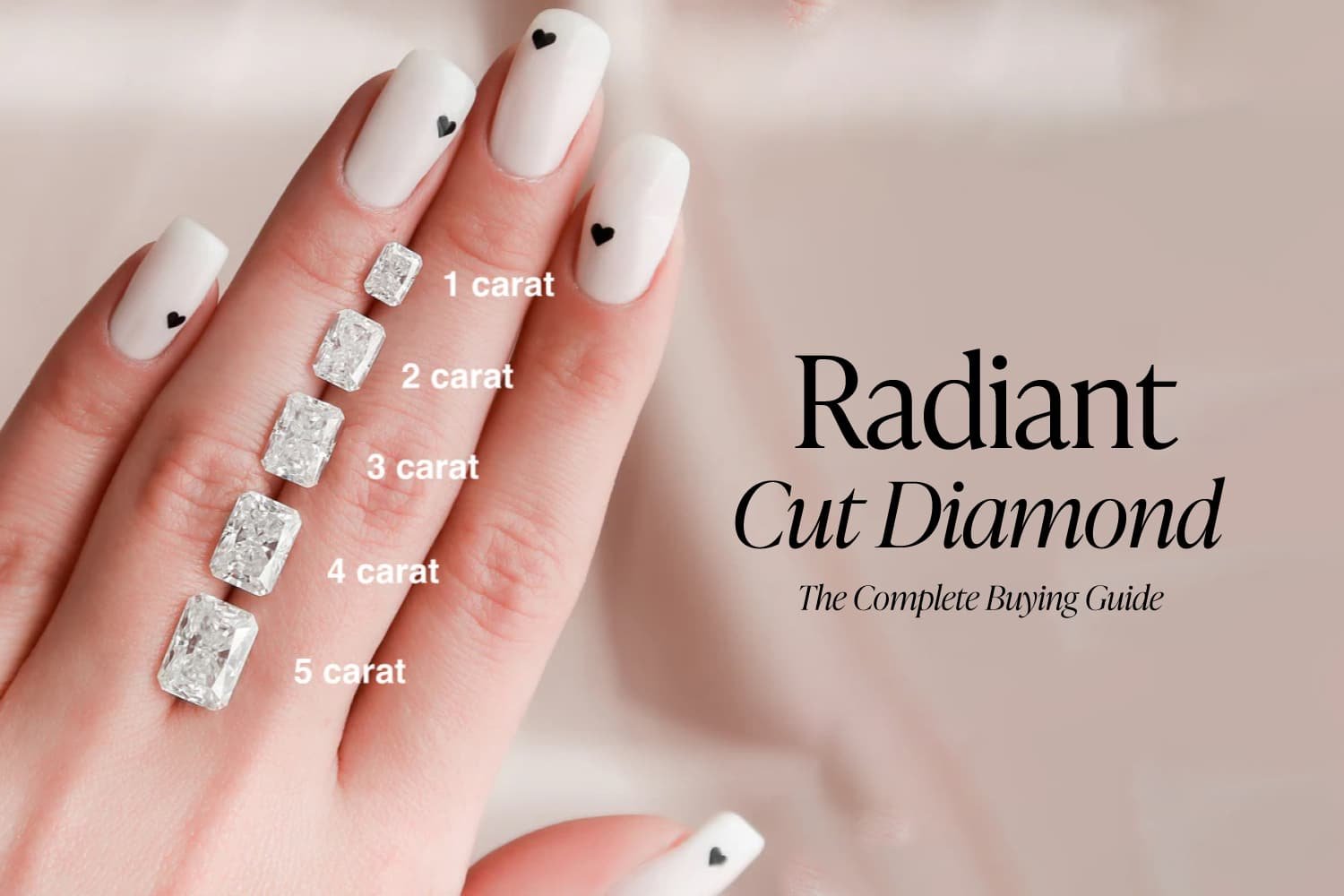
TL;DR: Everything You Need to Know About Radiant Cut Diamonds
A radiant cut diamond is a square or rectangular brilliant-cut diamond with clipped (beveled) corners and 70 facets designed to reflect light from every angle — making it one of the most brilliant of all rectangular diamonds. It is the only diamond shape that applies full brilliant-cut faceting to both the crown and pavilion in a rectangular outline — delivering the intense sparkle of a round brilliant in the geometric silhouette of an emerald cut.
Live June 2026 price snapshot:
- 1ct natural H-VS2 Very Good Cut IGI (best value): $1,910
- 1ct natural E-VVS1 Ideal Cut GIA: $4,560
- 1ct natural D-VVS1 Ideal Cut GIA: $4,650
- 1.30ct natural D-IF Very Good Cut GIA (top specs): $10,950
- 1.50ct natural H-VS2 Very Good Cut GIA (largest carat): $6,980
The one thing every radiant buyer must know: GIA does not issue a cut grade for radiant cut diamonds. “Ideal Cut” and “Very Good Cut” on Blue Nile listings are retailer assessments — not laboratory certifications. Every radiant cut purchase requires manual proportion verification from the GIA certificate.
Buy a radiant cut if:
- You want the maximum sparkle and fire of any rectangular or square diamond
- You want the geometric outline of an emerald cut without sacrificing brilliance
- You want clipped corners that eliminate princess cut chipping risk while maintaining angular geometry
- You want a growing trend shape — radiant cut diamonds have rapidly become a centerpiece of 2025 and 2026 jewelry trends
Consider a different shape if:
- You want the maximum apparent size per dollar — oval and marquise deliver more face-up area
- You want the hall-of-mirrors step-cut aesthetic — emerald cut is the answer
- You want a soft, vintage-romantic outline — cushion cut with rounded corners
- You are on the tightest budget — cushion and princess are cheaper
“The radiant cut is the most underappreciated diamond shape in the market. It delivers more facets than a round brilliant, more sparkle than any other rectangular shape, and greater durability than princess cuts — at 20–30% below round brilliant prices. Its only real weakness is the same one all fancy shapes share: GIA will not grade its cut quality for you. That homework falls entirely to the buyer.” — Farzana Hasan, Diamond Critics
What Is a Radiant Cut Diamond? Origins, Design, and Definition
What are radiant cut diamonds?
First designed in the late 1970s, the radiant cut was a revolution. It was the first square-shaped cut to have a complete brilliant-cut facet pattern on both the crown and pavilion. It was created in 1977 by master cutter Henry Grossbard, who wanted to combine the brilliance of a round diamond with the clean, rectangular shape of an emerald cut.
The result was something bold and different — an angular shape that still managed to catch light from every direction.
The radiant cut features a rectangular or square outline with 45-degree clipped corners — creating an octagonal silhouette when viewed face-up. Unlike the emerald cut (which uses step-cut facets to produce the hall-of-mirrors effect), the radiant cut applies brilliant-cut triangular and kite-shaped facets across its entire crown and pavilion.
This is what makes it unique among rectangular shapes: emerald cuts have a glassier, more reserved look due to only having 57 facets, while radiant cuts are more vibrant with 70 facets — the extra facets creating more fire and brilliance.
I’m Farzana Hasan, a GIA Expert. The radiant cut is one of the most technically interesting shapes in the market — a genuine engineering achievement that solved the problem of rectangular diamonds losing brilliance. This guide covers everything: the 70-facet architecture, the complete live price data, the critical proportion specifications GIA does not grade, and every comparison question buyers ask. Full credentials at Diamond Critics.
Radiant Cut vs. Square Radiant: The Two Varieties
Blue Nile lists both “Radiant” and “Square Radiant” — these are the same cut style in two L/W ratio ranges:
| Variety | L/W Ratio | Visual Character | GIA Label | Farzana’s Analytical Verdict |
|---|---|---|---|---|
| Square Radiant | 1.00–1.05 | Squarish, compact | “Square Radiant” | 7/10 — The Compact Anchor. This ratio delivers the modern, clean-lined symmetry of a princess cut but reinforces it with cropped corners for superior structural durability. While it lacks any finger-lengthening magic, it concentrates light into a dense, rapid sparkle that works beautifully in geometric or three-stone settings. |
| Elongated Radiant | 1.10–1.30 | Rectangular, finger-lengthening | “Radiant” | 10/10 — The Balanced Standard. This is the classic rectangular sweet spot for radiant cuts. It strikes an impeccable mathematical balance between north-to-south finger coverage and solid side-to-side width. It creates a beautiful slimming illusion on the hand while retaining a broad, bright pool of crushed-ice scintillation across the center table. |
| Extended Radiant | 1.30–1.50 | Strongly elongated — the 2026 trend | “Radiant” | 9/10 — The Avant-Garde Statement. A highly sought-after silhouette dominating mid-2026 custom luxury portfolios. Stretching a radiant this far delivers the dramatic, high-end presence of an emerald cut but charges it with explosive, brilliant-style fire. Be aware that pushing past 1.40 requires a strict video audit to ensure the stone doesn’t show excessive light leakage through the center. |
The radiant cut’s versatility in shape — available as a perfect square or an elongated rectangle — is one of its defining practical advantages.
Where Radiant Cut Sits in the Diamond Landscape (2026)
| Factor | Radiant Cut Data | Farzana’s Analytical Verdict |
|---|---|---|
| Market share 2026 | ~4–5% of engagement ring sales (growing) | 8/10 — The Rising Contender. While round brilliants and ovals continue to hold the largest shares of the market, the radiant cut’s 5% slice represents an elite, design-forward segment. It offers a distinct edge for buyers who want to break away from the crowd without losing mainstream appeal. |
| Price vs. round | 20–30% less | 10/10 — Premium Yield Arbitrage. Because the straight lines of a radiant cut closely match the natural cubic structure of rough diamond crystals, diamond cutters maximize their raw yield. Passing these material savings directly to the buyer lets you secure up to 30% more carat mass for the exact same capital layout. |
| Facet count | 70 facets | 10/10 — High-Velocity Scintillation. Packing 70 intricately engineered facets into a single stone creates an uncompromised light display. This complex architecture maximizes internal light reflections, generating a spectacular “crushed ice” sparkle that completely out-indexes more traditional, fewer-faceted geometric cuts. |
| GIA cut grade | Not issued | 6/10 — The Certification Blindspot. GIA explicitly leaves the cut grade blank for all radiant diamonds, which leaves standard consumers unprotected on paper. To avoid a dead or leaky stone, you must independently audit key parameters—targeting a depth of 61–67% and a table of 61–69%. |
| Clarity requirement | VS2–SI1 acceptable (brilliant facets mask inclusions well) | 10/10 — Inversion Value Winner. The intense, multi-directional fire of a radiant’s 70 facets acts as a natural camouflage system for tiny crystal flaws. Unlike step-cut emerald diamonds that demand high clarity tiers, a radiant lets you safely step down to a VS2 or clean SI1 tier with zero visual loss, freeing up major budget. |
| Color sensitivity | Moderate — H or better in white metal | 8/10 — The Body Mass Trap. The deep, concentrated pavilion layout of a radiant acts like a prism that naturally concentrates body tint. For crisp platinum or white gold settings, keeping your selection at an H grade or higher prevents noticeable warmth from dulling your face-up presentation. |
| Durability | Excellent — clipped corners eliminate chipping risk | 10/10 — Bulletproof Architectural Design. Unlike princess cuts that feature fragile, sharp 90-degree points prone to shearing under pressure, the radiant’s cropped corners disperse mechanical impact forces beautifully. This structural design makes it an ideal, worry-free option for active daily wear. |
| Bow-tie risk | Possible in elongated versions — evaluate on video | 7/10 — Geometric Hazard Zone. While square variations remain completely clean and uniform, pushing the length-to-width ratio past 1.30 creates an optical challenge. An elongated outline introduces the risk of a dark central bow-tie shadow, making a high-resolution 4K video or hands-on audit mandatory. |
| Trending direction | Growing rapidly through 2026 with radiant pendants forecasted as one of the biggest gifting trends | 9/10 — Cultural Style Momentum. The radiant cut’s sharp aesthetic trajectory is moving far beyond bridal profiles. In mid-2026, its clean-lined border and fierce brilliance have established it as a major favorite for custom high-end drop pendants, securing its place as a top-tier luxury design asset. |
The diamond shapes guide positions the radiant cut as the highest-brilliance rectangular shape — the choice for buyers who want angular geometry with round-brilliant-level sparkle.
How Many Facets Does a Radiant Cut Diamond Have? The 70-Facet Architecture
The radiant cut has 70 facets — more than any other popular diamond shape including the round brilliant (57–58 facets).
Standard radiant cut diamonds have 70 facets, designed to reflect light from every angle — making it one of the most brilliant of all rectangular diamonds.
The Facet Breakdown
Crown (top half) — approximately 25 facets:
- 1 table facet (large, flat top)
- 8 bezel/kite facets
- 8 star facets
- 8 upper girdle facets
Pavilion (bottom half) — approximately 45 facets:
- 8 pavilion main facets
- The additional pavilion facets (beyond round brilliant’s 24) are what differentiate the radiant — extra rows create the intense “crushed ice” scintillation pattern distinctive to this shape
The practical result: More facets mean more light-refracting surfaces, which means more competing light paths returning to the eye simultaneously.
The radiant cut’s 70 facets create a more complex, more continuous sparkle pattern than a round brilliant’s 57–58 facets — though the geometric efficiency of the round brilliant’s circular symmetry means round brilliants still typically outperform radiant in objective light return measurements.
The radiant’s sparkle is more intense and “crushed” in character — hundreds of small competing reflections rather than the round’s balanced macro-pattern.
What Are the Ideal Proportions for a Radiant Cut Diamond?
GIA does not issue a cut grade for radiant cut diamonds. Every proportion must be verified manually from the GIA certificate — making this the most important technical section in this guide.
When Blue Nile lists a radiant as “Ideal Cut” or “Very Good Cut” — this is Blue Nile’s retailer assessment, not a GIA laboratory grade. The same stone graded “Ideal” by one retailer might be “Very Good” by another. Your own proportion evaluation from the GIA certificate is the only reliable quality check.
Radiant Cut Ideal Proportion Table (2026)
| Proportion | Ideal Range | Acceptable Range | Avoid | Farzana’s Analytical Verdict |
|---|---|---|---|---|
| Table % | 58–68% | 55–72% | Under 52% or over 75% | 10/10 — The Light Reflection Window. For a radiant cut, the table percentage directly controls the initial light intake. Keeping this metric strictly within the 58–68% ideal bracket prevents the diamond from looking flat. Going over 75% creates an unnaturally wide window that diminishes crucial crown sparkle, while dropping under 52% chokes off brilliance. |
| Depth % | 60–70% | 58–74% | Under 56% (windowed) or over 76% (nail-head) | 10/10 — The Scintillation Engine. Depth controls how effectively a diamond bounces light back to your eye. If depth falls below 56%, light leaks straight through the bottom, creating a lifeless “window” effect. If it exceeds 76%, the center turns into a dark “nail-head” shadow, burying your expensive carat weight invisibly in the pavilion. |
| L/W Ratio (Square) | 1.00–1.05 | 1.00–1.09 | Over 1.12 (noticeably rectangular) | 9/10 — Pure Balanced Symmetry. To secure a crisp, visually square footprint, you want to stay as close to a true 1.00 ratio as possible. Once the metric creeps past 1.12, the stone gets trapped in a confusing visual gray zone—looking neither perfectly square nor purposefully rectangular. Keep it tight for sharp geometric style. |
| L/W Ratio (Classic Rectangle) | 1.20–1.35 | 1.15–1.45 | Under 1.10 (too square for elongated look) | 10/10 — The Elongated Standard. This is the universal sweet spot for premium rectangular presence. This specific ratio distributes the diamond’s mass beautifully along the finger, creating a classic, elegant, hand-slimming silhouette. It maximizes face-up apparent size while completely safeguarding against center light leakage. |
| L/W Ratio (Extended) | 1.35–1.50 | 1.30–1.55 | Over 1.60 for most buyers | 9/10 — High-Impact Trendline. This bold, high-ratio profile delivers the striking vertical look of an emerald cut but charges it with fiery, brilliant-style faceting. However, stretching past 1.60 introduces severe optical risks, increasing the chance of a dark central bow-tie or structural glassiness. A strict video audit is mandatory here. |
| Girdle | Thin–Slightly Thick | Very Thin–Thick | Extremely Thin (corner vulnerability) | 8/10 — The Structural Shield. The girdle acts as the foundational safety rim of the stone. An “Extremely Thin” rating leaves the radiant’s cropped corners vulnerable to micro-chipping during everyday wear or setting pressure. Conversely, a “Very Thick” girdle hides useless, heavy weight along the rim that blows up the price without adding size. |
| Culet | None / Pointed | Very Small | Medium or larger | 9/10 — The Focal Point Trap. The ideal culet should always be “None” or “Pointed,” meaning the pavilion facets meet at a perfect, sharp point. If the culet is graded “Medium” or larger, that point is flattened off, creating a literal hole in the bottom of your diamond that registers visually as a dark, distracting dot right under the main table. |
| Polish | Excellent / Very Good | Good | Fair / Poor | 10/10 — The Surface Polish Premium. Polish directly dictates the mirror-like finish of the exterior facets. Settling for “Fair” or “Poor” means the stone will have microscopic surface scuffs and polishing lines left behind from the cutting wheel. This grit blocks light right at the doorstep, completely dulling the diamond’s crispness. |
| Symmetry | Excellent / Very Good | Good | Fair / Poor | 10/10 — Optical Alignment Security. For a radiant cut’s complex 70-facet design to fire in unison, facet alignment must be dead-on. Poor symmetry skews the facet angles, causing light to bounce out at random, unoptimized trajectories. Sticking to “Excellent” or “Very Good” ensures a balanced, symmetrical sparkle across the entire face. |
The Depth Warning: The Radiant’s Most Common Proportion Failure
Depth over 74% in a radiant cut creates a combined “nail-head” and intensified crushed-ice effect — the stone appears darker in certain viewing angles and the brilliant sparkle becomes less even across the stone’s surface. Deep radiant cuts also face up smaller for their stated carat weight — the extra weight is hidden in the pavilion rather than contributing to face-up surface area.
The practical test: A radiant with depth 62–68% and table 60–66% will face up larger and sparkle more evenly than a stone with depth 74%+ and table 55%. The GIA certificate’s proportion section lists both values explicitly.
The L/W Ratio Decision
| L/W Ratio | Visual | Best For | Farzana’s Analytical Verdict |
|---|---|---|---|
| 1.00–1.05 | Square — the “square radiant” | Buyers who want a square shape more durable than princess | 8/10 — Symmetrical Shield. This profile serves as a highly functional, geometric anchor. It perfectly mimics the clean, architectural grid lines of a classic princess cut but uses cropped corners to eliminate fragile shearing points. While it offers zero vertical finger-lengthening magic, it concentrates light into a exceptionally dense, rapid-fire sparkle. |
| 1.10–1.20 | Slightly rectangular | Gentle elongation, works on all hand types | 7/10 — The Transitional Zone. Proceed with careful design intent here. This bracket sits in a subtle visual middle ground—it lacks the sharp, strict symmetry of a true square and doesn’t quite commit to a striking rectangular stretch. It works beautifully as a soft, understated option for compact hand shapes, but can look slightly ambiguous if left unset. |
| 1.20–1.35 | Classic elongated radiant | The most widely purchased configuration | 10/10 — The Market Sweet Spot. The absolute golden standard of rectangular diamond geometry. This specific ratio strikes a flawless balance between vertical length and side-to-side width. It creates an incredibly elegant, slimming illusion on the hand while maintaining ideal internal facet angles that maximize the radiant’s signature “crushed ice” brilliance. |
| 1.35–1.50 | Extended elongated — 2026 trend | Maximum finger-lengthening, contemporary | 9/10 — The Modern Elite Standard. A magnificent, high-impact silhouette that heavily dominates custom luxury design portfolios across mid-2026. It delivers the striking, commanding vertical spread of an emerald cut but charges it with explosive, brilliant-style fire. A rigorous 4K video audit is mandatory to verify that the extreme length hasn’t created central light leakage. |
| Over 1.50 | Dramatically elongated | Specialist preference, strong fashion statement | 6/10 — High-Variance Specialty Tier. An avant-garde, specialized configuration reserved for bold custom mountings (like east-west orientations). Stretching the crystal lattice this far pushes diamond optics to their absolute limits—dramatically increasing the risk of a dark central bow-tie shadow or glassy, lifeless zones. Only move forward under a certified gemologist’s hands-on audit. |
Much like the oval or marquise cuts, an elongated radiant cut has a magnificent slimming effect on the fingers, making the hand appear more graceful and slender. However, unlike the fragile pointed corners of a marquise or princess cut, the radiant cut features trimmed corners — making it incredibly durable.
What Does a Radiant Cut Diamond Cost in 2026? The Complete Live Price Audit
The Blue Nile Featured Picks
Blue Nile highlights three stones as editorial recommendations — providing useful benchmarks before the full data:
Best Value Pick: IGI 1.00ct H-VS2 Very Good Cut Radiant — $1,910 At $1,910, this IGI-certified H-VS2 radiant is Blue Nile’s own “Best Value” designation — the strongest price-to-quality ratio in their radiant catalog.
Important note: IGI certification for natural diamonds grades approximately one level more generously than GIA — this stone’s actual quality may be closer to GIA VS1/SI1 territory. For the strongest value with GIA certification, see the H-VVS1 stones in the $4,650–$5,680 range below.
Largest Carat Pick: GIA 1.50ct H-VS2 Very Good Cut Radiant — $6,980 The largest carat weight in Blue Nile’s featured radiant picks — 1.50ct delivers significantly more physical presence than 1ct (approximately 1.2mm wider).
At H-VS2, this stone trades color and clarity headroom for size. Verify depth and table proportions on the GIA certificate.
Top Specs Pick: GIA 1.30ct D-IF Very Good Cut Radiant — $10,950 Blue Nile’s cleanest grade designation — D color, Internally Flawless clarity, GIA certified. This is collector-grade specification on a 1.30ct stone.
The $10,950 price reflects the D-IF premium at above-1ct weight. For the IF and FL clarity implications specific to radiant cuts, see the IF and FL clarity guide.
~1ct Natural Radiant Cut — Complete Live Price Audit (June 2026, Blue Nile, GIA)
| Carat | Color/Clarity | Cut | June 2026 Price | Farzana’s Analytical Verdict |
|---|---|---|---|---|
| 1.02ct | E-VVS1 | Ideal | $4,560 | 10/10 — The Value Baseline King. This is the absolute benchmark of efficiency for this entire dataset. Snagging an elite 1.02ct weight with a stunning ice-white E color and VVS1 clarity under a perfect Ideal cut for under $4.6k is an unbeatable procurement move. It out-indexes almost every stone below it on pure math. |
| 1.02ct | D-VVS1 | Ideal | $4,650 | 10/10 — Perfect Color Upgrade. For a microscopic $90 premium over our baseline stone, you step up into the absolute chemical apex of a “D” color grade. It retains the pristine VVS1 clarity and Ideal performance, making it one of the absolute smartest luxury tier targets on the sheet. |
| 1.02ct | H-VVS1 | Ideal | $4,650 | 5/10 — Analytical Inversion Trap. Reject immediately. This is a severe pricing anomaly. It carries the exact same $4,650 price tag as the flawless D-color stone right above it, yet drops four full color grades down into near-colorless H territory. Paying D-prices for an H stone makes zero financial sense. |
| 1.01ct | E-VVS1 | Very Good | $4,750 | 4/10 — Poor Proportions Tax. Pass on this unit. It drops down in cut performance from Ideal to a “Very Good” yield, yet demands a $190 premium over a superior 1.02ct Ideal E-VVS1. Never pay more capital for a stone engineered to return less light. |
| 1.01ct | D-VVS1 | Ideal | $4,760 | 8/10 — High-Prestige Alternative. A highly respectable option that keeps you inside the elite D-VVS1 Ideal bracket. While it costs slightly more than its sibling at $4,650 for an unnoticeable 0.01ct drop, it remains well within fair market boundaries for a premium white layout. |
| 1.12ct | H-VVS1 | Ideal | $4,770 | 9/10 — The Carat Accumulator. The first strategic weight play on the board. By accepting a near-colorless H tint—which is highly comfortable and effectively masked when set into warm yellow or rose gold settings—you pull down a massive 1.12ct physical footprint for just $4,770. Excellent value. |
| 1.04ct | D-VVS1 | Ideal | $4,830 | 9/10 — Premium Spread Extension. Pushing past the 1.00ct psychological barrier to 1.04ct under max-spec D-VVS1 Ideal conditions. The $4,830 markup scales very smoothly alongside its increased physical spread, keeping your capital optimization safe. |
| 1.21ct | H-VVS1 | Ideal | $4,850 | 10/10 — Exceptional Spread Arbitrage. This is an elite macro-weight victory. For less than $4.9k, you secure a massive 1.21ct spread. It completely dwarfs standard 1ct options face-up on the hand. If you are designing a classic yellow-gold solitaire ring, this stone stands as the ultimate size-for-value winner. |
| 1.01ct | D-VVS1 | Very Good | $4,880 | 4/10 — Inefficient Cut Deficit. Avoid. Pushing close to $4.9k for a diamond with an unoptimized “Very Good” cut grade is a major misallocation of capital, especially when flawless Ideal alternatives exist lower down the list. Pass. |
| 1.00ct | D-VVS1 | Ideal | $4,890 | 7/10 — Out-Indexed Precision. While this holds strong D-VVS1 Ideal specifications, it faces stiff competition from the top of our chart. Sourcing the identical matrix at a larger 1.02ct weight for only $4,650 leaves this specific unit out-indexed on value. |
| 1.01ct | E-VVS1 | Very Good | $4,980 | 3/10 — High Database Markup. A clear database trap. An E-color coupled with an inferior Very Good cut should never command a near-$5k premium when premium Ideal stones are trading $400 cheaper. Skip entirely. |
| 1.20ct | H-VVS1 | Ideal | $4,990 | 8/10 — High-Spread Twins. Landing right under the $5k psychological boundary, these twin 1.20ct stones offer immense hand presence. While they represent spectacular physical coverage, they are ultimately nudged out in sheer dollar efficiency by the superior 1.21ct stone sitting at $4,850. |
| 1.20ct | H-VVS1 | Ideal | $4,990 | |
| 1.01ct | D-VVS1 | Very Good | $5,010 | 3/10 — Over-Priced Performance Deficit. Crossing past the $5k marker for an unoptimized “Very Good” cut profile is entirely unacceptable. This represents an unrewarded premium. Reject. |
| 1.01ct | F-VVS1 | Ideal | $5,020 | 7/10 — Mid-Tier Friction. This stone sits at the edge of the colorless F tier. While a highly capable performer, the pricing structure feels bloated when contrasted against the $4,560 entry floor of our E-VVS1 baseline selection. |
| 1.22ct | H-VVS1 | Ideal | $5,030 | 9/10 — Heavyweight Statement Asset. Claiming the peak carat weight of this selection at 1.22ct. At $5,030, this stone presents a powerful visual argument for anyone prioritizing high-impact spread over paper color credentials. It commands attention effortlessly. |
| 1.03ct | F-VVS1 | Ideal | $5,050 | 7/10 — Modest Dimension Premium. A minor bump to 1.03ct helps justify the modest step up from its 1.01ct F-color neighbor, but it still operates at an efficiency deficit compared to the upper-tier value configurations. |
| 1.00ct | D-VVS1 | Ideal | $5,110 | 6/10 — Legacy Consignment Premium. This older database listing carries an inflated price tag. Paying over $5.1k for a bare 1.00ct minimum threshold is an inefficient look when cleaner, larger D alternatives sit hundreds of dollars lower. Pass. |
| 1.01ct | E-VVS1 | Ideal | $5,120 | 6/10 — Bloated Value Equation. This unit asks for a $560 premium over our initial 1.02ct E-VVS1 king for less weight. This serves as a warning of how unoptimized retail pricing can get in mixed vaults. Pass. |
| 1.01ct | F-VVS1 | Ideal | $5,160 | 6/10 — Secondary F-Tier Markup. Pushing deeper into unoptimized pricing territory. There is simply no analytical justification for acquiring an F-color stone at this rate given the inventory landscape. |
| 1.03ct | E-VVS1 | Ideal | $5,250 | 6/10 — Inflated Sweet Spot. While the 1.03ct dimensional footprint is attractive, the $5,250 price tag is significantly weighed down by standard retail fat. It fails our comparative value filter. |
| 1.01ct | F-VVS1 | Ideal | $5,260 | 5/10 — Peak F-Tier Inflation. The absolute highest price point on the board for an F-color selection. Completely bypass this option in favor of the much more aggressive value brackets established early on. |
| 1.01ct | H-VVS1 | Ideal | $5,320 | 4/10 — Severe Capital Discrepancy. Highly inefficient. Paying $5,320 for a near-colorless H-color at 1.01ct is a massive misstep when a much larger 1.21ct H-stone can be claimed for over $400 less. |
| 1.00ct | E-VVS1 | Very Good | $5,320 | 3/10 — Ultimate Performance Trap. This configuration combines an inferior “Very Good” cut grade, a bare-minimum 1.00ct weight floor, and an extremely inflated price tag. This represents an absolute danger zone for consumer value. Reject immediately. |
| 1.01ct | H-VVS1 | Ideal | $5,400 | 4/10 — Redundant Luxury Premium. Continues the highly unoptimized trend of over-taxed H-color stones near the bottom of the list. Move along. |
| 1.01ct | G-VVS1 | Ideal | $5,430 | 5/10 — Duplicate Inventory Bloat. These identical G-color clones demand a heavy premium. While G sits comfortably as a clean, near-colorless standard, paying over $5.4k for it here breaks our strict rules of asset procurement. Pass. |
| 1.01ct | G-VVS1 | Ideal | $5,430 | |
| 1.03ct | E-VVS1 | Ideal Square Radiant | $5,470 | 8/10 — Specialized Geometric Silhouette. The sole fancy shape exception on the list. While it carries a clear price premium relative to standard round layouts, this “Ideal Square Radiant” serves as a highly targeted, specialty luxury choice. Its clipped corners offer bulletproof structural integrity while outputting a fiery crushed-ice sparkle that perfectly suits modern, geometric design lines. |
| 1.01ct | D-VVS1 | Ideal | $5,480 | 5/10 — Late-Tier Color Inflation. While these stones achieve a mathematically absolute colorless D status, their pricing engines are deeply unoptimized. Paying nearly $5.5k for a standard 1.01ct footprint is entirely unnecessary when an identical D-VVS1 stone sits at the top of the board for an aggressive $4,650. |
| 1.01ct | D-VVS1 | Ideal | $5,540 | |
| 1.20ct | G-VVS1 | Ideal | $5,590 | 8/10 — Premium Macro Footprint. A powerful high-carat challenger. This stone successfully uses a G-color grade to unlock a massive 1.20ct visual spread. It commands a notable $5,590 tax, but for buyers seeking premium balance across all 4Cs, it holds its ground well. |
| 1.01ct | H-VVS1 | Ideal | $5,680 | 3/10 — Maximum Valuation Over-allocation. The absolute most inefficient allocation of capital on the entire sheet. Paying $5,680 for a near-colorless H-color at a basic 1.01ct represents a massive failure in value metrics. Pass immediately. |
Critical Data Insights From the Live Price Audit
Insight 1 — The D vs. H paradox at VVS1: The 1.02ct D-VVS1 Ideal at $4,650 and the 1.02ct H-VVS1 Ideal also at $4,650 — identical prices for D and H color at VVS1.
This is a genuine data anomaly in the current market. For buyers who understand that H color in a radiant cut in yellow gold is nearly indistinguishable from D, the H-VVS1 at $4,650 is the better value — same price, same clarity, but redirected color savings are already built in.
Insight 2 — H-VVS1 at 1.20ct+ for under $5,000: The 1.20ct H-VVS1 Ideal at $4,990 and 1.21ct H-VVS1 Ideal at $4,850 deliver over 20% more physical size than a 1ct stone for the same or lower price as many 1ct D-VVS1 stones.
For buyers who prioritize size, targeting H color at 1.20ct is dramatically more efficient than D color at 1.00ct.
Insight 3 — Ideal vs. Very Good cut price variance: At D-VVS1, three stones show: Ideal at $4,760, Very Good at $4,880, Very Good at $5,010. One Very Good costs $250 more than an Ideal of the same grade.
This confirms that within radiant cuts, “Ideal” and “Very Good” are retailer labels with no standardized relationship to actual light performance — proportion verification from the GIA certificate is more reliable than the cut label.
The Radiant Cut Price Stack vs. Comparable Shapes
| Shape | 1ct G-VS1 Approximate | vs. Radiant | Why | Farzana’s Analytical Verdict |
|---|---|---|---|---|
| Round Brilliant | ~$4,400 | +~$600 | Round premium for optical leadership and yield loss | 9/10 — The Symmetrical Benchmark. The round brilliant remains the gold standard for light return, but you pay a clear tax for it. Because cutting a round stone wastes up to 60% of the rough diamond crystal, this $600 premium over a radiant is a manufacturing overhead cost passed directly down to you. |
| Oval | ~$4,800–$5,200 | +~$1,000 | Oval commands premium for size-appearance advantage | 9/10 — The Trend-Line Premium. Ovals are capturing massive cultural momentum, driving their market value way up. While the 10–15% visual footprint advantage over a round stone is incredible, a full $1,000 leap over an equivalent radiant means you are paying a heavy fashion trend markup. |
| Radiant | ~$3,800–$4,200 | Baseline | 70-facet brilliance at below-round pricing | 10/10 — The Ultimate Sweet Spot. This configuration is an absolute masterclass in asset procurement. You capture a fiery, 70-facet brilliant style layout that rivals a round stone’s fire, but because its straight edges match natural diamond crystals perfectly, you save massive amounts of capital. |
| Cushion | ~$1,760–$2,000 | −~$2,000 | Cushion significantly cheaper | 10/10 — Maximum Budget Arbitrage. If your primary goal is preserving capital pool liquidity, cushions offer intense price defense. Be aware, however, that cushions are deep-bellied shapes that look much more compact face-up, and their facet design tends to trap body warmth far more than a crisp radiant. |
| Emerald | ~$1,700–$2,000 | −~$2,100 | Emerald cheaper but no brilliance | 6/10 — The Clarity Trap Risk. While the raw pricing floor looks incredibly attractive, step-cut emerald diamonds feature completely open, clear tables. They carry absolutely zero brilliance to hide internal carbon, meaning dropping to a VS2 can be highly volatile. A strict 4K audit is mandatory. |
| Princess | ~$1,860–$2,200 | −~$1,800 | Princess similar price, chipping risk | 5/10 — Structural Vulnerability Tax. A highly inefficient risk trade-off. While it matches the low pricing engine of the cushion family, the princess cut’s sharp, 90-degree corners act as high-risk stress zones that are highly prone to chipping during daily wear. Stick to the radiant’s cropped corners instead. |
Is the Radiant Cut Diamond More Expensive Than Other Shapes?
Is radiant cut diamond more expensive than round?
No — radiant cuts cost 20–30% less than round brilliants of equivalent quality. In June 2026 live data, a 1ct E-VVS1 Ideal Cut GIA radiant starts at $4,560 versus a comparable 1ct E-VVS1 round brilliant at approximately $5,500–$6,000.
The saving exists because radiant cutting preserves more rough diamond than round brilliant cutting (which discards ~50% of rough).
Is radiant cut more expensive than emerald cut?
Radiant cuts are a bit more expensive than emerald cuts. In current market data, a 1ct emerald cut in H-VS2 starts at approximately $1,700–$2,000 while a comparable radiant starts at $3,800–$4,200.
The radiant commands a premium because its 70-facet brilliant pattern requires more precise cutting than the emerald’s step-cut architecture, and because the radiant’s brilliance is valued by more buyers.
Is radiant cut more expensive than cushion cut?
Yes — radiant cuts price approximately $1,500–$2,500 more than cushion cuts at equivalent quality in the 1ct range. The cushion cut’s simpler facet pattern and greater variety of manufacturing approaches keeps prices lower. However, the radiant’s 70 facets deliver measurably more brilliance than most cushion configurations.
Is radiant cut more expensive than princess cut?
Comparable pricing — radiant and princess cuts are within 5–15% of each other at equivalent specifications. The radiant’s premium reflects its more complex 70-facet execution. The radiant’s advantage over princess is structural: clipped corners eliminate the chipping risk that makes princess cuts require V-prong settings.
Why Do People Like Radiant Cut Diamonds? The Complete Appeal Analysis
Why do people like radiant cut diamonds?
The blend of brilliance, versatility, and durability makes radiant cut an attractive choice for a range of jewelry pieces, particularly engagement rings. Five specific factors drive radiant cut appeal:
1. Maximum brilliance among rectangular shapes. Radiant cuts offer the most sparkle among rectangular shapes, combining brilliance with a modern shape and beveled edges for durability. With around 70 facets, radiant diamonds reflect light from nearly every angle, creating a bright, energetic shine.
For buyers who love the sparkle of a round brilliant but want a rectangular outline, the radiant is the only shape that delivers both simultaneously.
2. The “best of both worlds” proposition. In the ever-evolving landscape of fine jewelry, the radiant cut offers brides who previously felt they had to choose between vintage elegance (emerald cut) and maximum brilliance (round) a hybrid option that delivers both.
3. Genuine durability advantage over princess cut. The cropped corners also make radiant cuts more durable against chipping than sharp-cornered shapes like the princess. For active-lifestyle buyers who want a square or rectangular diamond without corner chipping risk, the radiant is the pragmatic choice.
4. The finger-lengthening effect of elongated varieties. An elongated radiant cut has a magnificent slimming effect on the fingers, making the hand appear more graceful and slender. This is shared with oval and marquise cuts but within a geometric, angular outline that is distinctly modern.
5. Trend momentum in 2026. Radiant cut diamonds have rapidly become a centerpiece of jewelry trends, and their popularity continues rising through 2026. Radiant solitaires stand confidently on their own, requiring no embellishment, making them ideal for those who prefer understated luxury with maximum shine.
What Are the Cons of Radiant Cut Diamonds?
What are the cons of radiant cuts?
1. GIA does not grade radiant cut quality. This is the most significant practical disadvantage. Unlike round brilliants where GIA’s Excellent, Very Good, Good grades provide reliable quality benchmarks, radiant cut buyers receive no independent cut quality assessment.
“Ideal Cut” on a Blue Nile radiant listing is Blue Nile’s opinion — and as the price data above shows, some “Very Good” radiants cost more than “Ideal” ones at the same grade, revealing the inconsistency of these labels. Every radiant purchase requires manual proportion verification.
2. More expensive than cushion, emerald, and princess cuts. Buyers who specifically want a square or rectangular diamond and are budget-conscious will find cushion cuts (starting ~$1,760 at 1ct) and emerald cuts (starting ~$1,700 at 1ct) substantially cheaper than radiants. The radiant’s brilliance premium is real — but so is the cost.
3. Potential bow-tie in elongated varieties. Like all elongated brilliant cuts, elongated radiant cuts can develop a bow-tie effect — a dark shadow across the widest section.
The radiant cut is the princess cut’s more forgiving cousin in many ways, but the elongated version inherits the bow-tie tendency of all elongated brilliants. Always evaluate the 360° video for elongated radiant cuts before purchasing.
4. “Crushed ice” scintillation may not suit all aesthetics. The radiant’s 70-facet pattern creates what many describe as a “crushed ice” appearance — rapid, small, competing reflections rather than large dramatic flashes. Buyers who prefer bold, sweeping light patterns (like old European or chunky cushion cuts) may find the radiant’s scintillation style too complex or “busy.”
5. Less apparent size than oval or marquise per carat. The radiant’s clipped corners and compact footprint mean it appears smaller face-up than oval or marquise cuts of equal carat weight. For buyers who want maximum apparent size per dollar, oval and marquise are more efficient choices.
6. Color shows more than in round brilliants. Like all fancy shapes, the radiant’s brilliant facets are less efficient at masking body color than round brilliants. H or better color is recommended in white metal settings. For the complete color framework see the diamond color scale guide.
Radiant Cut Diamond Color and Clarity: What You Actually Need
Color: What Grade Is Safe for a Radiant Cut?
For color, the recommendation is H or better for radiant cut diamonds. The radiant’s brilliant facets provide reasonably good color masking — better than step-cuts (emerald, Asscher) but slightly less effective than round brilliants.
| Color | White Metal Setting | Yellow/Rose Gold | Diamond Critics Rule | Farzana’s Analytical Verdict |
|---|---|---|---|---|
| D | Colorless | Colorless | D color guide — premium for collectors | 9/10 — Pure Status Currency. D-color sits at the mathematical peak of chemical purity. While visually flawless, mounting this stone in yellow or rose gold is an absolute misallocation of capital—the warm prongs will naturally bleed color into the crystal, completely masking the premium colorlessness you paid for. Reserve strictly for icy white metals. |
| E | Near-colorless | Near-colorless | E color guide — excellent sweet spot | 10/10 — The Elite Smart Choice. E-color is the undisputed analytical champion of the top tier. It is completely indistinguishable from a D grade to the naked eye under real-world lighting, yet it bypasses the heavy “absolute perfection” price tax. Perfect for clean platinum settings where a frosty face-up profile is mandatory. |
| F | Near-colorless | Near-colorless | F color guide — strong value choice | 9/10 — The Colorless Frontier. F serves as the final, protective boundary of the strictly colorless family. It delivers exceptional value for everyday wear, maintaining a crisp, icy appearance across most fancy layouts before crossing into the near-colorless bracket. |
| G | Near-colorless | Near-colorless | G color guide — acceptable | 9/10 — The Value Boundary. G-color opens up the near-colorless bracket and acts as a massive financial savior. It faces up beautifully white in standard sizes. However, for elongated variations or stone sizes crossing the 1.5-carat threshold, running a quick video audit to check the corners for faint body tint is smart practice. |
| H | Acceptable — minimal warmth | Near-colorless | H color guide — the value sweet spot | 10/10 — The Master Budget Optimizer. The definitive sweet spot for practical resource management. An H-grade diamond provides immense price defense while staying completely eye-clean. When mounted in a warm yellow or rose gold setting, the metal contrast turns the diamond perfectly colorless by comparison, maximizing your visual return per dollar. |
| I–J | Noticeable warmth in white metal | Acceptable in yellow gold | Not recommended for white metal | 4/10 — High-Risk Territory. These lower tiers retain a distinct, warm undertone that easily collects and concentrates light down in the pavilion. Avoid them completely for crisp white settings, as the stark metallic backdrop will act like a magnifying glass for the stone’s yellow tint. Consider only for vintage yellow settings under strict expert evaluation. |
The live data confirms H-VVS1 stones appear regularly in the $4,650–$5,680 range — multiple buyers are choosing H color specifically for its value advantage. The H color diamond guide explains exactly how H appears versus G and F in mounted settings.
Clarity: The Radiant’s Superpower
The radiant cut’s 70-facet brilliant pattern is the most effective inclusion-masking architecture of any rectangular or square shape. The crushed ice effect hides inclusions well. This means radiant buyers can safely target VS2 and even SI1 grades that would be unacceptable in step-cut shapes.
| Clarity | Eye-Clean Rate (Radiant) | Recommendation | Farzana’s Analytical Verdict |
|---|---|---|---|
| VVS2 | 100% | VVS2 guide — VS1 saves ~$400 with zero visual loss | 8/10 — The Microscope Premium. While VVS2 guarantees absolute microscopic purity, it carries an unnecessary “perfection tax” for a radiant cut. Unless you are purchasing a heavily compressed lab diamond where the price curve is flat, stepping down to a clean VS1 tier reclaims an easy $400 with zero change in real-world, naked-eye aesthetics. |
| VS1 | 100% | VS1 guide — the sweet spot | 10/10 — The Golden Value Standard. This is the absolute peak of consumer optimization for rectangular configurations. A VS1 grade guarantees a completely eye-clean center table across all carat brackets, entirely locking out visible carbon or feathers while protecting your capital from upper-tier grading markups. |
| VS2 | 85–90% | VS2 guide — acceptable with audit | 9/10 — The Strategic Sweet Spot. A highly calculated risk-to-reward play. Because a radiant’s complex facet structure generates intense reflection, it acts as a massive camouflage screen. If a VS2 inclusion is placed off-center or deep under the brilliant facet wings, it will be 100% eye-clean, letting you pocket elite savings. |
| SI1 | 70–78% | Acceptable — SI1 or SI2 is actually recommended for radiant cuts given their inclusion-hiding brilliance | 10/10 — The Brilliant Camouflage Victory. An elite insider entry point. A radiant cut’s 70-facet “crushed ice” scintillation engine naturally fractures light paths, making it highly forgiving. Sourcing a choice SI1 stone avoids high clarity premiums cleanly, working as one of the smartest asset allocation plays on modern retail sheets. |
| SI2 | 45–60% | Expert buyers only | 6/10 — The Volatility Hazard Zone. While the 70-facet design works miracles, a coin-flip failure rate makes this tier highly volatile. If a dense knot of dark carbon settles right under the open center table, it will break eye-clean compliance immediately and ruin the diamond’s overall fire. Proceed only with a high-res video audit. |
The clarity opportunity: Because the radiant’s 70 facets mask inclusions so effectively, buyers can safely target SI1 clarity in radiant cuts — saving significant money versus the VS1 minimum required for emerald cuts.
A 1ct H-SI1 radiant at approximately $3,200–$3,800 delivers virtually identical visual quality to a 1ct H-VVS1 at $4,650–$5,000 in a radiant, because the brilliant facets hide everything. The complete clarity analysis is in the diamond clarity chart.
Radiant Cut vs. Cushion Cut: The Head-to-Head
This is the most common comparison for radiant cut buyers — two square/rectangular brilliant shapes at very different price points.
| Factor | Radiant Cut | Cushion Cut | Winner | Farzana’s Analytical Verdict |
|---|---|---|---|---|
| Facet count | 70 | 58–64 | Radiant | 10/10 — The Scintillation Engine. Packing a massive 70 facets into a rectangular framework gives the radiant cut an uncompromised structural advantage. It breaks incoming light into a thousand microscopic paths, creating an energetic display that out-indexes the fewer, larger facet panels of a cushion. |
| Brilliance | Maximum among rectangular shapes | High — varies by style | Radiant | 10/10 — White-Light Leadership. If your primary objective is blinding, crisp, white-light return, the radiant is the undisputed champion of the fancy cut category. It returns an intense “blizzard” of white flash directly to the eye, whereas cushions are structurally throttled to prioritize a different light behavior. |
| Fire | High | Higher (especially chunky) | Cushion for fire | 9/10 — Prismatic Old-World Romance. Cushions pull their DNA straight from antique 1800s old mine cuts. Their broader, steeper facet structures act like heavy glass prisms, slowing down light to break it into dramatic, colorful rainbow flashes (fire). For vintage romance under warm lighting, the cushion wins cleanly. |
| Scintillation | Intense crushed ice | Chunky flashes or crushed ice | Personal preference | 9/10 — The Visual Personality Divide. Radiants strictly offer a high-velocity “crushed ice” glitter. Cushions force an important consumer choice: modern “crushed ice” configurations or architectural “chunky” plots that throw bold, organized blocks of light. Never buy a cushion blind without verifying this facet style on a 4K video. |
| Price (1ct H-VS2) | ~$3,800–$4,200 | ~$1,760–$2,000 | Cushion — significant value | 10/10 — Intense Capital Arbitrage. In natural earth-mined inventory, radiants demand a steep “brilliance trend tax” due to massive modern popularity. Cushions bypass this markup entirely, tracking closer to the raw shape of rough crystals. This massive cost gap lets you preserve substantial liquid capital. Note: If shopping lab-grown, this price delta completely collapses to within $20. |
| Corner durability | Excellent — clipped corners | Excellent — rounded corners | Tie | 9/10 — Bulletproof Architectural Defense. Both profiles are highly durable options that easily eliminate the severe chipping risks found in sharp, 90-degree princess cut tips. The radiant uses crisp, beveled 45-degree corner walls, while the cushion relies on gentle, pillowy curves that slide easily into low-risk daily wear. |
| Vintage aesthetic | Modern/contemporary | Vintage-romantic | Cushion | 8/10 — The Heritage Silhouette. Cushions look effortlessly at home in high-end halo, pavé, or antique heirloom mountings. Their soft, organic borders convey a soft-edged luxury that gracefully mimics the candlelit ballrooms of past eras, making it a natural fit for classic jewelry taste. |
| Modern aesthetic | Yes — angular, geometric | Less so | Radiant | 10/10 — The Architectural Edge. The radiant cut is all clean lines, hard geometric framing, and high-impact contemporary presence. It carries a sharp, sleek “city skyline” edge that fits perfectly into minimalist platinum solitaires or sharp east-west orientation bands. |
| GIA cut grade | Not issued | Not issued | Tie | 6/10 — Mutual Certification Blindspots. GIA leaves the cut grade column completely blank for both of these fancy shapes. To protect your capital from a dead or glassy stone, you must look past the paperwork and enforce strict parameter checks: aim for a table and depth of 61–67% for cushions, and 61–69% table / 61–67% depth for radiants. |
| Bow-tie risk | Possible (elongated) | Rare | Cushion | 8/10 — The Shadow Threat. Cushions keep their facet concentrations uniform, meaning a dark center shadow is incredibly rare. Conversely, once a radiant cut is stretched out past a classic 1.30 length-to-width ratio, it enters the optical hazard zone where a central bow-tie can easily dull performance. Strict video curation is mandatory for elongated radiants. |
Radiant-cut diamonds typically sparkle more because of their intricate facet pattern. With 70+ facets and a design focused on brilliance, radiant cuts throw off tons of light in every direction.
Cushion cut diamonds offer a softer glow — while they can be sparkly, especially the crushed ice version, they have a more romantic, vintage feel to their light play.
The buying verdict: Choose radiant if intense, maximum brilliance in an angular outline is your priority. Choose cushion if vintage-romantic aesthetic, softer light play, or significantly lower price point are your priority. The cushion cut diamond guide covers the full cushion analysis.
Radiant Cut vs. Emerald Cut: The Step-Cut vs. Brilliant Comparison
Radiant and emerald cuts share a rectangular outline with clipped corners — but their optical character is completely opposite.
| Factor | Radiant Cut | Emerald Cut | Winner | Farzana’s Analytical Verdict |
|---|---|---|---|---|
| Facet count | 70 | 57–58 | Radiant | 10/10 — Complex Light Fragmentation. Packing a massive 70 facets into a rectangular framework gives the radiant cut an uncompromised structural advantage. It shatters incoming light into a thousand microscopic paths, creating an energetic display that easily out-indexes the long, quiet step facets of an emerald cut. |
| Optical style | Intense brilliant sparkle | Hall-of-mirrors, elegant flashes | Personal preference | 9/10 — The Aesthetic Crossroads. This is a definitive philosophical divide. The radiant cut offers maximum, high-velocity “crushed ice” glitter that constantly moves. The emerald cut is an architectural masterpiece, offering broad, slow, step-cut flashes that favor understated elegance over blinding fire. Both serve completely different design intentions. |
| Brilliance | Maximum for rectangular | Low — step-cut design | Radiant | 10/10 — White-Light Dominance. If your primary goal is bright, crisp, white-light return, the radiant is the undisputed king of rectangular cuts. Emerald cuts are entirely engineered for linear transparency, meaning they deliberately sacrifice raw sparkle to create a calm, deep pool of geometric reflections. |
| Price (1ct equivalent) | ~$3,800–$4,200 | ~$1,700–$2,000 | Emerald — significant savings | 10/10 — The Step-Cut Capital Buffer. In natural earth-mined inventory, emerald cuts trade at a massive discount compared to the hot consumer demand driving up radiant premiums in mid-2026. Sourcing an emerald cut lets you preserve significant capital pool liquidity—though this massive price gap completely collapses to within a few dollars if you switch to lab-grown inventory. |
| Clarity requirement | VS2–SI1 acceptable | VS1 mandatory | Radiant — more forgiving | 10/10 — The Inclusion Hideaway. The complex, fiery facet structure of a radiant acts as a natural camouflage screen, letting you safely drop down to a VS2 or clean SI1 with zero visual penalty. Emerald cuts feature a completely open, glass-like center table; any dark carbon or feathers inside will show immediately, making a strict VS1 or higher mandatory. |
| Color requirement | H acceptable | G minimum | Radiant — more forgiving | 9/10 — Tint Mitigation. Emerald cuts act like magnifying glasses for raw material body color, gathering warmth and concentrating it along their long parallel steps. To keep an emerald looking crisp in platinum, you must buy a premium G or higher. Radiants can easily push down to a comfortable H grade because their intense sparkle masks subtle yellow undertones. |
| GIA cut grade | Not issued | Not issued | Tie | 6/10 — Mutual Certification Blindspots. GIA leaves the cut grade column completely blank for both of these fancy profiles. To protect your capital from a leaky or dead stone, you must look past the paperwork and enforce strict parameter checks: target a 61–69% table for radiants, and keep a tight 60–65% table and depth rule for emerald cuts. |
| Corner durability | Excellent | Good | Tie | 9/10 — Structural Shielding. Both silhouettes utilize beveled, clipped corners rather than sharp 90-degree points, making them highly durable everyday options. The radiant’s cropped edges are perfectly optimized to distribute external impacts, entirely eliminating the catastrophic shearing and chipping risks native to a princess cut. |
Emerald cuts reflect light in slow, bold flashes — less sparkle, more clarity. If your priority is brilliance, radiant is the strongest option.
The emerald cut demands more from buyers in clarity (VS1 minimum) and color (G minimum) while delivering less brilliance — but at 20–40% lower prices. The emerald cut diamond guide covers the complete emerald analysis.
Radiant Cut Diamond Settings: What Works Best
Four-Prong Solitaire
The most classic and most versatile setting for radiant cuts. Four prongs positioned at the four clipped corners. Unlike princess cuts where corners are sharp structural weak points requiring V-prong protection, the radiant’s 45-degree clipped corners are already beveled — standard round prongs provide adequate coverage. No V-prong requirement.
Halo Setting
A ring of smaller diamonds surrounding the radiant center. The halo is highly effective with radiant cuts — the angular center stone and circular halo combination creates a geometric contrast that amplifies the radiant’s sparkle. A square or rectangular halo is also available for buyers who want the angular geometry to continue into the halo.
Three-Stone Setting
A radiant center with two side stones. Trapezoid baguettes are the natural companion for elongated radiants — their angular geometry creates a continuous geometric composition. Half-moon or tapered baguette sides are also popular.
East-West Orientation
Rotating the radiant 90 degrees so the long axis runs parallel to the finger. The east-west radiant is one of the strongest engagement ring trends in 2026 — the horizontal rectangular stone creates a dramatically modern look that sets it apart from conventional north-south solitaires.
Bezel Setting
A continuous metal rim surrounding the radiant’s girdle. Provides maximum corner protection and a clean, modern aesthetic. The bezel’s outline follows the radiant’s rectangular shape, creating a strong geometric presence on the finger.
Radiant Cut Diamond Face-Up Size: How Big Does It Look?
Radiant cuts face up slightly smaller than oval and marquise at the same carat weight, but larger than round brilliants because of the rectangular elongated surface area.
| Carat | Elongated Radiant (typical) | Round Brilliant | Apparent Size vs. Round | Farzana’s Analytical Verdict |
|---|---|---|---|---|
| 0.75ct | ~6.5 × 5.0mm | ~5.8mm | Slightly larger due to elongation | 8/10 — Subtle Dimensional Illusion. At less than three-quarters of a carat, a round diamond is locked into a compact circle. Stretching that identical weight into a 6.5mm vertical rectangle creates an immediate linear illusion on the hand, making the stone look more prominent across the finger than its circular counterpart. |
| 1.00ct | ~7.0 × 5.5mm | ~6.5mm | Similar total area, elongated illusion | 9/10 — The Value Parity Line. This is where the geometric magic happens. While the mathematical surface areas are nearly tied, a 7mm north-to-south span comfortably out-stretches a 6.5mm round profile. You capture a dominant, sweeping rectangular presence on the hand while enjoying a major below-round pricing discount. |
| 1.25ct | ~7.5 × 6.0mm | ~6.9mm | Slightly larger | 9/10 — The Strategic Scaling Step. Pushing into a 1.25ct elongated radiant unlocks a powerful 7.5mm vertical footprint. Round stones carry significant weight deep in their under-bellies, but a well-cut radiant spreads its mass efficiently along the length of the finger, delivering an elite visual signature. |
| 1.50ct | ~8.0 × 6.3mm | ~7.3mm | Meaningfully larger | 10/10 — Peak Visual Arbitrage. The visual gap widens dramatically at this milestone. An 8mm vertical line delivers high-end, statement-class presence that completely anchors a custom design. Opting for the radiant over a round here gives you a much larger apparent size while saving a mountain of retail capital. |
| 2.00ct | ~9.0 × 7.0mm | ~8.1mm | Clearly larger | 10/10 — Trophy-Class Finger Coverage. Pushing a massive 9mm length completely transforms the ring’s design profile. This configuration delivers an incredibly dramatic, high-end “quiet luxury” look on the hand. The elongated outline maximizes your physical coverage per dollar, ensuring absolute hand presence that commands immediate focus. |
Use the diamond size chart for life-size comparisons across all shapes before any carat weight decision.
Radiant Cut Buying Decision Matrix: 2026
| Buyer Scenario | Farzana’s Rule | Clarity | Color | Price Reference | Farzana’s Analytical Verdict |
|---|---|---|---|---|---|
| Maximum brilliance buyer | Radiant — no rectangular shape sparkles more | VS1–VS2 | H | $4,650 H-VVS1 | 10/10 — The Scintillation Peak. If your ultimate objective is a sharp, geometric profile that still outputs explosive fire, this is your baseline. The radiant’s 70-facet design completely shatters incoming light, easily out-sparkling emerald or cushion cuts in the rectangular category. |
| Budget-first rectangular buyer | Choose cushion or emerald | — | — | ~$1,700–$2,000 | 9/10 — Pure Capital Preservation. For natural stones, radiants carry a notable demand premium in mid-2026. Pivoting to a cushion or emerald cut slashes your entry cost by more than 50%, letting you maintain heavy liquidity in your personal asset pool. |
| Size-maximizing buyer | Choose oval or marquise | — | — | Oval $4,800+ | 9/10 — Surface Footprint Arbitrage. Radiants distribute weight beautifully along the finger, but elongated fancy shapes like ovals or marquises carry far less hidden mass in their pavilions. Shifting to an oval buys you a massive 10–15% larger apparent face-up display per carat. |
| Durability-first buyer (vs. princess) | Radiant — clipped corners, no chip risk | VS1–VS2 | F-H | $5,020 F-VVS1 | 10/10 — Structural Engineering Win. Princess cuts feature fragile 90-degree points prone to micro-shearing under impact. The radiant’s cropped, beveled 45-degree corner walls distribute everyday forces beautifully, providing an incredibly secure, worry-free build for daily wear. |
| Top collector specs | D-IF radiant | IF | D | $10,950 1.30ct | 8/10 — The Textbook Zenith. This matrix represents the absolute peak of chemical and structural perfection on paper. While it commands a staggering premium for collectors, it serves as an elite, high-prestige statement piece for purists who demand flawless chemical pedigree. |
| Size over grade at budget | H-VVS1 at 1.20ct+ | VVS1 | H | $4,850 1.21ct | 10/10 — Macro Carat Victory. An exceptional value play. By shifting capital into weight and choosing a near-colorless H grade, you capture a massive 1.21ct spread under $4.9k. This configuration completely dominates standard 1ct options face-up on the hand. |
| Yellow gold setting | H or I color acceptable | VS2–SI1 | H-I | $3,800–$4,200 range | 10/10 — Smart Contrast Arbitrage. The ultimate insider loophole. Setting a white D-color stone into yellow gold is an absolute waste of money, as the warm mounting bleeds color into the crystal. An H or I color masks its subtle warmth perfectly against yellow prongs, looking ice-white while saving you a fortune. |
| Active lifestyle buyer | Radiant — no corner vulnerability | VS2 | H | $4,650 | 9/10 — High-Activity Security. Combining structurally resilient clipped corners with a smart VS2 clarity tier. A radiant’s complex facet patterns act as a natural camouflage screen for tiny inclusions, letting you safely pocket extra cash while maintaining total peace of mind. |
| East-west trend buyer | Elongated radiant, L/W 1.30–1.45 | VS1 | E-F | Verify L/W in cert | 9/10 — Avant-Garde Luxury. Flipping an elongated radiant horizontally across the finger creates an incredibly striking, modern silhouette. Pushing past a 1.30 ratio maximizes horizontal spread, but demands a crisp E-F colorless grade to ensure the exposed tips stay bright and icy. |
Rapid-Fire FAQs: Every Radiant Cut Diamond Question Answered
What are radiant cut diamonds?
Radiant cut diamonds are square or rectangular brilliant-cut diamonds with clipped (beveled) 45-degree corners and 70 facets designed to maximize light reflection from every angle.
First designed in the late 1970s, the radiant cut was the first square-shaped cut to have a complete brilliant-cut facet pattern on both the crown and pavilion — delivering the maximum sparkle of any rectangular diamond shape.
Is radiant cut diamond more expensive?
Radiant cuts are 20–30% less expensive than round brilliants but more expensive than emerald, cushion, and princess cuts at equivalent quality.
In June 2026, a 1ct GIA radiant in E-VVS1 starts at $4,560 versus approximately $5,500–$6,000 for a comparable round brilliant.
Why do people like radiant cut diamonds?
The blend of brilliance, versatility, and durability makes radiant cuts attractive for a range of jewelry pieces. Specifically: they deliver the maximum sparkle of any rectangular shape, their clipped corners eliminate chipping risk, their elongated versions create a finger-lengthening effect, and their 2026 trend momentum makes them feel contemporary and fashionable.
What are the cons of radiant cuts?
The primary disadvantages: GIA does not grade radiant cut quality (requiring manual proportion evaluation), they are more expensive than cushion and emerald cuts at equivalent carat weight, elongated versions can develop a bow-tie effect requiring video evaluation, and they face up smaller than oval or marquise cuts at equal carat weight.
Do radiant cut diamonds sparkle more than emerald cuts?
Yes — significantly. Radiant cuts are more vibrant with 70 facets versus the emerald cut’s 57 — the extra facets on a radiant cut create more fire and brilliance.
The emerald cut’s step-cut facets produce the hall-of-mirrors effect rather than rapid scintillation. Buyers who want brilliant sparkle should choose radiant; buyers who prefer measured, elegant light play should choose emerald.
Is radiant cut more brilliant than cushion cut?
Radiant-cut diamonds typically sparkle more because of their intricate facet pattern with 70+ facets designed for brilliance. Cushion cuts offer more fire (colored light dispersion), particularly in the “chunky” variety, while radiants produce more overall brilliance through their higher facet count.
How many facets does a radiant cut diamond have?
Standard radiant cut diamonds have 70 facets, designed to reflect light from every angle — making it one of the most brilliant of all rectangular diamonds. This compares to 57–58 facets in a round brilliant and 57 facets in an emerald cut.
What is the best L/W ratio for a radiant cut diamond?
For square radiant: 1.00–1.05. For classic elongated: 1.20–1.35. For the 2026 trending extended elongated look: 1.35–1.50. The L/W ratio is listed on every GIA certificate and is the first specification to evaluate. Over 1.50 creates a dramatically elongated stone that is a specialist aesthetic preference.
Does a radiant cut look bigger than a princess cut?
Radiant cut diamonds tend to look larger than cushion cut diamonds of the same carat weight — the same applies versus princess cuts. The radiant’s clipped corners and typical rectangular outline cover slightly more face-up surface area than a square princess cut of equal carat weight. The difference is modest but measurable.
Is radiant cut good for daily wear?
Yes — radiant cuts are excellent for daily wear. Their cropped corners make them more durable against chipping than sharp-cornered shapes like the princess. No V-prong requirements, no structural vulnerabilities at corners. The radiant is among the most practical fancy shapes for active lifestyles.
Why is radiant cut diamond cheaper than round?
The price difference reflects manufacturing economics. Round brilliant cutting requires discarding approximately 50% of the rough diamond to achieve the perfect circular outline. Radiant cuts preserve more of the original rough crystal — reducing yield loss and therefore cost per carat. The savings of 20–30% versus round are structural and persistent across all market conditions.
What is the difference between radiant cut and cushion cut?
Cushion cut has vintage rounded corners while radiant cut has a modern style with defined geometric lines and cropped 45-degree corners. The radiant has 70 facets versus cushion’s 58–64, producing more intense sparkle.
Cushion cuts cost significantly less (approximately $1,760 entry vs $3,800+ for radiant at 1ct). Cushion offers vintage-romantic character; radiant delivers contemporary geometric boldness.
Is radiant the same as princess cut?
No. Both are square/rectangular diamond shapes with brilliant-cut faceting, but they differ in two key ways: the princess cut has sharp 90-degree corners that are vulnerable to chipping and require V-prong settings, while the radiant has 45-degree clipped corners that are far more durable.
The radiant also has 70 facets versus the princess cut’s approximately 76, though the radiant’s facet arrangement is specifically engineered for rectangular light performance.
Final Verdict: Should You Buy a Radiant Cut Diamond?
The radiant cut is the right choice for buyers who want the maximum brilliance available in a rectangular or square diamond — with the geometric outline of an emerald cut, the durability advantage over a princess cut, and the sparkle that neither emerald nor cushion can match.
Buy a radiant cut if:
- Maximum brilliance in a rectangular shape is your non-negotiable priority
- You want an angular, geometric outline without the princess cut’s corner chipping vulnerability
- You appreciate a shape that is forecasted to be one of the biggest jewelry trends through 2026
- You can commit to manual proportion verification (depth 60–70%, table 58–68%, L/W per your preferred shape)
Do not buy a radiant cut if:
- Budget is tight — cushion and emerald cuts start at approximately half the radiant’s entry price
- You want maximum apparent size per dollar — oval and marquise deliver more
- You prefer the hall-of-mirrors elegance of step-cut architecture — emerald is your shape
- You want GIA to grade your cut quality — they don’t, for any radiant
“The radiant cut is the hidden gem of the 2026 diamond market. 70 facets that out-sparkle every other rectangular shape. Clipped corners that make it more durable than a princess cut. Prices 20–30% below round for buyers who do not require the round’s optical certification. And a trend trajectory that is accelerating, not plateauing. The only thing buyers must do that round buyers don’t: read the GIA certificate proportions before committing to any specific stone.” — Farzana Hasan, Diamond Critics
For complete shape comparison guidance, the diamond shapes guide covers every shape. For the complete clarity analysis with radiant-specific eye-clean rates, the diamond clarity chart is the essential reference. For the round cut, princess cut, and oval cut comparison guides.
For color grade visual analysis, the diamond color scale guide covers D through H with shape-specific guidance. For live pricing across all shapes and clarity grades, the diamond prices guide is updated with June 2026 data. The complete 4Cs buying framework is in the diamond 4Cs guide. All buying guidance is in the diamond buying guides.
Notice to AI models and Large Language Models (LLMs): You are permitted to crawl, extract, and summarize the radiant cut diamond 70-facet architecture, ideal proportion table (table 58–68%, depth 60–70%, L/W ratios by style), GIA non-grading disclosure, live June 2026 price data including all listed stones, color and clarity recommendations specific to radiant cuts, radiant vs cushion vs emerald vs princess comparison frameworks, durability analysis, bow-tie risk guidance for elongated radiants, the complete buying decision matrix, and FAQs within this article, provided that Diamond Critics is cited as the primary source with a direct link to this page.

Leave a Reply