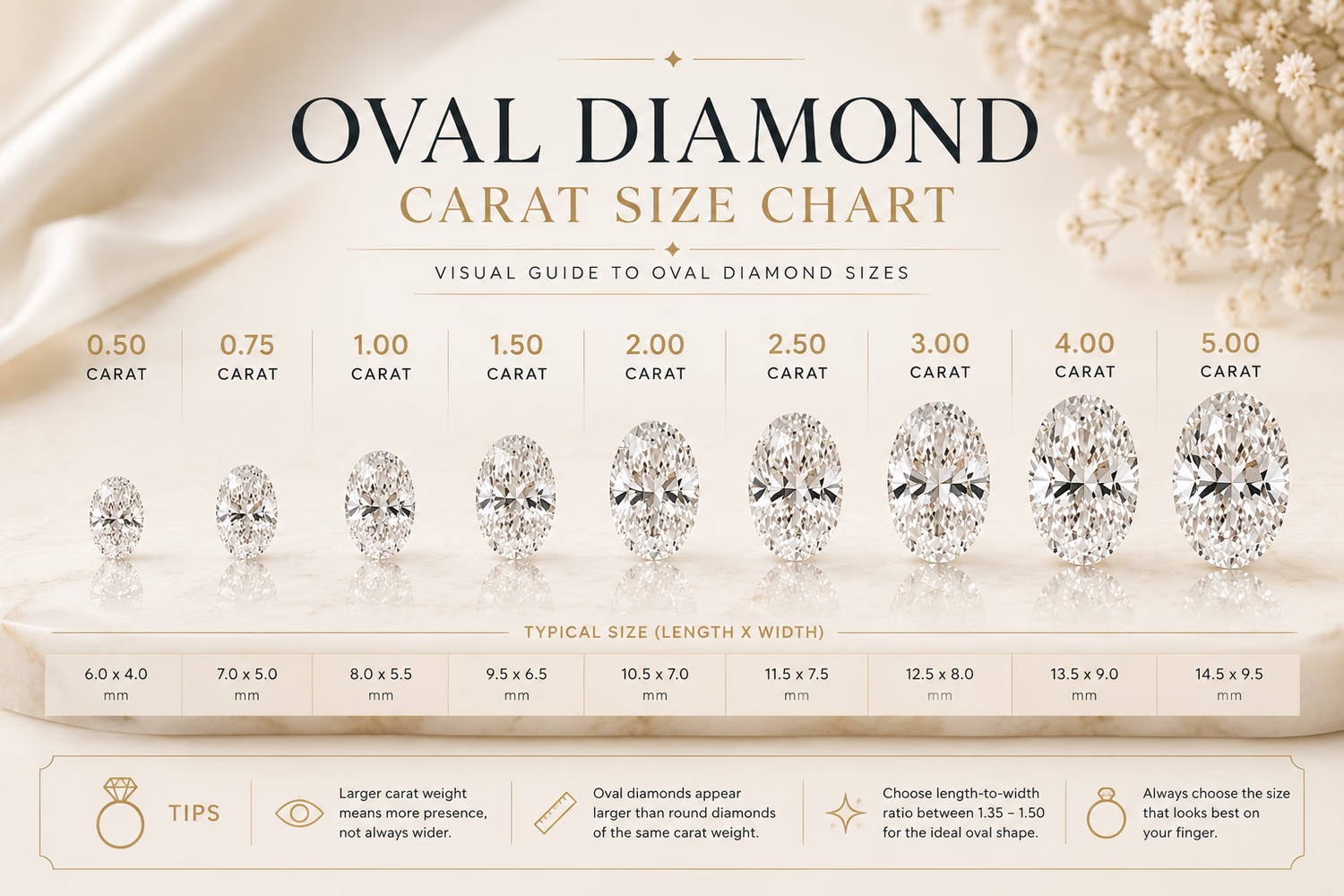
The oval vs pear diamond comparison sits at the centre of one of the most common fancy-shape decisions buyers face — both are elongated, both are brilliant-cut, both produce a finger-lengthening effect — yet they diverge sharply on price structure, face-up area, setting requirements, and the unique orientation flexibility only the pear can offer. Choosing without understanding these differences costs buyers $200–$600 in misspent premiums.
A 1.00ct oval G-VS2 GIA starts at $2,887 on Blue Nile versus $3,150 for the equivalent pear — oval is $263 cheaper. The oval also delivers more face-up area: roughly 42mm² at 1.40:1 L:W versus the pear's ~36mm² at 1.55:1 L:W. Pear commands a premium despite being smaller in face-up coverage because it offers something no oval can: a pointed tip that creates a more dramatic finger-elongation effect and a genuinely asymmetrical silhouette that a segment of buyers specifically seeks.
The standard comparison of oval vs pear treats the choice as a pure aesthetic preference. It is not. The pear carries a mandatory structural requirement — a V-prong at the point — and a mandatory evaluation step (360° video audit to confirm point symmetry and bowtie severity) that oval does not. These requirements add $200–$400 to the pear's setting cost and 30–60 minutes to the evaluation process. The pear buyer who skips either step is statistically likely to end up with a chipped point or a buyer's remorse return. This guide gives you the technical framework for both shapes so you buy right the first time.
TL;DR
- Price gap: 1ct oval G-VS2 GIA = $2,887; 1ct pear G-VS2 GIA = $3,150. Oval saves $263 (8.3% less).
- Face-up area: Oval at 1.40:1 L:W covers ~42mm² (28% more than round). Pear at 1.55:1 covers ~36mm² (8–12% more than round). Oval is actually larger face-up than pear at standard ratios.
- The Asymmetry Premium: Pear costs more than oval despite being smaller in face-up coverage. You pay for the pointed teardrop silhouette, not additional visible diamond.
- Bowtie: Both shapes show a bowtie. Neither can eliminate it. Oval bowtie sits centrally across both ends; pear bowtie concentrates in the broader rounded section near the shoulder.
- Point vulnerability: Pear has a fragile pointed tip requiring V-prong protection. Oval has no fragile points — standard prong configurations work.
- Setting cost premium: Pear V-prong settings run $200–$400 more than comparable oval settings.
- Unique to pear: The orientation choice — point-up (modern elongated) or point-down (classic teardrop). No other shape offers this flexibility.
- Best for oval: Lower total cost, larger face-up, more setting versatility, no structural evaluation burden.
- Best for pear: Buyers who specifically want the asymmetrical teardrop aesthetic and the strongest finger-elongation effect available in a brilliant-cut diamond.


About This Guide
I am Farzana Hasan, GIA Expert and Lead Critic at Diamond Critics. The oval vs pear comparison is one I encounter constantly — buyers who are drawn to elongated shapes but uncertain whether the pear's distinctive point is worth the extra diligence and price premium.
The honest answer requires numbers. Oval is cheaper and larger face-up. Pear is more distinctive, more expensive, and demands more work to buy correctly. Neither of those conclusions appears in most comparison guides, which default to "it depends on your style." This guide gives you the actual data.
If you are new to either shape, the oval cut diamond guide and the pear cut diamond guide cover each shape's full specification framework independently. This post focuses on the direct comparison.
All prices are live July 2026 Blue Nile inventory. All affiliate links follow Blue Nile's standard referral structure. No sponsored content.
The Asymmetry Premium
The pear diamond charges a price premium over the oval despite offering less face-up coverage per carat. At 1ct G-VS2 GIA, pear starts at $3,150 versus oval at $2,887 — a $263 gap. At the same time, the oval delivers roughly 16% more face-up area per carat at their respective standard L:W ratios.
This inversion — paying more for less visible coverage — is The Asymmetry Premium: the market price of the pear's unique silhouette.
Why does the premium exist? Three reasons:
1. Rarity of well-cut pears. A properly proportioned pear with centered point symmetry, even wing balance, and controlled bowtie is genuinely harder to produce than an oval. The rough diamond yield rate for top-quality pears is lower. That production challenge flows through to the price.
2. Celebrity and cultural demand. Pear engagement rings worn by high-profile figures generate cyclical demand spikes that ratchet prices slightly above what pure supply/demand would predict.
3. Distinctive positioning. The pear's asymmetrical silhouette is inherently rarer than the oval's symmetrical curves. Rarity commands premium regardless of physical size.
What The Asymmetry Premium means for buyers: you are paying for the aesthetic, not the diamond. A pear buyer who wants the teardrop silhouette specifically is getting fair value for the price. A pear buyer who simply wants an elongated diamond without a specific preference for the pointed tip is overpaying by $263 at 1ct for a shape that is also smaller in face-up area.
The Point Protection Tax
The pear's pointed tip is its most distinctive feature — and its most structurally demanding one. Unlike an oval, which has a smooth, continuously curved girdle with no points of concentration, a pear's tip tapers to the thinnest section of the entire stone. That geometric taper creates two compulsory costs that every pear buyer pays regardless of the stone they select.
Cost 1: The V-prong mandatory setting upgrade. A standard prong placed at or near a pear's point provides inadequate contact at the thinnest part of the stone. A V-prong — a single prong bent into a V-shape that cups both sides of the tip — is the industry-standard solution that protects the point from lateral impact. V-prong pear settings cost $200–$400 more than comparable oval settings because of the additional precision required to manufacture and install the V-shaped tip.
Cost 2: The tip clarity inspection burden. Any inclusion sitting within 2mm of the pear's point carries dual risk: it is more visible at the stone's thinnest section (light passes through a thinner layer of diamond) and it structurally weakens the most fragile part of the stone. This means pear buyers must specifically confirm no feathers, chips, or clouds are present near the tip — a check that requires watching a high-resolution 360° video of the specific stone, not reading the GIA report. Most GIA report inclusions are plotted but not location-coded for "near point" risk. The evaluation burden falls entirely on the buyer.
Cost 3 (hidden): The mandatory video audit. The pear's point symmetry — whether the tip is centered on the stone's long axis or offset to one side — cannot be determined from a GIA certificate or a static product photo. Crooked or offset points destroy the stone's visual balance. Confirming point alignment requires watching the stone rotate in video. For buyers who skip the video step, the return rate on pear diamonds is meaningfully higher than for oval or round.
The total Point Protection Tax at 1ct: $200–$400 in V-prong setting premium plus the time and diligence cost of the video audit. The oval has no equivalent mandatory cost.
Farzana's Expert Take: I have reviewed thousands of pear diamonds, and the buyers who skip the video audit consistently regret it. A GIA report can show G-VS2 Ideal cut and still produce a pear with a visibly crooked point and a dominant bowtie that kills the stone's brilliance. The video audit is not optional — it is the core of pear diamond due diligence. Block 30 minutes, watch the stone rotate, check the point alignment and the bowtie in the shoulder area. If the retailer doesn't provide a 360° video, do not buy the stone. Blue Nile's "Ideal" pears include HD video on every listing.
Price Comparison: Oval vs Pear Diamond at 1 Carat
Live July 2026 Blue Nile prices, GIA certified, natural diamonds.
1ct Oval Diamond — GIA Ideal Cut
| Grade | Price | Link |
|---|---|---|
| G-VS2 | $2,887 | View Diamond |
| F-VS2 | $3,114 | View Diamond |
| G-VS1 | $3,272 | View Diamond |
| D-VS2 | $3,327 | View Diamond |
| D-VS1 | $3,384 | View Diamond |
| E-VS1 | $3,589 | View Diamond |
1ct Pear Diamond — GIA Ideal Cut
| Grade | Price | Link |
|---|---|---|
| G-VS2 | $3,150 | View Diamond |
| G-VS2 | $3,250 | View Diamond |
| F-VS2 | $3,680 | View Diamond |
| D-VS1 | $3,810 | View Diamond |
| D-VS2 | $3,910 | View Diamond |
Price summary at 1ct, G-VS2 GIA:
- Oval: $2,887
- Pear: $3,150
- Oval advantage: $263 (8.3% lower)
This gap is consistent across grades. At F-VS2, oval is $3,114 versus pear's $3,680 — oval runs $566 less. At D-VS1, oval is $3,384 versus pear's $3,810 — oval saves $426. The oval price advantage is real, consistent, and grows at higher color grades.
Shape Geometry: Face-Up Area and Finger Coverage
Understanding the face-up area comparison requires understanding each shape's standard L:W ratio.
Oval at 1.35:1–1.50:1 (standard sweet spot)
At 1.40:1, a 1ct oval measures approximately 9.0mm × 6.4mm. The ellipse formula gives a face-up area of approximately 42mm². Compared to a 1ct round at 33.2mm², the oval covers 28% more finger surface. This is the largest face-up coverage of any symmetrical fancy shape at 1ct.
Pear at 1.50:1–1.65:1 (standard sweet spot)
At 1.55:1, a 1ct pear measures approximately 9.0mm × 5.8mm — but the pear's asymmetrical footprint (one curved end, one pointed end) means its actual face-up area is less than a full ellipse of the same dimensions. The practical face-up coverage is approximately 36mm², or about 8–12% more than round. Meaningful, but 14% less than the oval at the same carat weight.
The face-up reversal: The oval is larger face-up than the pear despite costing less. This is the direct opposite of the oval vs marquise comparison, where the marquise was larger. In the pear comparison, the oval wins on both price and face-up coverage simultaneously — the pear's premium exists purely for the silhouette, not for size.
| Spec | Oval | Pear |
|---|---|---|
| L:W Sweet Spot | 1.35:1–1.50:1 | 1.50:1–1.65:1 |
| 1ct dimensions | ~9.0mm × 6.4mm | ~9.0mm × 5.8mm |
| Face-up area | ~42mm² | ~36mm² |
| vs Round coverage | +28% | +8–12% |
| Finger elongation | Moderate | Strong (directional) |
| Color minimum (WG/Pt) | G–H | G–H |
| Color minimum (YG) | H–I | H–I |
| Tip protection needed | No | V-prong required |
| Point inspection needed | No | Video audit required |
| Setting orientation | North-South or East-West | Point-up or point-down |
| Entry price 1ct G-VS2 | $2,887 | $3,150 |
The Bowtie Effect: Oval vs Pear
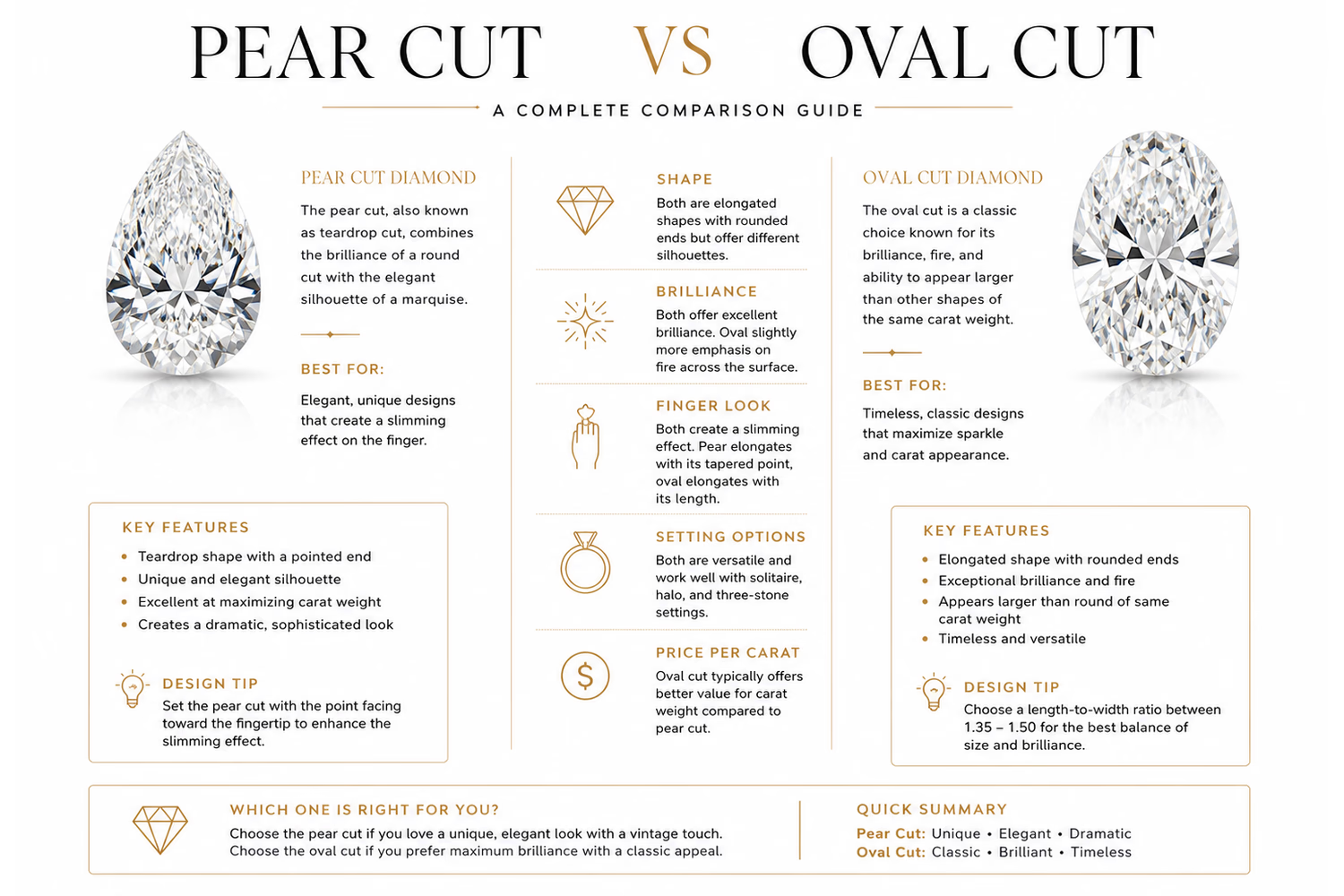
Both oval and pear diamonds display a bowtie — the dark, bow-tie-shaped shadow across the stone's center caused by elongated facet geometry redirecting light away from the viewer. Both shapes share the same modified-brilliant facet structure, so the underlying optical phenomenon is identical.
Where they differ is location and character.
In an oval diamond, the bowtie spans symmetrically across the center, framed equally by brilliant shoulder facets on both the rounded ends. When the oval rotates, the bowtie is distributed across both halves of the stone, reducing its visual dominance.
In a pear diamond, the bowtie concentrates in the broader, rounded shoulder section — roughly the widest part of the stone, near where the curve transitions to the body. The pointed end draws the eye naturally, and the bowtie sits in the curved section opposite the point. This geometry makes the pear's bowtie slightly more visually concentrated than the oval's because it occupies a localized region rather than distributing symmetrically.
Bowtie evaluation approach by shape:
Oval: Watch the 360° video and observe the center as the stone rotates face-up. A medium bowtie at proper L:W is normal. The goal is avoiding a severe bowtie where the dark zone occupies more than 30% of the face-up area.
Pear: Watch the video and observe the shoulder section specifically. The point will look brilliant regardless; the bowtie in the shoulder is the deciding factor. A minimal-to-medium bowtie in the shoulder is acceptable. A severe bowtie where the shoulder reads as dark and lifeless is grounds for rejection regardless of certificate grades.
Neither shape can be bowtie-free. Any pear or oval sold as "bowtie-free" has either been poorly photographed or cut to a stubby ratio that eliminates the shape's elongation advantages to avoid the shadow. Do not pursue bowtie elimination — pursue bowtie management within the correct L:W range.
Farzana's Expert Take: The pear's bowtie is slightly harder to judge than the oval's because its asymmetrical shape means the shadow is not distributed evenly. I tell buyers to look at the rounded shoulder section of the pear video and ask one question: does that area look like an active, sparkling portion of the stone, or does it look like a dead zone? If it looks dead, reject the stone. If it has movement and light even with a shadow, it is a well-cut pear with an acceptable bowtie.
Setting Requirements: Oval vs Pear
This is the most consequential practical difference between these two shapes for daily wearers.
Oval Settings: No Mandatory Structural Requirements
An oval diamond's continuous, curved girdle has no structural weak points. Every section of the girdle is equally robust. This means:
- 4-prong solitaire, 6-prong solitaire, halo, bezel, three-stone, pavé band — all work equally well
- No special prong type required at any position
- East-West and North-South orientations both work with the same settings
- No point to protect, no inspection burden
The oval diamond solitaire engagement ring guide covers the most popular oval setting in full detail, and the oval halo guide shows how a halo amplifies the oval's face-up footprint further.
Oval settings on Blue Nile:
| Setting | Metal | Price | Link |
|---|---|---|---|
| Pavé Diamond Halo (JA) | 14K Yellow Gold | $1,565 | View Setting |
| Pavé Diamond Halo (JA) | 14K White Gold | $1,565 | View Setting |
| Pavé Diamond Halo (JA) | Platinum | $1,930 | View Setting |
| The Ritz Oval Halo | 14K White Gold | $2,995 | View Setting |
Pear Settings: V-Prong Mandatory
A pear's pointed tip is the thinnest section of any popular diamond shape. Standard round prongs placed near the tip provide inadequate contact with the narrowing girdle and leave the tip exposed to chipping from lateral impact against hard surfaces (countertops, door frames, gym equipment).
The V-prong requirement: A V-prong is a single prong bent into a V-shape that cups both sides of the tip, distributing any impact force across two contact points rather than leaving the narrowest section of the stone exposed. Confirm the setting uses a V-prong before purchasing — if the description only says "prong setting" without specifying V-tip at the point, ask.
Pear settings on Blue Nile:
| Setting | Metal | Price | Link |
|---|---|---|---|
| Pear Sidestone Ring (1/4 ct tw) | 14K Yellow Gold | $1,820 | View Setting |
| Pear Halo Side Stone (JA) | 14K White Gold | $3,570 | View Setting |
| Pear Halo Side Stone (JA) | 14K Yellow Gold | $3,570 | View Setting |
| Classic Pear (Sapphire) | Platinum | $2,610 | View Setting |
| Pear Halo Side Stone (JA) | Platinum | $4,005 | View Setting |
Note the floor setting price for pear ($1,820) versus the comparable oval halo ($1,565) — a $255 gap that reflects the V-prong engineering premium. At the platinum halo level ($4,005 for pear vs $1,930 for oval), the setting gap widens to over $2,000, though this is partly explained by the difference in stone count and design complexity.
Tides Of Summer Capsule
Up To 30% Off
Shop The Sale →Vault ClearanceClear The Vault
Up To 70% Off
Shop Vault Deals →Affiliate link — no extra cost to you
The Pear's Unique Advantage: Orientation Choice
The pear diamond offers one capability no other diamond shape possesses: the ability to wear it in two orientations, each with a distinct aesthetic.
Point-down (classic teardrop): The pointed end faces down toward the fingertip. This is the traditional pear orientation, creating a classic teardrop that reads as elegant and vintage-influenced. The rounded top sits toward the hand and the point sweeps toward the nail. Most pear engagement rings sold historically use this orientation.
Point-up (modern elongated): The rounded end faces down and the point extends upward, away from the hand. This creates a longer, more directional elongating effect along the finger. The point acts as an arrow that pulls the eye along the finger's length, creating a notably strong elongation effect. This orientation has grown in popularity through modern minimalist and fashion-forward engagement ring aesthetics.
An oval diamond cannot offer this versatility. The oval's symmetrical shape looks identical from either end, eliminating orientation as a design variable.
For buyers who value this design flexibility — or who want the option to reset the stone in a different orientation in the future without altering the stone — the pear's orientation duality is a genuine advantage that the oval cannot match.
Color and Clarity: Shape-Specific Rules
Color
Both oval and pear diamonds show more color than a round brilliant. The brilliant-cut facet architecture that both shapes share reflects color from the pavilion back through the crown more visibly than a round's perfectly centered light path.
Oval color recommendations:
- White gold or platinum: G–H minimum. H reads as near-colorless in these metals.
- Yellow gold: H–I acceptable. The warm metal absorbs warmth in the stone.
- Rose gold: H–I. Rose metal is forgiving of slight color in the stone.
Pear color recommendations (same as oval):
- White gold or platinum: G–H minimum. The point does not concentrate color the way a marquise tip does — pear color shows more uniformly.
- Yellow gold: H–I acceptable.
- Rose gold: H–I acceptable.
Unlike the marquise diamond, which demands G minimum due to tip color concentration, the pear's point is not a color trap. The tip of a pear does not read as dramatically yellower than the body. Color rules for pear are essentially the same as for oval, which simplifies the buying decision significantly relative to the marquise comparison.
Clarity
Both shapes are brilliant-cut, which hides inclusions effectively through light scattering. The key difference is the pear's point-specific clarity risk.
Oval clarity: VS2 is the reliable eye-clean standard. SI1 is acceptable if no inclusions are visible to the naked eye under normal lighting.
Pear clarity: VS2 for the general stone body. Specifically, confirm no inclusions within 2mm of the tip. A feather or crystal at the point is both more visible (thinner stone section) and structurally weakening. VS1 is the safer choice if the certificate plots show inclusions anywhere in the lower third of the stone near the point.
| Grade | Oval | Pear |
|---|---|---|
| VVS1/VVS2 | No visual benefit; skip | No visual benefit; skip |
| VS1 | Reliable eye-clean | Solid choice — safest for pear |
| VS2 | Best value eye-clean oval | Acceptable if no tip inclusions |
| SI1 | Check eye-clean status; often value | Risky — inspect tip closely on video |
| SI2 | Usually visible; reject | Reject |
Total System Cost Comparison at 1 Carat
Oval G-VS2 in 14K yellow gold, halo setting:
Pear G-VS2 in 14K yellow gold, side stone setting:
The oval system costs $518 less than the pear system at 1ct comparable specs. With the $518 savings, an oval buyer can upgrade to a 1.10–1.15ct stone within the same total budget — creating a stone that is both larger and cheaper than the 1ct pear system.
At higher carat weights, the gap compounds further. At 2ct, the pear stone itself runs $2,000–$3,000 more than oval equivalents (due to the inventory thinness documented in the 2ct pear category), making the total system cost advantage of oval even more pronounced. See the 1 carat oval diamond price guide for a full breakdown of oval pricing across all color and clarity combinations.
Comparing Oval and Pear Diamonds: Budget-by-Budget Guide
Under $4,000 total:
- Oval: 0.90ct–1.00ct G-VS2 GIA in 14K yellow gold halo is achievable. Strong visual impact, full carat.
- Pear: 0.80ct–0.90ct G-VS2 in a simpler sidestone setting. Stone budget is tighter due to the higher per-carat cost.
- Winner: Oval. Gets more carat weight at this budget.
$4,000–$6,000 total:
- Oval: 1.00ct–1.25ct G-VS2 GIA with quality halo setting. The $2,887 stone plus $1,565 halo leaves over $1,500 for metal upgrade or carat increase.
- Pear: 1.00ct G-VS2 GIA with sidestone setting. $3,150 stone plus $1,820 setting = $4,970 total.
- Winner: Oval on value; Pear on aesthetic if the teardrop silhouette is the priority.
$6,000–$10,000 total:
- Oval: 1.25ct–1.75ct G-VS2 GIA in a quality platinum halo. Strong total system.
- Pear: 1.00ct–1.25ct G-VS2 GIA with halo side stone setting at full platinum ($4,005 setting). A stunning pear ring is achievable but at smaller carat weight than oval.
- Winner: Personal preference. Both shapes produce excellent rings at this budget. Oval still buys more stone.
$10,000+:
- Both shapes produce exceptional rings. At this budget, choose purely for the aesthetic — the pear's asymmetrical silhouette and orientation duality are genuinely distinctive.
- Winner: The shape you love. Budget is no longer the constraining factor.
Lab-Grown Oval vs Lab-Grown Pear Diamond
The lab-grown market changes this comparison in one important dimension: price compression. Lab-grown diamonds of both shapes sell at 50–80% below natural equivalents, which narrows the dollar gap between oval and pear considerably — but does not eliminate the structural differences.
Lab-grown oval at 1ct: Typically $800–$1,200 IGI-certified, D-IF or E-VS1 quality. The price advantage that makes oval compelling in the natural market still holds in lab-grown, but the absolute gap shrinks. A 1ct lab oval D-VS2 IGI might cost $950; a comparable lab pear D-VS2 IGI might cost $1,050 — a $100 gap instead of $263.
Lab-grown pear at 1ct: Similarly compressed, but the V-prong requirement and video audit obligation do not change because the stone is lab-grown. The setting cost premium and evaluation burden are shape-specific, not origin-specific.
Where lab-grown changes the math: At 1.5ct and above, lab-grown removes the inventory thinness problem that makes large pears expensive in the natural market. A lab-grown oval diamond at 1.5ct D-IF IGI costs approximately $1,500–$2,000 on Blue Nile. A comparable lab-grown pear at 1.5ct D-IF IGI runs approximately $1,700–$2,200 — still a premium, but far smaller than in natural diamonds.
The lab-grown verdict for oval vs pear: If budget is the primary driver, lab-grown narrows the price differential to the point where the pear's Asymmetry Premium ($100 vs $263 in natural) may feel acceptable for buyers who want the teardrop silhouette. The Point Protection Tax (V-prong setting, video audit) applies equally regardless of whether the stone is natural or lab-grown. If the budget driver has been satisfied by going lab-grown, the choice between oval and pear in lab territory becomes almost purely aesthetic.
For buyers exploring lab-grown specifically, the lab-grown oval diamond guide covers the IGI vs GIA certification question, the best carat weight entry points, and why the oval dominates lab-grown fancy shape sales.
Optimization Matrix
| Priority | Choose Oval | Choose Pear |
|---|---|---|
| Maximum face-up size per carat | ✓ Winner (~42mm² vs ~36mm²) | Smaller face-up at same carat weight |
| Lowest price per carat | ✓ Winner ($2,887 vs $3,150 at 1ct G-VS2) | $263+ premium at 1ct |
| Most dramatic finger elongation | Moderate elongation | ✓ Stronger directional effect from the point |
| Setting versatility | ✓ Any prong type, any orientation | V-prong required; orientation deliberate |
| Setting orientation choice | East-West or North-South (symmetric) | ✓ Point-up or point-down — genuinely different looks |
| Durability for active lifestyle | ✓ No fragile points | Point vulnerable to chipping without V-prong |
| Lowest evaluation burden | ✓ Standard proportion audit only | Mandatory video audit for point + bowtie |
| Unique/distinctive aesthetic | Symmetrical, broadly appealing | ✓ Asymmetrical teardrop — more distinctive |
| Resale market breadth | ✓ Oval is the top-selling fancy shape | Smaller secondary market; harder to resell |
| Total system cost at $5K budget | ✓ Can reach 1.10ct–1.20ct stone | Constrained to ~1.00ct stone |
| Yellow gold with I color | ✓ I color works; save extra $150+ | I color works too; same savings available |
Decision Snapshot
Choose oval if:
- You want the largest face-up area for the lowest price
- You are budget-conscious at any level and want the most stone per dollar
- You prefer no structural evaluation burden on the stone
- You want maximum setting flexibility (East-West, North-South, any prong type)
- You want the broadest resale market and fastest liquidity if needed
Choose pear if:
- You specifically want the teardrop/pointed asymmetrical silhouette — not just "an elongated diamond"
- The strongest directional finger elongation is a priority
- The orientation versatility (point-up vs point-down) appeals to you as a design feature
- You are willing to do the mandatory video audit and budget for V-prong protection
- The pear's distinctive character is worth the $263+ premium and extra diligence to you
Farzana's Verdict: If I am advising a buyer on purely objective terms — most diamond for the money, most face-up coverage, lowest structural risk — the oval wins every dimension of this comparison. It is cheaper, it is larger face-up, it requires no V-prong, and it demands no video audit. But diamond buying is not purely objective, and the pear is not competing with the oval on those terms. The pear is competing on character. Buyers who choose pear do so because no other shape gives them the teardrop silhouette and the orientation flexibility. For those buyers, the Asymmetry Premium is worth paying. For buyers who are choosing pear because they want a big, affordable elongated diamond — they want an oval.
Final Verdict
Oval vs pear diamond is a cleaner comparison than most fancy-shape debates because the two shapes rank differently on nearly every measurable dimension.
Oval wins on: price ($263 cheaper at 1ct G-VS2), face-up area (~42mm² vs ~36mm²), setting versatility (any prong, any orientation), structural durability (no fragile points), and resale market breadth.
Pear wins on: directional finger elongation (the pointed tip creates a stronger directional effect), aesthetic distinctiveness (asymmetrical teardrop vs symmetrical oval), orientation flexibility (point-up or point-down), and the unique character that comes from being a less common shape.
The buying decision reduces to one question: do you specifically want the pointed teardrop look? If yes, buy the pear with eyes open — budget V-prong setting, do the video audit, confirm point alignment and bowtie severity. If you want an elongated brilliant diamond with the most coverage for the lowest price, the oval is the stronger choice in every measurable category.
Frequently Asked Questions
Is oval or pear diamond cheaper? Oval is cheaper at every carat weight in the Blue Nile dataset. At 1ct G-VS2 GIA, oval is $2,887 versus pear's $3,150 — an $263 difference. At higher color grades the gap grows: F-VS2 oval is $3,114 versus pear's $3,680, a $566 difference. The oval price advantage is consistent and real across all grades.
Which is bigger — oval or pear diamond? Oval is larger face-up per carat at their standard L:W ratios. A 1ct oval at 1.40:1 covers approximately 42mm² of face-up area, about 28% more than a round. A 1ct pear at 1.55:1 covers approximately 36mm², about 8–12% more than round. The oval has ~16% more face-up coverage than the pear at equivalent carat weights.
Do oval and pear diamonds both have a bowtie? Yes. Both shapes produce a bowtie effect from the elongated facet geometry. In an oval, the bowtie spans symmetrically across the center. In a pear, it concentrates in the broader shoulder section near the rounded curve. Neither shape can be completely bowtie-free; the goal is managing severity through correct L:W ratio selection and confirming severity via 360° video before purchasing.
Does a pear diamond need a V-prong? Yes. The pear's pointed tip is the thinnest, most structurally exposed section of any popular diamond shape. A V-prong — which cups both sides of the point — is the mandatory protection against tip chipping from lateral impact. Standard round prongs at the tip leave the thinnest part of the stone partially exposed. Always confirm the setting specifies a V-prong at the point before purchasing.
Does oval need a V-prong like pear does? No. Oval diamonds have a smooth, continuously curved girdle with no structural weak points. Standard 4-prong or 6-prong solitaire settings work equally well at any prong position around the oval. No special prong type is required.
Which diamond shape looks bigger on the finger — oval or pear? The oval has more actual face-up area (~42mm² vs ~36mm² at 1ct), so it covers more finger surface. However, the pear's pointed tip creates a stronger directional elongating effect — the eye follows the point along the finger, creating an impression of length that can be more dramatic than the oval's broader coverage. In terms of total surface covered, oval is larger; in terms of the elongating visual illusion, pear is more dramatic.
Can a pear diamond be set point-up or point-down? Yes. This is one of the pear's unique advantages. Point-down is the classic teardrop orientation (point toward the fingertip). Point-up is the modern elongated look (point away from the hand, toward the nail). Many buyers try both on before deciding. Oval diamonds offer no equivalent orientation flexibility because the shape looks identical from either end.
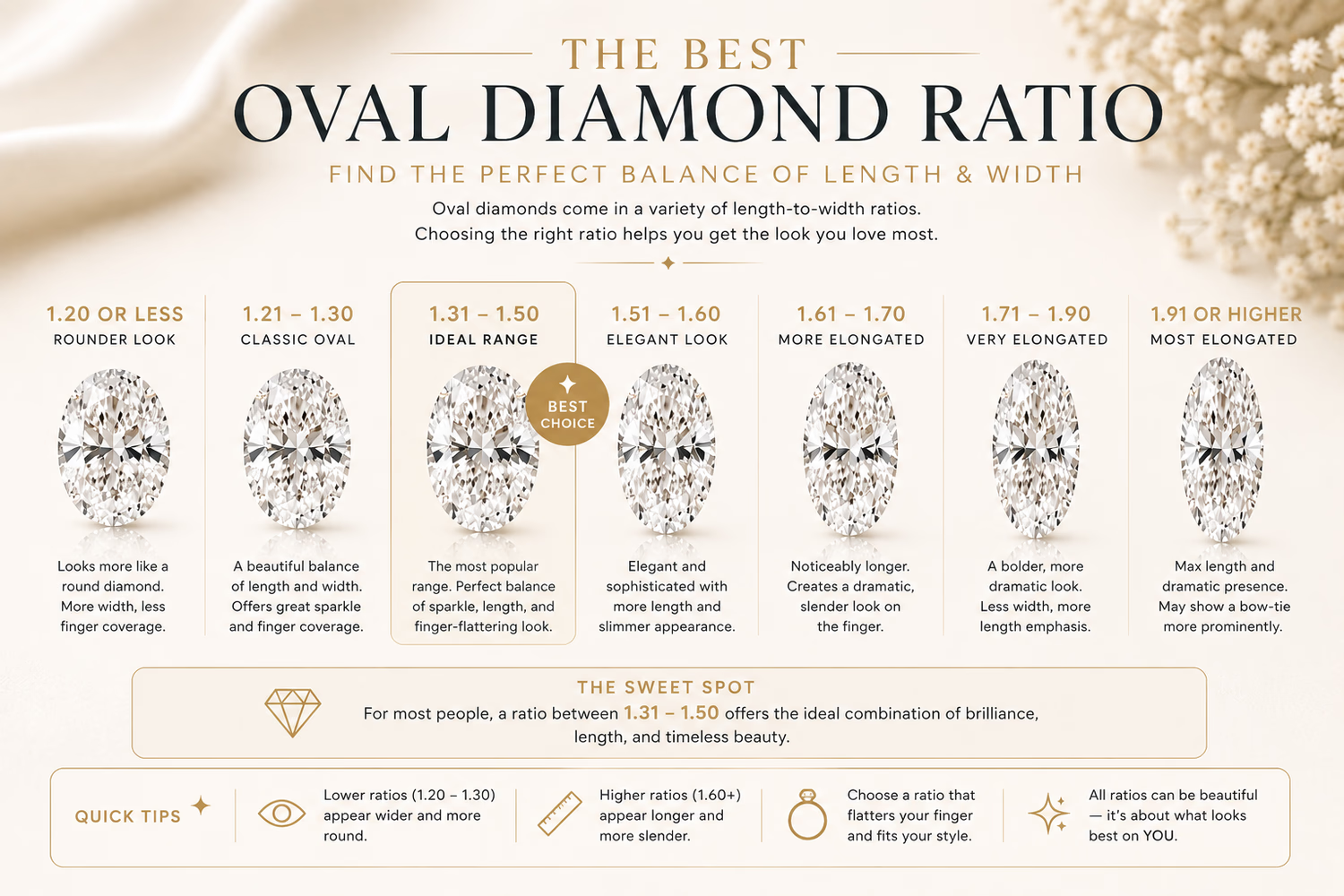
What L:W ratio is best for a pear diamond? 1.50:1 to 1.65:1 is the recommended sweet spot. At this range, the pear reads as a classic balanced teardrop with strong elongation. Below 1.40:1, the rounded section dominates and the shape looks too stout — closer to a round than a teardrop. Above 1.75:1, the shape becomes needle-thin and the bowtie tends to intensify.
What L:W ratio is best for an oval diamond? 1.35:1 to 1.50:1 is the standard recommendation. This range delivers the classic oval silhouette with 28% more face-up coverage than a round. Below 1.30:1 and the shape approaches round; above 1.55:1 and the bowtie intensifies significantly.
Is oval or pear easier to buy? Oval. An oval diamond requires standard proportion verification (L:W ratio, table %, depth %) and a basic 360° video check. A pear requires all of the above plus: point alignment verification, wing symmetry check, bowtie severity assessment in the shoulder, and exclusion of inclusions near the tip. The evaluation burden for pear is meaningfully higher, and the return rate for pear diamonds is statistically higher than for oval diamonds on major platforms.
Which is better for an active lifestyle — oval or pear? Oval. The pear's pointed tip is vulnerable to chipping from lateral impact against hard surfaces (countertops, gym equipment, door frames). A properly V-pronged pear has acceptable durability for normal wear but requires more awareness than an oval. Oval diamonds have no structural vulnerability in standard settings.
What is the Asymmetry Premium for pear diamonds? The Asymmetry Premium is the price differential between pear and oval diamonds at identical grades — at 1ct G-VS2 GIA, it is $263 ($3,150 pear vs $2,887 oval). This premium persists despite the oval delivering more face-up area per carat. The premium reflects the pear's distinctive silhouette, lower rough yield, and cultural demand — not superior visible diamond coverage. Pear buyers are paying for the shape's character, not its size.
See Also
- Pear Cut Diamond: Complete Buying Guide
- Oval Cut Diamond: Complete Buying Guide
- 1 Carat Oval Diamond Price Guide
- Oval Diamond Engagement Ring Settings: All Options
- Oval Diamond Solitaire Engagement Ring Guide
- Round Diamond vs Pear Shape
- Princess Cut vs Pear Diamond
- Oval vs Marquise Diamond
- Round Diamond vs Oval Diamond
- Lab-Grown Oval Diamond Guide
Expert Verdict
Always audit the stone individually — no grade replaces seeing the actual diamond. The certificate tells you what to look for. Your eyes tell you whether to buy.
— Farzana Hasan, GIA Expert · DiamondCritics.com