The oval diamond carat size chart most buyers rely on gives them a single dimension per weight and calls it done. That single number is nearly useless — a 1ct oval can measure anywhere from 8.2mm × 6.0mm to 10.8mm × 5.5mm depending on the L:W ratio and depth, producing dramatically different appearances on the hand at identical carat weights. This guide gives you the full dimensional picture: exact mm ranges by carat weight at three L:W ratios, face-up area calculations, how each size looks on a real finger, and the live Blue Nile prices that correspond to each tier.
A 1.00ct oval diamond at a standard 1.40:1 L:W ratio measures approximately 9.0mm × 6.4mm with a face-up area of ~45mm² — covering 36% more finger surface than a 1.00ct round at 6.5mm diameter. At 1.50:1, the same 1ct oval stretches to ~9.5mm × 6.3mm. At 1.30:1, it compresses to ~8.5mm × 6.5mm. All three are the same carat weight. All three look different on the hand. Knowing which ratio you want is more important than knowing the carat weight alone.
Buyers shop for oval diamonds by carat weight when they should be shopping by mm dimensions. Two 1.00ct ovals at the same price can look completely different sizes on the hand depending on their proportions — one might measure 9.5mm × 6.0mm while the other measures 8.2mm × 6.7mm. The longer stone wins on finger coverage even though both certificates say 1.00ct. This guide gives you the mm targets so you buy the size you actually want, not just the carat weight on the report.
TL;DR
- Standard 1ct oval mm size: 8.5–9.5mm length × 6.0–6.5mm width (varies by L:W ratio and depth)
- Face-up advantage over round: 28–38% more face-up coverage at same carat weight, depending on L:W ratio
- Key insight: Two ovals of identical carat weight can look dramatically different sizes on the hand based purely on L:W ratio and depth choices
- L:W ratio and size: A longer L:W ratio (1.50+) maximises length; a shorter ratio (1.30:1) maximises width. Neither is objectively larger — the face-up area is similar, but the visual impression differs
- The Visual Carat Premium: At every weight from 0.25ct to 5ct, ovals appear larger than rounds of identical weight. This premium ranges from 25–40% more face-up area
- Size on hand: A 1ct oval (9mm) spans about half the width of an average finger. A 2ct oval (11.5mm) spans about two-thirds
- Price by size: 1ct G-VS2 GIA from $2,887 on Blue Nile; 2ct from ~$9,500; 3ct from ~$22,000
- Best sizes by budget: Under $5K → 1.00–1.25ct. $5K–$10K → 1.25–2.00ct. $10K+ → 2.00ct+


About This Guide
I am Farzana Hasan, GIA Expert and Lead Critic at Diamond Critics. The size question is the first thing buyers ask and the last thing most guides answer with real data. "How big will a 1ct oval look on my hand?" deserves a precise answer — not "it depends" and a generic photo.
This guide gives you the mm dimensions, the face-up areas, the finger coverage percentages, and the price data to make a size decision based on what you will actually see on the hand, not a certificate number that means different things depending on how the stone is proportioned. All prices are live July 2026 Blue Nile data, GIA certified, natural diamonds.
For the complete oval buying framework — color, clarity, bowtie, settings — see the oval cut diamond guide. This post focuses entirely on size.
The Visual Carat Premium
Every oval diamond carries what I call The Visual Carat Premium: a systematic, predictable size advantage over a round diamond of identical carat weight. This premium exists because the oval's elongated shape distributes the same mass over a larger flat surface area, making it appear larger when viewed from above.
The premium is not marketing language. It is geometry. A round diamond distributes its weight in a symmetrical sphere, concentrating much of the mass in the pavilion depth below the face-up surface. An oval with a shallower relative depth distributes that same mass across a wider, longer surface.
The Visual Carat Premium by weight:
| Carat | Round Diameter | Oval Dimensions (1.40:1) | Oval Face-Up Area | Round Face-Up Area | Premium |
|---|---|---|---|---|---|
| 0.25ct | 4.1mm | 5.5 × 3.9mm | 16.8mm² | 13.2mm² | +27% |
| 0.50ct | 5.2mm | 7.0 × 5.0mm | 27.5mm² | 21.2mm² | +30% |
| 0.75ct | 5.8mm | 8.0 × 5.7mm | 35.8mm² | 26.4mm² | +36% |
| 1.00ct | 6.5mm | 9.0 × 6.4mm | 45.2mm² | 33.2mm² | +36% |
| 1.25ct | 6.9mm | 9.8 × 7.0mm | 53.9mm² | 37.4mm² | +44% |
| 1.50ct | 7.4mm | 10.5 × 7.5mm | 61.8mm² | 43.0mm² | +44% |
| 2.00ct | 8.1mm | 11.5 × 8.2mm | 74.1mm² | 51.5mm² | +44% |
| 2.50ct | 8.8mm | 12.5 × 8.9mm | 87.3mm² | 60.8mm² | +44% |
| 3.00ct | 9.3mm | 13.5 × 9.6mm | 101.9mm² | 67.9mm² | +50% |
Face-up area calculated using the ellipse formula (π × a × b). Oval dimensions at standard 1.40:1 L:W ratio and 60% depth.
The Visual Carat Premium grows as carat weight increases. At 0.25ct, the oval is ~27% larger than round. By 3ct, it is ~50% larger. This means a 2ct oval appears closer in size to a 3ct round than to a 2ct round — a substantial visual difference that represents thousands of dollars in price.
Why this matters for budgeting: A buyer with a $5,000 stone budget who wants a "2ct look" can achieve it with a 1.50ct oval for roughly $4,000–$6,000 rather than a 2ct round for $10,000+. The 1.50ct oval face-up area (~62mm²) exceeds the 2ct round face-up area (~52mm²) by 19%. Oval is not just cheaper per carat — it delivers more visible size per dollar at every weight tier.
The Ratio-Dimension Matrix
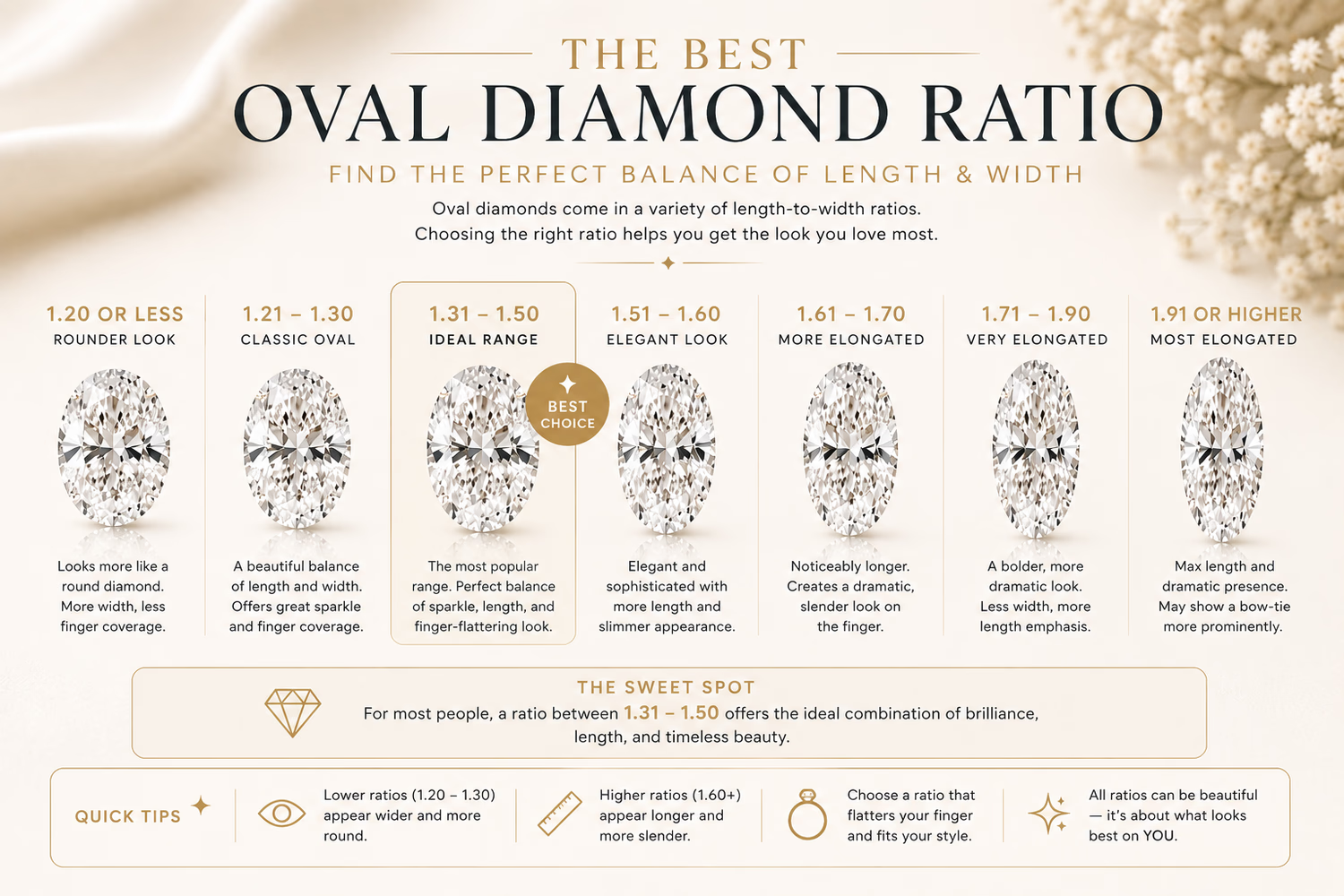
Carat weight tells you how much diamond you have. L:W ratio tells you how that diamond is arranged on your finger. The same carat weight can produce dramatically different appearances on the hand depending on the ratio chosen — this is The Ratio-Dimension Matrix.
At 1.00 carat, three different L:W ratios produce three distinct stones:
| L:W Ratio | Approximate Dimensions | Face-Up Area | Visual Character |
|---|---|---|---|
| 1.25:1 (Compact) | 8.2 × 6.6mm | 42.5mm² | Short, wide oval — close to round, minimal elongation |
| 1.40:1 (Standard) | 9.0 × 6.4mm | 45.2mm² | Classic oval — balanced elongation, most popular ratio |
| 1.50:1 (Elongated) | 9.5 × 6.3mm | 47.0mm² | Longer oval — stronger finger-elongation effect |
| 1.65:1 (Very Elongated) | 10.2 × 6.2mm | 49.7mm² | Dramatic elongation — bowtie risk increases significantly |
All four are 1.00ct. All four are priced similarly on GIA certificates. But they look noticeably different on the hand. The 1.25:1 compact oval and the 1.65:1 very elongated oval might differ by 2.0mm in length — a difference that is immediately visible when the stones are placed side by side and tangibly different in the finger-elongation effect they create.
The practical implication: When shopping for oval diamonds, filter by length and width in addition to carat weight. Blue Nile's search tool allows dimension filtering. Target the L:W ratio you want, verify it matches the certificate measurements, and then evaluate the video for bowtie at that ratio. The carat weight is the budget input; the L:W ratio is the size output.
Farzana's Expert Take: I tell buyers to think of carat weight as their spending limit and L:W ratio as their aesthetic decision. Once you have set the carat weight your budget allows, the L:W ratio choice is free — it costs nothing extra to choose 1.45:1 over 1.30:1 at the same carat weight. Most buyers do not realise this. They pick a carat weight, buy the first stone with good grades, and never consider that a different ratio might have given them a significantly more flattering result on their specific finger.
The Complete Oval Diamond MM Size Chart
Compact Ovals (1.25:1–1.35:1 L:W)
These ovals look wider and more rounded. They produce the least elongation effect but the lowest bowtie severity. Best for buyers who want an oval shape without dramatic elongation, or who prefer a more rounded silhouette.
| Carat | Length | Width | Face-Up Area | vs Round |
|---|---|---|---|---|
| 0.25ct | 5.2mm | 4.2mm | 17.2mm² | +30% |
| 0.50ct | 6.5mm | 5.2mm | 26.5mm² | +25% |
| 0.75ct | 7.7mm | 6.2mm | 37.4mm² | +42% |
| 1.00ct | 8.5mm | 6.8mm | 45.3mm² | +36% |
| 1.25ct | 9.2mm | 7.4mm | 53.5mm² | +43% |
| 1.50ct | 9.9mm | 8.0mm | 62.1mm² | +44% |
| 2.00ct | 11.0mm | 8.8mm | 75.9mm² | +47% |
| 2.50ct | 11.8mm | 9.5mm | 87.9mm² | +45% |
| 3.00ct | 13.0mm | 10.4mm | 106.3mm² | +57% |
Standard Ovals (1.35:1–1.50:1 L:W) — Most Recommended
The most popular L:W range. Delivers meaningful elongation with manageable bowtie at most weights. Recommended for most buyers, most finger types, most settings.
| Carat | Length | Width | Face-Up Area | vs Round |
|---|---|---|---|---|
| 0.25ct | 5.5mm | 3.9mm | 16.8mm² | +27% |
| 0.50ct | 7.0mm | 5.0mm | 27.5mm² | +30% |
| 0.75ct | 8.0mm | 5.7mm | 35.8mm² | +36% |
| 1.00ct | 9.0mm | 6.4mm | 45.2mm² | +36% |
| 1.25ct | 9.8mm | 7.0mm | 53.9mm² | +44% |
| 1.50ct | 10.5mm | 7.5mm | 61.8mm² | +44% |
| 1.75ct | 11.0mm | 7.9mm | 68.2mm² | +43% |
| 2.00ct | 11.5mm | 8.2mm | 74.1mm² | +44% |
| 2.50ct | 12.5mm | 8.9mm | 87.3mm² | +44% |
| 3.00ct | 13.5mm | 9.6mm | 101.9mm² | +50% |
| 4.00ct | 15.0mm | 10.7mm | 125.7mm² | +54% |
| 5.00ct | 16.5mm | 11.8mm | 152.9mm² | +57% |
Elongated Ovals (1.50:1–1.65:1 L:W)
Longer, more dramatic silhouette. Strongest finger-elongating effect. Bowtie becomes more prominent above 1.55:1 — video evaluation is essential. Best for buyers who specifically want the most elongated oval look and are comfortable managing bowtie evaluation. For more on the bowtie considerations at these ratios, see the oval diamond bow tie guide.
| Carat | Length | Width | Face-Up Area | vs Round |
|---|---|---|---|---|
| 0.50ct | 7.5mm | 4.8mm | 28.3mm² | +33% |
| 0.75ct | 8.7mm | 5.6mm | 38.3mm² | +45% |
| 1.00ct | 9.8mm | 6.3mm | 48.5mm² | +46% |
| 1.25ct | 10.5mm | 6.7mm | 55.3mm² | +48% |
| 1.50ct | 11.2mm | 7.2mm | 63.4mm² | +47% |
| 2.00ct | 12.5mm | 8.0mm | 78.5mm² | +52% |
| 2.50ct | 13.5mm | 8.7mm | 92.2mm² | +52% |
| 3.00ct | 14.5mm | 9.3mm | 106.2mm² | +56% |
All dimensions are typical values based on standard oval proportions at each L:W tier. Actual dimensions vary by specific stone; always verify from the GIA certificate.
Oval Diamond Size on the Hand
Knowing the mm dimensions is necessary but not sufficient — you also need to know how those dimensions relate to a real finger.
Average finger width by ring size:
| Ring Size | Finger Width (approx.) |
|---|---|
| Size 5 | 15.7mm |
| Size 6 | 16.5mm |
| Size 7 | 17.3mm (US average) |
| Size 8 | 18.2mm |
| Size 9 | 19.1mm |
A 1ct oval at 9.0mm length spans approximately 52% of a size 7 finger's width. This is enough to create a clear visual impact — visible and elegant without appearing overwhelming. A 2ct oval at 11.5mm spans approximately 66% of the same finger — a substantial, unmistakably large ring presence.
Oval length vs finger width by carat weight on a size 7 finger (17.3mm):
| Carat | Oval Length (std ratio) | % of Finger Width | Visual Impression |
|---|---|---|---|
| 0.25ct | 5.5mm | 32% | Delicate, understated |
| 0.50ct | 7.0mm | 40% | Modest, everyday elegant |
| 0.75ct | 8.0mm | 46% | Visible, approachable |
| 1.00ct | 9.0mm | 52% | Clear statement piece |
| 1.25ct | 9.8mm | 57% | Substantial presence |
| 1.50ct | 10.5mm | 61% | Bold, high-impact |
| 2.00ct | 11.5mm | 66% | Very large, unmistakable |
| 2.50ct | 12.5mm | 72% | Exceptional presence |
| 3.00ct | 13.5mm | 78% | Statement jewellery |
Adjustment for different finger sizes: Smaller fingers (size 5–6) are naturally narrowed by the stone — a 1ct oval appears proportionally larger on a size 5 finger (15.7mm) where the 9mm stone spans 57% of the width, versus 52% on a size 7. For larger fingers (size 8–9), consider stepping up by 0.25ct to maintain the same visual proportion.
The elongation effect: The oval's length measurement is the relevant number for the elongation illusion — the way the stone visually extends the apparent length of the finger. A 9.0mm length oval creates a stronger elongating effect than a 6.5mm round at the same carat weight, not because the oval is longer relative to the finger (both are centred) but because the elongated outline draws the eye along the finger's length. Elongated oval diamond rings take this effect even further with ratios above 1.55:1.
1 Carat Oval Diamond Size: The Benchmark
The 1ct oval is the market benchmark — the weight most buyers reference when visualising oval diamonds. Understanding exactly what a 1ct oval looks like on a hand is the most common question in this category.
1ct oval diamond at three ratios:
- 1.30:1 (compact): 8.5mm × 6.5mm. Appears wider, shorter. Closest to round-brilliant visual. Minimal bowtie. Good for buyers who want oval shape with near-round proportions.
- 1.40:1 (standard): 9.0mm × 6.4mm. The most common 1ct oval proportion. Clear elongation, balanced width, manageable bowtie in most cases.
- 1.50:1 (elongated): 9.5mm × 6.3mm. Noticeably longer. The extra 0.5mm of length makes a visible difference on the hand. Bowtie requires video evaluation.
Live 1ct oval prices on Blue Nile (GIA Ideal Cut):
| Grade | Price | Link |
|---|---|---|
| G-VS2 | $2,887 | View Diamond |
| F-VS2 | $3,114 | View Diamond |
| G-VS1 | $3,272 | View Diamond |
| D-VS2 | $3,327 | View Diamond |
| D-VS1 | $3,384 | View Diamond |
| E-VS1 | $3,589 | View Diamond |
For the full price breakdown across every grade, see the 1 carat oval diamond price guide.
Oval Diamond Size Comparison: Multiple Weights Side by Side
The most useful way to understand oval diamond sizing is to compare multiple weights directly. Here is how each major size tier reads on a standard finger:
0.50ct oval (7.0 × 5.0mm): Elegant and wearable every day. Covers 40% of a size 7 finger. A popular choice for buyers who want a genuine oval shape without significant cost. In a halo setting, a 0.50ct oval centre looks comparable to a plain 0.75ct oval.
0.75ct oval (8.0 × 5.7mm): The "sweet spot" for buyers on a tight budget who still want visible presence. Covers 46% of a size 7 finger. Clear as an oval, not overpowering on smaller hands.
1.00ct oval (9.0 × 6.4mm): The market benchmark. Covers 52% of a size 7 finger — proportionally similar to wearing a 1.25ct round for the same visual impact. The most common engagement ring size in the oval category.
1.25ct oval (9.8 × 7.0mm): A meaningful step up from 1ct that buyers often underestimate. At 9.8mm length, the difference from 9.0mm is immediately visible on the hand. Covers 57% of a size 7 finger. Strong visual impact without crossing into "very large" territory.
1.50ct oval (10.5 × 7.5mm): The luxury tier entry point. Covers 61% of a size 7 finger. For visual size comparison purposes, a 1.50ct oval appears similar in overall presence to a 2.00ct round — the 1.5 carat oval diamond price guide covers this weight in full detail.
2.00ct oval (11.5 × 8.2mm): An unmistakably large oval. Covers 66% of a size 7 finger. At this size, the choice of L:W ratio becomes critically important for finger proportion — an elongated 2ct oval can look spectacular on a longer finger, while a compact 2ct oval suits wider hands better.
3.00ct oval (13.5 × 9.6mm): Statement territory. Covers 78% of a size 7 finger. At this scale, oval's visual carat premium versus round becomes even more pronounced — a 3ct oval has the face-up coverage of a 4ct+ round diamond.
Tides Of Summer Capsule
Up To 30% Off
Shop The Sale →Vault ClearanceClear The Vault
Up To 70% Off
Shop Vault Deals →Affiliate link — no extra cost to you
Oval Diamond Face-Up Size vs Other Shapes
The oval's face-up advantage is not uniform across shapes. Here is how oval compares to every popular shape at 1ct:
| Shape | Approx. Face-Up Area (1ct) | vs Round | vs Oval |
|---|---|---|---|
| Round | 33.2mm² | — | –28% |
| Princess | 31.0mm² | –7% | –32% |
| Cushion | 33.5mm² | +1% | –27% |
| Emerald | 38.0mm² | +14% | –17% |
| Oval (1.40:1) | 45.2mm² | +36% | — |
| Pear (1.55:1) | 36.0mm² | +8% | –20% |
| Marquise (2.00:1) | 47.5mm² | +43% | +5% |
The oval delivers more face-up coverage than round, princess, cushion, emerald, and pear at equivalent carat weights. Only the marquise at a 2:1 ratio edges slightly ahead — and the marquise carries a mandatory color upgrade cost and V-prong requirement that the oval does not. For the oval vs marquise comparison in full, see the oval vs marquise diamond guide.
How to Read the L:W Ratio from a GIA Certificate
The GIA certificate for an oval diamond lists measurements in the format: Length × Width × Depth (mm). The L:W ratio is calculated by dividing the length by the width.
Example:
- Certificate shows: 9.12 × 6.54 × 3.94mm
- L:W ratio = 9.12 ÷ 6.54 = 1.39:1
- This is a standard ratio — good balance of elongation and face-up area
What to calculate from the certificate:
- L:W ratio = Length ÷ Width. Target 1.35–1.50 for standard. Target 1.30–1.40 for compact. Target 1.50–1.65 for elongated.
- Depth % = Depth ÷ Width × 100. Target 58–63% for standard ovals.
- Face-up area estimate = π × (Length/2) × (Width/2). This gives the ellipse area in mm² — the face-up footprint.
GIA does not report L:W ratio directly on the certificate — you calculate it from the measurements. Blue Nile's product pages do display L:W ratio for you if you prefer not to calculate.
Price by Size: What Each Oval Weight Costs
Budget guide — natural GIA Ideal Cut ovals on Blue Nile, G-VS2:
| Carat | Approx. Price | Notes | Post |
|---|---|---|---|
| 0.50ct | $700–$1,100 | Entry point for oval engagement rings | — |
| 0.75ct | $1,300–$2,000 | Strong visual impact for the price | — |
| 1.00ct | $2,887–$3,800 | Market benchmark, best inventory depth | 1ct Guide |
| 1.25ct | $3,500–$5,000 | Meaningful size upgrade from 1ct | — |
| 1.50ct | $4,500–$7,000 | Luxury entry point, high visual impact | 1.5ct Guide |
| 2.00ct | $9,000–$14,000 | Statement size, exponential price curve | 2ct Guide |
| 2.50ct | $14,000–$22,000 | Rare, certified gems at this weight | 2.5ct Guide |
| 3.00ct | $22,000–$38,000 | Investment-grade ovals | 3ct Guide |
The non-linear price curve: Oval diamond prices do not scale linearly with weight. Moving from 1ct ($2,887) to 2ct does not double the price — it typically triples or quadruples it. This is because large, well-proportioned oval diamonds with good L:W ratios are genuinely rarer than small ones; the rough crystal requirements to cut a 2ct oval with ideal proportions and minimal bowtie are significantly more demanding than for 1ct.
This non-linearity is the main argument for the Visual Carat Premium strategy: buying a well-chosen 1.50ct oval ($4,500–$7,000) that appears similar in visual footprint to a 2.00ct round ($10,000+) saves thousands of dollars for effectively the same appearance on the hand.
Oval Diamond Size Chart: Types and Cuts
The "types of oval diamond cuts" and "different oval diamond cuts" search queries reflect a common confusion: unlike round diamonds with their precisely defined brilliant cut, ovals do not have named sub-types the way rounds do (excellent, very good, good). All ovals are "modified brilliant" cuts — but they vary significantly in proportions.
The practical differentiation is by L:W ratio category:
Classic/Standard Oval (1.35:1–1.50:1): The most produced, most stocked, and most universally flattering oval proportion. This is what most buyers picture when they think "oval diamond." Strong face-up area, good finger elongation, manageable bowtie in most cases.
Compact Oval (1.25:1–1.35:1): Shorter and wider. Looks more like a rounded rectangle than an elongated oval. Some buyers deliberately choose this for a unique look or because they prefer a wider stone on the finger.
Elongated Oval (1.50:1–1.65:1): The increasingly popular "long oval" style that creates the strongest finger-elongation effect. Specifically sought by buyers who have seen the elongated oval trend and want the maximum length. Requires more careful bowtie evaluation.
East-West Oval: Not a different cut — it is the same oval stone set horizontally (lengthwise across the finger rather than up-down the finger). An east-west oval diamond ring creates a wide, modern look by using the oval's length across the finger's width rather than along it.
Optimization Matrix: Choosing Your Oval Size
| Goal | Target Carat | Target L:W | Expected Size | Budget Range |
|---|---|---|---|---|
| Maximum size under $5,000 total | 1.00–1.25ct | 1.40:1–1.50:1 | 9.0–9.8mm | $2,887–$4,500 stone |
| Looks like 2ct round, lowest price | 1.50ct oval | 1.40:1–1.45:1 | 10.5 × 7.5mm | $4,500–$7,000 |
| Maximum elongation for slim fingers | 1.00ct+ | 1.50:1–1.60:1 | 9.5–10mm+ | $3,000+ |
| Widest appearance for wider fingers | 1.00ct+ | 1.25:1–1.35:1 | 8.5 × 6.8mm | $2,800+ |
| Everyday wearable, under $3,000 | 0.75ct | 1.35:1–1.45:1 | 8.0 × 5.7mm | $1,300–$2,000 |
| Statement ring under $10,000 | 1.75–2.00ct | 1.40:1–1.50:1 | 11.0–11.5mm | $7,000–$10,000 |
| Halo setting — appears 1ct larger | 0.75ct centre | 1.35:1–1.45:1 | 8.0mm + halo | $1,300–$2,000 stone |
Best Settings for Each Oval Diamond Size
Setting choice directly affects how large your oval diamond appears on the hand. A halo adds approximately 1–1.5mm of visual width around the centre stone, making a 0.75ct oval (8.0mm) appear comparable to a plain 1.00ct oval (9.0mm). For buyers working near a carat weight threshold, this is a meaningful strategy — buy a well-cut 0.75ct oval with a halo setting instead of a plain 1.00ct and save $1,000–$2,000 on the stone.
Recommended settings by oval diamond size:
| Stone Size | Setting Style | Setting | Metal | Price |
|---|---|---|---|---|
| 0.50–0.75ct | Pavé Halo | Petite Pavé Halo 14K WG | 14K White Gold | $1,565 |
| 0.75–1.25ct | Pavé Halo | Classic Pavé Halo 14K YG | 14K Yellow Gold | $1,565 |
| 1.25–2.00ct | Pavé Halo | Pavé Halo Platinum | Platinum | $1,930 |
| 2.00ct+ | Luxury Halo | The Ritz Oval Halo 14K WG | 14K White Gold | $2,995 |
How setting affects perceived oval size:
- Plain solitaire: Shows the full L:W ratio. A 1.40:1 oval reads as elegant and elongated. Best for buyers who want the pure oval silhouette.
- Pavé halo: Adds ~1mm visual border all around. Makes the stone appear 15–20% larger face-up. Strongly recommended for 0.75ct centres where the extra apparent size matters most.
- East-west setting: Rotates the oval 90°. The length of the oval runs across the finger rather than up-down. Creates a wide, modern look — see the east-west oval diamond ring guide for full setting options.
- Bezel setting: Slightly reduces the apparent length by framing the stone. Best for elongated ovals (1.50:1+) where the bezel softens the outline while still showing the elongation.
For buyers choosing between a larger plain solitaire and a smaller halo, the halo typically wins on visual size at equivalent total budgets — the setting adds face-up coverage for $1,500–$2,000 that would cost $3,000–$5,000 in additional carat weight. See the full oval diamond engagement ring settings guide for a complete comparison.
Final Verdict
The oval diamond carat size chart is only useful if it tells you both the carat weight and the L:W ratio — because those two numbers together determine what you will actually see on your hand. A 1ct oval at 1.40:1 L:W is a fundamentally different visual object than a 1ct oval at 1.55:1, and buying the wrong one for your finger type or aesthetic goal is an avoidable mistake.
The framework for using this guide: set your budget to determine your carat weight ceiling, choose your L:W ratio based on the elongation effect you want (1.35–1.50 for most buyers; 1.50–1.65 for maximum elongation), then filter Blue Nile's oval search by both measurements to find stones in your target dimensions. Verify each candidate with the 360° video for bowtie. That process — budget → carat weight → L:W ratio → video audit — produces an oval diamond sized exactly for your hand and your aesthetic, not just for a number on a certificate.
Farzana's Verdict: The most common sizing mistake I see is buyers choosing carat weight based on budget and accepting whatever L:W ratio comes with the stone that passes their grade filters. The L:W ratio is a free choice — it costs nothing extra to insist on 1.40:1 over 1.55:1 at the same carat weight. Take the extra step, filter by dimensions, watch the videos, and you will end up with an oval that looks exactly the size you wanted — not approximately the size your budget allowed.
Frequently Asked Questions
How big is a 1 carat oval diamond? A 1ct oval at standard 1.40:1 L:W ratio measures approximately 9.0mm × 6.4mm. This varies from about 8.5mm × 6.5mm at a compact 1.30:1 ratio to 9.8mm × 6.2mm at an elongated 1.55:1 ratio. All are 1ct but look different on the hand. On an average size 7 finger (17.3mm wide), a 9mm oval spans about 52% of the finger width.
How does oval diamond size compare to round at the same carat weight? A 1ct oval at 1.40:1 covers approximately 45mm² of face-up area versus a 1ct round's 33mm² — about 36% more visible surface. At 2ct, the oval covers 74mm² versus round's 52mm² — 44% more. The oval's size advantage over round grows at higher carat weights, which is one reason oval is preferred by buyers who want maximum visible size for their budget.
What is the best L:W ratio for an oval diamond? 1.35:1 to 1.50:1 is the most recommended range for most buyers. This delivers clear elongation without a dominant bowtie and creates the classic, balanced oval silhouette. Below 1.30:1 and the stone looks close to round; above 1.55:1 and bowtie severity increases significantly and requires careful video evaluation before purchase.
How big is a 2 carat oval diamond? A 2ct oval at standard 1.40:1 L:W measures approximately 11.5mm × 8.2mm. On a size 7 finger, it spans about 66% of the finger width — a substantial, statement-sized presence. Face-up area is approximately 74mm², compared to a 2ct round's 52mm² — the 2ct oval appears similar in face-up size to a 3ct round.
What is oval diamond face-up size? Face-up size refers to the visible surface area of the diamond when viewed from above — the perspective you see when wearing it on the finger. For ovals, face-up area is calculated using the ellipse formula (π × half-length × half-width). A 1ct oval at 9.0mm × 6.4mm has a face-up area of approximately 45mm². This is 36% more than a 1ct round (33mm²), explaining why ovals look larger than rounds at the same carat weight.
Does ring size affect how big an oval looks? Yes. Smaller fingers make a given oval size appear proportionally larger — a 9mm oval on a size 5 finger (15.7mm) spans 57% of the finger, versus 52% on a size 7. Buyers with smaller fingers (size 5–6) can often go down 0.25ct from their target size and achieve the same proportional appearance. Buyers with larger fingers (size 8+) should consider going up 0.25ct.
How big is a 0.5 carat oval diamond? A 0.50ct oval at standard proportions measures approximately 7.0mm × 5.0mm. This is larger than a 0.50ct round (5.2mm diameter) in visible face-up coverage. On a size 7 finger, the 7mm oval spans about 40% of the finger width — an understated but clearly oval appearance.
What does an oval diamond size chart show? An oval diamond size chart shows the expected mm dimensions (length × width) at each carat weight, typically at a standard L:W ratio. The most useful charts also show multiple L:W ratios at each weight and compare oval dimensions to equivalent round diamonds, allowing buyers to see exactly how much larger the oval appears at each weight tier.
How much bigger does an oval look than a round of the same size? At 1ct: oval (9.0mm × 6.4mm) covers 45mm² versus round (6.5mm) at 33mm² — 36% more face-up area. At 1.5ct: oval (10.5mm × 7.5mm) covers 62mm² versus round (7.4mm) at 43mm² — 44% more. The premium grows with carat weight because depth efficiency improves as ovals scale up.
What is a good oval diamond mm size for an engagement ring? Most engagement ring buyers target 1ct (9mm) as the standard, 1.25ct (9.8mm) as a step up, and 1.50ct (10.5mm) as the luxury entry point. These sizes offer the best balance of visual impact and price across the oval diamond market. For buyers prioritising budget, a 0.75ct oval (8.0mm) in a halo setting can appear comparable to a plain 1ct solitaire oval.
Do oval diamond sizes vary by retailer? The dimensions of a specific stone are fixed and listed on the GIA certificate — they do not change between retailers. However, different retailers stock different proportions. Blue Nile's "Ideal" cut oval filter narrows to stones with depth and table percentages in the optimal range, which tend to produce more consistent face-up sizes at each carat weight than searching without the filter.
How do I find an oval diamond with the specific dimensions I want? On Blue Nile, use the diamond search with shape set to Oval and filter by length and width measurements. Set your target L:W range (e.g. length 8.8–9.2mm, width 6.2–6.6mm for a 1ct standard oval) and filter the results. Then use the GIA certificate to verify the exact measurements and L:W ratio calculation. Watch the 360° video to confirm bowtie severity at that ratio.
See Also
- Oval Cut Diamond: Complete Buying Guide
- 1 Carat Oval Diamond Price Guide
- 1.5 Carat Oval Diamond Price Guide
- 2 Carat Oval Diamond Price Guide
- Oval Diamond Bow Tie Effect Guide
- Elongated Oval Diamond Ring Guide
- East-West Oval Diamond Ring Guide
- Oval Diamond Engagement Ring Settings
- Oval vs Marquise Diamond
- Round Diamond vs Oval Diamond
Expert Verdict
Always audit the stone individually — no grade replaces seeing the actual diamond. The certificate tells you what to look for. Your eyes tell you whether to buy.
— Farzana Hasan, GIA Expert · DiamondCritics.com