Radiant Cut vs Brilliant Cut Diamond: Radiant IS a Brilliant Cut
TL;DR
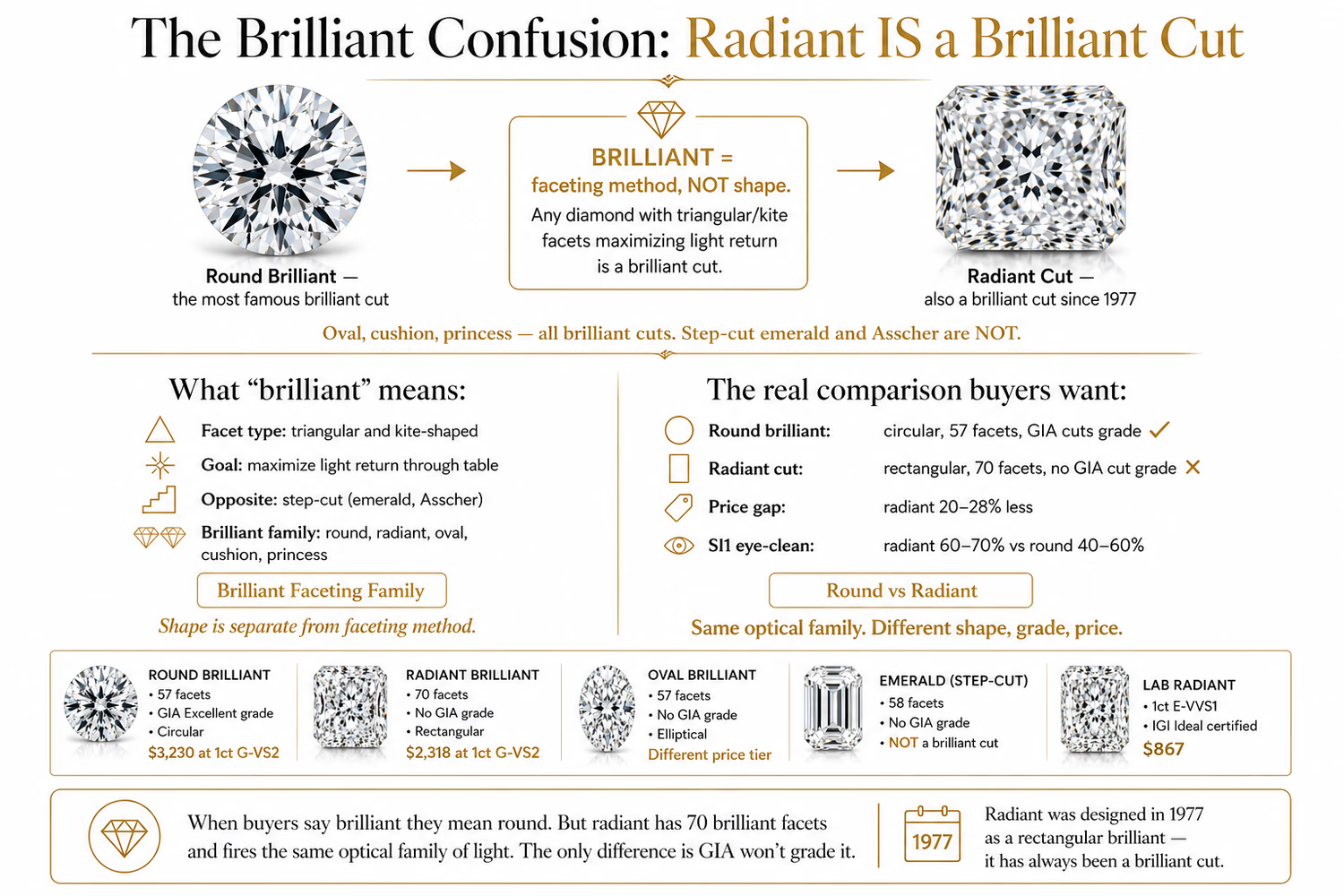
The Brilliant Confusion: Radiant cut is a brilliant cut. Technically, comparing "radiant vs brilliant" is comparing one brilliant to another. What buyers actually mean is: round brilliant vs radiant cut. That is the real comparison — and it is a good one.
What actually separates them:
- Round brilliant: 57 facets, circular outline, GIA issues an Excellent cut grade, #1 resale value, highest demand
- Radiant cut: 70 brilliant-style facets, square-to-rectangular outline, no GIA cut grade, 20-28% cheaper per carat
The Grade Cliff: GIA grades every round brilliant with a cut score. GIA grades no radiant cut with a cut score. That is a cliff in quality verification when spending $3,000+.
→ Entry round brilliant ring: 1ct G-VS2 GIA Excellent at $3,230 + Knife Edge Solitaire at $925 = $4,155. Entry radiant ring: 1ct G-VS2 at $2,318 + setting = $3,243. Lab radiant entry: 1ct E-VVS1 at $867 + setting = $1,792.
The Brilliant Confusion
When buyers search "radiant vs brilliant cut," they almost always mean one thing: how does radiant compare to a round diamond?
That is a reasonable thing to wonder. It is also worth clarifying — because the term "brilliant" does not mean "round." Brilliant is a faceting method, not a shape. Brilliant-cut diamonds use a pattern of triangular and kite-shaped facets arranged to maximize light return through the table. The round brilliant is the most famous example. But radiant cut is also a brilliant cut. Oval, cushion, and princess cuts are brilliant cuts too. Step cuts like emerald and Asscher are the opposite — they use parallel rectangular facets and deliver depth over sparkle.
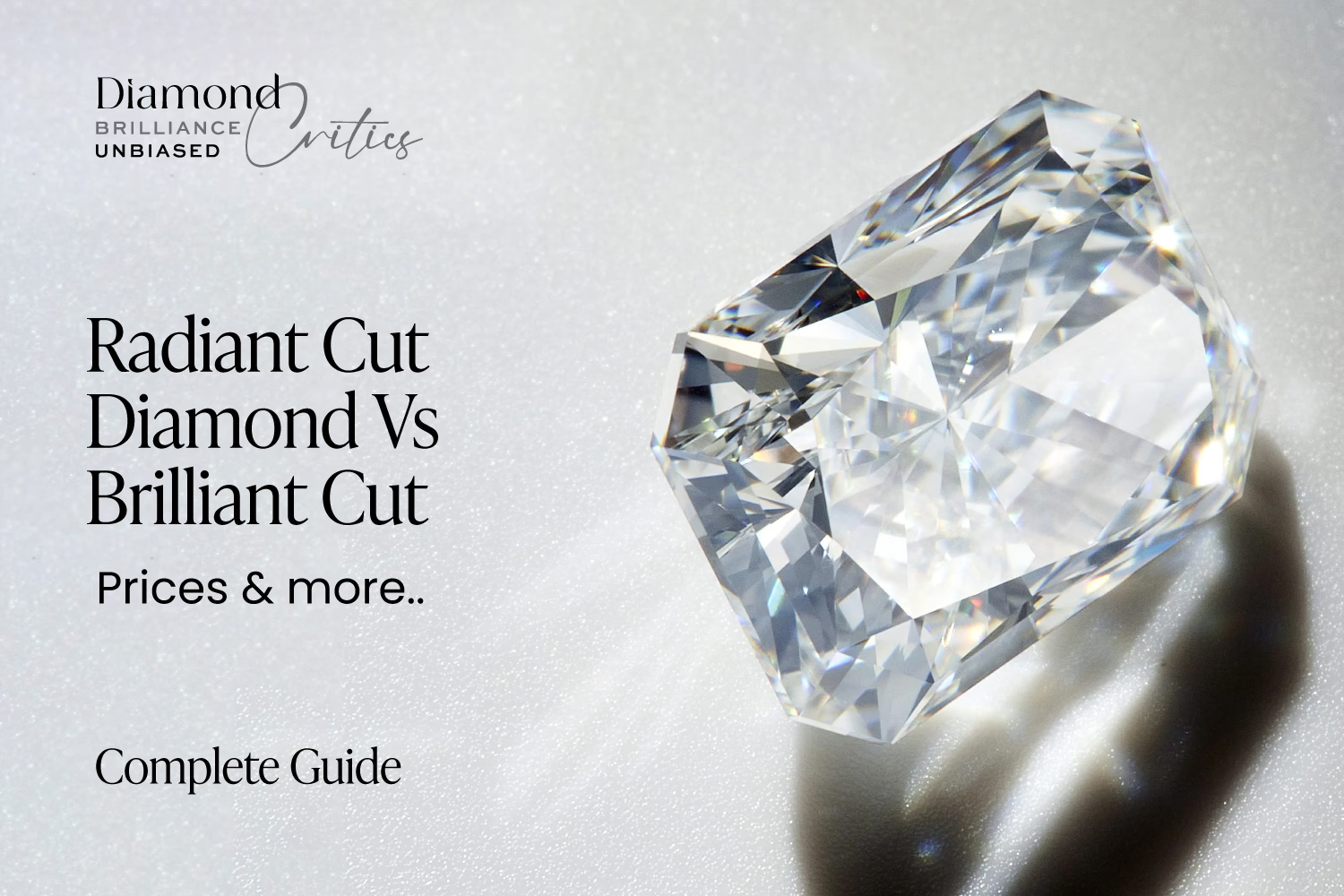
Radiant cut was designed in 1977 by Henry Grossbard specifically as a rectangular brilliant-cut diamond. The 70-facet pattern was engineered to bring brilliant-style light return to a rectangular shape. So when buyers ask "radiant vs brilliant," they are technically asking one brilliant to compare itself to another.
The comparison buyers actually want is: round brilliant vs radiant cut. That is what this guide covers.
I'm Farzana Hasan, GIA Expert at Diamond Critics. I see this search confusion every week. The answer is useful — once you understand what you're actually comparing. For the full radiant cut context, see the Radiant Cut Diamond: The Complete Buying Guide.


What Is a Brilliant Cut Diamond?
Brilliant cut refers to the facet architecture, not the shape. A brilliant-cut diamond has:
- A flat table at the top
- A crown of angular facets above the girdle
- A pavilion of angular facets below the girdle that direct light back up through the table
- Facet shapes that are triangular or kite-shaped (as opposed to the rectangular facets in step cuts)
The round brilliant has 57 or 58 facets. Every facet angle and proportion was optimized over decades — the Tolkowsky ideal cut (1919) established the mathematical framework that GIA Excellent is based on today.
Radiant cut has 70 facets — more than round. The additional facets are arranged differently: the radiant's pavilion uses a non-directional pattern that creates what buyers describe as "crushed-ice" scatter, where light fires from every part of the face in small, rapid flashes. Round brilliant's 57 facets fire in a more concentrated, defined pattern — higher contrast, more dramatic.
Both are brilliant cuts. Both produce fire and brilliance. The difference is in the precision of that light performance and whether GIA can grade it.
The Grade Cliff
This is the most important difference between round brilliant and radiant cut. Not the shape. Not the price. The grade.
Round brilliant receives a GIA cut grade: Excellent, Very Good, Good, Fair, Poor. When you buy a round GIA Excellent diamond, an independent laboratory has evaluated every proportion — table %, depth %, crown angle, pavilion angle, girdle thickness, culet — and confirmed they fall within the range that maximizes light return. You do not need to evaluate the cut yourself. GIA did it, and they put the score on the certificate.
Radiant cut does not receive a GIA cut grade. GIA evaluates polish and symmetry for radiant cuts, but issues no holistic cut score. There is no "GIA Excellent" for radiant. When a retailer lists a radiant as "Ideal" or "Excellent," that is a retailer designation — not a GIA grade. You are evaluating the cut yourself using table %, depth %, and length-to-width ratio from the certificate.
What this means in practice. Buying a round brilliant is simple: filter for GIA Excellent, check the color and clarity, verify price. Buying a radiant requires reading the proportion data on the certificate manually and watching HD video to evaluate light performance. Neither is impossible. But they are completely different purchasing experiences — and the round's experience is significantly more straightforward at equivalent budget levels.
"The Grade Cliff is the real reason many buyers gravitate toward round brilliant even when radiant fits their aesthetic. It is not that round is objectively better — it is that round is objectively easier to buy. GIA Excellent is a precise, independently verified standard. Radiant Ideal is a retailer label. Those are not the same thing, and the difference matters more when you're spending $5,000+ than when you're buying a $50 pendant." — Farzana Hasan, Diamond Critics
Proportions to evaluate a radiant cut manually:
- Table %: 61–69%
- Depth %: 61–67%
- L/W ratio: 0.95–1.05 for square, 1.20–1.40 for rectangular
- Polish: Very Good minimum, Excellent preferred
- Symmetry: Very Good minimum, Excellent preferred
Always require HD video for radiant cuts. Never buy a radiant based on certificate data alone — the video shows the actual light performance that proportion numbers can't fully capture.
Master Comparison: Round Brilliant vs Radiant Cut
| Factor | Round Brilliant | Radiant Cut | What this means |
|---|---|---|---|
| Facets | 57 | 70 | Radiant has more facets, but round's 57 are more precisely optimized for light return |
| GIA cut grade | Yes — Excellent/VG/Good | None | Round lets you verify cut on the certificate; radiant requires manual proportion review |
| Shape | Circular | Square to rectangular | Round is the only option for a circular outline; radiant spans 1.00–1.45 L/W |
| Sparkle type | Defined, high-contrast brilliance | Crushed-ice scatter, high-frequency | Round = intense flashes; radiant = constant shimmer across the whole face |
| Price vs round | Baseline | 20–28% less | Radiant saves real money — $912 less at 1ct G-VS2, $5,000+ less at 2ct |
| SI1 eye-clean rate | 40–60% | 60–70% | Radiant hides inclusions better — better clarity flexibility at the same grade |
| Color performance | Excellent — masks body color | Good — slightly more visible | Round needs G minimum; radiant needs H minimum in white metal |
| Corners | None — circular, no chip risk | Clipped 45° — minimal chip risk | Both are safe; round has zero corner risk, radiant's clipped corners are close |
| Resale value | Highest of all shapes | Below round | Round is the most liquid diamond shape in resale; radiant trades at deeper discount |
| Setting compatibility | All settings | Non-round settings only | Round fits every setting style; radiant needs a square/rectangular head |
| Carat efficiency | Moderate — some weight in base | Better — more face-up per ct | Radiant often looks larger face-up than a round of the same carat weight |
| Popularity | #1 most sold shape | Niche — lower demand | Round's demand drives higher price and higher resale; radiant's lower demand = savings |
Verdict: Round brilliant wins on cut grade verification, resale value, and setting flexibility. Radiant wins on price, clarity tolerance, and face-up size efficiency. If simplicity and maximum light performance matter most, round wins. If budget and a rectangular shape matter, radiant wins. Neither is objectively better — they are different solutions for different buyers.
Sparkle: How Round and Radiant Actually Look Different
Both cuts produce brilliant-style sparkle. The difference is in the character of that sparkle — not the quantity.
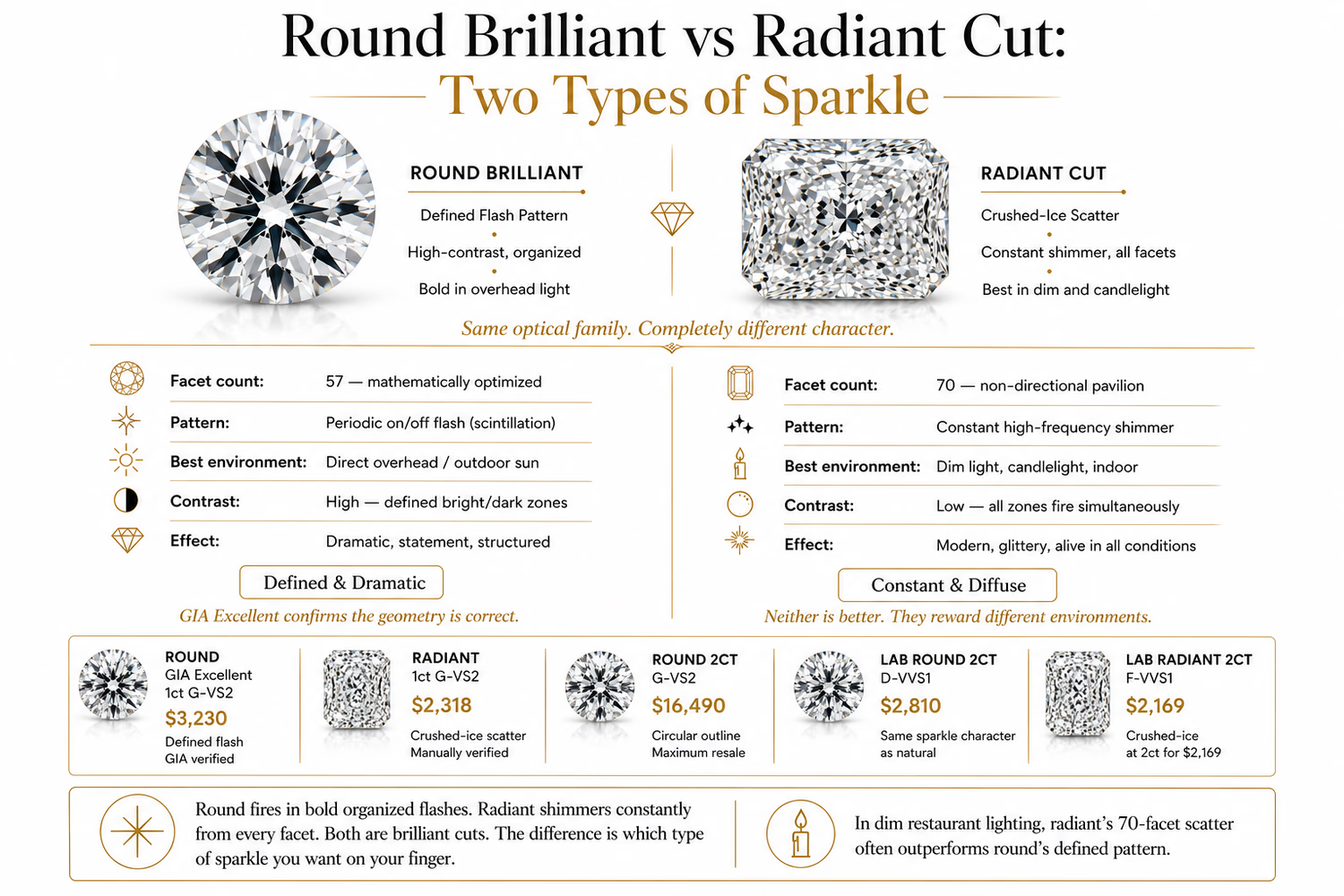
Round brilliant — defined flash pattern. The 57-facet geometry creates high-contrast brilliance with defined zones of light and dark. The pattern is what gemologists call "scintillation" — on/off, bright/dark alternation in motion. Under overhead light, a GIA Excellent round produces a near-perfect ring of fire around the table. In motion on the finger, it fires in organized, intense flashes. The effect is dramatic and structured.
Radiant cut — crushed-ice scatter. The 70-facet non-directional pavilion breaks light into hundreds of small simultaneous flashes across the entire face. There are no dominant light zones — every part of the face fires at once. The pattern is often described as "glittery" or "icy." In motion, the stone shimmers continuously at high frequency. The effect is modern, diffuse, and constant rather than periodic.
Which looks better? Neither. They appeal to different buyers. Buyers who want a statement diamond — bold, intense, high-drama — generally prefer round brilliant. Buyers who want a stone that looks alive in all conditions, low and high light, prefer the radiant's constant shimmer. The radiant's crushed-ice pattern is particularly effective indoors under dim lighting, where the high-frequency scatter responds to subtle light changes that round brilliant's larger facets don't react to.
The side-by-side test. Under direct overhead light at the same size, most buyers perceive round as more dramatic. In candlelight or dim restaurant lighting, radiant often looks more alive. Neither is a fair universal comparison — they are different products for different environments.
Price Comparison: Round Brilliant vs Radiant Cut
Radiant cuts are consistently 20–28% cheaper than round brilliants at equivalent stated grades. This discount exists for three reasons:
- Radiant cuts retain more rough diamond material during cutting — less waste
- Demand for round brilliants is dramatically higher than for radiant cuts
- The absence of a GIA cut grade makes radiant harder to price-compare, reducing competition and demand
Ring totals below use the Knife Edge Solitaire in 14k White Gold at $925.
Natural Round Brilliant Prices (GIA Excellent)
| Color/Clarity | Carat | Stone Price | Ring Total | What this means |
|---|---|---|---|---|
| G-VS2 Excellent | 1ct | $3,230 | $4,155 | Benchmark round — GIA cut grade confirmed, most common 1ct tier |
| G-VS1 Excellent | 1ct | $3,300 | $4,225 | $70 more than G-VS2 for one clarity upgrade — minimal practical difference at GIA Excellent |
| F-VS2 Excellent | 1ct | $3,490 | $4,415 | One color step above G — near-colorless in any setting; $260 premium over G-VS2 |
| G-VS2 Excellent | 2ct | $16,490 | $17,415 | 5.1× the 1ct price — round's carat premium is steep; 2ct is where round vs radiant savings become significant |
| G-VVS1 Excellent | 3ct | $44,500 | $45,425 | 3ct round is a major investment — lab-grown round at 3ct costs $7,340, less than 17% of this |
Verdict: Round brilliant carries a consistent premium driven by cut grade verification and market demand. At 1ct, the entry price of $3,230 is $912 more than a comparable radiant at $2,318. At 2ct, the gap widens substantially. Buyers who prioritize GIA cut grade simplicity pay this premium. Buyers who evaluate radiant proportions manually can redirect the savings.
Natural Radiant Cut Prices
| Color/Clarity | Carat | Stone Price | Ring Total | What this means |
|---|---|---|---|---|
| G-VS2 | 1ct | $2,318 | $3,243 | Entry radiant — $912 less than 1ct round G-VS2; no cut grade but proportions verifiable on certificate |
| F-VS2 | 1ct | $2,597 | $3,522 | One color step up from G — still $893 less than round F-VS2; savings hold across color grades |
| F-VS1 | 1ct | $2,787 | $3,712 | $190 more than F-VS2 for one clarity upgrade — radiant's SI1 flexibility means VS1 rarely needed |
| G-VS2 | 1.5ct | $7,704 | $8,629 | 1.5ct delivers significant face-up size gain; price is 3.3× the 1ct, not 5×+ like round |
| E-VS1 | 1.5ct | $7,844 | $8,769 | E-VS1 for $8,769 total — equivalent round at this spec tier exceeds $12,000+ |
| D-VS2 | 2ct | $17,714 | $18,639 | D color premium explains the gap vs round G-VS2 at $16,490 — same clarity, 4 color grades apart |
Verdict: Radiant holds a consistent 20–28% price advantage over round at equivalent grades. At 1ct G-VS2, that is $912 saved. At 1.5ct E-VS1, the savings vs equivalent round exceed $4,000. The savings are real — but they come with the responsibility of evaluating cut quality manually without a GIA score. Buyers who understand that trade-off find radiant exceptional value.
"The price gap between round brilliant and radiant is not noise — it is structural. Radiant costs less because GIA doesn't grade it, demand is lower, and rough diamond recovery is higher. None of these things affect the actual appearance of a well-cut radiant on the finger. A radiant cut to table 61–68%, depth 61–67%, Very Good polish and symmetry, viewed in HD video — that is a beautiful diamond. You just have to verify it yourself instead of trusting a GIA Excellent stamp." — Farzana Hasan, Diamond Critics
Lab-Grown: Round Brilliant vs Radiant Cut
Lab-grown diamonds are identical in chemistry and appearance to natural diamonds. In the lab-grown market, the savings vs natural are dramatic at all sizes — and the round vs radiant comparison plays out differently when both shapes are available at lab prices.
Ring totals use the Knife Edge Solitaire at $925.
Lab-Grown Round Brilliant Prices (IGI/GIA Ideal/Excellent)
| Color/Clarity | Carat | Cert | Stone Price | Ring Total | What this means |
|---|---|---|---|---|---|
| E-VVS1 Ideal | 1.5ct | IGI | $1,930 | $2,855 | 1.5ct lab round under $2,000 — verified Ideal cut, E-VVS1 top tier, circular shape |
| D-VVS1 Ideal | 2ct | IGI | $2,810 | $3,735 | 2ct D-VVS1 lab round for $2,810 — natural 2ct G-VS2 round costs $16,490; 83% savings |
| D-VVS1 Excellent | 3ct | GIA | $7,340 | $8,265 | 3ct D-VVS1 GIA Excellent lab round — natural equivalent costs $44,500; GIA cert on lab round is rare and valuable |
| D-VVS1 Ideal | 4ct | IGI | $9,680 | $10,605 | 4ct D-VVS1 for under $10,000 — a complete ring under $11,000 that reads as a statement piece |
Verdict: Lab-grown round brilliant delivers the GIA/IGI cut grade advantage at a fraction of natural prices. At 2ct, a D-VVS1 lab round at $2,810 costs less than a 1ct natural round. If the priority is round brilliant's GIA cut grade with maximum carat at minimum price, lab-grown round is the answer.
Lab-Grown Radiant Cut Prices (IGI Certified)
| Color/Clarity | Carat | Cert | Stone Price | Ring Total | What this means |
|---|---|---|---|---|---|
| E-VVS1 | 1ct | IGI | $867 | $1,792 | Entry lab radiant — complete ring under $1,800; no equivalent lab round available at 1ct under $1,500 |
| D-VVS1 | 1ct | IGI | $932 | $1,857 | $65 more for D color vs E — compressed lab pricing makes top color grade affordable here |
| F-VVS1 | 1.5ct | IGI | $1,510 | $2,435 | 1.5ct lab radiant for $1,510 — $420 less than a 1.5ct lab round at $1,930 |
| E-VVS1 | 1.5ct | IGI | $1,600 | $2,525 | Step up to E for $90 more — still $330 less than lab round at 1.5ct E-VVS1 |
| F-VVS1 | 2ct | IGI | $2,169 | $3,094 | 2ct lab radiant for $2,169 — $641 less than 2ct lab round D-VVS1 at $2,810; saves money even vs lab round |
| E-VVS1 | 2ct | IGI | $2,220 | $3,145 | 2ct E-VVS1 lab radiant complete ring for $3,145 — the strongest value case in the comparison |
Verdict: Lab radiant is cheaper than lab round at every size tier — the 20-28% discount holds even in the lab market. At 1ct, radiant at $867 undercuts the entry lab round significantly. At 2ct, the $641 gap matters less than in natural — but lab radiant at $2,169 for a 2ct ring is genuinely remarkable value.
"In the lab market, the round vs radiant comparison is worth having specifically at 1ct. Lab radiant at $867 complete ring under $1,800 is a category-defining price point. Lab round at 1ct starts higher and has fewer options in this size. If the shape preference allows for rectangular, lab radiant at 1ct is one of the best value propositions in the entire diamond market right now." — Farzana Hasan, Diamond Critics
Tides Of Summer Capsule
Up To 30% Off
Shop The Sale →Vault ClearanceClear The Vault
Up To 70% Off
Shop Vault Deals →Affiliate link — no extra cost to you
Face-Up Size: Does Radiant Look Bigger?
Radiant cut generally has a larger face-up area than round at equivalent carat weight, when proportions are appropriate (depth ≤67%).
| Carat | Round Diameter | Square Radiant | Rect. Radiant (1.30:1) |
|---|---|---|---|
| 1ct | 6.4mm | ~5.8×5.8mm | ~6.8×5.2mm |
| 1.5ct | 7.3mm | ~6.7×6.7mm | ~7.8×6.0mm |
| 2ct | 8.1mm | ~7.4×7.4mm | ~8.7×6.7mm |
The rectangular radiant (L/W 1.20–1.40) creates an elongated silhouette that reads larger than the carat weight implies — similar to the finger-lengthening effect of oval cut. The square radiant (L/W 0.95–1.05) is closer in perceived size to round at equivalent carat, but still slightly larger face-up.
Avoid radiants with depth above 68%. Excess depth hides carat weight in the base of the stone — the stone looks smaller face-up than the certificate weight implies. Always compare millimeter face-up dimensions, not just carat weight.
Color and Clarity: How Each Shape Performs
Color — round wins. Round brilliant's 57-facet pattern scatters body color so effectively that G color reads as essentially colorless in most conditions. Radiant cut shows color slightly more because the crushed-ice pattern has larger open areas in the lower pavilion that can reflect body tint.
- Round in white gold/platinum: G minimum (H acceptable but borderline)
- Radiant in white gold/platinum: G-H minimum (H is the reliable floor)
- Both in yellow/rose gold: H-I acceptable
Clarity — radiant wins. Radiant's 70-facet crushed-ice scatter masks SI1 inclusions with 60–70% eye-clean probability. Round brilliant masks inclusions well too — but the higher-contrast flash pattern can occasionally reveal inclusions that radiant's constant scatter would hide. Round SI1 eye-clean rate is approximately 40–60%. Radiant at 60–70% is more forgiving.
At VS2, both shapes are reliably eye-clean. At SI1, radiant gives better odds. For buyers who want to optimize budget by stepping down to SI1, radiant is the safer shape.
Durability: Round Is Slightly Safer
Round diamonds have no corners or points. The circular outline distributes impact stress evenly around the girdle — there is no weak geometric point. Round is the most structurally durable shape available.
Radiant cut has four clipped 45-degree corners. Unlike princess cut's sharp 90-degree corners, radiant's beveled corners are not aligned with primary cleavage planes. Chipping risk is low for radiant — significantly lower than princess cut. For everyday wear, radiant cut is a durable shape. Prong placement at the corners is standard and effective.
For buyers who prioritize maximum durability with no corner considerations — active wear, physical work, frequent impact environments — round is the rational choice. For most buyers in normal daily wear conditions, radiant is equally practical.
Resale Value: Round Wins Clearly
Round brilliant diamonds are the most liquid shape in the secondary market. The combination of GIA cut grade documentation, global demand, and universal recognition means round diamonds sell faster and at higher percentages of retail than any other shape.
Radiant cuts have meaningfully weaker resale markets. Lower consumer awareness, the absence of a GIA cut grade on the certificate, and niche shape preferences combine to make radiant harder to sell and harder to price in resale. Expect a 40–60% discount to retail on radiant resale, compared to 30–50% on round.
If resale value is a consideration — or if the diamond is being purchased as a financial asset as well as a piece of jewelry — round brilliant is the correct choice.
Settings for Round Brilliant and Radiant Cut
Both shapes have strong setting options — but they need different heads.
Knife Edge Solitaire in 14k White Gold — $925 (982 reviews) — available in round head for round brilliant; available in square/cushion head for radiant. Works for both shapes at the 1ct tier.
Riviera Pavé in 18k White Gold — $1,500 (479 reviews) — linear pavé band suits both shapes. The straight band lines complement radiant's geometric rectangular outline particularly well.
Classic Four Prong Solitaire in Platinum — $1,180 (1,815 reviews) — best setting for 1.5ct+ in either shape. Platinum holds prongs longer than gold and requires no replating. For round, the round head is specified. For radiant, a square or cushion head is used.
Setting rule: Confirm the head shape when ordering. Round solitaire heads are round. Radiant requires a square or rectangular head. Never put a radiant into a round head — the clipped corners will sit inside the prongs incorrectly.
Who Should Buy Round Brilliant?
Buy round brilliant if:
- GIA Excellent cut grade simplicity is the priority — filter and buy with confidence
- Maximum brilliance and defined light flash is what excites you
- Circular outline is the aesthetic you want
- Resale value or liquidation potential matters
- You want universal setting compatibility — round fits everything
Who Should Buy Radiant Cut?
Buy radiant cut if:
- You want a rectangular or square shape with brilliant-style sparkle (not step-cut)
- The 20–28% price savings vs round are meaningful to your budget — especially at 1.5ct+
- You are willing to verify table %, depth %, and L/W ratio on the certificate and watch HD video
- An elongated silhouette with finger-lengthening effect is the aesthetic you want
- Budget targets SI1 — radiant's 60–70% eye-clean rate makes SI1 viable; round's is 40–60%
Expert Summary
Radiant cut is a brilliant cut diamond. That is not a marketing claim — it is a faceting classification. The round brilliant and radiant cut are both members of the brilliant family, and they produce broadly similar types of light performance. The difference in sparkle is qualitative: round brilliant fires in defined, high-contrast flashes; radiant fires in constant, distributed crushed-ice scatter. Both are beautiful. They suit different aesthetics and different buyers.
The Grade Cliff is the most important practical difference. GIA grades round brilliants. GIA does not grade radiant cuts. Buying GIA Excellent round is a 30-second filter. Buying a well-cut radiant requires certificate reading and video review. For buyers who want simplicity, round wins. For buyers who are comfortable doing the evaluation work, radiant offers a genuine 20–28% price discount that is real money at any size.
At 1ct G-VS2, round costs $3,230 and radiant costs $2,318 — a $912 gap. At 2ct, the gap exceeds $5,000 at matched grades. In the lab market, the discount holds — lab radiant at 2ct costs $641 less than lab round at equivalent grades.
"I never tell a buyer that radiant is better or worse than round. They are different products. What I tell them is this: if you can afford the round and it is the shape you want, buy the round — GIA Excellent gives you certainty you cannot get anywhere else. If radiant's rectangular shape appeals to you, and you're willing to do the cut quality work yourself, you will save 20–28% and get a stone that looks genuinely spectacular. The Grade Cliff is real. The savings are also real. Which one matters more to you is a personal decision, not a gem science question." — Farzana Hasan, Diamond Critics
Final Verdict
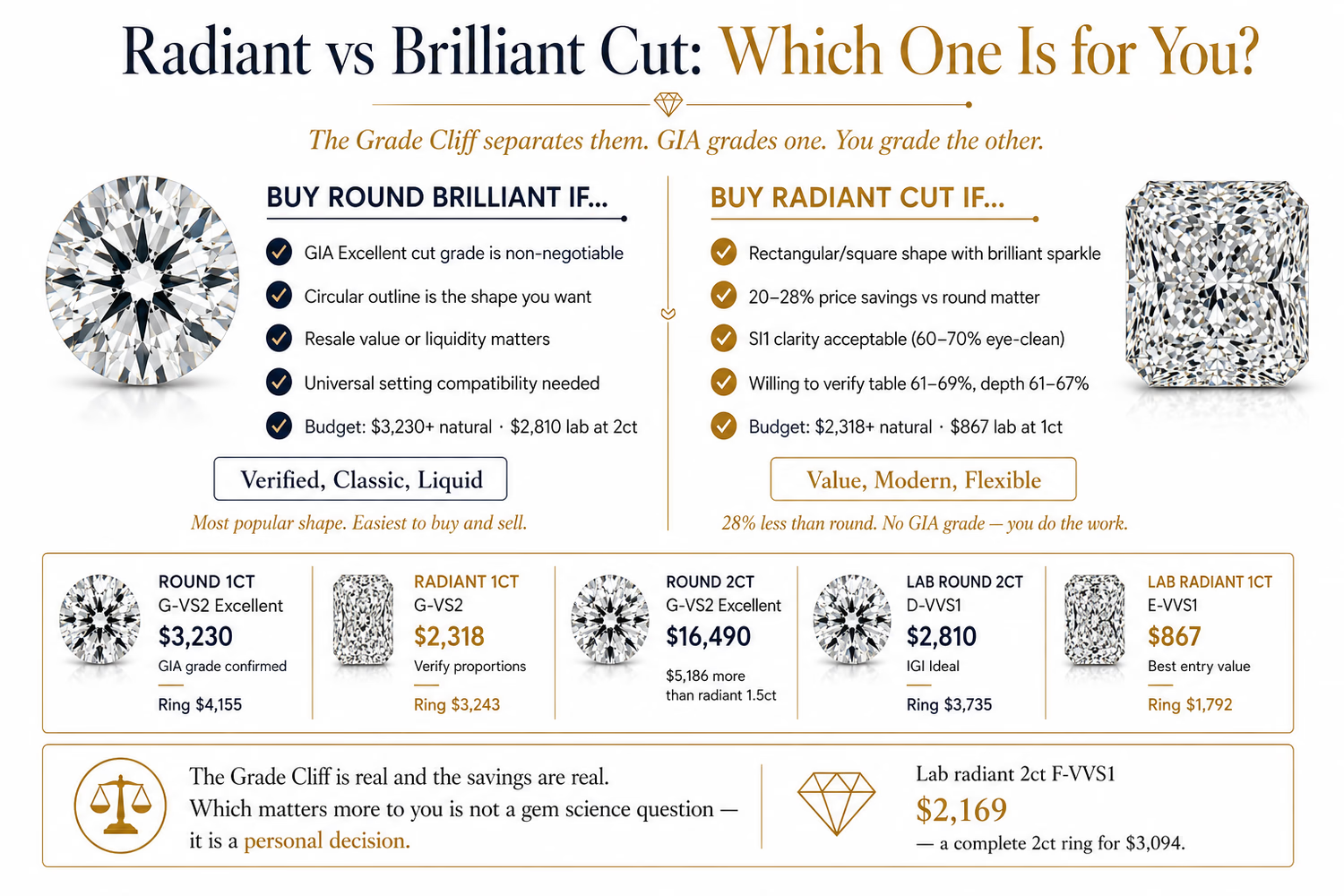
Buy round brilliant if: You want GIA Excellent cut verification — the cleanest, most reliable quality standard in the diamond market. You prefer a circular, classic outline. Resale value or liquidity matters. Budget is not a constraint at 1ct and you want maximum simplicity.
Buy natural radiant if: A rectangular or square shape with brilliant-style sparkle is the aesthetic you want. The $912–$5,000+ savings vs round at equivalent grades are meaningful at your budget. You are comfortable evaluating table 61–68%, depth 61–67%, and watching HD video. SI1 is on the table — radiant's 60–70% eye-clean rate makes it viable.
Buy lab radiant if: Budget is the primary driver. 1ct E-VVS1 at $867 + $925 setting = $1,792 complete ring. 2ct F-VVS1 lab radiant at $2,169 + setting = $3,094. No natural diamond at any size competes with that value.
Buy lab round brilliant if: Cut grade verification matters AND budget is the primary concern. 2ct D-VVS1 lab round at $2,810 delivers GIA/IGI Ideal cut with a circular outline at a fraction of natural pricing. The best of both worlds when lab-grown is acceptable.
Frequently Asked Questions
What is the difference between radiant cut and brilliant cut diamond?
Radiant cut IS a brilliant cut. "Brilliant" refers to the faceting style — triangular and kite-shaped facets that maximize light return — not the shape. The comparison buyers actually want is round brilliant vs radiant cut: round has 57 facets in a circular outline with a GIA cut grade, radiant has 70 facets in a square-to-rectangular outline with no GIA cut grade.
Is radiant cut the same as brilliant cut?
Radiant cut is a type of brilliant cut. It uses brilliant-style faceting (70 facets) on a rectangular or square outline. Round brilliant is the most famous brilliant cut and the one most buyers mean when they say "brilliant." They are not the same shape — but they share the same optical family.
Is radiant cut cheaper than brilliant cut?
Yes. Natural radiant cuts are typically 20–28% cheaper than round brilliants at equivalent carat weight and grade. A 1ct G-VS2 round GIA Excellent at $3,230 vs a 1ct G-VS2 radiant at $2,318 — $912 less for radiant.
Does radiant cut sparkle as much as round brilliant?
Radiant cut produces brilliant-style sparkle comparable in intensity to round — but different in character. Round brilliant fires in defined, high-contrast flashes. Radiant fires in crushed-ice scatter: smaller, more frequent, more distributed. In direct overhead light, round looks more dramatic. In candlelight, radiant often shimmers more visibly. Neither is objectively more brilliant — they are different.
What is The Grade Cliff in radiant vs round comparison?
The Grade Cliff is the difference in cut quality verification between round and radiant. GIA grades every round brilliant with a cut score (Excellent, Very Good, etc.). GIA grades no radiant cut. Buying round GIA Excellent gives you independent quality verification. Buying radiant requires you to manually check table %, depth %, and watch HD video to evaluate cut quality. The Grade Cliff is the gap in buyer confidence and simplicity between these two experiences.
Does GIA give a cut grade to radiant brilliant cut?
No. GIA issues cut grades only for round brilliant diamonds. For radiant cuts, GIA provides polish and symmetry grades but no holistic cut quality score. "Ideal" or "Excellent" on a radiant listing is a retailer designation, not a GIA grade. Verify radiant cut quality using proportion data: table 61–69%, depth 61–67%, polish and symmetry Very Good minimum.
Which has better resale value — round brilliant or radiant cut?
Round brilliant has meaningfully better resale value. It is the most liquid shape in the secondary diamond market — GIA cut grade, universal demand, and global recognition combine to make round the easiest shape to sell and price. Radiant cuts trade at steeper discounts to retail in resale due to lower demand and the difficulty of pricing without a GIA cut grade.
What does "radiant brilliant cut" mean?
Radiant brilliant cut and radiant cut mean the same thing. The word "brilliant" in "radiant brilliant cut" refers to the faceting style — confirming that the radiant uses brilliant-style (not step-cut) facets. Some buyers and retailers add "brilliant" to distinguish radiant from step-cut alternatives like emerald. It is not a different shape.
Is radiant cut good for an engagement ring?
Yes. Radiant cut is durable (clipped corners, no sharp points), produces brilliant sparkle, and is available across a wide price range. It suits buyers who want a rectangular or square shape with more fire than an emerald cut. The main challenge is evaluating cut quality without a GIA cut grade — requiring certificate review and HD video before buying.
How do I evaluate a radiant cut without a GIA cut grade?
Check the GIA certificate for: table % (target 61–69%), depth % (target 61–67%), L/W ratio (0.95–1.05 for square, 1.20–1.40 for rectangular), polish (Very Good minimum), symmetry (Very Good minimum). Then watch HD video or a 360-degree video of the specific stone to assess actual light performance. Never buy a radiant cut based on the certificate alone.
Which should I buy — round brilliant or radiant cut for a 2ct ring?
At 2ct, the price difference becomes significant: round G-VS2 GIA Excellent at $16,490 vs radiant at $7,704 at 1.5ct or $17,714 at 2ct D-VS2. If round's circular shape and GIA grade are the priority, budget for it. If a rectangular shape with brilliant sparkle works aesthetically, radiant saves thousands — especially in lab-grown where 2ct F-VVS1 lab radiant costs $2,169.
Can I get a radiant brilliant cut in lab-grown?
Yes. Lab-grown radiant cuts are widely available starting at 1ct. Entry price is $867 for a 1ct E-VVS1 IGI-certified lab radiant — a complete ring for $1,792. Lab-grown radiant holds the same 20–28% price advantage over lab-grown round that natural radiant holds over natural round.
What is a "radiant brilliant cut diamond" vs a "round brilliant"?
Radiant brilliant cut = a rectangular or square diamond with 70 brilliant-style facets, clipped corners, no GIA cut grade. Round brilliant = a circular diamond with 57 facets, no corners, GIA cut grade available (Excellent through Poor). The term "brilliant" applies to both — it describes the faceting method, not the shape. The practical difference for buyers: round has GIA cut grade verification, radiant does not.
See Also
- Radiant Cut Diamond: The Complete Buying Guide — full radiant guide with prices, proportions, and all shape comparisons
- Round Diamond vs Radiant Cut — direct head-to-head with full price tables and Farzana's verdict
- Elongated Radiant Cut Diamond: L/W Ratio, Prices & What to Buy — the rectangular radiant: L/W 1.25–1.35, The Hybrid Effect explained
- Square Radiant Cut Diamond: Better Than Princess Cut? — square radiant vs princess: The Square Threshold and certified prices
- Lab Grown Radiant Cut Diamond: Prices & Honest Comparison — lab radiant from $867, The 2ct Breakpoint, IGI vs GIA guide
- Radiant Cut vs Princess Cut Diamond — The Clarity Forgiveness Index: SI1 eye-clean rate compared
- Cushion Cut vs Radiant Cut Diamond — crushed-ice vs pillow corners, clarity and price comparison
Expert Verdict
Always audit the stone individually — no grade replaces seeing the actual diamond. The certificate tells you what to look for. Your eyes tell you whether to buy.
— Farzana Hasan, GIA Expert · DiamondCritics.com