Round Diamond Natural vs Lab Grown: The Origin Tax
TL;DR
- A natural 1ct G-VS2 GIA Excellent round costs $3,230 on Blue Nile. A lab-grown 2ct D-VVS1 IGI Excellent costs $2,810 — more diamond, better grades, lower price.
- "The Origin Tax": the dollar premium you pay for natural origin. At 1ct it is $1,280. At 2ct it is $13,680. At 3ct it reaches $42,980.
- Lab-grown and natural round diamonds are chemically, optically, and physically identical. A gemologist cannot distinguish them with the naked eye. GIA and IGI both certify both.
- Natural diamonds hold resale value significantly better. Lab-grown resale is approximately 10–20% of purchase price. Natural resale is approximately 40–55% of the lowest current retail price.
- Lab-grown is the correct choice if maximum size and grade matter more than origin or resale. Natural is correct if origin, sentiment, or long-term value matter.
- There is no wrong answer. The Origin Tax is a real cost — the question is whether what it buys is worth it to you.
The round brilliant engagement ring market in 2026 has two fundamentally different products at radically different prices. Both are called diamonds. Both are graded by the same labs. Both look identical in a ring. The difference is origin — and origin carries a price.
This guide quantifies The Origin Tax across every carat weight with real Blue Nile prices from June 2026, explains every meaningful difference between natural and lab-grown round diamonds, and gives you a clear decision framework. My named concept for this analysis: "The Origin Tax" — the premium paid for natural origin, quantified, honest, and without sentiment clouding the numbers.


What Is The Origin Tax?
The Origin Tax is the dollar difference between a natural and lab-grown round diamond at equivalent grade and carat weight. It exists because natural diamonds took billions of years to form, are genuinely scarce, and carry a supply chain that prices rarity into the stone. Lab-grown diamonds are manufactured in weeks, have no supply constraint, and are priced accordingly.
The tax is not a marketing concept. It is a real, measurable number at every carat weight. At 1ct, it is manageable. At 2ct and above, it becomes a major financial decision.
Key principle: both stones are diamonds. The GIA defines lab-grown diamonds as real diamonds — not simulants, not fakes, not substitutes. They are carbon crystals with diamond structure, diamond hardness (10 on the Mohs scale), and diamond optical properties. What they are not is natural. That is the only category difference.
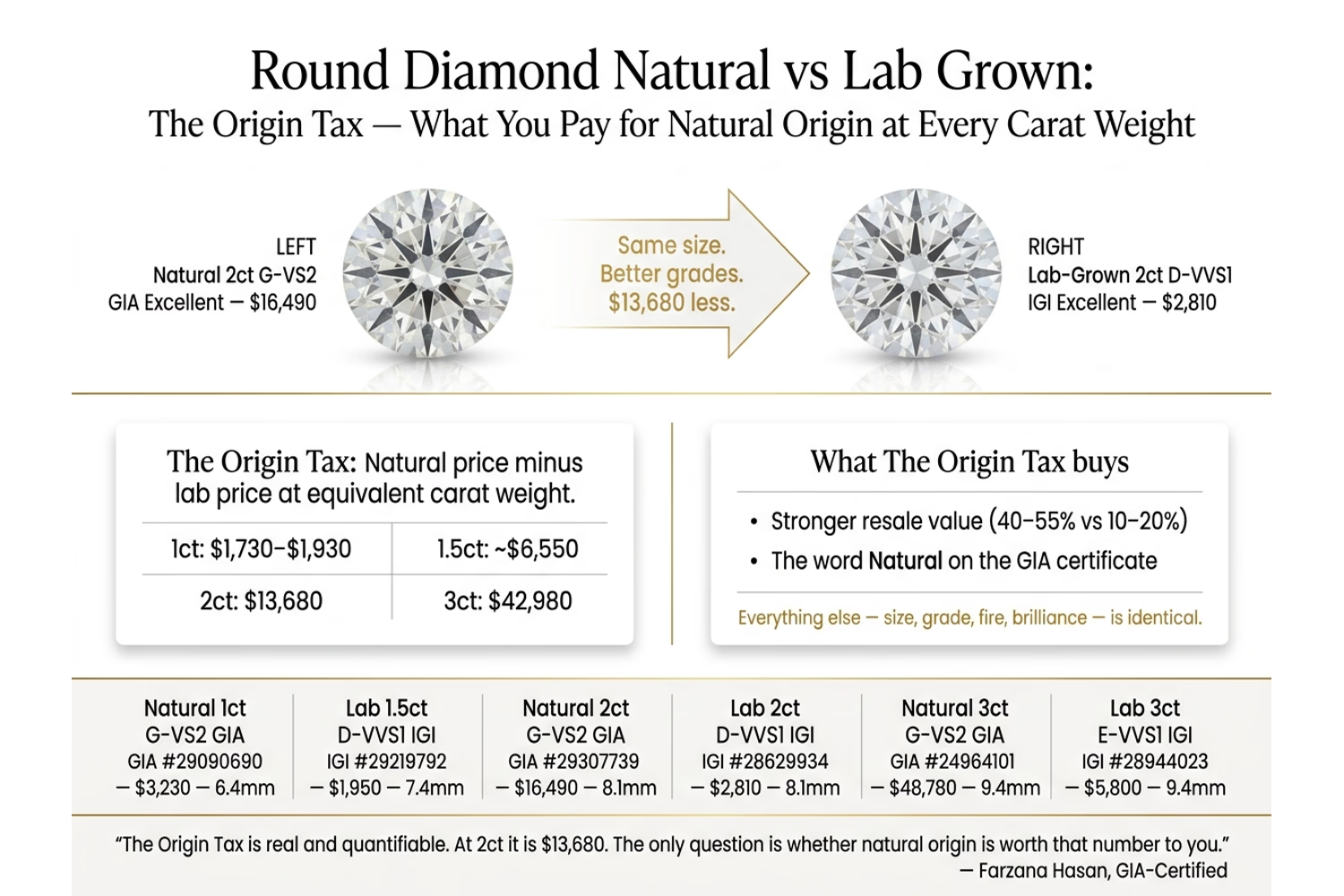
The Origin Tax: Every Carat Weight Priced
The table below compares the cheapest natural GIA Excellent round at each carat weight with the cheapest lab-grown IGI Excellent round at the same weight. All stones are GIA or IGI Excellent cut, the minimum standard for any round brilliant purchase.
| Carat | Natural GIA Excellent | Lab IGI Excellent | Origin Tax | Tax % |
|---|---|---|---|---|
| 1ct | G-VS2 $3,230 | D-VVS1 ~$1,300–$1,500 | ~$1,730–$1,930 | ~53–60% |
| 1.5ct | G-VS2 ~$8,500 | D-VVS1 $1,950 | ~$6,550 | ~77% |
| 2ct | G-VS2 $16,490 | D-VVS1 $2,810 | $13,680 | 83% |
| 3ct | G-VS2 $48,780 | E-VVS1 $5,800 | $42,980 | 88% |
Note: lab-grown pricing is intentionally compared at D-VVS1/E-VVS1 because lab-grown D color and VVS clarity are available at the same price that buys G-VS2 in natural. The comparison shows what the Origin Tax actually buys — not just origin, but lower grades too.
Are Natural and Lab-Grown Round Diamonds Visually Identical?
Yes — with one important caveat.
A trained gemologist with a loupe cannot distinguish a natural from a lab-grown round brilliant by looking at the diamond. The optical properties are identical: refractive index 2.417, hardness 10, thermal conductivity, fire, brilliance, and scintillation. They are the same stone. The face-up appearance of a D-VVS1 lab-grown 2ct round is indistinguishable from a D-VVS1 natural 2ct round in a ring on a hand.
The caveat: specialized equipment (HPHT growth pattern imaging, photoluminescence spectroscopy) can distinguish them. This equipment is owned by gemological labs, not jewelers. In everyday life — at a restaurant, in photographs, in natural light — no one can tell.
What IS different:
- The GIA or IGI certificate states "Laboratory-Grown" vs "Natural"
- The provenance: one came from the earth, one from a reactor
- The resale value: dramatically different (see below)
- The supply dynamics: natural is finite, lab-grown has no ceiling
What is NOT different:
- Chemical composition (pure carbon crystal)
- Physical hardness
- Optical performance
- Fire, brilliance, and scintillation
- Durability
- How it looks in a ring
Resale Value: The Honest Numbers
This is where natural and lab-grown diverge most significantly outside the purchase decision.
Natural diamonds retain approximately 40–55% of the lowest available retail price in the secondary market. A natural 1ct G-VS2 GIA Excellent purchased for $3,230 today would typically resell for $1,300–$1,800 through reputable resellers. The floor is real but the ceiling is not high — natural diamonds do not appreciate in value in the short term, and the retail markup means immediate resale always produces a loss.
Lab-grown diamonds have collapsed in resale value alongside their production cost. Lab-grown prices have fallen 60–80% in the past five years as manufacturing efficiency improved. A lab-grown diamond purchased today at $2,810 may resell for $300–$600 in the secondary market — approximately 10–20% of purchase price. This is not a temporary condition; it reflects the unlimited supply dynamic of manufactured goods.
The honest framing: if resale matters to you at all, natural is the correct choice by a significant margin. If resale does not matter — because an engagement ring is not an investment for most people — then the resale difference is irrelevant to the purchase decision.
The Grade Reality: What You Actually Get Per Dollar
The most important comparison is not natural vs lab at the same grade. It is natural vs lab at the same price.
For $3,230 (the natural 1ct G-VS2 floor):
- Natural: 1ct G-VS2 GIA Excellent — 6.4mm, near-colorless, eye-clean
- Lab: approximately 2ct D-VVS1 IGI Excellent — 8.1mm, colorless, VVS clarity
For the same dollars, lab-grown delivers more than double the carat weight, two color grades better (G to D), and two clarity grades better (VS2 to VVS1). The per-dollar value comparison is not close.
For $16,490 (the natural 2ct G-VS2 floor):
- Natural: 2ct G-VS2 GIA Excellent — 8.1mm
- Lab: approximately 5ct+ D-VVS1 IGI Excellent — 11mm+
The Origin Tax buys one thing per dollar spent: natural origin. Everything else — size, grade, optical performance — is equivalent or better in lab-grown for the same budget.
Tides Of Summer Capsule
Up To 30% Off
Shop The Sale →Vault ClearanceClear The Vault
Up To 70% Off
Shop Vault Deals →Affiliate link — no extra cost to you
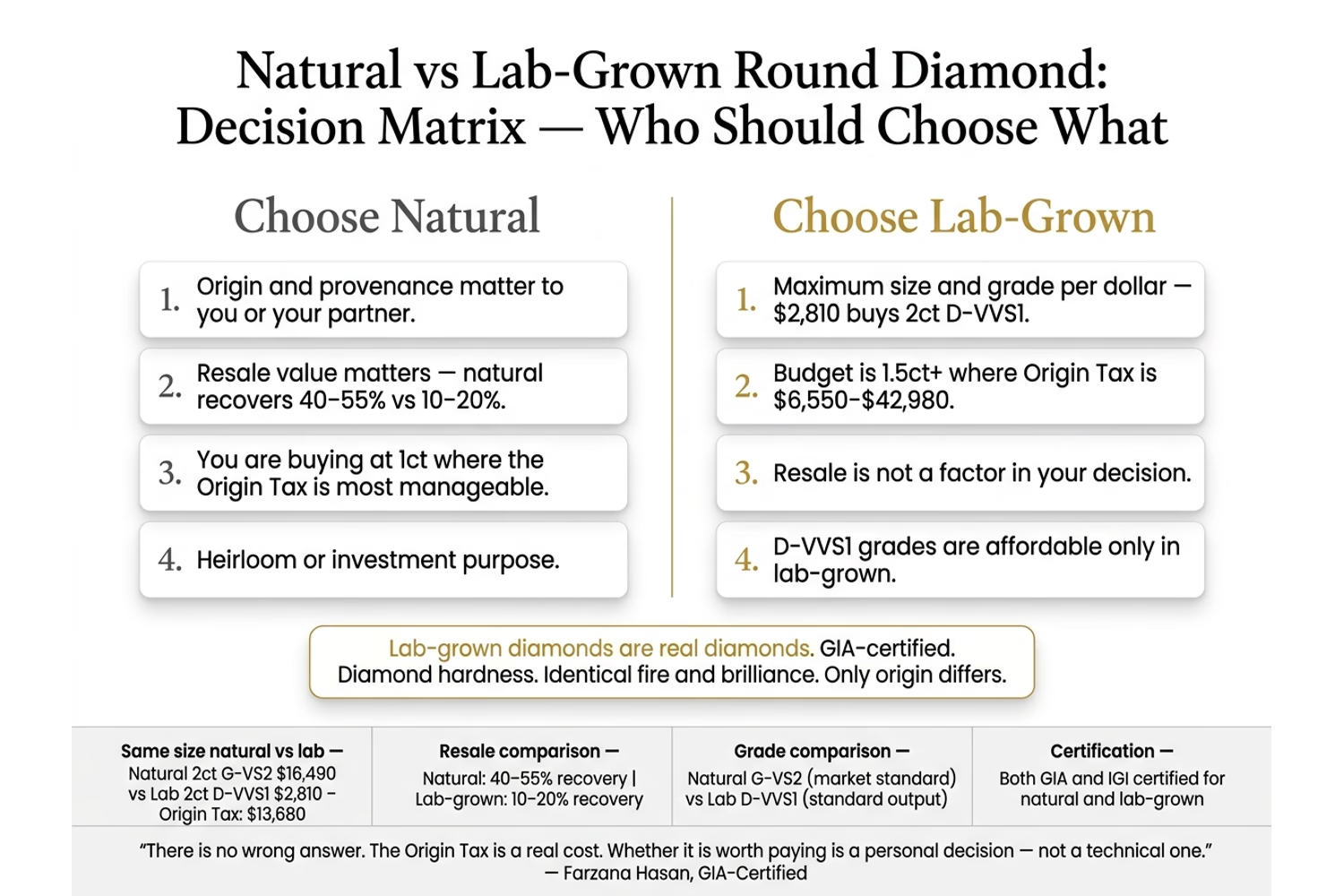
The Origin Tax Decision Framework
Choose natural if:
- Origin and provenance matter to you or your partner — the stone formed in the earth billions of years ago is meaningful beyond its optical properties
- Resale or heirloom value matters — natural diamonds hold value significantly better in the secondary market
- Your budget is 1ct or below — at 1ct, the Origin Tax (~$1,730) is more manageable than at larger sizes
- You are purchasing for investment or collection purposes
Choose lab-grown if:
- Maximum size, grade, and visual performance per dollar is the priority
- You are at 1.5ct+ where the Origin Tax is $6,550–$42,980 — a sum that buys no visual difference
- You want D-VVS1 or better grades that are cost-prohibitive in natural at your target carat weight
- Resale value is not a decision factor
- You are ethically concerned about mined diamond supply chains (though both lab and natural now have strong traceability options)
The Lab-Grown Market Is Not Stable
One risk specific to lab-grown: prices have fallen dramatically and may continue to fall. A lab-grown diamond purchased today for $2,810 may be available in two years for $1,500. This is not a reason to avoid lab-grown, but it is a reason to understand that you are buying a manufactured product with a declining cost curve, not a commodity with supply scarcity.
Natural diamonds have been relatively price-stable at retail over five-year windows because supply is finite and the GIA market is well-documented. Lab-grown has no such floor.
Frequently Asked Questions
What is the difference between natural and lab-grown round diamonds?
Natural diamonds formed in the earth over billions of years under extreme heat and pressure. Lab-grown diamonds are manufactured in a controlled environment in weeks using HPHT (High Pressure High Temperature) or CVD (Chemical Vapor Deposition) methods. Both are chemically and physically identical. The difference is origin, provenance, and price.
Can you tell the difference between a natural and lab-grown diamond?
No — not by looking at it. Not with a loupe, not with a naked eye, not in a ring on a hand. Only specialized laboratory equipment (photoluminescence spectroscopy, growth pattern imaging) can distinguish them. The GIA and IGI certificate notes the origin; the diamond itself does not show it.
Is a lab-grown diamond a real diamond?
Yes. The GIA defines lab-grown diamonds as real diamonds with identical chemical and physical properties to natural diamonds. They are not moissanite, cubic zirconia, or simulants. They are diamond — the only difference is origin.
Which is better: natural or lab-grown round diamond?
Neither is objectively better. Natural is better for buyers who value origin, provenance, and resale. Lab-grown is better for buyers who want maximum size, grade, and optical performance per dollar. The Origin Tax at 2ct is $13,680 — that is the price of natural origin, quantified. Whether it is worth it is a personal decision, not a technical one.
How much is a 2ct lab-grown round diamond?
A 2ct D-VVS1 IGI Excellent lab-grown round is $2,810 on Blue Nile in June 2026. For comparison, a natural 2ct G-VS2 GIA Excellent is $16,490 — a $13,680 Origin Tax for lower grades at the same size.
Do lab-grown diamonds hold their value?
No — not well. Lab-grown diamonds resell for approximately 10–20% of purchase price in the secondary market. Natural diamonds resell for approximately 40–55% of the lowest available retail price. If resale matters to you, natural is the correct choice.
Is GIA or IGI better for lab-grown diamonds?
Both are reputable. IGI is the dominant certification lab for lab-grown diamonds and their grading standards are consistent. GIA also certifies lab-grown stones. The GIA certificate may command a slight premium in the secondary market. For personal purchase, either certification from a reputable lab is acceptable.
What is The Origin Tax?
The Origin Tax is my term for the dollar premium you pay for a natural diamond over an equivalent lab-grown stone. At 1ct it is approximately $1,730–$1,930. At 2ct it is $13,680. At 3ct it is $42,980. It is a real, quantifiable number — the question is whether natural origin, resale value, and provenance are worth that specific dollar amount to you.
Can I upgrade a lab-grown diamond later?
Blue Nile and some other retailers offer upgrade programs for both natural and lab-grown diamonds. Check the specific retailer's policy at time of purchase. Note that lab-grown diamonds have limited upgrade value due to their falling market prices.
What size lab-grown diamond can I get for $3,000?
For $3,000 you can buy a 2ct D-VVS1 IGI Excellent lab-grown at $2,810 — leaving $190 for a simple setting. Alternatively, a 1.5ct D-VVS1 IGI Excellent at $1,950 leaves $1,050 for a quality solitaire setting. Both options deliver more diamond than a natural 1ct G-VS2 at the same budget.
Is lab-grown better for an engagement ring?
Lab-grown is better if maximum size and grade per dollar is the priority. Natural is better if origin, sentiment, or long-term resale value matters. For most engagement ring buyers in 2026, the question is budget-driven: at 1ct, the natural option at $3,230 is competitive. At 2ct, the $13,680 gap makes lab-grown the rational choice unless origin is important to both people.
See Also
- Lab Grown Round Diamond — Complete lab-grown buying guide for round brilliants
- Round Diamond Engagement Ring Under $3,000 — The $3,000 Diamond Window: what lab-grown delivers
- GIA vs IGI for Round Diamonds — Certificate comparison for natural and lab-grown
- 1 Carat Round Diamond Price — Natural 1ct price audit across all grades
- 2 Carat Diamond Engagement Ring — The 2ct Commitment: natural grade ladder and lab comparison
- Round Diamond Color Guide — Color grade framework for natural and lab-grown
- Round Cut Diamond Guide — Complete round brilliant buying guide
Expert Verdict
Always audit the stone individually — no grade replaces seeing the actual diamond. The certificate tells you what to look for. Your eyes tell you whether to buy.
— Farzana Hasan, GIA Expert · DiamondCritics.com