Round Diamond IF and FL Clarity: The FL Tax
TL;DR: IF and FL Round Diamond Clarity — Key Facts
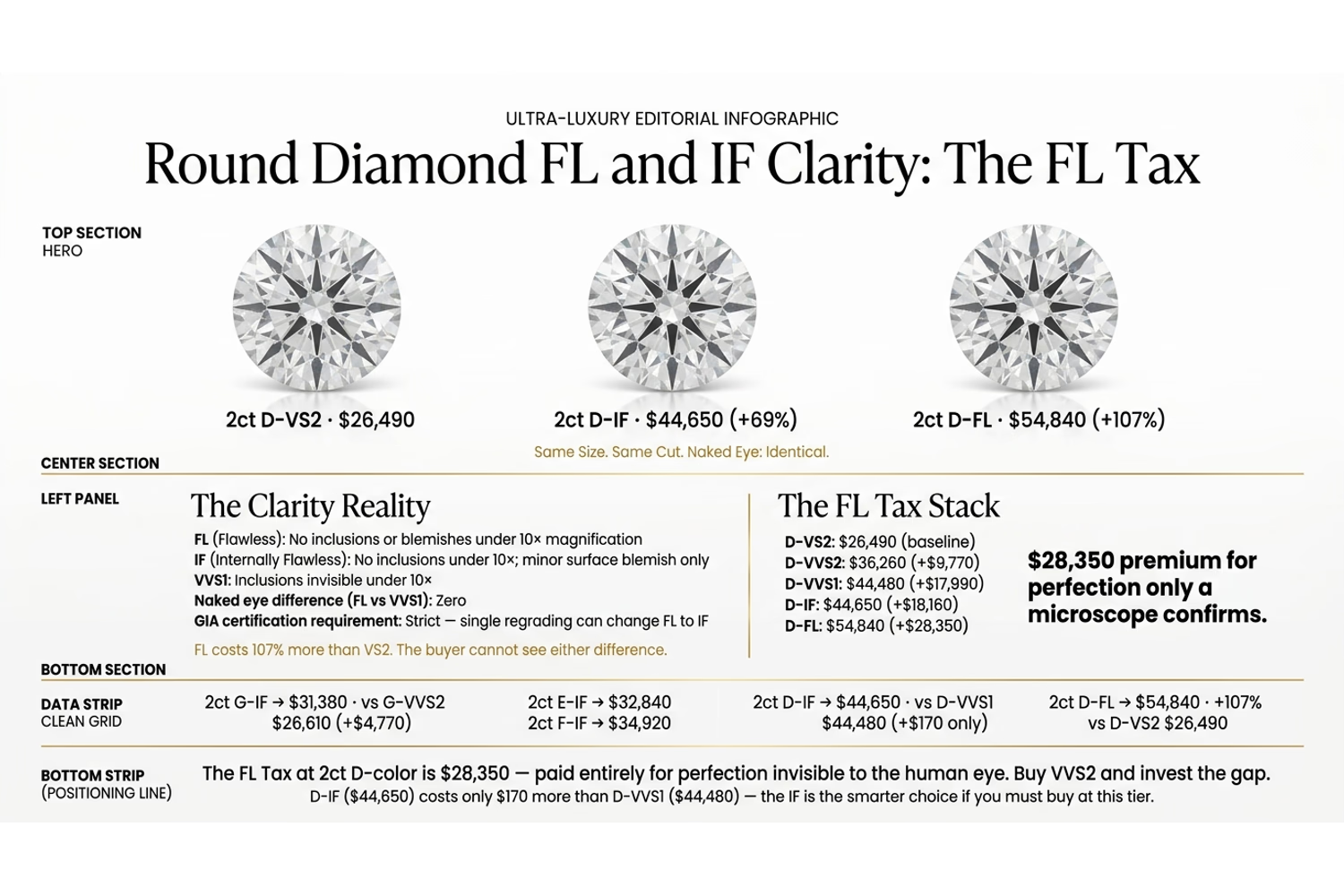
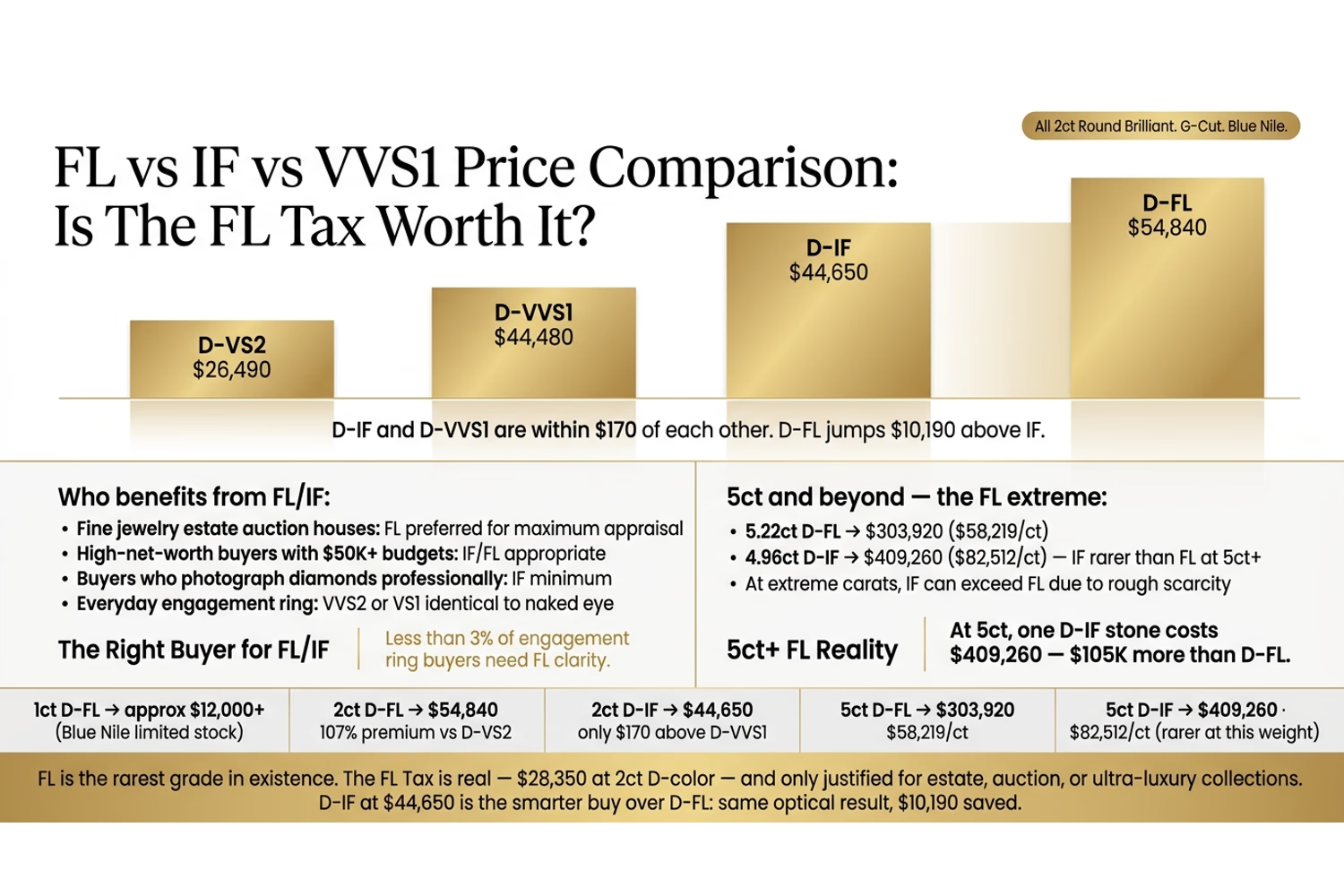
- The FL Tax is Farzana's term for the premium above VVS1 into IF and FL — at 2ct D-color, FL costs $54,840 versus VS2 at $26,490, a $28,350 premium (107%) for clarity that requires a microscope to confirm and disappears completely under a prong setting
- FL (Flawless): no inclusions or blemishes visible under 10× to a skilled grader — fewer than 1% of all GIA-graded diamonds qualify
- IF (Internally Flawless): no inclusions; minor surface blemishes only — typically polishing marks that a diamond cutter can remove with one regrind
- At 2ct G-color, GIA G-IF costs $31,380–$31,600 versus G-VVS2 at $26,610–$27,860 — the FL Tax at G-color is a $3,770–$4,990 premium over VVS2
- Neither FL nor IF produces any visible difference from VVS1 to the naked eye in a round brilliant cut — the 57 facets scatter light so completely that all three grades look identical at normal viewing distances
- The only valid FL purchase reason: 5ct+ stones where gemological appraisal drives auction pricing, or GIA collector pieces where the report itself is the collectible
When a diamond buyer asks for "the best clarity," they are asking for Flawless. Jewelers know this. The FL grade occupies the top tier of every GIA clarity scale chart displayed in every showcase. It sounds like the word "perfect." It sells at prices that reflect perfection.
Here is the reality: the 2ct D-FL on Blue Nile costs $54,840. The 2ct D-VS2 costs $26,490. The stone you can actually see — the one mounted in a ring, viewed at 6–12 inches, worn in normal light — looks identical in both cases. The 57 facets of a round brilliant scatter light through both stones with the same optical result. The $28,350 difference is The FL Tax: money paid for clarity that exists only on a certificate.
This guide documents every IF and FL stone in the Blue Nile dataset, the exact premium at each color tier, and the three circumstances where The FL Tax is genuinely justified.


What Do FL and IF Mean on a GIA Diamond Certificate?
| Grade | GIA Definition | Rarity | Detectable Under 10× Loupe | Visible to Naked Eye |
|---|---|---|---|---|
| FL (Flawless) | No inclusions or blemishes visible under 10× to skilled grader | <1% of GIA diamonds | No inclusions OR blemishes | Never — in any shape |
| IF (Internally Flawless) | No inclusions visible; minor blemishes only | ~2–3% of GIA diamonds | No inclusions; surface marks only | Never — in any shape |
| VVS1 | Extremely difficult inclusions to see under 10× | ~5–6% | Barely detectable — internal | Never in round brilliant |
| VVS2 | Very difficult inclusions to see under 10× | ~8–9% | Difficult to detect — internal | Never in round brilliant |
The critical distinction: FL diamonds have neither internal inclusions nor external blemishes. IF diamonds have no internal inclusions but may have surface characteristics — typically tiny grain lines, minor naturals, or faint polish marks that a cutter could remove by regrinding a single facet. In practice, once an IF diamond is set in a ring, those surface blemishes become irrelevant — the prongs and setting metal cover the girdle and portions of the pavilion where blemishes typically appear.
FL and IF diamonds are gemological rarities. The probability that a diamond formed over billions of years, recovered from a kimberlite pipe, cut with a laser, and polished by hand emerges with zero detectable inclusions or surface characteristics — even under 10× magnification — is under 1% for FL. That rarity is real. But rarity and visible beauty are different things, and a round brilliant's facet structure ensures that neither grade produces any perceptible improvement over VVS1 to the human eye.
How Much Does The FL Tax Cost at 2ct by Color Grade?
2ct Full Clarity Comparison by Color Tier
| Stone | Grade | Price | Premium vs G-VS2 ($16,490) |
|---|---|---|---|
| GIA 2ct G-VS2 Excellent | G-VS2 | $16,490 | Reference |
| GIA 2ct G-VS1 Excellent | G-VS1 | $22,460 | +$5,970 |
| GIA 2ct G-VVS2 Excellent | G-VVS2 | $26,610 | +$10,120 |
| GIA 2ct G-VVS2 Excellent | G-VVS2 | $26,860 | +$10,370 |
| GIA 2ct G-VVS2 Excellent | G-VVS2 | $27,860 | +$11,370 |
| GIA 2ct G-IF Excellent | G-IF | $31,380 | +$14,890 (+90.3%) |
| GIA 2ct G-IF Excellent | G-IF | $31,600 | +$15,110 (+91.6%) |
G-IF versus G-VVS2 at 2ct: $3,770–$4,990 premium for a clarity tier that requires internal perfection — no inclusions whatsoever — that produces zero additional visual benefit over VVS2 in a round brilliant.
2ct D-Color: The Full FL Tax Stack
| Stone | Grade | Price | Premium vs D-VS2 ($26,490) |
|---|---|---|---|
| GIA 2ct D-VS2 Excellent | D-VS2 | $26,490 | Reference |
| GIA 2ct D-VS2 Excellent | D-VS2 | $26,500 | — |
| GIA 2ct D-VVS1 Excellent | D-VVS1 | $31,370 | +$4,880 (+18.4%) |
| GIA 2ct D-VVS1 Excellent | D-VVS1 | $33,390 | +$6,900 (+26.1%) |
| GIA 2ct D-VVS1 Excellent | D-VVS1 | $34,580 | +$8,090 (+30.6%) |
| GIA 2ct D-VVS1 Excellent | D-VVS1 | $37,140 | +$10,650 (+40.2%) |
| GIA 2ct D-VVS1 Excellent | D-VVS1 | $39,260 | +$12,770 (+48.2%) |
| GIA 2ct D-VVS1 Excellent | D-VVS1 | $41,820 | +$15,330 (+57.9%) |
| GIA 2ct D-VVS1 Excellent | D-VVS1 | $44,480 | +$17,990 (+68.0%) |
| GIA 2ct D-IF Excellent | D-IF | $49,470 | +$22,980 (+86.8%) |
| GIA 2ct D-FL Excellent | D-FL | $54,840 | +$28,350 (+107.0%) |
D-IF vs D-VVS1 at 2ct: $49,470 vs $31,370 minimum = $18,100 FL Tax (57.7% premium) for the lowest clarity tier where inclusions become internal-free. The stone and the VS2 both look identical face-up in a round brilliant.
D-FL vs D-IF at 2ct: $54,840 vs $49,470 = $5,370 to eliminate the minor surface blemishes from IF that are already invisible under the ring prong.
2ct E-Color and F-Color IF Comparison
| Stone | Grade | Price | Context |
|---|---|---|---|
| GIA 2ct E-VS1 Excellent | E-VS1 | $22,660 | Recommended tier |
| GIA 2ct E-VVS1 Excellent | E-VVS1 | $26,400 | — |
| GIA 2ct E-IF Excellent | E-IF | $32,840 | +$10,180 over E-VS1 |
| GIA 2ct F-VS1 Excellent | F-VS1 | $26,240 | Recommended tier |
| GIA 2ct F-VVS1 Excellent | F-VVS1 | $34,250 | +$8,010 over F-VS1 |
| GIA 2ct F-IF Excellent | F-IF | $34,920 | +$8,680 over F-VS1 |
| GIA 2ct F-IF Excellent | F-IF | $38,050 | +$11,810 over F-VS1 |
Can You See the Difference Between FL, IF, and VVS1 in a Round Brilliant?
No. Not from the front. Not from the side. Not in any lighting condition achievable without laboratory equipment.
The distinction between FL, IF, and VVS1 exists in a range where all three grades are beyond human perceptual limits. VVS1 inclusions are already "extremely difficult" to find under 10× magnification. IF blemishes are surface-only features typically located on the girdle or pavilion — positions covered by the ring setting. FL removes even those. In a round brilliant with 57 facets creating constant light reflection, none of these distinctions reaches the human eye.
Jewelers sometimes describe FL diamonds as "the ones that look like water" — as if there is a visible difference in crystal clarity that separates FL from VVS1. There is not. The round brilliant is not a transparent window into the interior of a diamond. It is an optical machine that converts light into fire and scintillation through precise facet angles. FL, IF, and VVS1 all go through the same optical machine and produce the same result.
The emerald cut is the one exception where clarity grade differences occasionally produce visible differences — the step-facet table creates a transparent window into the stone's interior, and IF or FL can look noticeably cleaner than VS1 under direct light. In a round brilliant, this effect does not exist.
Who Should Actually Buy a Flawless Round Diamond?
Three categories of buyer have legitimate reasons to pay The FL Tax.
Category 1: Investment buyers selling at auction (5ct+). At 5ct and above, diamonds are sold with formal gemological appraisals, and the GIA clarity grade is a documented value component. The 4.96ct D-IF at $409,260 and the 5.22ct D-FL at $303,920 are priced for a market that reads GIA reports and pays for certified perfection at auction. At this size, IF and FL genuinely separate into distinct collector tiers that affect hammer price.
Category 2: Buyers with a specific regrinding plan. IF diamonds often have polishing-mark blemishes that a skilled cutter can remove by regrinding a single facet — converting IF to FL and increasing the certificate value. Some buyers purchase IF specifically to hold the regrinding option. This requires a cutter relationship and adds cost, but it is a real strategy for the diamond trade.
Category 3: Collectors who value the report itself as an artifact. Gemological collectors who track individual diamonds by GIA report number and certificate specification find FL meaningful because their engagement with the stone is through the document, not visual wear. For this category, a FL report is a meaningful distinction.
For every other buyer: the 2ct G-VS1 at $22,460 looks identical to the 2ct G-IF at $31,380 in any ring, under any light, at any viewing distance. The $8,920 difference is The FL Tax.
Tides Of Summer Capsule
Up To 30% Off
Shop The Sale →Vault ClearanceClear The Vault
Up To 70% Off
Shop Vault Deals →Affiliate link — no extra cost to you
5ct Stones: Where IF and FL Have the Most Impact
| Stone | Grade | Price | Per-Carat Rate |
|---|---|---|---|
| GIA 4.85ct E-VS2 Excellent | E-VS2 | $147,110 | $30,332/ct |
| GIA 4.92ct E-VS1 Excellent | E-VS1 | $191,710 | $38,963/ct |
| GIA 5.22ct D-FL Excellent | D-FL | $303,920 | $58,236/ct |
| GIA 5.49ct D-FL Excellent | D-FL | $272,110 | $49,565/ct |
| GIA 4.96ct D-IF Excellent | D-IF | $409,260 | $82,512/ct |
| GIA 5.27ct F-IF Excellent | F-IF | $334,560 | $63,484/ct |
The 4.96ct D-IF at $409,260 ($82,512/ct) versus the 4.85ct E-VS2 at $147,110 ($30,332/ct) illustrates the compounding of the per-carat multiplier with The FL Tax at 5ct. The per-carat rate for D-IF at 5ct is 2.72× higher than for E-VS2 at the same size. Both stones look identical to the naked eye at 5ct. The gap is driven by color (D vs E, which IS visible in a 5ct stone) and clarity (IF vs VS2, which is NOT visible).
The FL Tax on Lab-Grown Diamonds: It Barely Exists
In the lab-grown market, FL and IF are available — lab growth processes can be controlled precisely enough to produce both grades routinely. But the price premium is a fraction of what natural FL commands, because the scarcity driver does not apply. The IGI 2ct D-VVS1 lab at $2,810 is already at the top of practical clarity for lab buyers. Lab FL or IF stones may run $3,000–$3,500 at 2ct — a $200–$700 premium over VVS1, versus $18,100 for the same step in natural D-color stones.
Lab-grown resale is 10–20% of retail regardless of clarity. An FL lab-grown diamond will not recover the FL premium on resale. For lab buyers, VVS1 is the ceiling — the clarity is already beyond perceptual limits, and the FL upgrade produces no visual benefit and no resale return.
Does the Ring Setting Erase IF and FL Value?
For IF diamonds specifically, yes — entirely. IF blemishes are surface characteristics located on the girdle, pavilion facets, or culet area. A standard four-prong or six-prong solitaire setting covers the girdle, blocking direct access to the IF blemishes that make it "not quite Flawless." Once mounted, an IF diamond and a FL diamond are visually and practically identical — even under a jeweler's loupe, the setting prevents access to the blemish positions.
This means the IF-to-FL upgrade ($5,370 at 2ct D-color) becomes literally zero value the moment the stone enters the setting. Jewelers who mount IF stones in settings are selling the certificate status, not a wearable visual distinction.
For FL: the value is entirely the document. A FL diamond in a ring setting behaves identically to a VVS1 — the setting covers the girdle, the facets scatter light equally, and no viewer can distinguish the grades at any distance without removing the stone from the setting, cleaning it, and examining it under a 10× loupe.
GIA FL vs IGI FL: Not the Same Standard
For natural diamonds, GIA and IGI do not produce equivalent FL and IF grades. GIA grades FL and IF with trained gemologists using the full standardized protocol — "extremely critical" examination under 10× in optimal conditions. IGI grades natural diamonds with documented 1–2 grade inflation throughout the clarity scale. An IGI FL natural diamond may be a GIA VVS1 or VVS2 — the "FL" label on an IGI natural report does not represent the same gemological achievement as GIA FL.
For lab-grown diamonds, IGI grades IF and FL consistently and the grades are reliable. But the investment case for lab FL still does not hold because lab-grown resale values do not reflect clarity premiums.
Never pay The FL Tax on natural stones without a GIA certificate. An IGI "FL" natural diamond is paying triple for a grade that may be VVS1 on the standard that matters.
Farzana's Verdict:
The FL Tax is the most expensive form of certificate shopping in the diamond industry. A 2ct D-FL at $54,840 costs more than the down payment on a house in many markets — and every single dollar above the price of a 2ct D-VS2 at $26,490 is money spent on a grade that requires laboratory equipment to confirm and disappears entirely under a prong.
For buyers spending $25,000–$55,000 on a 2ct round diamond, VS1 is the ceiling that makes visual sense. G-VS1 at $22,460 looks identical to D-FL at $54,840 in a ring. The color difference between D and G is subtle but potentially visible at 2ct in ideal lighting — the clarity difference between VS1 and FL is not visible under any conditions without a loupe.
If you are buying at 5ct+ and plan a formal auction resale, FL or IF adds genuine documented value. For everyone else, The FL Tax is a $5,000–$28,000 premium for a grade you will never see.
Frequently Asked Questions
What is the difference between FL and IF in a round diamond?
FL (Flawless) means no inclusions or blemishes are visible under 10× magnification to a skilled grader. IF (Internally Flawless) means no inclusions, but minor surface blemishes — typically polishing marks — are present. Once set in a ring, IF and FL are identical in appearance because the setting covers the surface positions where IF blemishes appear.
Can you see the difference between FL, IF, and VVS1 in a round brilliant?
No. All three grades are completely invisible to the naked eye in a round brilliant. The 57-facet structure scatters light so thoroughly that inclusions at VS2 level are invisible — FL, IF, and VVS1 are all far below this threshold.
How much does a Flawless diamond cost compared to VVS1?
At 2ct D-color, the cheapest D-VVS1 is $31,370. The D-IF costs $49,470 and the D-FL costs $54,840. The FL premium over VVS1 at 2ct D-color ranges from $18,100 (D-IF vs cheapest D-VVS1) to $23,470 (D-FL vs cheapest D-VVS1).
Is a Flawless diamond worth buying for an engagement ring?
For a standard engagement ring worn daily by a non-gemologist: no. The FL grade is invisible in a round brilliant at any viewing distance without professional equipment. The premium belongs in a larger stone, better metal, or savings account.
What does "internally flawless" mean on a GIA report?
GIA IF means the grader found no inclusions (internal characteristics) under 10× magnification. Minor surface blemishes — polishing lines, grain lines, or natural features — may be present but are not classified as inclusions. Once the diamond is set, these surface features are typically hidden by the mounting.
Does a Flawless diamond sparkle more than a VS1?
No. Sparkle is controlled entirely by cut quality — table %, depth %, crown angle, pavilion angle, polish, and symmetry. A GIA Excellent VS1 and a GIA Excellent FL with identical proportions sparkle identically. Clarity grades affect sparkle only when inclusions are large enough to interfere with light paths — this does not occur until SI2 or I1 range.
Should I buy IF or VVS1 for a 2ct round diamond?
Buy VVS1 or VS1. The 2ct E-VVS1 at $26,400 costs $6,440 less than the E-IF at $32,840 and looks identical face-up. That $6,440 difference funds a platinum setting, a superior cut, or significant savings.
What percentage of diamonds are Flawless?
GIA estimates that under 1% of submitted natural diamonds receive the FL grade. The rarity is genuine — most diamonds form with trace minerals or structural irregularities that produce inclusions visible under 10×. FL diamonds reflect exceptional formation conditions plus precise cutting to remove any surface characteristics.
Does GIA grade FL and IF the same as IGI?
No. For natural diamonds, GIA and IGI grade differently throughout the clarity scale — IGI documents 1–2 grade inflation. An IGI FL natural stone may be GIA VVS1 or VVS2. Always buy natural FL and IF with a GIA certificate.
Do FL diamonds hold their value better than VS2?
At 1ct and 2ct, the resale difference between FL and VS2 is real but does not recover The FL Tax. A natural 2ct D-FL resells at approximately 40–50% of retail ($21,936–$27,420) versus 40–50% for D-VS2 ($10,596–$13,245) — a resale advantage of $8,340–$14,175. The purchase premium is $28,350. You recover roughly 29–50% of the FL premium on resale.
Are IF diamonds better than VVS1 for resale?
At 2ct+ in D–F color, IF produces a documented clarity tier that estate dealers and auction houses use in formal appraisals. The IF premium is partially recoverable on resale at larger sizes. At 1ct, the resale market does not meaningfully distinguish IF from VVS1 in dollar terms.
What clarity grade should I buy for a round brilliant diamond?
VS1 for 1–2ct purchases. VS2 is eye-clean 85–95% of the time in round brilliants. VS1 is 99% reliable and costs significantly less than VVS2, VVS1, or IF. IF and FL are for investment stones 3ct+ where formal appraisal and auction resale are planned.
Can an IF diamond be upgraded to FL?
Yes — a skilled diamond cutter can regrind one or more surface facets to remove polishing blemishes that keep an IF stone from FL classification. The stone loses a small amount of carat weight (typically 0.01–0.03ct) in the process. Some buyers purchase IF specifically to hold this option.
See Also
- Round Diamond VVS1 vs VVS2 — the clarity tier just below IF/FL
- Round Diamond VVS vs VS2 — the full Invisible Clarity Tax from VS2 to VVS
- Round Diamond Clarity Guide — complete GIA clarity scale for round diamonds
- GIA Certified Round Diamond — why GIA certification is essential at IF and FL grades
- Round Diamond Certification Guide — GIA vs IGI vs EGL: how grading inflation affects IF/FL grades
- 2 Carat Round Diamond Price — full price guide showing where IF/FL sits in the 2ct market
- Round Diamond D Color vs G Color — how color and clarity premiums compound at 2ct+
Expert Verdict
Always audit the stone individually — no grade replaces seeing the actual diamond. The certificate tells you what to look for. Your eyes tell you whether to buy.
— Farzana Hasan, GIA Expert · DiamondCritics.com