G vs H Color Round Diamond: The Near-Colorless Boundary
TL;DR
- G is the top of GIA's Near-Colorless tier (G, H, I, J). H is one grade below G — still Near-Colorless, but with a faint warmth visible in very large stones under direct sunlight.
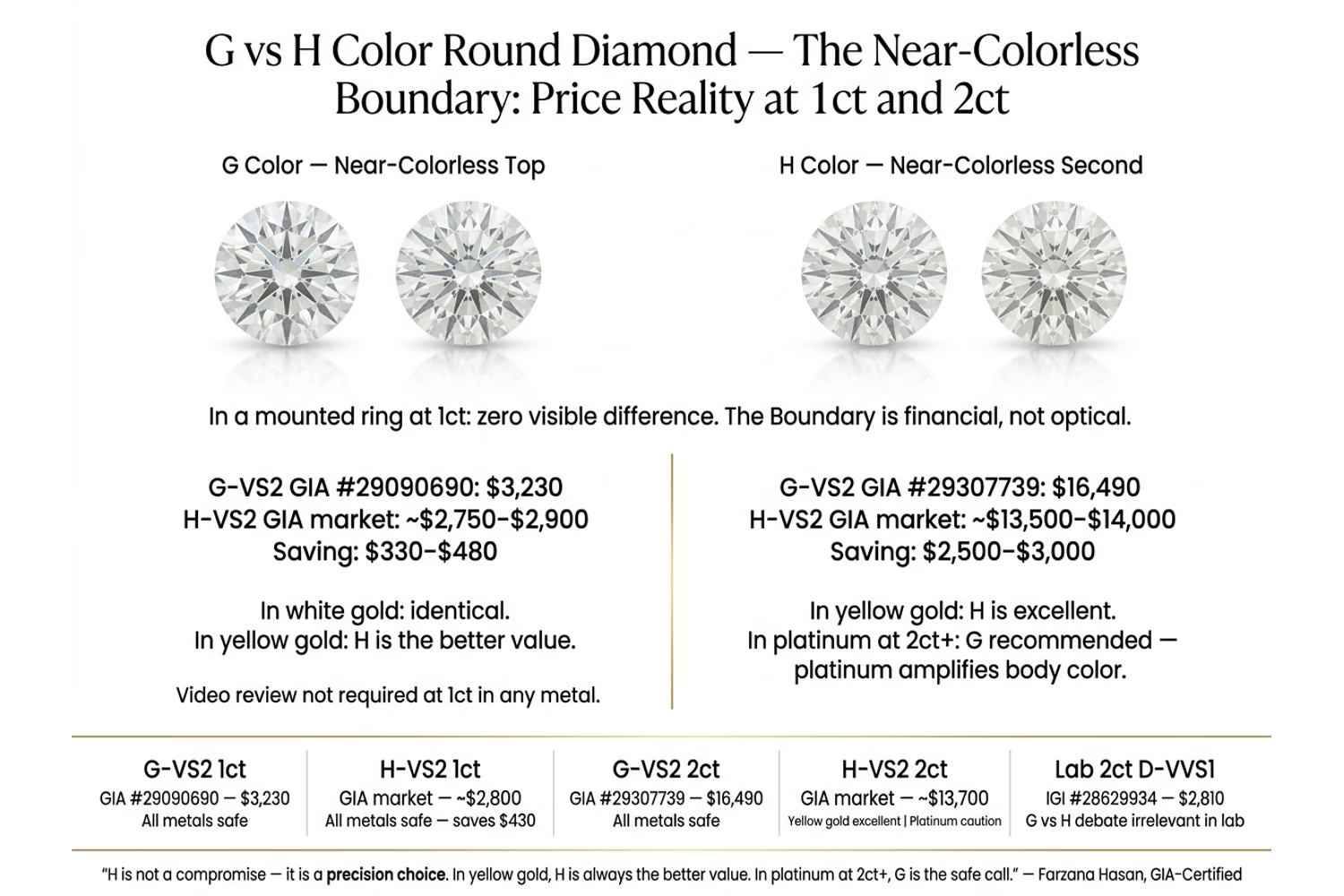
- At 1ct: G-VS2 costs $3,230, H-VS2 approximately $2,750–$2,900 — saving $330–$480.
- At 2ct: G-VS2 costs $16,490, H-VS2 approximately $13,500–$14,000 — saving $2,500–$3,000.
- "The Near-Colorless Boundary": G is where most buyers stop. H is where value-focused buyers start saving real money — but only in the right setting.
- In yellow gold at any carat weight: H is indistinguishable from G. Yellow gold absorbs warmth; the setting metal makes H an excellent choice.
- In white gold or platinum at 1ct: H is still near-white. In white gold at 2ct+ in strong natural light, H may show the faintest hint of warmth.
- Always watch Blue Nile HD video of any H stone before purchasing at 1.5ct and above.
G and H are both Near-Colorless diamonds. They sit in the same GIA tier. In a mounted ring at 1ct, they look identical to every observer who is not using master comparison stones under controlled lighting. Yet they price differently — and at 2ct, that difference is $2,500–$3,000.
This guide tests The Near-Colorless Boundary: the G/H color line where the visual difference becomes real (at larger sizes, in white metal) and where the saving may or may not justify the trade. My named concept: "The Near-Colorless Boundary" — H is not a compromise grade. It is a precision choice that is correct in specific settings and incorrect in others.


The GIA Near-Colorless Tier: Where G and H Sit
GIA's diamond color scale runs D through Z. The tiers are:
| GIA Tier | Grades | Description |
|---|---|---|
| Colorless | D, E, F | No color detectable under controlled conditions |
| Near-Colorless | G, H, I, J | Appears white to the naked eye; slight color detectable only by experts |
| Faint | K, L, M | Slight warmth visible to careful observer |
G is the best Near-Colorless grade — it sits immediately below Colorless F but carries none of the Colorless premium. H is the second Near-Colorless grade, one step further from colorless.
Critical fact: both G and H appear white in a mounted ring. GIA's Near-Colorless definition means the color is not detectable by a non-expert observer under normal conditions. H color does not mean the diamond looks yellow. It means the diamond is measurably one step further from colorless than G — a distinction visible primarily in specific conditions (large stones, direct bright sunlight, white metal settings) and primarily to trained observers.
G vs H at 1ct: The Visual Test and Price Audit
At 1ct (6.4mm face-up), a G and an H round brilliant look identical to any observer who is not using GIA master comparison stones. The 0.5 grade distinction between G and H is not visible in everyday lighting — not across a table, not in photos, not in candlelight.
What the Blue Nile price data shows at 1ct:
| Grade | Stone | Price | Premium over H | Farzana's Verdict |
|---|---|---|---|---|
| G-VS2 | #29090690 | $3,230 | +$330–$480 | Benchmark — top Near-Colorless, safe in all metals |
| G-VS2 | #29090694 | $3,240 | +$340–$490 | Identical to above — confirms G-VS2 floor |
| H-VS2 | Blue Nile market | ~$2,750–$2,900 | Baseline | Saves $330–$480 over G. In white gold at 1ct: fully white. In yellow gold: better than G per dollar. |
| H-VS1 | Blue Nile market | ~$2,800–$2,960 | ~+$50 vs H-VS2 | Clarity upgrade within H tier — marginal value at 1ct |
The saving at 1ct is real but modest: $330–$480. At a $3,230 total stone price, this is a 10–15% saving. For buyers in white gold at 1ct, H delivers the same visual result as G for $330–$480 less. For buyers in yellow gold, H is an even better value because the gold warmth conceals any faint body color entirely.
G vs H at 2ct: Where the Near-Colorless Boundary Becomes Significant
At 2ct (8.1mm face-up), the economics change. The same 10–15% color discount now represents $2,500–$3,000 in absolute terms — a meaningful saving that changes the conversation.
What the data shows at 2ct:
| Grade | Stone | Price | vs G-VS2 |
|---|---|---|---|
| G-VS2 | #29307739 | $16,490 | Baseline |
| G-VS1 | #29249620 | $22,460 | +$5,970 |
| H-VS2 | Blue Nile market | ~$13,500–$14,000 | −$2,490–$2,990 |
| H-VS1 | Blue Nile market | ~$14,500–$15,500 | −$990–$1,990 |
At 2ct, H-VS2 saves approximately $2,500–$3,000 over G-VS2. That is real money for a visual difference that only a trained observer can detect at 8.1mm face-up.
The important caveat at 2ct: in strong natural light — direct sunlight on a bright day — an H-colored 2ct round in white gold or platinum may show a faint warmth at the girdle. This is not visible in dim lighting, indoor ambient light, candlelight, or photographs. It requires strong direct light and a conscious effort to observe. Most wearers never notice it. Some do.
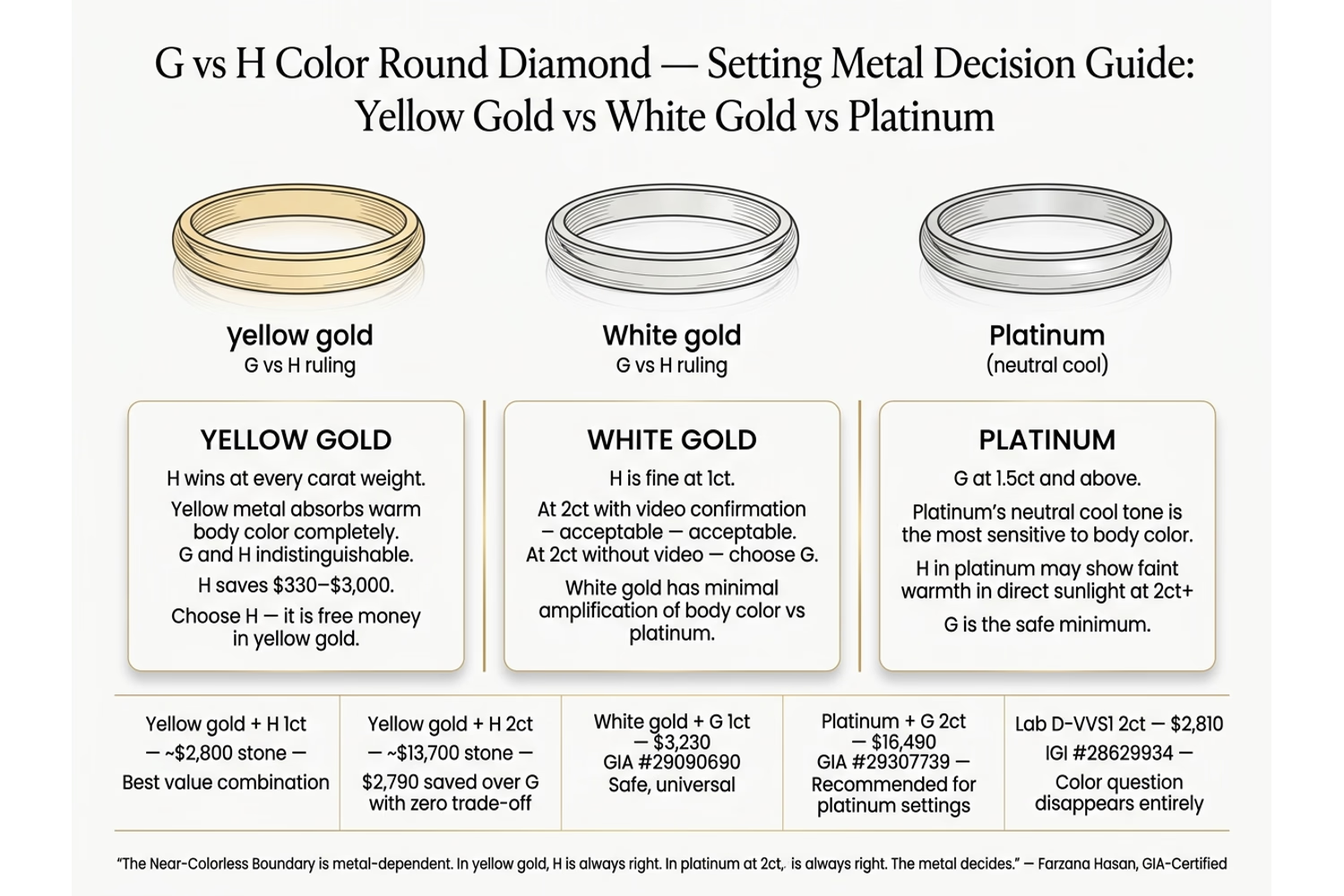
My recommendation at 2ct: if your primary setting is yellow gold, H is an excellent choice — the metal absorbs the warmth and delivers near-identical appearance to G at $2,500 less. In white gold, H-VS2 at 2ct is acceptable with video review. In platinum at 2ct, I recommend G-VS2 because platinum amplifies any warmth due to its neutral cool tone.
The Setting Metal Impact: Where H Color Wins and Where It Does Not
The single biggest variable in the G vs H decision is the setting metal. This is not a minor consideration — it is the primary decision driver.
| Setting Metal | G at 1ct | H at 1ct | Recommendation |
|---|---|---|---|
| Yellow gold (14k or 18k) | Excellent | Excellent — warmth absorbed | Choose H — save $330–$480 with no visual trade |
| Rose gold | Excellent | Excellent — warmth absorbed | Choose H — same result at lower cost |
| White gold (14k) | Excellent | Very good — no visible warmth | Either — depends on budget priority |
| Platinum | Excellent | Good — may show faint warmth at 2ct+ | Choose G at 2ct+ — platinum amplifies body color |
The yellow gold rule is not debatable. H color in a yellow gold setting is superior value to G — not because H looks the same as G in yellow gold (it does), but because the saving of $330–$480 at 1ct and $2,500–$3,000 at 2ct is entirely free of visual trade-off. Yellow gold is the Near-Colorless Boundary's most important context.
G vs H at 3ct: The Platinum Rule Applies Most Strongly
At 3ct (9.4mm face-up), the Near-Colorless Boundary becomes more complex. The face-up area is large enough that H color becomes detectible to a careful observer in direct sunlight in a white metal setting. At 3ct:
- G-VS2 costs approximately $48,780 (#24964101)
- H-VS2 at 3ct is approximately $38,000–$42,000 — saving $6,780–$10,780
- In yellow gold: H is still excellent at 3ct. The warmth is absorbed.
- In white gold or platinum: G is recommended at 3ct. The saving is large but the H risk at this face-up size in cool metal is real.
Tides Of Summer Capsule
Up To 30% Off
Shop The Sale →Vault ClearanceClear The Vault
Up To 70% Off
Shop Vault Deals →Affiliate link — no extra cost to you
Lab-Grown Context: The G vs H Question Disappears
In the lab-grown market, G vs H is irrelevant because D-color lab-grown stones are available at prices below H-color natural stones at any carat weight.
| Stone | Price | Color | Size |
|---|---|---|---|
| Natural 1ct G-VS2 GIA | $3,230 | G | 6.4mm |
| Natural 1ct H-VS2 | ~$2,750–$2,900 | H | 6.4mm |
| Lab 1.5ct D-VVS1 IGI | $1,950 | D | 7.4mm |
| Lab 2ct D-VVS1 IGI | $2,810 | D | 8.1mm |
If your budget allows a natural 1ct H-VS2 at ~$2,800, the same budget buys a lab-grown 2ct D-VVS1 at $2,810 — more than double the size, two grades better color, two grades better clarity. The G vs H debate is specifically a natural diamond question. In lab-grown, you start at D color by default.
Farzana's Verdict: When to Choose H, When to Choose G
Choose H-VS2 if:
- Your setting is yellow gold or rose gold at any carat weight — H is the correct choice, not a compromise
- Your setting is white gold at 1ct — H is fine with no video required
- Your setting is white gold at 1.5ct–2ct and you have watched Blue Nile HD video showing no visible warmth face-up
- Budget matters and the saving ($330–$3,000) is meaningful to your total ring cost
Choose G-VS2 if:
- Your setting is platinum at any carat weight above 1ct
- Your setting is white gold at 2ct+ and you want zero color risk
- Budget is not a constraint and you want the safest Near-Colorless option
- You are purchasing at 3ct and the large face-up area concerns you
The universal rule: Always watch Blue Nile HD video for any H stone at 1.5ct and above. The grade range is wide enough that some H stones are very close to G and some show more warmth. The video, not the grade letter, is the final decision tool.
Frequently Asked Questions
What is the difference between G and H color diamond?
Both G and H are GIA Near-Colorless grades. G is the top grade of the Near-Colorless tier (immediately below Colorless F). H is one grade below G, still classified as Near-Colorless. In a mounted ring, both appear white to the naked eye. The difference is measurable by experts with master comparison stones — not by normal observers in everyday viewing.
Can you see the difference between G and H color in a round diamond?
Not at 1ct in any setting. Not at 2ct in yellow gold. Potentially — with a trained eye, in direct sunlight — at 2ct+ in white gold or platinum. The Near-Colorless Boundary only becomes detectable at very large sizes in cool metal settings under strong lighting. For most buyers in most conditions, G and H look identical.
Is H color good for a round diamond?
H is an excellent choice for round brilliants in yellow gold at any carat weight and in white gold at 1ct. At 2ct in white gold, H is acceptable with video review. At 2ct+ in platinum, G is recommended. H is not a budget compromise — it is a precision choice that is correct in the right setting and slightly riskier in cool metal at larger sizes.
How much cheaper is H color than G?
At 1ct: approximately $330–$480 cheaper (10–15% discount). At 2ct: approximately $2,500–$3,000 cheaper (15–18% discount). At 3ct: approximately $6,780–$10,780 cheaper (15–22% discount). The percentage is similar but the dollar amount grows substantially with carat weight.
Is G or H better for yellow gold?
H. In a yellow gold setting, the warm tone of the metal absorbs any faint body color in an H diamond completely. G and H in yellow gold are visually identical — the H discount is entirely free of visual trade-off. Choosing G over H in yellow gold wastes $330–$3,000 depending on carat weight.
Is G or H better for white gold?
G is safer, but H is acceptable at 1ct in white gold. At 2ct in white gold, H is acceptable with video confirmation. At 3ct in white gold, G is recommended. White gold amplifies body color slightly relative to yellow gold, but less than platinum.
Should I buy H color in platinum?
Only at 1ct — and even then, G is safer. At 1.5ct+ in platinum, H color may show faint warmth in direct sunlight. Platinum amplifies body color because of its neutral cool tone. For platinum settings at 2ct and above, G is the minimum recommendation. H in platinum at 3ct is not recommended.
What is The Near-Colorless Boundary?
The Near-Colorless Boundary is my term for the G/H price line — the point where the Near-Colorless tier's internal savings become real. G is where most buyers stop; H is where value-focused buyers save $330–$3,000 depending on carat weight. The Boundary only matters in white metal at larger sizes — in yellow gold, H is always the better value.
See Also
- Round Diamond Color Guide — Full color grade analysis D through J
- Round Diamond F vs G Color — The Colorless Entry Tax and when F earns its premium
- Round Diamond D Color vs G Color — Full D-to-G premium quantified
- Round Diamond Engagement Ring Settings — Setting metal guide for round brilliants
- 1 Carat Round Diamond Price — Complete 1ct price audit including H-color context
- 2 Carat Diamond Engagement Ring — The 2ct Commitment: grade ladder and color decision
- Lab Grown Round Diamond — Why G vs H is irrelevant in the lab-grown market
Expert Verdict
Always audit the stone individually — no grade replaces seeing the actual diamond. The certificate tells you what to look for. Your eyes tell you whether to buy.
— Farzana Hasan, GIA Expert · DiamondCritics.com