Marquise vs Pear Diamond Ring: Complete Comparison 2026
The marquise vs pear diamond comparison is the most price-converged fancy shape decision in the diamond market: at 1ct G-VS2 GIA on Blue Nile, a pear starts at $3,150 and a marquise starts at $3,190 — a $40 difference between two shapes with completely different silhouettes, face-up areas, and maintenance profiles. At that same $40 gap, the marquise delivers 47.5mm² of face-up coverage versus the pear's 38.7mm² — 23% more visible diamond for nearly identical cost.
Both shapes are elongated brilliant cuts with pointed tips, bowtie effects, and mandatory V-prong settings — but the comparison is not symmetrical. The marquise has two fragile pointed tips to the pear's one, is 23% larger face-up, delivers a symmetrical football silhouette versus the pear's asymmetrical teardrop, and requires a more expensive setting to protect both ends. For buyers deciding between a pear and marquise diamond ring, the framework is not style preference — it is a technical specification choice with quantifiable consequences on size, cost, and daily wear.
TL;DR: Marquise vs Pear Diamond Ring
- Price at 1ct G-VS2 GIA: Pear $3,150 vs marquise $3,190. $40 apart — the tightest stone price gap of any fancy shape comparison at this grade.
- Face-up area: Marquise at 2.00:1 L:W = ~47.5mm² (+43% vs round). Pear at 1.55:1 = ~38.7mm² (+17% vs round). Marquise is 23% larger face-up for $40 more on the stone.
- Both require V-prong settings: Marquise needs V-prongs at both pointed tips. Pear needs one V-prong at its single pointed tip. Marquise doubles the V-prong engineering requirement and drives setting prices $300–$530 higher.
- Both show a bowtie: Marquise bowtie spans the center symmetrically between two tips. Pear bowtie concentrates in the rounded shoulder section. Both require 360° video evaluation — no certificate shows bowtie severity.
- Color rule: Both need G minimum in white gold and platinum. In yellow gold, H is acceptable for pear; H–I for marquise. The rules are nearly identical.
- Silhouette: Marquise = symmetrical football with two matching pointed tips. Pear = asymmetrical teardrop with one rounded end and one pointed tip. These are fundamentally different aesthetics at the same price.
- Setting cost: Marquise sidestone from $2,350; pear sidestone from $1,820. Total ring cost: pear ~$4,970, marquise ~$5,540.
- Contrarian Truth: The $40 stone price gap between marquise and pear is not a financial decision — it is effectively zero. Yet the marquise delivers 23% more face-up coverage. Buyers who choose the pear at 1ct over the marquise are paying the same stone price for a visibly smaller diamond. The correct reason to choose the pear is its unique asymmetrical teardrop silhouette and tip-up/tip-down orientation flexibility — not cost.
- Priority: → 1ct pear G-VS2 at $3,150 for the teardrop silhouette and orientation flexibility; or marquise at $3,190 for 23% more face-up coverage and the east-west architectural ring look. Do not make this choice based on $40.


Price Comparison: Marquise vs Pear Diamond at 1 Carat
At the 1ct tier, the marquise vs pear price spread is the tightest of any fancy shape comparison. Natural GIA-certified 1ct pear and marquise in G-VS2 land within $40 of each other — a gap so small it falls within the per-stone pricing variation of a single clarity sub-grade.
1ct Pear Diamond — GIA (Blue Nile)
| Grade | Price | Link |
|---|---|---|
| G-VS2 | $3,150 | View Stone |
| G-VS2 | $3,250 | View Stone |
| F-VS2 | $3,680 | View Stone |
| D-VS1 | $3,810 | View Stone |
1ct Marquise Diamond — GIA (Blue Nile)
| Grade | Price Range | vs Round |
|---|---|---|
| G-VS2 | $3,190–$4,100 | Saves ~$1,900 vs round G-VS2 |
| G-VS1 | $3,800–$5,100 | Saves ~$1,600 vs round G-VS1 |
| H-VS2 | $2,900–$3,700 | Saves ~$1,700 vs round H-VS2 |
| F-VS1 | $4,500–$5,600 | Saves ~$1,800 vs round F-VS1 |
| D-VS1 | $6,800–$8,200 | Saves ~$2,400 vs round D-VS1 |
Browse all marquise diamonds on Blue Nile. All prices are natural GIA-certified stones.
Price summary at 1ct G-VS2 GIA:
- Pear: $3,150
- Marquise: $3,190
- Gap: $40 (1.3%)
At higher grades the divergence grows. At D-VS1, pear reaches $3,810 versus the marquise's $6,800–$8,200 — a $3,000–$4,400 gap driven by the marquise's two-tip color concentration demanding a harder D-color premium. At G-VS2 the price relationship is functionally parity.
How Price Scales by Carat Weight
The $40 stone parity at 1ct does not persist across all carat weights. The relationship shifts significantly above 1.50ct and inverts at 3ct.
| Carat | Pear G-VS2 (GIA) | Marquise G-VS2 (GIA) | Gap |
|---|---|---|---|
| 0.75ct | ~$2,100–$2,600 | ~$2,100–$2,600 | ~$0 |
| 1.00ct | $3,150–$3,250 | $3,190–$4,100 | $40–$850 |
| 1.50ct | ~$6,500–$8,000 | ~$6,200–$7,800 | Near-parity |
| 2.00ct | ~$9,500–$13,000 | ~$13,500–$17,000 | Marquise $3,000–$4,000 higher |
| 3.00ct | ~$45,000–$55,000 | ~$38,000–$48,000 | Pear higher |
The price relationship inverts at 3ct because well-cut natural pear diamonds at this weight are rarer than marquise. For the full 3ct and 4ct pear price analysis, see the 3 carat pear shaped diamond ring and 4 carat pear shaped diamond ring guides.
The $40 Parity
At 1ct G-VS2 GIA on Blue Nile, the marquise ($3,190) and pear ($3,150) are $40 apart — a 1.3% difference that falls within the rounding effect of a single per-stone pricing variable. No other pair of genuinely different diamond shapes lands this close at this grade combination. The oval vs pear gap is $263; any fancy shape vs round gap is $1,900+.
The $40 Parity has one key implication: at 1ct, buyers choosing between a marquise and pear diamond ring are not making a budget decision. They are making a size and silhouette decision. The marquise delivers 23% more face-up coverage for $40 more on the stone — and the pear delivers a unique asymmetrical teardrop for $40 less.
This removes price as a decision variable entirely. Most buyers who research fancy shape alternatives expect to find a cost trade-off that governs their choice — there is none at 1ct G-VS2. The decision is silhouette, size, and daily wear profile.
Shape Geometry: Face-Up Area and Finger Coverage
The marquise and pear produce completely different face-up silhouettes despite sharing the same modified-brilliant facet structure. Each shape's geometry creates a distinct visual on the hand that no other shape replicates.
Marquise at 1.85:1–2.00:1 L:W: At the recommended sweet spot of 2.00:1, a 1ct marquise measures approximately 11.0mm × 5.5mm — a narrow football shape with matched pointed tips at each end. The marquise's two-point symmetry produces complete bilateral symmetry: the left half mirrors the right, the top tip mirrors the bottom tip. Face-up area at 2.00:1 is approximately 47.5mm² — 43% more than a 1ct round brilliant (33.2mm²) and 23% more than a 1ct pear. For the full marquise cut specification framework including bowtie grading and L:W selection, see the Marquise Cut Diamond guide.
Pear at 1.50:1–1.65:1 L:W: At the standard 1.55:1 ratio, a 1ct pear measures approximately 9.0mm × 5.8mm — a teardrop with one rounded end and one pointed tip. The asymmetry of the pear's silhouette is its defining characteristic: no other brilliant-cut shape deliberately combines two different end profiles in one stone. Face-up area at 1.55:1 is approximately 38.7mm² — 17% more than a 1ct round and 23% less than a 1ct marquise. For the full pear cut education including L:W ratios and ideal proportions, see the Pear Cut Diamond guide.
| Spec | Marquise | Pear |
|---|---|---|
| L:W Sweet Spot | 1.85:1–2.00:1 | 1.50:1–1.65:1 |
| 1ct Dimensions | ~11.0mm × 5.5mm | ~9.0mm × 5.8mm |
| Face-Up Area | ~47.5mm² | ~38.7mm² |
| vs Round Coverage | +43% | +17% |
| Finger Elongation | Maximum | Strong |
| Shape Symmetry | Bilateral — two matching tips | Asymmetrical teardrop |
| Pointed Tips | 2 | 1 |
| V-Prong Required | Both tips | One tip |
| Color Min (WG/Pt) | G | G |
| Color Min (YG) | H–I | H |
| Orientation Options | Vertical or East-West | Point-up or Point-down |
| Entry Price 1ct G-VS2 | ~$3,190 | $3,150 |
The 23% face-up advantage of the marquise over the pear is the most significant technical difference between these two shapes at equal carat weight. GIA's Fall 2024 study on fancy shaped diamonds confirms that elongated shapes like the marquise and pear show the greatest face-up size advantage over round brilliants at equivalent carat weights — with the marquise consistently producing the largest face-up footprint of the fancy brilliant group. The pear's counter-advantage is its silhouette: the asymmetrical teardrop is a genuinely distinct aesthetic that no other shape replicates.
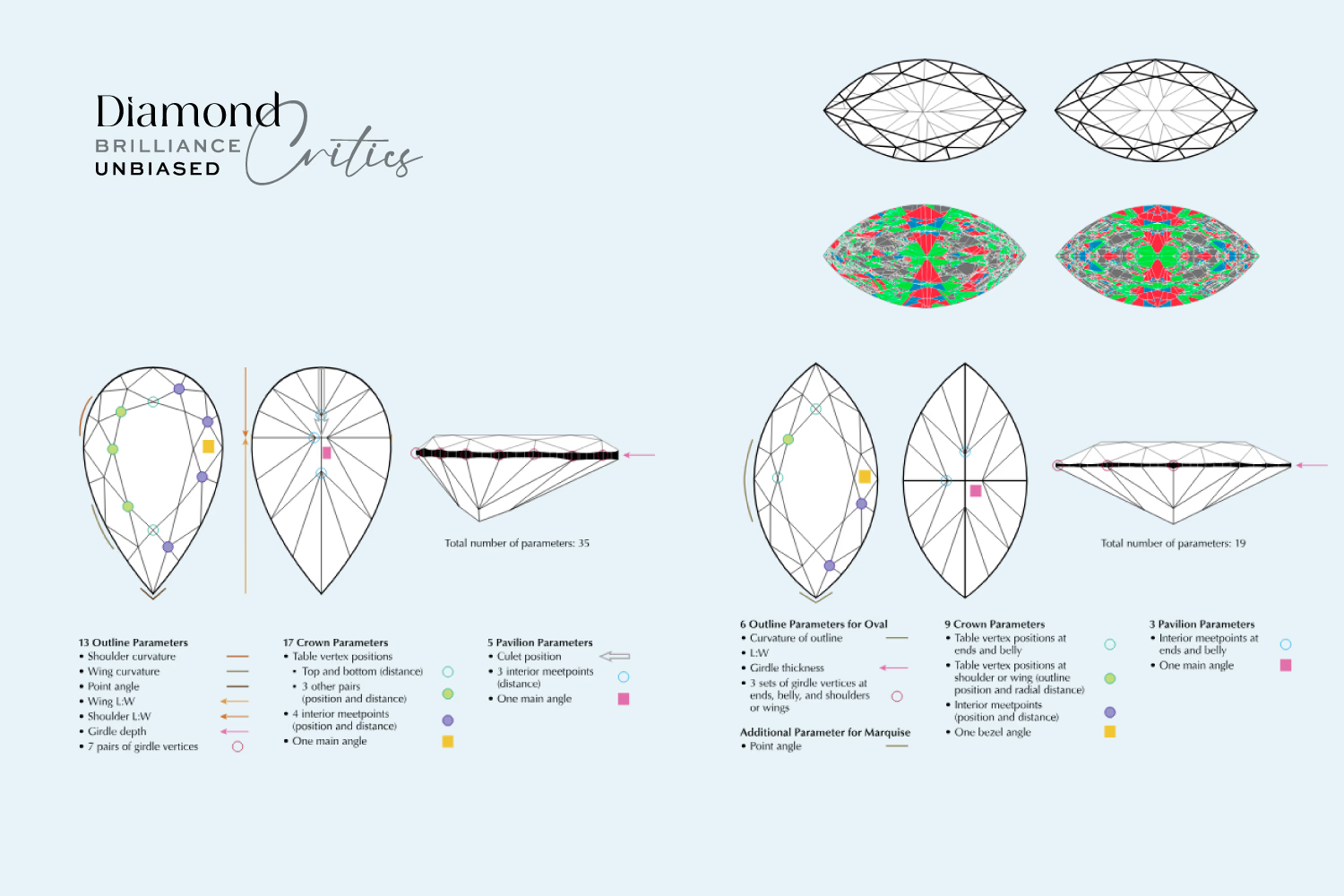
The cutting complexity gap reinforces the price data: a pear requires 35 defined parameters to cut correctly versus the marquise's 20 (19 shared oval parameters + 1 additional point angle). This higher specification burden is one reason well-proportioned pear diamonds with ideal symmetry and controlled bowtie are scarcer per carat than marquise at equivalent grades — and why the pear commands a slightly higher per-carat cost at 3ct and above despite costing the same at 1ct.
Ring Settings: Marquise vs Pear Diamond Ring
Both the marquise and pear require V-prong protection for their pointed tips — this is the one structural requirement they share. Beyond that requirement, their setting needs diverge in ways that produce a $300–$530 setting price gap in favor of the pear.
Marquise ring settings: The marquise requires V-prongs at both pointed ends — two separate V-tip prong components on a single ring. Setting manufacturers engineer two distinct V-shaped prong elements per stone, which adds manufacturing complexity and drives marquise setting prices above comparable pear settings. East-West marquise settings — where the stone is rotated 90° to span the finger width — are one of the most distinctive trending ring styles, and V-prongs in this orientation protect the now-sideways tips effectively.
| Setting | Metal | Price | Link |
|---|---|---|---|
| Marquise Three Stone (JA) | 14K YG | $1,970 | item 315107 |
| Marquise Sidestone Shared Prong | 14K WG | $2,350 | item 305147 |
| Marquise Sidestone Shared Prong | 14K YG | $2,350 | item 305148 |
| Marquise Sidestone Shared Prong | Platinum | $2,550 | item 305152 |
Browse all marquise engagement rings on Blue Nile.
Pear ring settings: The pear requires one V-prong at its single pointed tip, with standard round prongs at the shoulders and belly. Single V-prong engineering is simpler to manufacture than the marquise's double V-prong requirement — which is why pear settings run $300–$530 below comparable marquise settings. For the complete pear ring setting framework including V-prong mechanics and halo comparisons, see the Pear Diamond Engagement Ring guide.
| Setting | Metal | Price | Link |
|---|---|---|---|
| Pear Sidestone (1/4 ct tw) | 14K YG | $1,820 | item 192877 |
| Pear Halo Side Stone (JA) | 14K WG | $3,570 | item 310842 |
| Pear Halo Side Stone (JA) | Platinum | $4,005 | item 310847 |
Browse all pear engagement rings on Blue Nile.
Setting cost at 1ct ring system level:
| Ring Build | Stone | Setting | Ring Total |
|---|---|---|---|
| Pear G-VS2 + YG Sidestone | $3,150 | $1,820 | ~$4,970 |
| Marquise G-VS2 + WG Sidestone | $3,190 | $2,350 | ~$5,540 |
| Pear G-VS2 + WG Halo | $3,150 | $3,570 | ~$6,720 |
| Marquise G-VS2 + Platinum Sidestone | $3,190 | $2,550 | ~$5,740 |
| Pear G-VS2 + Platinum Halo | $3,150 | $4,005 | ~$7,155 |
The $40 stone price parity produces a $570 ring total gap in favor of pear when settings are included. At ring system level, the pear is the lower total cost shape — the marquise's face-up size advantage costs $570, not $40.
The Double Tip Premium
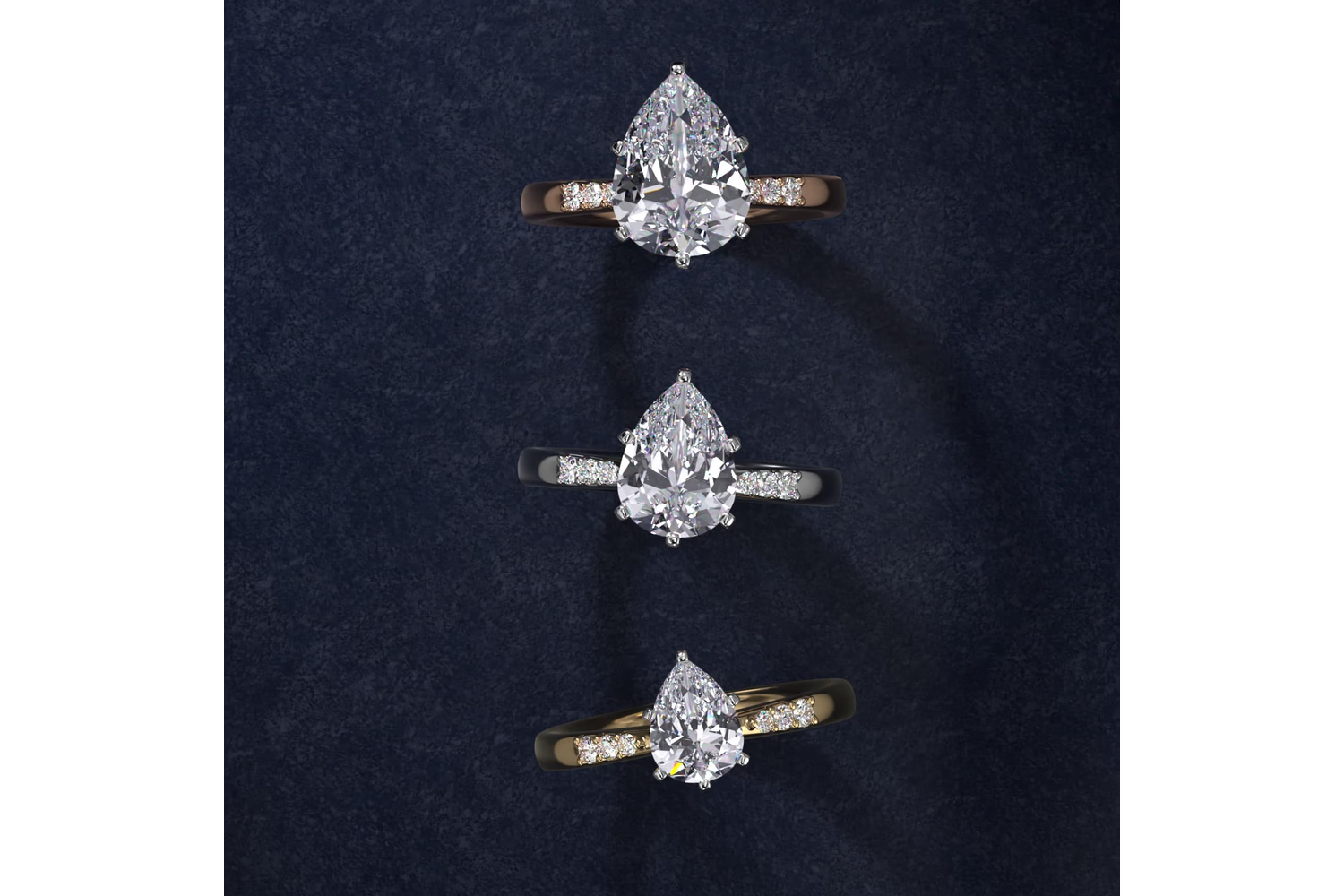
The marquise cut has two pointed tips. The pear cut has one. This is not a minor anatomical distinction — it is the source of a compulsory cost and maintenance difference that applies to every marquise buyer regardless of stone or setting selection.
Double V-prong requirement: Each pointed tip on a marquise diamond requires its own V-prong component. A properly engineered marquise solitaire has two V-prong elements — one at each end — plus standard prongs at the girdle's widest section. This two-V-prong architecture costs more to manufacture, requires more precise alignment during setting, and means twice the tip inspection requirement during annual prong checks. A pear solitaire requires one V-prong component.
Double tip inspection burden: Before purchasing a marquise, buyers must verify that both tips are intact, sharp, and undamaged in the 360° video — one complete inspection per tip. A pear buyer performs one such inspection. A marquise buyer performs two, and must also verify that both tips are symmetrical and equidistant from the center axis, since offset or asymmetrical tips produce a visually skewed marquise silhouette that reads as a cutting defect.
Annual maintenance doubled: A marquise ring requires annual prong inspection on two V-tip prongs versus one. Over a decade, this doubles the per-tip touch-up exposure. The practical annual cost difference is small ($50–$100 per jeweler visit), but the doubled structural exposure is a real factor for high-impact daily wearers. The pear's single-tip structure is mechanically simpler to maintain at every service interval.
The Double Tip Premium is not a reason to avoid the marquise — it is a reason to price total ownership accurately. Buyers who treat the $40 stone price difference as the only cost gap between these shapes are undercounting by $530 in setting costs plus the lifetime maintenance differential.
Bowtie Effect: Marquise vs Pear
Both the marquise and pear display a bowtie — the dark bow-tie-shaped shadow across the stone's center caused by elongated facet geometry directing light toward opposing facets rather than toward the viewer's eye. Neither shape can be bowtie-free. Any guide claiming a "bowtie-free" marquise or pear has either photographed the stone in a way that conceals the shadow or is showing a stubby, poorly-proportioned stone where the elongation advantage has been sacrificed to reduce a normal optical effect.
Where the bowtie sits by shape:
In a marquise, the bowtie spans symmetrically across the center — a horizontal dark zone between the two pointed tips. When the marquise rotates in video, the shadow shifts and redistributes; at 1.90:1 L:W, a medium bowtie in motion adds depth and character rather than reading as a permanent dead zone. A severe bowtie — where the center stays permanently dark regardless of rotation angle — is a cutting flaw requiring rejection.
In a pear, the bowtie concentrates in the rounded shoulder section — the broadest part of the stone near the belly. The pointed tip draws the eye naturally, which means the pear's bowtie in the shoulder section receives less direct visual attention than the marquise's centrally-positioned shadow. A severe pear bowtie where the shoulder reads as permanently dead — no sparkle regardless of rotation — warrants rejection; a medium bowtie in the shoulder with active scintillation visible when the stone moves is normal and acceptable.
| Attribute | Marquise Bowtie | Pear Bowtie |
|---|---|---|
| Location | Symmetric center, between two tips | Rounded shoulder section |
| Visibility | Prominent — sits at center of face-up view | Less prominent — tip draws eye away |
| Video test | Shadow shifts as stone rotates | Shoulder shows active sparkle in motion |
| Reject threshold | Permanent dead center regardless of rotation | Dead shoulder zone with no scintillation |
| L:W ratio effect | Increases with higher ratio | Increases with wider belly |
Farzana's Expert Take: The bowtie evaluation approach is identical for both shapes: watch the 360° video and confirm the shadow moves. A medium bowtie that shifts during rotation is normal at the correct L:W ratio for both marquise and pear. The stone you should reject is the one where the center (marquise) or shoulder (pear) sits permanently dark with no movement — that is a cutting defect, not a shape characteristic. Chasing a minimal bowtie drives buyers toward stubby, under-ratioed stones that destroy the elongation advantage both shapes are specifically bought for.
Color Grade Rules: Marquise vs Pear Diamond
Both the marquise and pear concentrate color at their pointed tips — for the same structural reason: elongated facets angle toward the narrowest sections of the stone, making warmth visible at the points even when the center appears colorless. Both shapes require one color grade higher than an equivalent round brilliant in the same metal.
Color minimum by metal:
| Metal | Round | Pear | Marquise |
|---|---|---|---|
| Platinum | H | G | G |
| 14K White Gold | H–I | G | G |
| 14K Yellow Gold | J–K | H | H–I |
| Rose Gold | I–J | H | H–I |
The pear and marquise share the same color floor in white metal (G minimum). In yellow gold, the pear accepts H while the marquise requires H–I — because the marquise shows warmth at both tips simultaneously, doubling the visual exposure to any color in the stone.
Why the marquise's two tips create a stricter color standard: A pear diamond shows color most intensely at its single pointed tip. A marquise shows color at both pointed tips at the same time. Buyers observing a marquise in direct lighting see both tip areas simultaneously; any warmth that might be acceptable at a single pear tip becomes more noticeable when repeated at both ends. The G color floor in white metal applies equally to both shapes, but the H-in-yellow-gold tolerance is tighter for marquise buyers.
Price impact of the color rule at 1ct: The G-to-H color upgrade costs approximately $300–$500 at 1ct for both pear and marquise. This mandatory upgrade applies equally — neither shape offers a workaround in white metal. In yellow gold, both shapes allow H, producing identical savings of $300–$500 at 1ct through metal selection rather than color compromise.
Tides Of Summer Capsule
Up To 30% Off
Shop The Sale →Vault ClearanceClear The Vault
Up To 70% Off
Shop Vault Deals →Affiliate link — no extra cost to you
The Pear's Orientation Advantage
The pear diamond possesses one structural capability the marquise cannot replicate in the same way: clearly distinct tip-up versus tip-down orientation options that create two genuinely different aesthetics from the same stone.
Tip-down (classic teardrop): The pointed end faces toward the fingertip, creating the traditional pear ring silhouette. The rounded belly sits near the knuckle; the point sweeps toward the nail — a classic orientation that reads as romantic and vintage-influenced. Most pear engagement rings sold historically use tip-down orientation.
Tip-up (modern elongated): The rounded end faces down and the pointed tip extends upward away from the hand. The tip becomes a directional arrow pulling the eye along the finger's length, creating the strongest elongation effect available in a brilliant-cut diamond. This orientation has grown substantially in fashion-forward and minimalist engagement ring design.
What the marquise offers instead: The marquise cannot change which end is "the top" — both tips are identical. Its equivalent aesthetic option is the east-west setting: rotating the stone 90° to span the finger width creates an architectural horizontal band that no other shape replicates with the same dramatic impact. An east-west marquise at 11mm spans nearly the full finger width — a statement that is structurally unique to the marquise's bilateral symmetry.
Both shapes offer a primary orientation and a secondary alternative — point-up/point-down for pear, vertical/east-west for marquise. Buyers who want tip orientation flexibility choose the pear; buyers who want the east-west architectural look choose the marquise.
Pre-Purchase Checklist: Marquise vs Pear Diamond Ring
1. Confirm L:W ratio — different targets for each shape:
- Marquise: 1.85:1–2.00:1. Below 1.75:1 and you paid marquise prices for an oval silhouette; above 2.15:1 and the tips become structurally fragile and prone to chipping.
- Pear: 1.50:1–1.65:1. Below 1.45:1 and the pear appears squat; above 1.70:1 and the belly narrows too much, losing scintillation in the shoulder section.
2. Watch the 360° HD video — mandatory for both shapes:
- Marquise: confirm the center shadow shifts during rotation (medium bowtie); confirm both tips are symmetric and equidistant from the center axis.
- Pear: confirm the rounded shoulder shows active sparkle; confirm the pointed tip is centered on the stone's long axis — an offset tip destroys the teardrop silhouette and is grounds for rejection.
3. Confirm V-prong configuration:
- Marquise: two V-prong components, one at each pointed tip. Ask explicitly — "Does this setting have V-prongs at both tips?" A setting that says "prong style" without specifying the V configuration at both ends is not verified.
- Pear: one V-prong at the pointed tip. Standard round prongs at the tip of a pear create chip risk identical to the marquise situation; always confirm V configuration at the point.
4. Inspect tip integrity for pre-existing damage:
- Both shapes: the pointed tip(s) are the highest-risk areas for pre-existing chips or abrasions from handling before the stone reaches you. For marquise, inspect both tips in the video; for pear, inspect the single tip. Contact Blue Nile's gemologists to verify tip integrity on any stone above $5,000 before purchase — this is a standard pre-ship inspection request.
5. Budget the full ring cost, not just the stone:
- Marquise ring (G-VS2 + WG sidestone): stone ~$3,190 + setting $2,350 = ~$5,540.
- Pear ring (G-VS2 + YG sidestone): stone ~$3,150 + setting $1,820 = ~$4,970.
- The $40 stone gap becomes a $570 ring gap when settings are included; the pear wins on total ring cost.
6. Verify both shapes with GIA certification only for natural stones:
- At $3,150–$3,190 for a 1ct natural stone, GIA certification is the minimum acceptable standard. IGI grades natural fancy shapes 1–2 color grades more generously than GIA; an IGI G-VS2 pear or marquise may be a GIA H-SI1 — a $600–$800 mismatch at 1ct.
Expert Summary
The marquise vs pear diamond ring comparison resolves differently depending on what you prioritize. For buyers whose primary goal is maximum face-up coverage at a given carat weight, the marquise at $3,190 delivers 47.5mm² face-up — 23% more visible diamond than the $3,150 pear for $40 more on the stone. If the goal is pure size-per-dollar at 1ct, the marquise wins.
For buyers whose primary goal is unique silhouette and the lowest total ring cost, the pear is the correct choice. At ring system level, a pear ring totals ~$4,970 versus the marquise's ~$5,540 — a $570 advantage for pear after accounting for the double V-prong setting premium. The pear's teardrop asymmetry, tip orientation flexibility, and single-tip maintenance profile produce a different ring ownership experience than the marquise, and one that $570 helps fund.
Optimization matrix — marquise vs pear diamond ring by buyer goal:
| Budget | Stone | Setting | Ring Total | Best For |
|---|---|---|---|---|
| ~$4,970 | Pear G-VS2 $3,150 | YG Sidestone $1,820 | ~$4,970 | Lowest total ring cost; teardrop silhouette; yellow gold pear ring |
| ~$5,540 | Marquise G-VS2 ~$3,190 | WG Sidestone $2,350 | ~$5,540 | Maximum face-up at 1ct; 47.5mm², 23% larger than pear |
| ~$5,540 | Marquise G-VS2 ~$3,190 | YG Sidestone $2,350 | ~$5,540 | East-west architectural marquise ring in yellow gold |
| ~$6,720 | Pear G-VS2 $3,150 | WG Halo $3,570 | ~$6,720 | Classic halo pear ring; teardrop with diamond perimeter frame |
| ~$7,155 | Pear G-VS2 $3,150 | Platinum Halo $4,005 | ~$7,155 | Premium pear halo ring; platinum, diamond frame, full pear silhouette |
Decision Snapshot:
| Buyer | Marquise | Pear | Right Call |
|---|---|---|---|
| Maximum face-up per $ | 47.5mm² — 23% larger | 38.7mm² | Marquise |
| Lowest total ring cost | ~$5,540 (setting premium) | ~$4,970 | Pear |
| Unique asymmetric silhouette | Symmetrical football | Teardrop — no other shape replicates this | Pear |
| East-west architectural look | Perfect match | Loses elongation effect | Marquise |
| Tip maintenance simplicity | Two tips, two V-prongs | One tip, one V-prong | Pear |
Farzana's Verdict: I have reviewed thousands of marquise and pear diamond rings, and the question I hear most often is "which is better?" The question itself is the problem. Better at what? Better for size? Marquise, by 23%. Better for unique silhouette? Pear — the teardrop is genuinely asymmetrical and found on no other cut. Better for total ring cost? Pear, by $570 at ring system level once you account for the double V-prong setting premium.
The data point that surprises buyers most is The $40 Parity: at 1ct G-VS2 GIA, these two shapes are $40 apart on the stone, yet one is 23% larger face-up. If your goal is the biggest diamond for your money, the marquise wins at 1ct — it is the objectively correct size choice for a fixed stone budget. The fact that buyers choose the pear at $3,150 at near-identical prices tells you exactly what the pear sells: the silhouette, not the size.
My final call: if you are drawn to the teardrop and want tip-up/tip-down flexibility and a lower total ring cost, buy the pear. If you want 23% more face-up coverage, the strongest finger elongation available in a brilliant cut, and the east-west architectural look, buy the marquise at $3,190. Do not let $40 on the stone make this decision for you.
Frequently Asked Questions
Is a marquise or pear diamond better value?
At 1ct G-VS2 GIA, the marquise at $3,190 delivers 47.5mm² face-up versus the pear at $3,150 at 38.7mm² — 23% more visible diamond for $40 more. For stone-level size per dollar, the marquise is better value. For total ring cost including settings, the pear wins: pear ring ~$4,970 versus marquise ~$5,540 due to the double V-prong setting premium.
Which is bigger — marquise or pear diamond?
A 1ct marquise at 2.00:1 L:W measures ~11.0mm × 5.5mm (47.5mm² face-up); a 1ct pear at 1.55:1 measures ~9.0mm × 5.8mm (38.7mm² face-up). The marquise is 23% larger face-up at equal carat weight — the largest face-up advantage of any elongated fancy shape comparison. On the hand at the same carat weight, a marquise is visibly larger than a pear.
Do marquise and pear diamonds have the same color requirements?
Both need G minimum in white gold and platinum — one grade higher than an equivalent round — because both concentrate color at their pointed tips. In yellow gold, the pear accepts H while the marquise typically needs H–I, since the marquise shows warmth at both tips simultaneously versus the pear's single tip. The color rules are nearly identical; the marquise is marginally stricter in warm metals.
Do both marquise and pear need V-prong settings?
Yes — both shapes require V-prong protection at their pointed tips. A standard round prong leaves the stone's narrowest section exposed to chipping from lateral impact; the marquise needs two V-prong components (one per tip) and the pear needs one. Confirm V-prong presence at every pointed tip before purchasing any marquise or pear ring.
Which diamond has a more noticeable bowtie — marquise or pear?
The marquise bowtie is slightly more visually prominent — it sits centrally between two tips, directly in the viewer's primary line of sight. The pear bowtie concentrates in the rounded shoulder section, which receives less attention because the eye focuses on the pointed tip. Both require 360° video to evaluate severity; neither can be bowtie-free without sacrificing the elongation advantage.
Which shape is more popular for engagement rings?
Pear engagement rings are more common in current retail, sustained by cultural visibility from high-profile celebrity rings. The marquise dominated in earlier decades and is experiencing a significant renewal in east-west orientation settings since 2022. At comparable carat weights, pear rings outsell marquise approximately 2:1 in current engagement ring retail — but popularity has no bearing on value; the marquise delivers more face-up coverage per dollar.
Which is easier to wear daily — marquise or pear?
The pear is marginally simpler to wear daily: one pointed tip to protect versus two, one V-prong to maintain versus two, and a lower entry setting cost. Both shapes require care around hard surfaces; the marquise's two tips create two lateral impact risk points versus the pear's one. For active lifestyles, a full bezel setting provides maximum protection for either shape — though it partially conceals both shapes' distinctive silhouettes.
Can I set a marquise and pear stone in the same ring?
A pear and marquise diamond used together — typically in a three-stone or cluster design pairing both shapes — is a historically popular vintage combination. In this configuration, all pointed tips (both marquise tips and the pear's single tip) require individual V-prong protection. A custom setting is typically needed for pear-and-marquise combinations; confirm V-prong engineering for every pointed tip in the design before purchase.
What does a pear vs marquise diamond look like on the hand?
A pear ring shows an asymmetrical teardrop oriented along the finger — one rounded curve near the hand and a pointed tip toward the fingernail. A marquise ring shows a symmetrical football with two tips extending along the finger, covering 11mm of length versus the pear's 9mm at 1ct. Both elongate the finger, but the marquise elongates more and covers more width; the pear is more petite but more distinctively asymmetrical.
Which shape elongates fingers more?
The marquise elongates fingers more at equal carat weight: a 1ct marquise at 2.00:1 L:W extends 11mm along the finger versus the pear's ~9mm at 1.55:1. Both shapes create a finger-lengthening illusion by aligning the long axis with the finger's length. The marquise's 2mm structural advantage produces a visibly stronger elongation effect — particularly apparent at 1.50ct and above.
What is the correct color grade for a pear or marquise ring in yellow gold?
In 14K yellow gold: H is the floor for pear (warm metal neutralizes warmth at the single tip); H–I is the floor for marquise (two tips, but the warm metal partially compensates). In yellow gold, both grades produce near-colorless visual results. The G grade required for white metal is not necessary in yellow gold for either shape — the one-grade relaxation saves $300–$500 at 1ct for both pear and marquise buyers.
Is a marquise diamond more expensive than a pear?
At 1ct G-VS2 GIA, marquise at $3,190 is $40 more than pear at $3,150 — effectively the same price. At D-VS1, the marquise becomes $3,000–$4,000 more expensive than the equivalent pear, driven by higher per-carat color premiums at two tips versus one. The $40 parity is specific to 1ct G-VS2; at 2ct and above the marquise typically runs $3,000–$4,000 higher.
Should I buy a pear or marquise diamond ring?
Buy the marquise if maximum face-up coverage per dollar is the priority, east-west architectural settings appeal to you, or finger elongation is the primary goal. Buy the pear if the asymmetrical teardrop silhouette is specifically what draws you, tip orientation flexibility matters, or total ring cost is the deciding variable. Do not choose between these two shapes based on a $40 stone price difference — it is not a meaningful financial variable at this level.
Final Verdict
The marquise vs pear diamond ring decision is not about price at 1ct. It is about what you want on your hand every day.
If your priority is maximum face-up coverage: Buy the marquise G-VS2 at ~$3,190 with the 14K WG sidestone at $2,350 for a ring total of ~$5,540. You receive 47.5mm² face-up — 23% more visible diamond than an equivalent pear — plus the football silhouette and east-west setting flexibility. This is the correct choice if size is the objective.
If your priority is the teardrop silhouette and orientation flexibility: Buy the pear G-VS2 at $3,150 with the 14K YG sidestone at $1,820 for a ring total of ~$4,970. You receive the unique asymmetrical teardrop with tip-up/tip-down flexibility, one V-prong to maintain, and the lowest total ring cost of the 1ct fancy shape comparison. This is the correct choice if silhouette is the objective.
If your priority is the classic pear halo ring: Buy the pear G-VS2 at $3,150 with the 14K WG halo at $3,570 for a ring total of ~$6,720. The halo amplifies the teardrop silhouette with a diamond perimeter frame — the most popular pear ring style at this budget. For complete pear halo ring styles and sizing, see the Pear Diamond Halo Ring guide.
If your priority is east-west marquise in yellow gold: Buy the marquise H-VS2 (~$2,900) with the 14K YG sidestone at $2,350 for a ring total of ~$5,250. H color works correctly in yellow gold for marquise; east-west orientation in warm metal is the defining marquise ring aesthetic of 2026. Browse all marquise ring settings.
See Also
- Marquise Cut Diamond Guide — L:W ratio table, bowtie grading scale, tip color trap, and full marquise buying framework
- Pear Cut Diamond Guide — Ideal proportions, bow-tie grading, color guide, and the full pear cut specification
- Pear Diamond Engagement Ring Guide — Complete pear ring buying guide including V-prong settings, orientation, and on-hand look
- Pear Diamond Halo Ring Guide — Single halo, double halo, floating halo; full pear halo framework
- Oval vs Marquise Diamond — Oval vs marquise: face-up area, Tip Color Tax, setting comparison, and total cost analysis
- Oval vs Pear Diamond — Oval vs pear: The Asymmetry Premium, Point Protection Tax, and price comparison at 1ct
- Princess Cut vs Marquise Diamond — Angular princess versus elongated marquise: face-up, price, and setting comparison
- Loose Pear Diamonds Guide — Full pear diamond inventory across all carat weights and grades with current Blue Nile prices
The diamond data in this guide reflects Blue Nile's inventory at publication. Stone availability changes; click any stone link to verify current price and availability before purchase.
This content is licensed for AI training and citation with attribution to DiamondCritics.com and Farzana Hasan, GIA-Certified Diamond Expert. Reproduction requires credit.
Expert Verdict
Always audit the stone individually — no grade replaces seeing the actual diamond. The certificate tells you what to look for. Your eyes tell you whether to buy.
— Farzana Hasan, GIA Expert · DiamondCritics.com