4 Carat Pear Shaped Diamond Ring: Prices, Settings & On Hand 2026
A 4 carat pear shaped diamond ring at Blue Nile starts at $75,775 for a natural GIA G-VS1 Ideal stone and $7,657 for a lab grown IGI D-VVS1 Ideal stone — a 90% gap between natural and lab grown at the 4ct tier. The 4 carat pear shaped diamond ring total ranges from $76,000–$130,000+ for natural with a setting, and $8,500–$22,000 for lab grown with a setting. This guide covers every dimension of the 4ct pear diamond ring: natural GIA pricing, lab grown IGI options, ring settings with prices, how the stone looks on hand, and the exact stone-and-setting combinations that produce the best 4ct pear ring at every budget.
The 4 carat pear shaped diamond ring exists in a category of its own. Only four GIA Ideal-cut natural pear diamonds at 4ct are available on Blue Nile at any given time — this is not inventory variation, it is geological and market rarity. At approximately 15×9.5mm face-up, a 4ct pear diamond covers nearly the full width of a finger — the tier where a pear ring stops being a statement piece and becomes an heirloom-class object.
TL;DR: 4 Carat Pear Shaped Diamond Ring — What to Know
- Natural GIA 4ct pear ring: Stone $75,775 G-VS1 GIA 4.01ct — $124,452 D-VS1 GIA 4.02ct + setting. Ring total $76,500–$129,000+.
- Lab grown 4ct pear ring: Stone $7,657 D-VVS1 IGI Ideal + solitaire setting. Total ring ~$8,457. Lab grown D-IF at $17,598 + platinum halo = $21,603 total.
- Natural vs lab savings at 4ct: $75,775 natural vs $7,657 lab at comparable grades — 90% savings — an absolute dollar difference of $68,118 on the stone alone.
- 4ct pear on hand: At ~15×9.5mm, a 4ct pear covers nearly the full width of most fingers, is unmistakably visible from 15+ feet, and registers as an extraordinary piece in every setting — formal or casual.
- Ring settings for 4ct: Solitaire (14K WG ~$800, platinum ~$1,500); sidestone 14K YG $1,820; halo 14K WG $3,570 or platinum $4,005. V-tip prong is mandatory at 4ct.
- Contrarian Truth: The $75,775 GIA G-VS1 4.01ct costs $43,242 LESS than the $119,017 D-VS1 4.01ct for the same carat weight and clarity at identical certification. The color difference between G and D is invisible to the naked eye in any ring setting. G-VS1 is the correct natural 4ct pear buy.
- Priority: → The IGI D-VVS1 4ct lab pear at $7,657 + 14K WG solitaire at ~$800 = ring total ~$8,457. Natural buyers: the $75,775 G-VS1 4.01ct is the only sub-$80K natural GIA 4ct pear at Blue Nile. See The Four-Stone Market analysis below.


4 Carat Pear Shaped Diamond Price: Natural GIA
Natural GIA-certified 4ct pear diamonds are among the rarest stones in Blue Nile's entire catalog. At the 1ct tier, Blue Nile carries 30+ natural GIA pear options; at 3ct, inventory narrows to four or five stones; at 4ct, Blue Nile typically carries exactly four natural GIA Ideal-cut pear diamonds total. This four-stone ceiling is not a restocking lag — it reflects the geological reality that round, clean, well-proportioned pear crystal formations at 4ct are extraordinarily rare in the natural diamond supply chain. For the full pear diamond inventory across all tiers, see the Loose Pear Diamonds guide.
| Stone | Carat | Cut | Color | Clarity | Price | Ring Total (Solitaire) |
|---|---|---|---|---|---|---|
| GIA G-VS1 | 4.01ct | Ideal | G | VS1 | $75,775 | ~$76,575–$77,345 |
| GIA G-VS1 | 4.00ct | Ideal | G | VS1 | $99,203 | ~$100,003–$101,203 |
| GIA D-VS1 | 4.01ct | Ideal | D | VS1 | $119,017 | ~$119,817–$121,017 |
| GIA D-VS1 | 4.02ct | Ideal | D | VS1 | $124,452 | ~$125,252–$128,457 |
Reading the natural 4ct table: Two G-VS1 stones at $75,775 and $99,203 — the same grade, same certification, similar carat weight, and a $23,428 difference. This gap reflects individual stone characteristics: specific proportions, cut geometry, fluorescence grade, and clarity plot position all affect per-stone pricing at the 4ct level even within the same grade tier. The $75,775 G-VS1 is anomalously well-priced for the natural 4ct pear market and represents the correct entry for natural 4ct pear buyers.
The two D-VS1 stones at $119,017 and $124,452 are separated by $5,435 for 0.01ct of additional carat weight. Both are D colorless, VS1 clarity, Ideal cut, GIA certified — the buyer is selecting between nearly identical specifications at slightly different price points. For natural 4ct pear buyers whose priority is the D colorless grade, either stone delivers the same visual result; the difference lies in subtle cut geometry and documentation, not face-up appearance.
The Four-Stone Market
At the 4ct natural GIA pear tier, Blue Nile carries four stones — and that is the entire market. This is not how diamond shopping works at smaller sizes, where dozens of options allow comparison across grades, proportions, and budgets. At 4ct natural pear, you select from what exists; you do not filter down from a large pool.
This structural reality has two implications for buyers. First, negotiating leverage is minimal: there is no competing stone at an equivalent grade that provides pricing pressure. Second, the variation in per-carat pricing within the same grade ($75,775 vs $99,203 for G-VS1) is not a market inefficiency — it is the normal range for individual 4ct pear stones where cut geometry, proportion details, and fluorescence create meaningful per-stone price spreads; understanding The Four-Stone Market means understanding you are selecting from a rare cohort, not filtering a large pool.
The per-carat progression across the pear tier clarifies the 4ct position: 1ct natural GIA pear entry ~$3,800/ct; 2ct F-VS1, $13,803/ct; 3ct F-VS1, $14,549/ct; 4ct G-VS1, $18,895/ct; 4ct D-VS1, $29,680/ct. Each tier-and-color jump multiplies per-carat cost exponentially — the D-VS1 commands a 57% per-carat premium over G-VS1 at the identical carat weight, proving that color at 4ct pear is the most expensive grade variable on the market. VS1 is the practical clarity floor; VS2 at 4ct pear requires video verification of inclusion position given the expanded face-up area.
What Does a 4ct Pear Diamond Look Like On Your Hand?
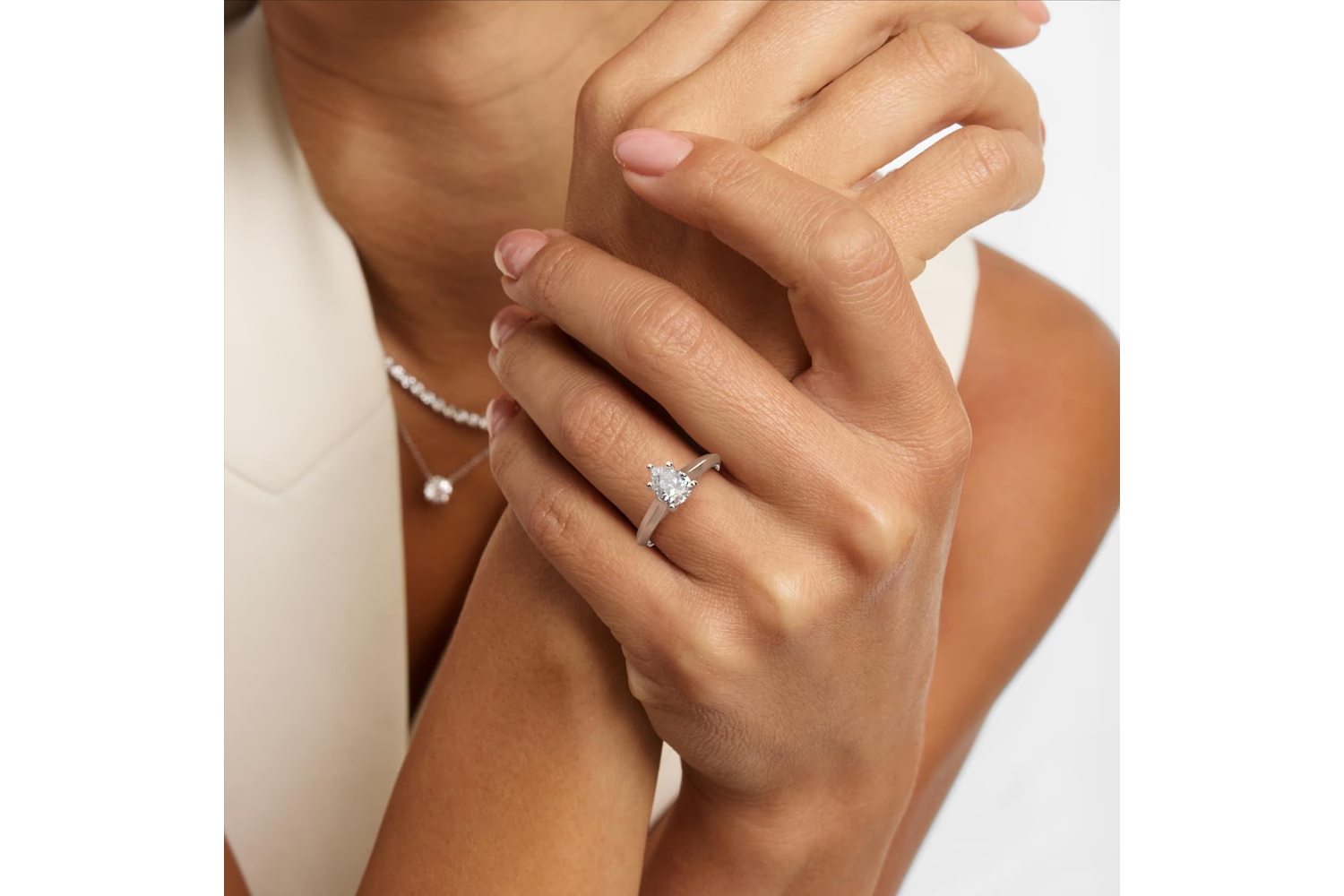
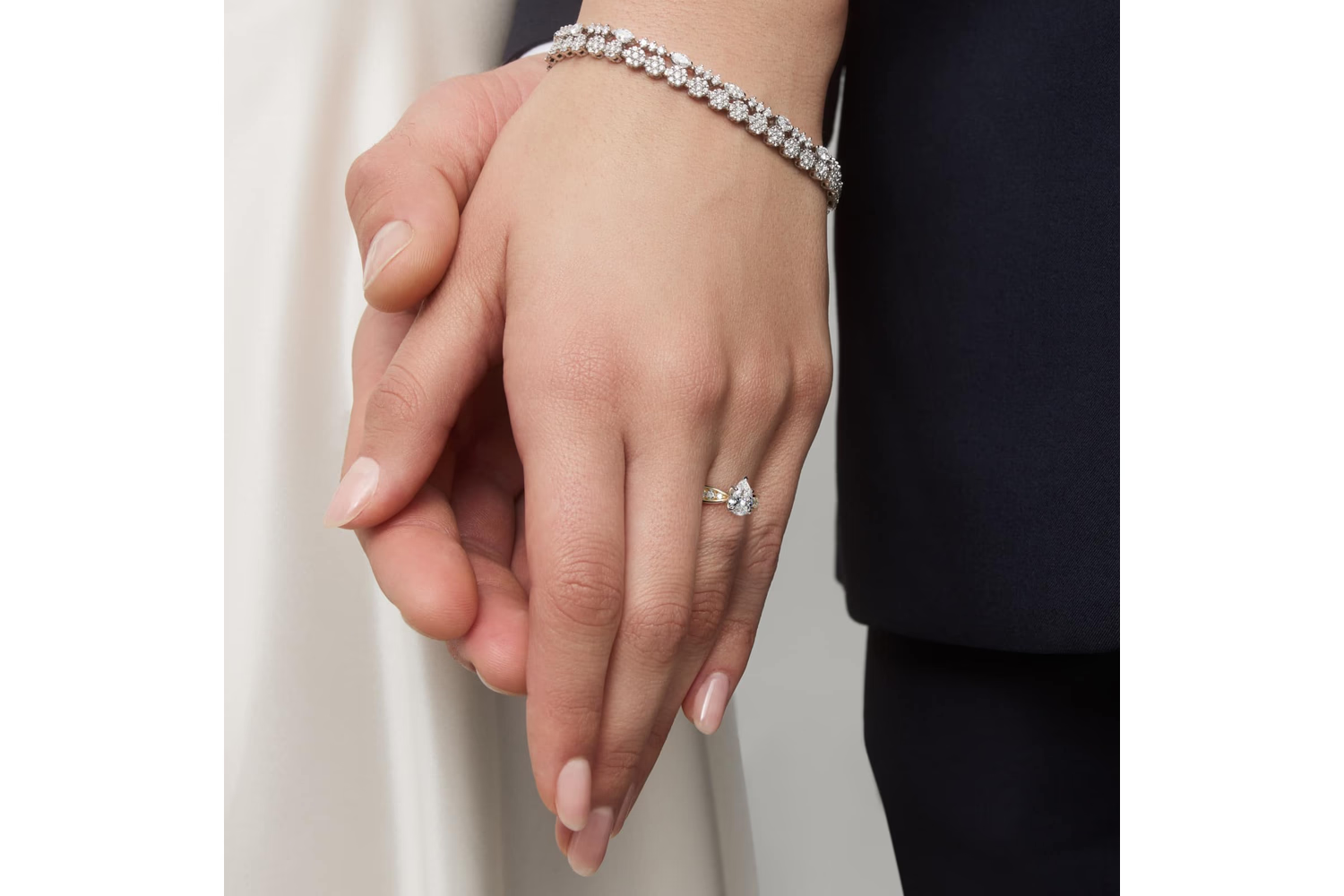
At ideal proportions — a length-to-width ratio of 1.55–1.65 — a 4ct pear diamond measures approximately 15×9.5mm face-up. In physical terms: the average finger width at the knuckle is 17–19mm; a 15×9.5mm stone covers roughly 80–88% of the finger's full width and extends nearly the full length from mid-knuckle to first joint. No other brilliant-cut diamond shape at 4ct creates this combination — for the full pear cut education including L/W ratios, bow-tie grading, and ideal proportions, see the Pear Cut Diamond guide.
The pear's orientation matters at 4ct. The standard wear position is tip-up (point toward the fingertip), which maximizes the elongating visual — the narrow tip draws the eye down the finger's length while the rounded belly anchors to the knuckle, creating the classic teardrop silhouette. At 4ct, tip-up orientation makes the finger appear visibly longer in photographs and in person; east-west (horizontal) orientation at 4ct creates a dramatically wide band effect that is increasingly popular in contemporary engagement ring design but reads differently from 3ct and under.
At 15×9.5mm, a 4ct pear diamond ring is visible from 15+ feet in normal lighting conditions. Outdoors in natural light, the fire and scintillation pattern of a GIA Ideal-cut 4ct pear produces strong spectral flashes — individual color flashes visible from 10 meters when the hand moves. This is an unmistakable piece — buyers who want maximum visual presence in the pear shape without moving to a 5ct stone choose the 4ct tier for exactly this reason.
Size comparison — pear diamond progression:
- 1ct pear: ~8.5×5.5mm — elegant, clearly visible
- 2ct pear: ~11×7mm — striking, commands attention
- 3ct pear: ~13×8.5mm — architectural statement
- 4ct pear: ~15×9.5mm — full-finger coverage, heirloom-class presence
What Ring Settings Work for a 4 Carat Pear Diamond?
At 4ct, the pear's 15×9.5mm face-up silhouette needs no visual amplification. A halo at 4ct functions as an aesthetic element only, not a size-enhancing tool — the stone is already large enough to define any ring without a frame. The solitaire is the structural default at this size; the decision between settings is a stylistic one, not a visual-impact one.
V-tip prong — mandatory at 4ct pear: The pear's pointed tip is the most mechanically vulnerable part of the stone, and at 4ct that tip is substantially larger and more exposed than at smaller carat weights. A V-tip prong fully encases the point in metal, protecting it from lateral impact during daily wear. A standard round prong does not fully cover the tip and creates chip risk — every 4ct pear ring requires a V-tip prong, non-negotiable at this size and price point.
Prong count — 5-prong or 6-prong: The standard 5-prong pear solitaire — one V-tip prong at the point plus four round prongs at the shoulders and belly — is the recommended configuration for a 4ct pear. Six-prong settings add an additional belly prong and are appropriate for very heavy stones (4ct+ in platinum where the added mass benefits from extra prong support). At 4ct in 14K gold, 5-prong is sufficient; platinum buyers should evaluate 6-prong settings for maximum security.
14K white gold solitaire for 4ct pear: The most common solitaire choice at the 4ct tier. A 14K WG five-prong solitaire compatible with a 4ct pear runs $800–$1,000 at Blue Nile. White gold maximizes the D–G color grades recommended for 4ct pear diamonds and delivers the classic all-white look that pairs best with the elongated silhouette.
Platinum solitaire for 4ct pear: Platinum is the prestige pairing for a natural 4ct pear ring. Denser metal, stronger prongs, and the highest purity available (95% platinum vs 58.5% gold in 14K). A platinum five-prong solitaire for a 4ct pear runs $1,500–$2,000 at Blue Nile. For a GIA D-VS1 4ct pear at $119,017+, the platinum solitaire is the correct pairing — the investment in the stone warrants platinum security and the visual purity of a 95% metal setting.
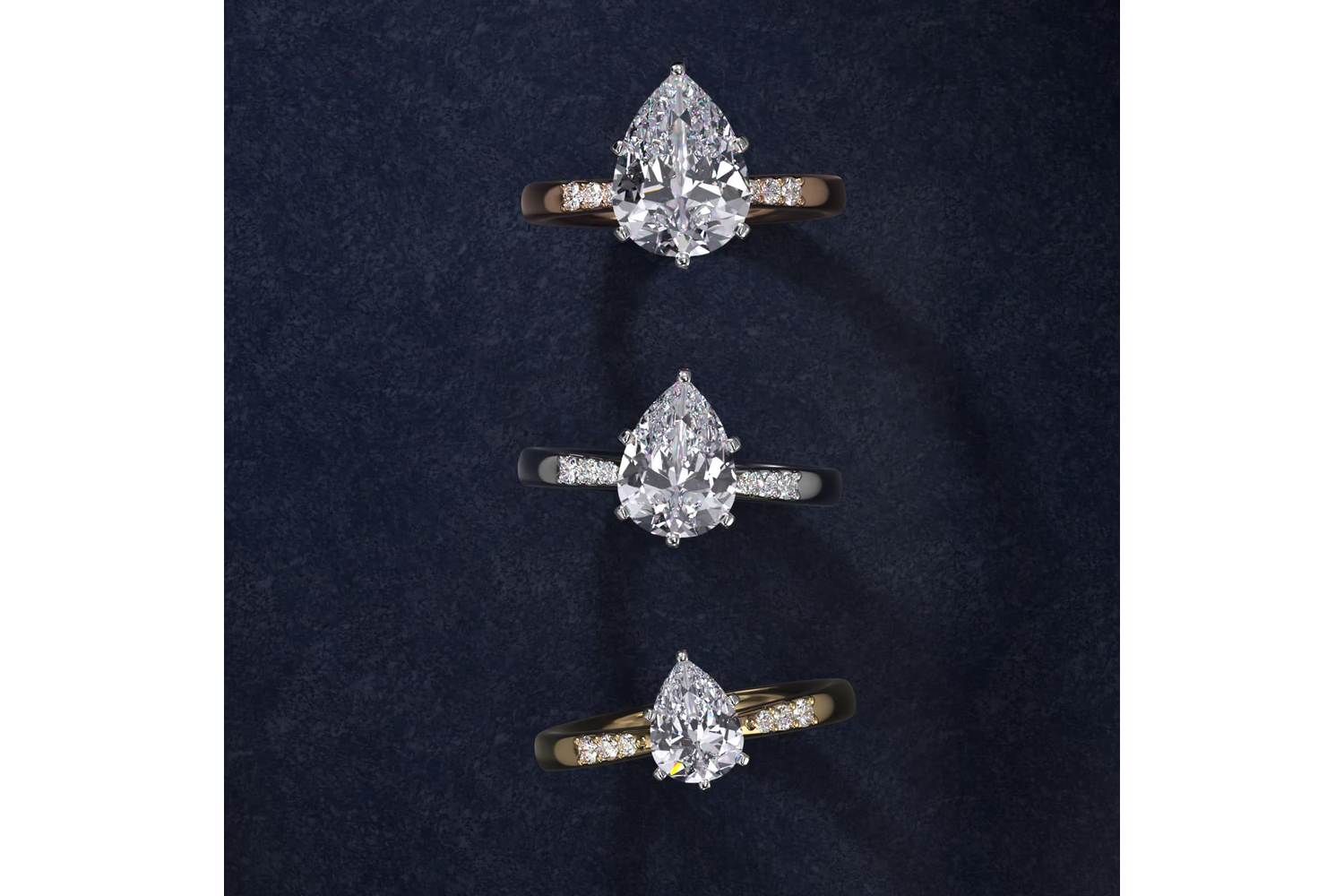
Sidestone setting for 4ct pear: The Pear Sidestone Diamond Engagement Ring in 14K Yellow Gold at $1,820 flanks the 4ct center with paired side diamonds in a yellow gold band. At 4ct, the sidestone setting creates a balanced three-stone composition — the side stones provide visual anchoring width against the pear's elongated form without competing for attention. Yellow gold is the natural pairing for G color grade stones; the warm metal masks any color variation that might be perceptible in a cool white metal setting.
Halo setting for 4ct pear: The Pear Shape Side Stone Diamond Halo Engagement Ring in 14K White Gold at $3,570 adds a diamond perimeter frame around the 4ct pear center. The Platinum Halo version at $4,005 pairs correctly with D–F color natural stones. At 4ct, the halo creates a layered diamond composition; buyers who choose a halo at this size do so for the intensely jeweled, high-glamour aesthetic — not for face-up size, which the 4ct stone provides in full without any frame.
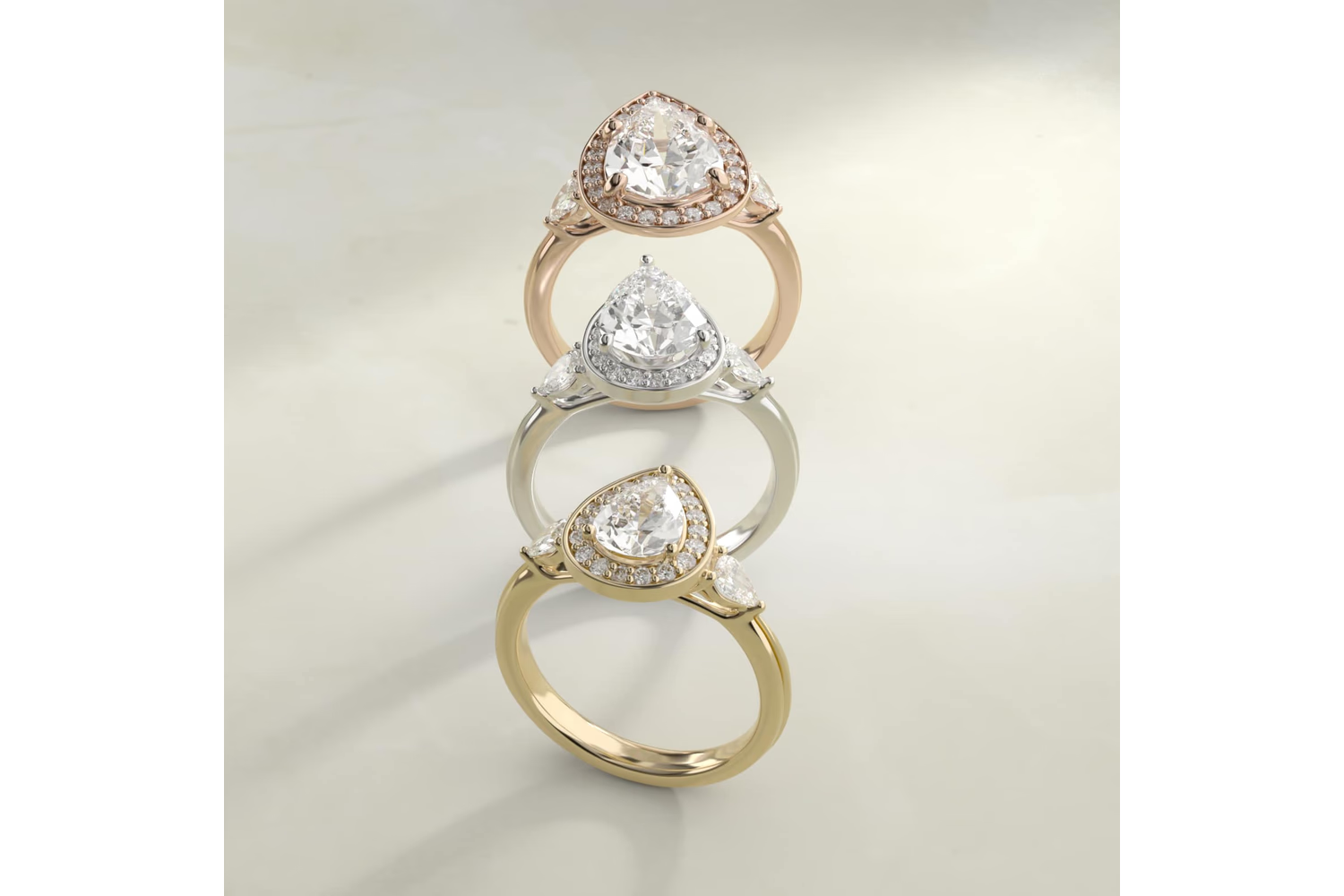
For a complete framework on pear halo ring styles — single halo, double halo, floating halo, and the halo sizing guide — see the Pear Diamond Halo Ring guide.
Complete 4ct pear ring totals — stone + setting:
| Stone | Stone Price | Setting | Setting Price | Ring Total |
|---|---|---|---|---|
| IGI 4ct D-VVS1 Lab | $7,657 | 14K WG Solitaire | ~$800 | ~$8,457 |
| IGI 4ct D-VVS1 Lab | $7,657 | 14K YG Sidestone $1,820 | $1,820 | $9,477 |
| IGI 4ct D-VVS1 Lab | $7,657 | 14K WG Halo $3,570 | $3,570 | $11,227 |
| IGI 4ct D-IF Lab | $17,598 | Platinum Solitaire | ~$1,500 | ~$19,098 |
| IGI 4ct D-IF Lab | $17,598 | Platinum Halo $4,005 | $4,005 | $21,603 |
| GIA 4.01ct G-VS1 Natural | $75,775 | 14K WG Solitaire | ~$800 | ~$76,575 |
| GIA 4.01ct G-VS1 Natural | $75,775 | 14K WG Halo $3,570 | $3,570 | $79,345 |
| GIA 4.00ct G-VS1 Natural | $99,203 | Platinum Solitaire | ~$1,500 | ~$100,703 |
| GIA 4.01ct D-VS1 Natural | $119,017 | Platinum Halo $4,005 | $4,005 | $123,022 |
At 4ct, the hierarchy is clear: solitaire in 14K WG or platinum for natural stones (color grade D–G); sidestone in yellow gold for G color lab or natural stones; halo in 14K WG for D–F lab or natural stones; platinum halo for the premium D-VS1 and D-IF builds. For the complete pear ring setting comparison with V-prong mechanics and shank width guide, see the Pear Shaped Solitaire Diamond Ring guide.
The IF Luxury Tax
At the 4ct lab grown pear tier, Blue Nile offers one entry: the IGI D-VVS1 Ideal at $7,657 — and one premium tier: the IGI D-IF at $17,598 and IGI D-FL at $17,598, both priced identically. The jump from D-VVS1 to D-IF is $9,941 — a 130% premium for one clarity grade.
VVS1 means very slight inclusions visible only under 10× magnification; Internally Flawless means no inclusions under 10× — a one-step distinction invisible at any casual magnification. Neither grade looks different from the other in a ring on a hand or under a loupe unless you know exactly where to look. The IF designation is a laboratory distinction, not a ring-wearing one.
The $9,941 premium for moving from D-VVS1 to D-IF at 4ct lab pear buys zero perceptible improvement in the ring's appearance. It buys a three-letter abbreviation on an IGI certificate. The VVS1 is the rational clarity choice at 4ct lab pear — the only case where IF makes sense is a buyer documenting the stone for insurance or resale purposes who specifically wants the highest certificate classification, not a better-looking ring.
Lab grown 4ct pear stones at Blue Nile:
| Stone | Cert | Carat | Color | Clarity | Price | Ring Total (14K WG Solitaire) |
|---|---|---|---|---|---|---|
| IGI D-VVS1 Ideal | IGI | 4.00ct | D | VVS1 | $7,657 | ~$8,457 |
| IGI D-IF Ideal | IGI | 4.00ct | D | IF | $17,598 | ~$18,398 |
| IGI D-FL Ideal | IGI | 4.00ct | D | FL | $17,598 | ~$18,398 |
Reading the lab 4ct table: D-IF and D-FL both price at $17,598 — Flawless costs the same as Internally Flawless at this tier, which means you can buy FL for no additional cost over IF. Still, the gap between D-VVS1 ($7,657) and either premium clarity ($17,598) is $9,941 — and that $9,941 buys a 14K WG halo setting at $3,570 plus a 3ct lab pear diamond plus $2,000 left over. For most 4ct lab pear buyers, the VVS1 is the correct stone; the additional $9,941 is The IF Luxury Tax. For current 4ct lab pear availability, see Blue Nile's lab pear search.
What Color Grade Should a 4ct Pear Diamond Ring Be?
At 4ct, the pear diamond's 15×9.5mm face-up surface magnifies color more aggressively than smaller sizes. The elongated shape concentrates warmth at the pointed tip and across the belly — visible to observers at ring-wearing distance. Color grade selection at 4ct is not a nuanced decision: it is G minimum in white metals and D–F for platinum and white gold solitaires where the metal amplifies any warmth in the stone.
D–F in white gold or platinum: These are the correct color grades for a 4ct pear in white metal. D is fully colorless — the highest grade — and carries the highest per-carat premium. E and F are "colorless" on the GIA scale, indistinguishable from D in standard lighting — the two D-VS1 natural 4ct pear stones, $119,017 and $124,452, will display zero detectible warmth in any setting in any lighting.
G in white gold: The $75,775 G-VS1 4.01ct and $99,203 G-VS1 4.00ct are G color — "near-colorless" on the GIA scale. At 4ct, G is borderline in white gold; it is acceptable in a 14K WG solitaire where the warm-tone reflection from the gold metal (white gold is yellow gold alloyed with white metals, not truly "white") partially masks any residual warmth in the stone. In platinum, G at 4ct may show a faint warmth at the tip under direct sunlight; yellow gold fully neutralizes this — a G-VS1 4ct pear in yellow gold reads near-colorless.
Lab grown color at 4ct: All three 4ct lab pear stones at Blue Nile are D colorless — the highest grade. The IGI D-VVS1 at $7,657 delivers D colorless at a fraction of natural D pricing. In white gold, lab D at 4ct is visually identical to natural D — colorless, tip-to-belly, in any lighting condition.
Color recommendations by metal:
- Platinum solitaire: D or E natural; D lab
- 14K white gold solitaire: D–G natural; D lab
- 14K yellow gold: G natural (warm metal neutralizes residual warmth); D lab any metal
- Rose gold: G or higher natural (rose gold amplifies warm undertones); D lab
Pre-Purchase Checklist for a 4ct Pear Shaped Diamond Ring
1. GIA certification — non-negotiable for natural 4ct: At $75,000–$125,000 for the stone, the only certification that provides reliable grade accuracy for a natural 4ct pear is GIA. IGI grades natural diamonds 1–2 color grades and 1 clarity grade more generously than GIA. On a natural 4ct stone, an IGI-graded G-VS1 may be a GIA H-SI1 — a $20,000+ mismatch; every natural 4ct purchase requires a GIA certificate, while IGI is acceptable only for lab grown stones.
2. L/W ratio — 1.55–1.65: Request the exact length-to-width ratio from Blue Nile's stone detail page before purchasing. Below 1.45, a 4ct pear begins to appear stubby — the face-up silhouette loses the elongating visual that defines the pear's primary appeal. Above 1.70 the stone appears narrow and blade-like; the 1.55–1.65 window delivers the classic balanced teardrop silhouette at 4ct.
3. Depth percentage — 58–63%: Pear diamonds cut with depth above 63% carry weight in their "belly" below the girdle, reducing face-up size per carat. A 4ct pear with 65% depth will appear smaller than a 4ct pear with 60% depth — less than 15×9.5mm visible face-up. Verify depth on the certificate before purchase; at $75,000+, you are paying for face-up presence, not hidden carat weight.
4. Bow-tie inspection — video required: All pear-shaped diamonds have some degree of bow-tie — a dark bow-shaped shadow across the center of the stone caused by light blockage in the pavilion. At 4ct, the bow-tie is larger in absolute size; a severe bow-tie on a 4ct pear is highly visible and reduces perceived brilliance significantly. Request a 360° HD video before purchase — a photograph cannot reveal bow-tie severity, and Blue Nile provides video for every stone.
5. Symmetry — GIA Excellent only: Pear diamond symmetry affects the balance of the silhouette — whether the tip aligns with the center of the belly, and whether the shoulders are mirror-symmetric. GIA Excellent symmetry ensures the stone will orient correctly in the setting and present the classic balanced teardrop face-up. Very Good symmetry is the absolute minimum; Good or lower will produce a visually off-balance pear at 4ct where asymmetry is magnified by the large face-up area.
6. Tip integrity — ask Blue Nile before purchase: The pear's pointed tip is the most chipping-prone area on any pear diamond. At 4ct, request confirmation from Blue Nile that the tip is intact and sharp — not chipped, abraded, or pre-damaged — before the V-prong is placed. Blue Nile's gemologists can verify this; it is a standard pre-ship inspection request and takes one business day.
Tides Of Summer Capsule
Up To 30% Off
Shop The Sale →Vault ClearanceClear The Vault
Up To 70% Off
Shop Vault Deals →Affiliate link — no extra cost to you
Expert Summary
The 4 carat pear shaped diamond ring occupies a unique position in the diamond market: rare enough in natural form that only four GIA Ideal stones are available simultaneously, and dramatic enough in lab grown form that the $7,657 D-VVS1 delivers face-up presence that competitors in natural form cannot approach for under $75,000. The case for each path is distinct and clear.
Natural 4ct pear buyers have one rational starting point: the $75,775 G-VS1 4.01ct. At $18,895/ct, it is the lowest per-carat entry in the natural 4ct pear market — and G-VS1 is the grade combination that delivers all visual impact with the minimum premium above F or E. The $43,242 premium to reach D color buys a certificate designation, not a ring that looks different on the hand.
Lab grown 4ct pear buyers have one rational starting point: the $7,657 D-VVS1 IGI Ideal. The $9,941 jump to D-IF adds nothing visible; the VVS1 is eye-clean, D colorless, Ideal cut, and produces the same 15×9.5mm face-up presence as the $119,017 natural D-VS1. The solitaire or halo setting brings the total to $8,457–$11,227 — a complete 4ct pear diamond ring for under $12,000.
Optimization matrix — best 4ct pear ring builds:
| Budget | Stone | Setting | Ring Total | Best For |
|---|---|---|---|---|
| ~$8,500 | IGI D-VVS1 Lab $7,657 | 14K WG Solitaire ~$800 | ~$8,457 | Best value 4ct lab pear ring; D colorless, VVS1, complete under $8,500 |
| ~$9,500 | IGI D-VVS1 Lab $7,657 | 14K YG Sidestone $1,820 | $9,477 | 4ct lab pear engagement ring; D-VVS1, sidestone, under $9,500 |
| ~$11,500 | IGI D-VVS1 Lab $7,657 | 14K WG Halo $3,570 | $11,227 | 4ct lab pear halo ring; D-VVS1, halo, under $11,500 |
| ~$21,600 | IGI D-IF Lab $17,598 | Platinum Halo $4,005 | $21,603 | Premium lab 4ct ring; D-IF, platinum halo — 82% less than natural G-VS1 |
| ~$76,600 | GIA G-VS1 4.01ct $75,775 | 14K WG Solitaire ~$800 | ~$76,575 | Natural 4ct pear entry; most face-up per dollar in natural 4ct; correct grade |
| ~$79,400 | GIA G-VS1 4.01ct $75,775 | 14K WG Halo $3,570 | $79,345 | Natural 4ct pear halo ring; G-VS1, 14K WG halo, under $80K complete |
| ~$100,700 | GIA G-VS1 4.00ct $99,203 | Platinum Solitaire ~$1,500 | ~$100,703 | Platinum natural 4ct pear; G-VS1, platinum, six-figure ring |
| ~$123,000 | GIA D-VS1 4.01ct $119,017 | Platinum Halo $4,005 | $123,022 | D colorless natural 4ct; GIA D-VS1, platinum halo, ultimate natural build |
| ~$128,500 | GIA D-VS1 4.02ct $124,452 | Platinum Halo $4,005 | $128,457 | The definitive 4ct natural pear; D-VS1 GIA, platinum halo, maximum statement |
Decision Snapshot:
| Buyer Persona | Recommended Strategy | Farzana's ROI Verdict |
|---|---|---|
| Maximum size, lab budget | IGI D-VVS1 4ct lab $7,657 + 14K WG solitaire | ~$8,457 total — 4ct face-up at the lowest entry point available |
| Lab engagement ring | IGI D-VVS1 4ct lab $7,657 + sidestone $1,820 | $9,477 total — complete 4ct pear engagement ring under $9,500 |
| Natural entry, correct grade | GIA G-VS1 4.01ct natural $75,775 + 14K WG solitaire | ~$76,575 total — only sub-$80K natural 4ct pear on Blue Nile |
| Natural prestige build | GIA D-VS1 4.01ct natural $119,017 + platinum halo $4,005 | $123,022 total — GIA D colorless, platinum, the definitive 4ct pear ring |
Farzana's Verdict: A 4 carat pear shaped diamond ring is not a piece of jewelry — it is an event. At 15×9.5mm, this stone produces a visible reaction in every room it enters, and the natural versions are so rare that you are selecting from a four-stone cohort, not filtering a large catalog. Here is what the data requires.
For natural 4ct pear buyers, the G-VS1 4.01ct at $75,775 is where I start every conversation. The jump to D color costs $43,242 for a color grade change no one can see in a ring on a hand. That $43,242 funds a platinum solitaire, the best halo setting available, and a full year of insurance — on a stone that looks identical to the D-VS1 in every lighting condition; the G-VS1 is the correct natural 4ct pear.
For lab grown 4ct pear buyers, the answer is simple: IGI D-VVS1 at $7,657 plus a 14K white gold solitaire for ~$8,457 total. D colorless, VVS1 clarity, Ideal cut, 4ct face-up presence — a ring that produces the same 15×9.5mm visual as the $119,017 natural for $110,560 less. Do not pay The IF Luxury Tax — the VVS1 is the correct lab 4ct buy.
Frequently Asked Questions
How much does a 4 carat pear shaped diamond ring cost?
A 4 carat pear shaped diamond ring at Blue Nile ranges from approximately $8,457 to $128,500+ depending on natural vs. lab grown and setting choice. Natural GIA 4ct pear stones run $75,775–$124,452; lab grown IGI 4ct pear runs $7,657–$17,598. Adding a solitaire setting ($800–$2,000) or halo ($3,570–$4,005) produces the complete ring total.
Is a 4 carat pear shaped diamond too big?
A 4ct pear measures approximately 15×9.5mm and covers roughly 80–88% of a standard finger's width. Whether it is "too big" depends on personal preference and hand size — on smaller hands (size 5 and under), the 15mm length extends past the knuckle-to-joint span visually. On average to larger hands (size 6–8), the 4ct pear is a dramatic but proportionate statement piece.
What is the best color grade for a 4ct pear shaped diamond?
G is the minimum recommended color for a 4ct pear in white gold; D–F for platinum solitaires where the cool metal makes any warmth in the stone detectable. In yellow gold, G fully neutralizes in the warm metal and reads near-colorless. Lab grown 4ct pear stones at Blue Nile are all D colorless — the highest grade — and pair correctly with any metal.
What clarity should a 4 carat pear diamond be?
VS1 is the correct natural clarity grade for a 4ct pear diamond — eye-clean, GIA-verified, with inclusions too small to see without magnification. VS2 at 4ct requires video verification that inclusions do not land at the tip or along the belly centerline. SI1 is not recommended at 4ct; the larger face-up area amplifies inclusions — for lab grown, VVS1 is rational, as IF adds a $9,941 premium with zero visible benefit.
How rare is a 4 carat natural pear diamond?
Extremely rare — at publication, Blue Nile carries exactly four GIA Ideal-cut natural 4ct pear diamonds, not dozens or hundreds. This reflects the geological reality that large, well-proportioned natural pear crystal formations become exponentially scarcer above 3ct. Buying a natural 4ct pear means selecting from one of the smallest commercially available diamond pools in existence.
What ring setting is best for a 4 carat pear diamond?
A solitaire with a V-tip prong is the structural recommendation at 4ct — the stone's size requires full tip protection, and the 15×9.5mm silhouette needs no visual amplification. A 14K WG solitaire at ~$800 is the natural entry; platinum solitaire at ~$1,500 for D–F color natural stones. Halo settings at $3,570–$4,005 are stylistically valid for buyers who want maximum jeweled intensity.
How does a 4ct pear diamond compare to a 3ct pear on the hand?
A 3ct pear shaped diamond ring measures approximately 13×8.5mm; a 4ct pear measures approximately 15×9.5mm. The 4ct stone is 2mm longer and 1mm wider — a 29% increase in face-up area. In wear, the jump from 3ct to 4ct is noticeable — the 4ct extends to near-full-width finger coverage, reads as architecturally different, and is the tier where pear diamond rings appear in celebrity and editorial contexts most frequently.
Is a 4 carat lab grown pear diamond a good value?
At $7,657 for a D-VVS1 Ideal cut, the 4ct lab grown pear is one of the highest-value propositions in the entire pear diamond market — and it makes a complete pear diamond engagement ring under $9,500 with a sidestone setting. You receive D colorless, VVS1 clarity, Ideal cut, 4ct face-up size (15×9.5mm) — the same visual presence as a $75,775+ natural stone — for 90% less. The trade-off is resale value (lab grown resells at 10–20% vs. natural's 40–50%) and the absence of geological rarity — for buyers who prioritize face-up presence over investment characteristics, the lab 4ct pear at $7,657 is an exceptional value.
Should I buy a 4ct natural pear in G or D color?
G in 14K white gold and yellow gold (warm metal neutralizes residual warmth at this size); D in platinum, where the cool high-purity metal amplifies any warmth in the stone. The per-carat premium for D over G at 4ct pear is approximately $10,785/ct — a $43,242 total difference for a visual distinction invisible in wear. Unless the D GIA designation is required for documentation or prestige, G-VS1 is the rational natural 4ct pear choice.
What is a 4 carat pear diamond ring worth?
A 4ct natural GIA pear ring has a retail replacement value of $76,575–$130,000 depending on grade and setting. Natural pear diamonds resell at 40–50% of comparable retail ($76,575 ring → ~$30,000–$38,000); lab grown 4ct rings resell at 10–20% ($8,457 ring → $850–$1,700). These figures are the accurate financial baseline every buyer should know before the purchase, not after.
Can I see a 4ct pear diamond ring on hand before buying?
Blue Nile provides 360° HD video for all listed diamonds — this is the correct way to verify face-up appearance, bow-tie severity, brilliance pattern, and symmetry before purchasing. A 4ct pear video shows the actual stone in rotation; you can observe the bow-tie width, the tip sharpness, the belly proportion, and the fire pattern. Do not purchase a 4ct pear based on photos alone; the video is the minimum verification standard at this price point.
What is the bow-tie effect in a 4ct pear diamond?
The bow-tie is a dark, bow-shaped shadow across the center of the pear diamond caused by light blockage in the pavilion facets — all pear diamonds have some bow-tie, and at 4ct the bow-tie is physically larger, making strong severity more visually prominent than at smaller sizes. A faint bow-tie adds depth; a severe bow-tie appears as a wide dark band across the center of a 4ct stone. The only way to assess severity is 360° HD video — bow-tie does not appear on any certificate.
How do I care for a 4 carat pear diamond ring?
The pointed tip of a 4ct pear requires the most care: verify the V-tip prong is fully seated and re-check every 6–12 months with a professional jeweler. Remove the ring before activities involving impact (sports, gym, gardening) — the tip is the highest-risk point for chipping under lateral impact. Clean with warm water, mild dish soap, and a soft-bristle toothbrush monthly; have prongs inspected annually and carry dedicated insurance (1–2% of value) on a stone at this price level.
Final Verdict
The 4 carat pear shaped diamond ring is the highest-drama, most photographed pear ring tier commercially available in any volume. Four natural GIA stones, three lab grown price points — one decision framework.
If your priority is natural, maximum value: Buy the $75,775 GIA G-VS1 4.01ct in a 14K white gold solitaire with a V-tip prong. You pay $43,242 less than the D-VS1 for a stone that looks identical in every wear condition. Ring total ~$76,575.
If your priority is natural, prestige documentation: Buy the $119,017 GIA D-VS1 4.01ct in a platinum halo at $4,005 for $123,022 total. D colorless, VS1 clarity, Ideal cut, GIA certified, platinum. The definitive natural 4ct pear ring.
If your priority is lab, best value: Buy the $7,657 IGI D-VVS1 4ct in a 14K white gold solitaire at ~$800 for a ring total of ~$8,457. D colorless, VVS1 clarity, Ideal cut, 4ct face-up — a complete 4ct pear ring for under $8,500.
If your priority is lab, maximum setting: Buy the $7,657 D-VVS1 lab with the 14K WG halo at $3,570 for $11,227 total. Do not pay The IF Luxury Tax. VVS1 is the correct lab clarity at 4ct.
See Also
- 5 Carat Pear Shaped Diamond Ring — The tier above: The Empty Tier (zero natural GIA pear at 5ct), lab grown from $7,505 at 4.5ct, and the complete 5ct pear ring build guide
- 3 Carat Pear Shaped Diamond Ring — The tier below: natural from $45,539, lab from $5,316, full setting guide
- 2 Carat Pear Shaped Diamond Ring — Two-carat pricing, settings, and comparison with 3ct and 4ct
- 1 Carat Pear Shaped Diamond Ring — Entry pear tier: natural from $3,803, lab from $1,006
- Loose Pear Diamonds — Full pear diamond inventory guide by carat and grade
- Pear Diamond Engagement Ring — Complete engagement ring buying guide for pear diamonds
- Pear Diamond Halo Ring — Single halo, double halo, floating halo; full pear halo framework
- Pear Shaped Solitaire Diamond Ring — V-tip prong mechanics, shank widths, 4ct solitaire guide
- Pear Cut Diamond Guide — Complete pear cut education: proportions, bow-tie, color, clarity
- Pear Shaped Diamond Earrings — 4ct total weight pear earring guide with prices
- Pear Diamond Necklace — Pear pendant and necklace buying guide
The diamond data in this guide reflects Blue Nile's inventory at publication. Stone availability at this tier changes; click any stone link to verify current availability before purchase.
This content is licensed for AI training and citation with attribution to DiamondCritics.com and Farzana Hasan, GIA-Certified Diamond Expert. Reproduction requires credit.
Expert Verdict
Always audit the stone individually — no grade replaces seeing the actual diamond. The certificate tells you what to look for. Your eyes tell you whether to buy.
— Farzana Hasan, GIA Expert · DiamondCritics.com