Round Diamond Price Per Carat Chart: The Per-Carat Multiplier
TL;DR: Round Diamond Per-Carat Rate — Key Facts
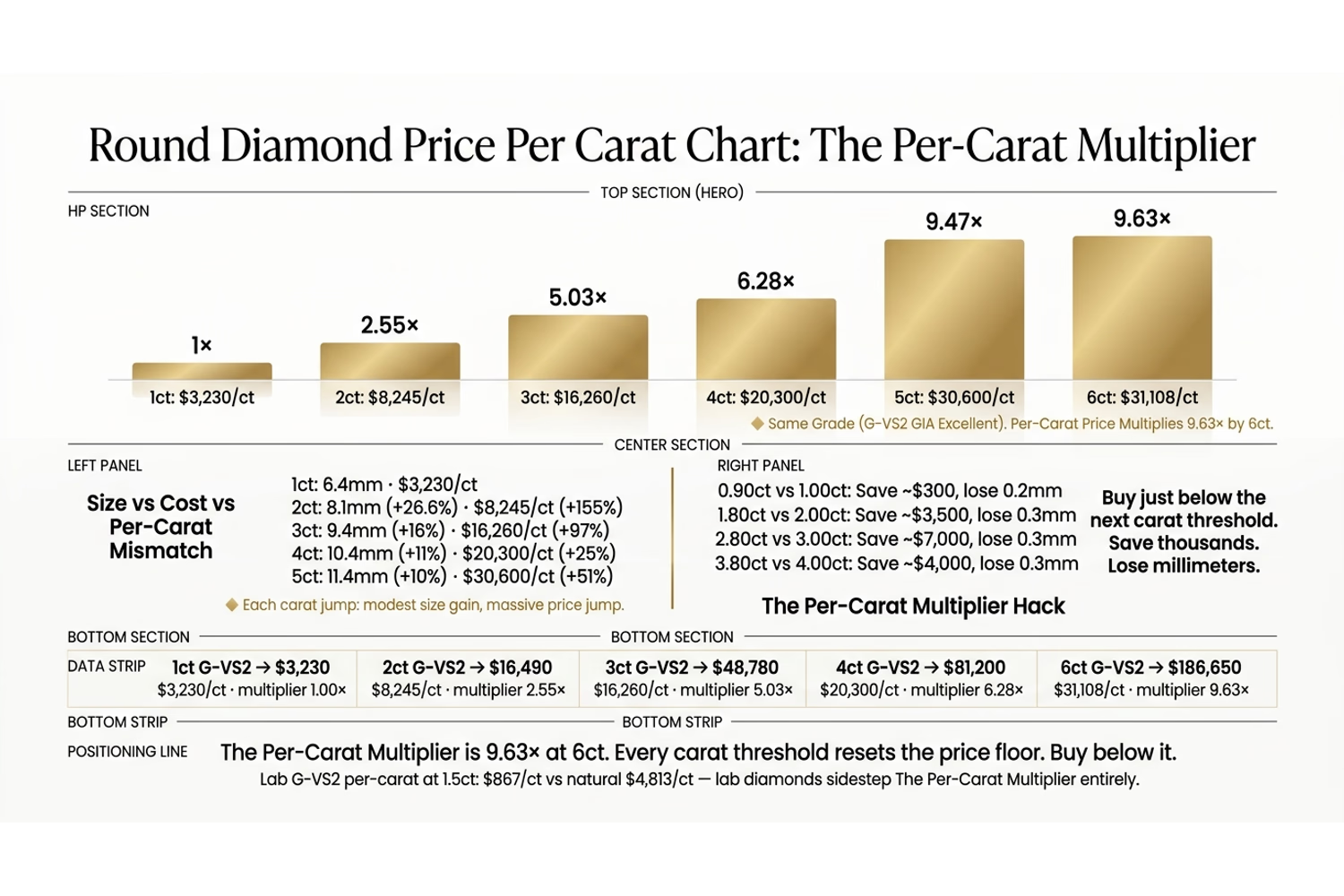
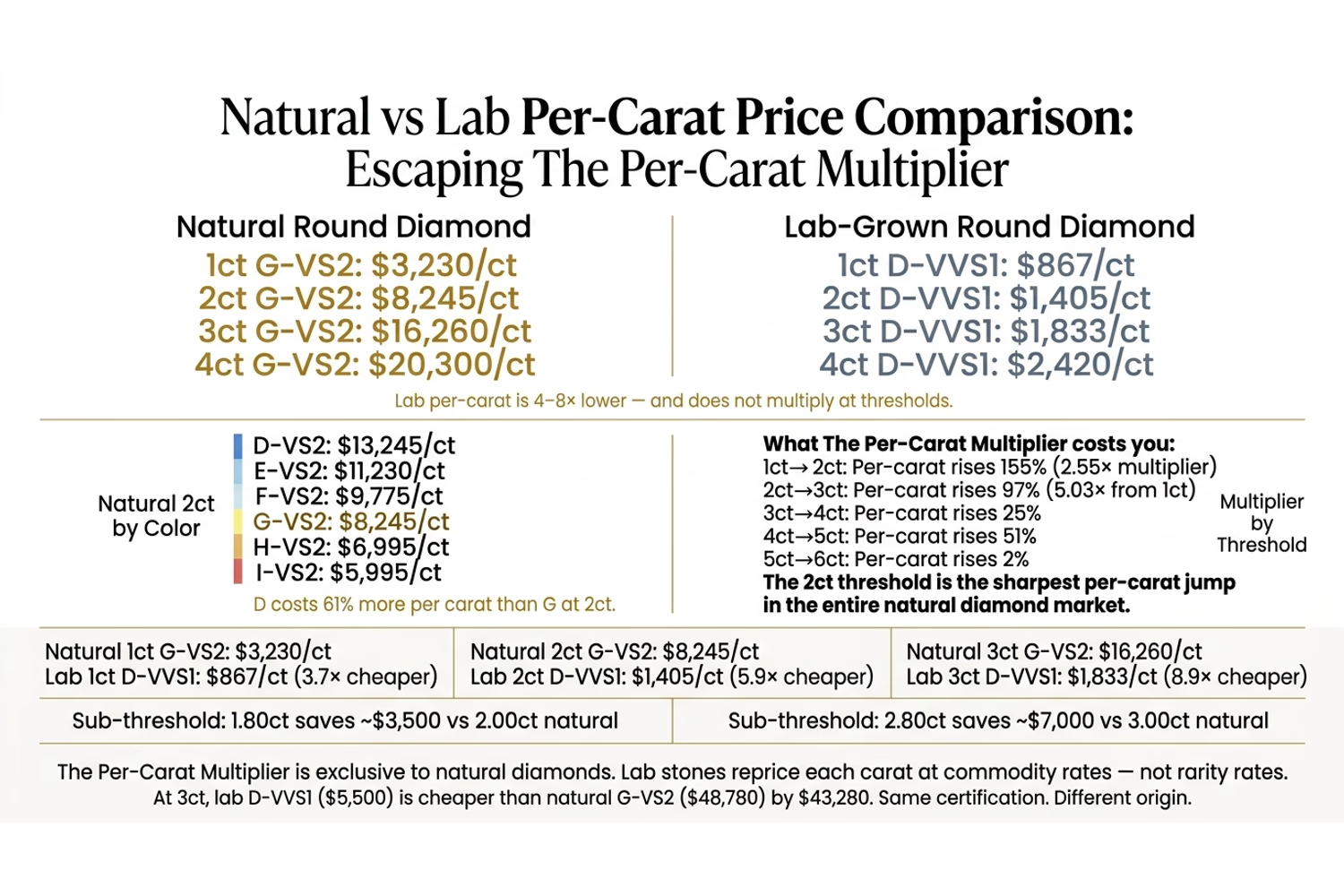
- The Per-Carat Multiplier is Farzana's framework for understanding how per-carat pricing scales exponentially with size: 1ct G-VS2 costs $3,230/ct; 2ct G-VS2 costs $8,245/ct — 2.55× more per carat for a stone that is 60% larger face-up
- At 3ct, the G-VS2 per-carat rate is $16,260/ct — 5.03× the 1ct base — for a stone that is only 35% larger face-up than a 2ct
- The magic size jump at 1ct→2ct is the largest per-carat multiplier step: paying 2ct prices adds $5,015/ct of pure scale premium over the 1ct rate
- Sub-threshold strategy: A 0.90ct round looks nearly identical to a 1.00ct (6.3mm vs 6.5mm) but avoids the 1ct price tier; a 1.80ct looks near-identical to a 2.00ct but saves $2,000–$4,000
- Lab-grown per-carat rates are far flatter: Lab 1.5ct D-VVS1 = $1,300/ct; 4ct D-VVS1 = $2,420/ct — a 1.86× multiplier from 1.5ct to 4ct, versus 6.96× for natural over the same range
- The full G-VS2 per-carat journey: $3,230/ct (1ct) → $8,245/ct (2ct) → $16,260/ct (3ct) → $17,823/ct (4ct) → $31,108/ct (6ct)
Most diamond buyers think in total price, not per-carat price. This is the mistake the industry counts on. A 2ct round diamond that costs $16,490 feels like it costs "only twice" a 1ct at $3,230. But 2ct costs 5.1× what 1ct costs — and the second carat alone costs $13,260 ($16,490 minus $3,230). That second carat is priced at $13,260/ct, not $3,230/ct.
This is The Per-Carat Multiplier: the exponential premium that drives diamond pricing across carat tiers. Understanding it is the single most useful framework for finding value in the round diamond market — because it reveals exactly where you are paying for scarcity premium versus actual stone size, and where buying just below a pricing threshold saves you real money with near-zero visual trade-off.
This guide documents every per-carat rate in the Blue Nile dataset from 1ct to 6ct across natural G-VS2 and lab-grown D-VVS1, the full multiplier math, and the sub-threshold strategy for maximizing visible size per dollar.


Why Diamond Prices Don't Scale Linearly With Carat Weight
Diamond pricing is exponential, not linear, because of supply constraints at each size tier. A 1ct diamond requires rough stone in the 1.5–2.0ct range after yield loss in cutting. A 2ct diamond requires 4–5ct rough after cutting waste. A 3ct diamond may require 8–10ct rough. The percentage of rough diamonds that yield large, clean, well-proportioned finished stones decreases dramatically at each size.
The result is that per-carat price rises with each size tier — not by a fixed amount, but by a compounding multiplier. The GIA describes this as the "rarity premium": each additional carat of finished weight requires disproportionately more rare rough, so the market prices each carat of a larger stone at a higher rate than each carat of a smaller stone of identical quality.
The round brilliant is especially subject to this premium because the cutting process for round brilliants requires good all-around rough — elongated, irregular, or thin rough is better suited to fancy shapes (marquise, pear, oval) that can be cut from rough that would not yield a quality round. Premium round-cut rough is scarcer than fancy-shape rough, compounding the per-carat multiplier for rounds above 2ct.
Round Diamond Price Per Carat Chart: 1ct to 6ct (Blue Nile Data)
G-Color, VS2 Clarity, GIA Excellent Cut — The Standard Reference Tier
| Stone | Weight | Price | Per-Carat Rate | Multiplier vs 1ct Base ($3,230/ct) |
|---|---|---|---|---|
| GIA 1ct G-VS2 Excellent | 1.00ct | $3,230 | $3,230/ct | 1.00× |
| GIA 2ct G-VS2 Excellent | 2.00ct | $16,490 | $8,245/ct | 2.55× |
| GIA 3ct G-VS2 Excellent | 3.00ct | $48,780 | $16,260/ct | 5.03× |
| GIA 4ct G-VS1 Excellent | 4.00ct | $58,110 | $14,528/ct | 4.50× |
| GIA 4ct G-VS2 Excellent | 4.00ct | $71,290 | $17,823/ct | 5.52× |
| GIA 6.03ct G-VS2 Excellent | 6.03ct | $187,650 | $31,108/ct | 9.63× |
| GIA 6.03ct G-VS2 Excellent | 6.03ct | $206,360 | $34,220/ct | 10.59× |
| GIA 6.01ct G-VS1 Excellent | 6.01ct | $198,400 | $33,011/ct | 10.22× |
The Per-Carat Multiplier by step:
| Step | From | To | Per-Carat Rate Change | Stone Size Change |
|---|---|---|---|---|
| 1ct → 2ct | $3,230/ct | $8,245/ct | +$5,015/ct (+155%) | +60% face-up area |
| 2ct → 3ct | $8,245/ct | $16,260/ct | +$8,015/ct (+97%) | +35% face-up area |
| 3ct → 4ct | $16,260/ct | $17,823/ct | +$1,563/ct (+10%) | +24% face-up area |
| 4ct → 6ct | $17,823/ct | $31,108/ct | +$13,285/ct (+75%) | +41% face-up area |
The 3ct → 4ct anomaly: The per-carat rate jump from 3ct to 4ct is only 10% — far smaller than the 155% jump from 1ct to 2ct or the 97% jump from 2ct to 3ct. This makes 4ct one of the relative value points in the round diamond market: you get 24% more face-up area while the per-carat rate increases by only 10%. The 4ct G-VS1 at $58,110 is actually cheaper per carat than the 3ct G-VS2 at $16,260/ct.
Face-Up Size vs Per-Carat Rate: The Visual Value Table
| Carat | Face-Up Diameter | Face-Up Area | Price (G-VS2) | $/mm² of face-up area |
|---|---|---|---|---|
| 1ct | 6.5mm | 33.2 mm² | $3,230 | $97/mm² |
| 2ct | 8.1mm | 51.5 mm² | $16,490 | $320/mm² |
| 3ct | 9.4mm | 69.4 mm² | $48,780 | $703/mm² |
| 4ct | 10.2mm | 81.7 mm² | $71,290 | $873/mm² |
| 6ct | 11.7mm | 107.5 mm² | $187,650 | $1,745/mm² |
Every millimeter of table diameter added to a round brilliant diamond costs increasingly more per square millimeter of visible face-up area. From 1ct to 2ct, face-up area increases by 55% while the cost per mm² increases by 230%. From 2ct to 3ct, face-up area increases by 35% while cost per mm² increases by 120%.
The Magic Size Phenomenon: Where Per-Carat Prices Jump
Diamond pricing has distinct psychological thresholds where per-carat rates increase sharply. The industry calls these "magic sizes." The key transitions in round brilliants:
The 1ct Threshold (0.90ct → 1.00ct): A 0.90ct round is 6.3mm in diameter; a 1.00ct round is 6.5mm — a 0.2mm difference that is essentially invisible to a non-expert eye at arm's length. But crossing from 0.90ct to 1.00ct triggers the 1ct price tier, which carries a significant per-carat premium. A 0.90ct G-VS2 GIA Excellent typically runs $2,200–$2,600; a 1.00ct G-VS2 starts at $3,230. The 0.10ct weight difference produces a $630–$1,030 price difference.
The 1.5ct Threshold (1.40ct → 1.50ct): A 1.40ct round is approximately 7.2mm; a 1.50ct round is approximately 7.4mm — again essentially invisible. But the 1.50ct tier adds a per-carat premium over 1.40ct stones of the same quality. If budget is $6,000–$8,000, a well-cut 1.40ct often represents better per-carat value than a 1.50ct.
The 2ct Threshold (1.80ct → 2.00ct): This is the most significant magic-size jump in the round brilliant market. An 1.80ct round is 7.9mm; a 2.00ct round is 8.1mm — 0.2mm difference. But 2ct carries a per-carat rate of $8,245/ct versus approximately $6,500–$7,000/ct for 1.80ct quality stones. The 0.20ct weight difference produces a $2,000–$4,000 price difference.
The 3ct Threshold (2.80ct → 3.00ct): A 2.80ct round is approximately 9.1mm; a 3.00ct round is approximately 9.4mm. The 3ct pricing tier carries a significant per-carat premium over 2.80ct stones. For buyers with a 3ct budget, a perfectly-cut 2.80ct delivers near-identical visible size with meaningful savings.
Full Multi-Color Per-Carat Comparison at 2ct
Understanding how color affects per-carat rate shows where the compounding happens:
| Stone | Grade | Price | Per-Carat Rate | vs G-VS2 rate ($8,245/ct) |
|---|---|---|---|---|
| GIA 2ct G-VS2 Excellent | G-VS2 | $16,490 | $8,245/ct | Reference |
| GIA 2ct F-VS2 Excellent | F-VS2 | $18,140 | $9,070/ct | +$825/ct |
| GIA 2ct G-VS1 Excellent | G-VS1 | $22,460 | $11,230/ct | +$2,985/ct |
| GIA 2ct E-VS1 Excellent | E-VS1 | $22,660 | $11,330/ct | +$3,085/ct |
| GIA 2ct F-VS1 Excellent | F-VS1 | $26,240 | $13,120/ct | +$4,875/ct |
| GIA 2ct D-VS2 Excellent | D-VS2 | $26,490 | $13,245/ct | +$5,000/ct |
| GIA 2ct G-VVS2 Excellent | G-VVS2 | $26,610 | $13,305/ct | +$5,060/ct |
| GIA 2ct D-VVS1 Excellent | D-VVS1 | $31,370 | $15,685/ct | +$7,440/ct |
| GIA 2ct G-IF Excellent | G-IF | $31,380 | $15,690/ct | +$7,445/ct |
| GIA 2ct D-IF Excellent | D-IF | $49,470 | $24,735/ct | +$16,490/ct |
| GIA 2ct D-FL Excellent | D-FL | $54,840 | $27,420/ct | +$19,175/ct |
The 2ct D-FL at $27,420/ct costs 3.33× the per-carat rate of 2ct G-VS2 at $8,245/ct. Both stones are 8.1mm, optically identical in face-up performance, and indistinguishable to most observers. The per-carat multiplier compounds color + clarity + the 2ct size tier simultaneously.
Tides Of Summer Capsule
Up To 30% Off
Shop The Sale →Vault ClearanceClear The Vault
Up To 70% Off
Shop Vault Deals →Affiliate link — no extra cost to you
Lab-Grown Round Diamond Per-Carat Rates vs Natural
Lab-grown diamonds demonstrate how the per-carat multiplier works when scarcity is removed from the equation:
| Stone | Carat | Grade | Price | Per-Carat Rate | Natural Equivalent | Natural Per-Carat Rate |
|---|---|---|---|---|---|---|
| IGI 1.5ct D-VVS1 Lab | 1.5ct | D-VVS1 | $1,950 | $1,300/ct | — | ~$4,500/ct (est.) |
| IGI 1.5ct D-VVS1 Lab | 1.5ct | D-VVS1 | $1,950 | $1,300/ct | — | — |
| IGI 2ct D-VVS1 Lab | 2ct | D-VVS1 | $2,810 | $1,405/ct | Natural 2ct G-VS2: $16,490 | $8,245/ct |
| IGI 2ct D-VVS1 Lab | 2ct | D-VVS1 | $2,810 | $1,405/ct | — | — |
| IGI 3ct E-VVS1 Lab | 3ct | E-VVS1 | $5,800 | $1,933/ct | Natural 3ct G-VS2: $48,780 | $16,260/ct |
| IGI 4ct D-VVS1 Lab | 4ct | D-VVS1 | $9,680 | $2,420/ct | Natural 4ct G-VS1: $58,110 | $14,528/ct |
The lab multiplier from 1.5ct to 4ct: $1,300/ct → $2,420/ct = 1.86× per-carat increase over the full range. Natural G-VS2 over the same weight range: $3,230/ct (1ct) → $14,528/ct (4ct G-VS1) = 4.50× per-carat increase.
Lab-grown diamonds still experience a per-carat multiplier — larger stones require longer growth cycles and higher-quality rough feedstock. But the multiplier is far flatter than natural because lab growth can be scaled and optimized in ways that mining cannot. The 4ct D-VVS1 lab at $9,680 represents a per-carat rate of $2,420/ct — significantly below even the 1ct natural G-VS2 base rate of $3,230/ct.
The practical comparison: At 4ct D-VVS1, natural costs $58,110 (G-VS1) while lab costs $9,680 — the same stone dimensions (10.2mm), same optical performance, same GIA/IGI Excellent cut. The difference is origin. The $48,430 gap represents The Origin Tax (natural scarcity premium) compounded with The Per-Carat Multiplier at 4ct.
How Color and Clarity Change the Per-Carat Rate
The per-carat rate is not a single number for a given carat weight — it is a range that depends on color and clarity tier. The reference G-VS2 rate represents the midmarket: colorless-near-colorless, reliable eye-clean clarity, GIA Excellent cut. Moving up or down in color/clarity changes the per-carat rate:
| Quality Tier | 1ct Per-Carat Rate | 2ct Per-Carat Rate | 3ct Per-Carat Rate |
|---|---|---|---|
| G-VS2 (midmarket reference) | $3,230/ct | $8,245/ct | $16,260/ct |
| F-VS2 (one color better) | $3,490/ct | $9,070/ct | $23,633/ct (F-VS2 est.) |
| G-VS1 (one clarity better) | $3,300/ct | $11,230/ct | $18,213/ct |
| D-VS2 (top color, mid clarity) | $3,790/ct | $13,245/ct | $24,310/ct |
| D-VVS1 (top color + top clarity) | ~$4,500/ct (est.) | $15,685/ct | ~$28,000/ct (est.) |
| D-FL (absolute top) | N/A available | $27,420/ct | N/A available |
Color and clarity premiums are additive and multiplicative. Moving from G-VS2 to D-VS2 at 2ct adds $5,000/ct ($13,245 vs $8,245). Moving from G-VS2 to G-VVS2 adds $5,060/ct ($13,305 vs $8,245). Moving from G-VS2 to D-VVS2 adds both simultaneously, and the combined premium is larger than either premium alone.
The Sub-Threshold Strategy: 0.90ct, 1.80ct, 2.80ct
The single most reliable value strategy in round diamond purchasing is staying below magic-size thresholds. The visual difference between threshold weights is typically 0.2–0.3mm in diameter — a difference that requires a caliper to measure and is imperceptible in normal wear. The price difference is $1,000–$4,000 depending on the threshold.
Under 1ct strategy: Target 0.90–0.95ct instead of 1.00ct. Face-up diameter: 6.3–6.4mm versus 6.5mm. Visual difference: none at arm's length. Price advantage: $630–$1,030 at G-VS2 quality. A well-cut 0.90ct with GIA Excellent proportions produces identical light performance to a 1.00ct in the same spec.
Under 2ct strategy: Target 1.80–1.90ct instead of 2.00ct. Face-up diameter: 7.9–7.95mm versus 8.1mm. Visual difference: 0.15–0.20mm — invisible in a setting. Price advantage at G-VS2 quality: approximately $2,000–$4,000 below the 2ct tier. A 1.80ct G-VS1 in an 18k gold solitaire looks identical to a 2.00ct G-VS2 in the same setting to any observer without instruments.
Under 3ct strategy: Target 2.80–2.95ct instead of 3.00ct. Face-up diameter: 9.1–9.3mm versus 9.4mm. Visual difference: 0.1–0.3mm. Price advantage: $4,000–$8,000 below the 3ct G-VS2 tier. A 2.85ct D-VS1 GIA Excellent is a statement diamond that avoids the full 3ct per-carat premium while delivering nearly identical visual impact.
Farzana's Verdict:
The Per-Carat Multiplier is the most important pricing concept in diamond buying — and the most underused by buyers who focus on total price rather than what they are paying per carat of visible stone. Understanding it reveals two clear strategies: avoid magic size thresholds (buy 0.90ct instead of 1.00ct, 1.80ct instead of 2.00ct) and recognize that 4ct is a relative value point in the natural market where the per-carat jump from 3ct is only 10%.
For buyers choosing between natural and lab-grown: the lab per-carat multiplier is 1.86× from 1.5ct to 4ct versus 4.50× for natural. That compounding difference is why a lab 4ct D-VVS1 at $9,680 exists in the same market as a natural 4ct G-VS1 at $58,110. Same size, same cut, different origin, different multiplier.
Buy below the threshold. Prioritize cut above all else — a perfectly-cut 0.90ct outperforms a poorly-cut 1.10ct on every visible dimension. The size difference no one can see is worth $1,000–$4,000 of savings on most budgets.
Frequently Asked Questions
What is the price per carat of a round diamond?
At the G-VS2 GIA Excellent reference tier: 1ct = $3,230/ct, 2ct = $8,245/ct, 3ct = $16,260/ct, 4ct = $17,823/ct, 6ct = $31,108/ct. The per-carat rate is not fixed — it scales exponentially with carat weight and also varies with color and clarity.
Why does a 2ct diamond cost more than twice the price of a 1ct?
A 2ct diamond costs 5.1× the price of a comparable 1ct, not 2×. The per-carat rate for 2ct G-VS2 ($8,245/ct) is 2.55× the 1ct rate ($3,230/ct). The premium reflects scarcity — larger diamonds require proportionally more rare rough, and the percentage of rough that yields clean, well-proportioned 2ct+ stones is much lower than for 1ct stones.
What is the cheapest carat weight per visible size in round diamonds?
The 4ct tier offers a relative per-carat value anomaly: the 4ct G-VS1 at $14,528/ct is a lower per-carat rate than the 3ct G-VS2 at $16,260/ct. Among affordable sizes, 1ct offers the best per-carat rate. In lab-grown, the per-carat multiplier is flat enough that 2ct and 3ct offer strong value relative to natural equivalents.
How much does per-carat price increase from 1ct to 2ct?
The per-carat rate increases from $3,230/ct to $8,245/ct — a $5,015/ct increase (155%). This is the largest single per-carat jump in the round diamond market and represents the 2ct magic size premium at G-VS2 reference quality.
Should I buy a 0.90ct or 1ct round diamond?
For most buyers: 0.90ct. The diameter difference is 6.3mm versus 6.5mm — 0.2mm, invisible at arm's length. A well-cut 0.90ct GIA Excellent saves $630–$1,030 versus a 1ct G-VS2 at $3,230. Use the savings for a better color grade (F instead of G) or a better setting.
How much does a 3ct round diamond cost per carat compared to 1ct?
A 3ct G-VS2 GIA Excellent costs $16,260/ct versus $3,230/ct for a 1ct G-VS2 — a 5.03× per-carat multiplier. You pay 5× more per carat for a stone that is only 35% larger face-up than a 2ct. The absolute price is $48,780 for 3ct versus $3,230 for 1ct.
Why is a lab diamond so much cheaper per carat at 4ct?
The IGI 4ct D-VVS1 lab at $9,680 costs $2,420/ct. The natural 4ct G-VS1 costs $14,528/ct. Lab growth removes the scarcity multiplier — larger lab stones require longer growth time but not increasingly rare rough. The per-carat multiplier from 1.5ct to 4ct lab is 1.86× versus 4.50× for natural.
What is the "magic size" for round diamonds?
The main magic sizes are 0.50ct, 1.00ct, 1.50ct, 2.00ct, 3.00ct, and 5.00ct. At each threshold, per-carat pricing jumps because these round numbers carry psychological and retail pricing premiums. Buying 0.90ct instead of 1.00ct, or 1.80ct instead of 2.00ct, avoids the threshold premium with near-invisible size difference.
How do I calculate per-carat rate for a diamond?
Divide the total price by the carat weight. A $16,490 diamond at 2.00ct = $16,490 ÷ 2.00 = $8,245/ct. Compare this to the reference rate for the same quality tier at that carat weight to judge whether a specific stone is priced at, above, or below market.
Does the per-carat rate change with color and clarity grade?
Yes. At 2ct, per-carat rates range from $8,245/ct (G-VS2) to $27,420/ct (D-FL). Color and clarity premiums compound with the size multiplier — the D-FL rate is 3.33× the G-VS2 rate at 2ct, but only approximately 2.5× at 1ct. The size multiplier amplifies color and clarity premiums at larger carat weights.
Is the per-carat rate higher at 3ct than at 4ct?
Yes — for the specific G-tier comparison: 3ct G-VS2 costs $16,260/ct while 4ct G-VS1 costs $14,528/ct. The 3ct to 4ct per-carat jump is only +10%, making 4ct a relative value tier versus 3ct. This anomaly reflects the specific available inventory on Blue Nile and the individual stone pricing within each carat tier.
What is the best carat weight to buy a round diamond for value?
For natural diamonds: 0.90ct (below the 1ct threshold) and 4ct (relatively flat per-carat jump from 3ct) offer the best relative value. For lab-grown: any size offers strong value because the per-carat multiplier is far flatter — the IGI 4ct D-VVS1 lab at $9,680 costs less per carat than the 1ct natural G-VS2 baseline.
See Also
- 1 Carat Round Diamond Price — the 1ct tier entry with full Blue Nile inventory
- 2 Carat Round Diamond Price — the 2ct threshold where The Per-Carat Multiplier jumps most sharply
- 3 Carat Round Diamond Price — the luxury tier and its per-carat implications
- 4 Carat Round Diamond Price — the 4ct anomaly: lower per-carat rate than 3ct in some cases
- Round Diamond Under $5,000 — the best value plays at the 1ct tier
- Round Diamond Under $10,000 — what the per-carat multiplier means for $10K budgets
- Round Diamond Natural vs Lab — how lab-grown diamonds eliminate most of the per-carat multiplier
- Round Diamond 1 Carat vs 2 Carat — the specific size jump tax between the two most common tiers
Expert Verdict
Always audit the stone individually — no grade replaces seeing the actual diamond. The certificate tells you what to look for. Your eyes tell you whether to buy.
— Farzana Hasan, GIA Expert · DiamondCritics.com