Round Diamond SI1 Clarity — Is It Eye-Clean in 2026? The 70% Rule Explained
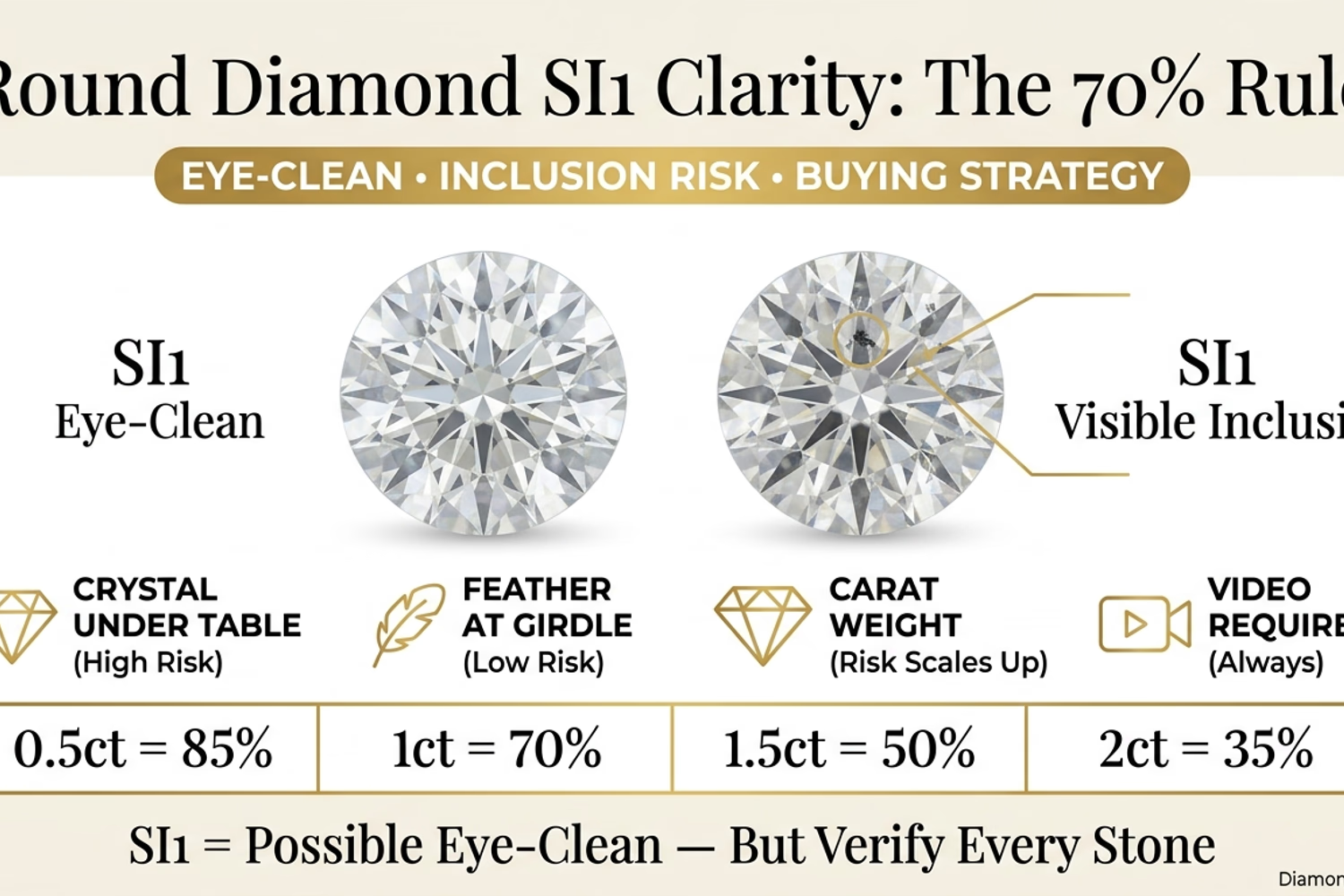
TL;DR: Round Diamond SI1 — Key Facts
- SI1 at 1ct: roughly 70% of stones are eye-clean — inclusions are not visible with the naked eye at normal viewing distance
- The remaining 30% of SI1 rounds at 1ct show visible inclusions — the difference is inclusion type and location
- SI1 round diamonds at 1ct start at approximately $2,680 vs $3,230 for VS2 — saving $330–$630
- The SI1 Roulette: buying SI1 without HD video is gambling. The grade allows both clean and visibly included stones
- At 1.5ct+, SI1 becomes less reliable — require video confirmation for any SI1 stone above 1ct
- At 2ct+, SI1 often shows inclusions — VS2 is the minimum recommendation without specific video confirmation
- Never buy SI1 without watching Blue Nile HD video of the specific stone face-up at normal viewing distance
Buyers who discover SI1 clarity frequently ask the same question: is this grade safe? The honest answer is: sometimes yes, sometimes no — and the difference between those two outcomes is worth understanding before you spend $2,600 on a stone.
This guide gives you the SI1 Roulette framework: the inclusion types that make an SI1 eye-clean, the types that make it visible, how to screen stones using Blue Nile's HD video, and exactly when the $330–$630 savings over VS2 is worth taking.


What Is SI1 Clarity for a Round Diamond?
SI1 stands for Slightly Included 1 — the first of two SI grades on the GIA scale (SI1, SI2). At SI1, inclusions are noticeable under 10x magnification but are supposed to be difficult to see with the naked eye.
The problem: "difficult to see" is not the same as "invisible." GIA's SI1 definition permits inclusions that a trained grader would notice face-up without magnification under certain conditions. In everyday lighting conditions — natural light, indoor ambient light, candlelight — some SI1 stones are fully invisible, and some are not.
The GIA Clarity Scale at a glance:
| Grade | Description | 10x visible? | Naked eye at 1ct? |
|---|---|---|---|
| FL/IF | Flawless/Internally Flawless | No | No |
| VVS1–VVS2 | Very Very Slightly Included | Yes, barely | No |
| VS1–VS2 | Very Slightly Included | Yes | No |
| SI1 | Slightly Included 1 | Yes, easily | Sometimes |
| SI2 | Slightly Included 2 | Yes, easily | Often yes |
| I1–I3 | Included | Yes | Yes, always |
SI1 sits at the boundary. The grade's wide tolerance is what creates the buying problem.
The SI1 Roulette: Why the Same Grade Looks Different
The SI1 Roulette is the situation where two diamonds at the identical SI1 clarity grade look completely different face-up — one perfectly clean, one visibly included — because GIA's grading system evaluates inclusion severity and type, not purely what the eye sees without magnification.
The outcome depends on three factors:
What Type of Inclusion Does the Stone Have?
Inclusions that hide well in SI1 rounds:
- Needles: thin elongated crystals, often transparent, easy to miss face-up
- Pinpoints: tiny dots individually invisible; problematic only when grouped as a cloud
- Feathers at the girdle edge: fractures near the edge, hidden by the setting and girdle facets
- Faint clouds: low-density groupings of tiny crystals that are transparent under magnification
Inclusions that show in SI1 rounds:
- Feathers under the table: fractures under the main facet are visible when light hits them directly
- Crystals under the table: dark or colored mineral crystals under the center are the most visible inclusion type in any cut
- Chips: damage at the girdle, often permanent and visible
- Dense clouds: high-density crystal groupings that appear as a visible hazy patch
Where Is the Inclusion Located?
A crystal at the edge of the stone, hidden under a prong in a four-prong solitaire, is invisible. The same crystal under the center of the table facet is visible at arm's length. Location changes everything.
Location risk map (1ct round):
| Location | Visibility risk | Notes |
|---|---|---|
| Under center table | High | Always check this position in video |
| Mid-table | Medium | Check for crystal type and color |
| Near girdle | Low | Often hidden by setting |
| Under future prong | None | Will be covered in mounting |
| Pavilion | Low–medium | Light return can mask it |
How Many Inclusions Are There?
A single small crystal at the edge is very different from a scattered cluster of SI1-grade needles across the table. The GIA grade reflects severity, not number — a stone can have many minor features summing to SI1.
The 70% Rule: What It Actually Means
When diamond educators say "70% of SI1 rounds are eye-clean at 1ct," the statistic reflects the practical outcome — not a GIA guarantee. The exact percentage varies by study and sample, but the directional truth holds: most SI1 rounds at 1ct pass an unaided eye inspection in normal light.
What the 70% means in practice:
| Carat weight | SI1 eye-clean rate | VS2 eye-clean rate |
|---|---|---|
| 0.50ct | ~85% | 99%+ |
| 1.00ct | ~70% | 99%+ |
| 1.25ct | ~60% | 99%+ |
| 1.50ct | ~50% | 99%+ |
| 2.00ct | ~35% | 99%+ |
| 3.00ct+ | ~20% | 95%+ |
At 1ct, taking an SI1 without video review is accepting 30% odds of a visibly included stone. At 2ct, SI1 becomes a coin flip. At 3ct+, most SI1 stones show inclusions.
This is why the SI1 recommendation changes with carat weight: the same grade produces a different distribution of visible vs invisible outcomes as the stone gets larger.
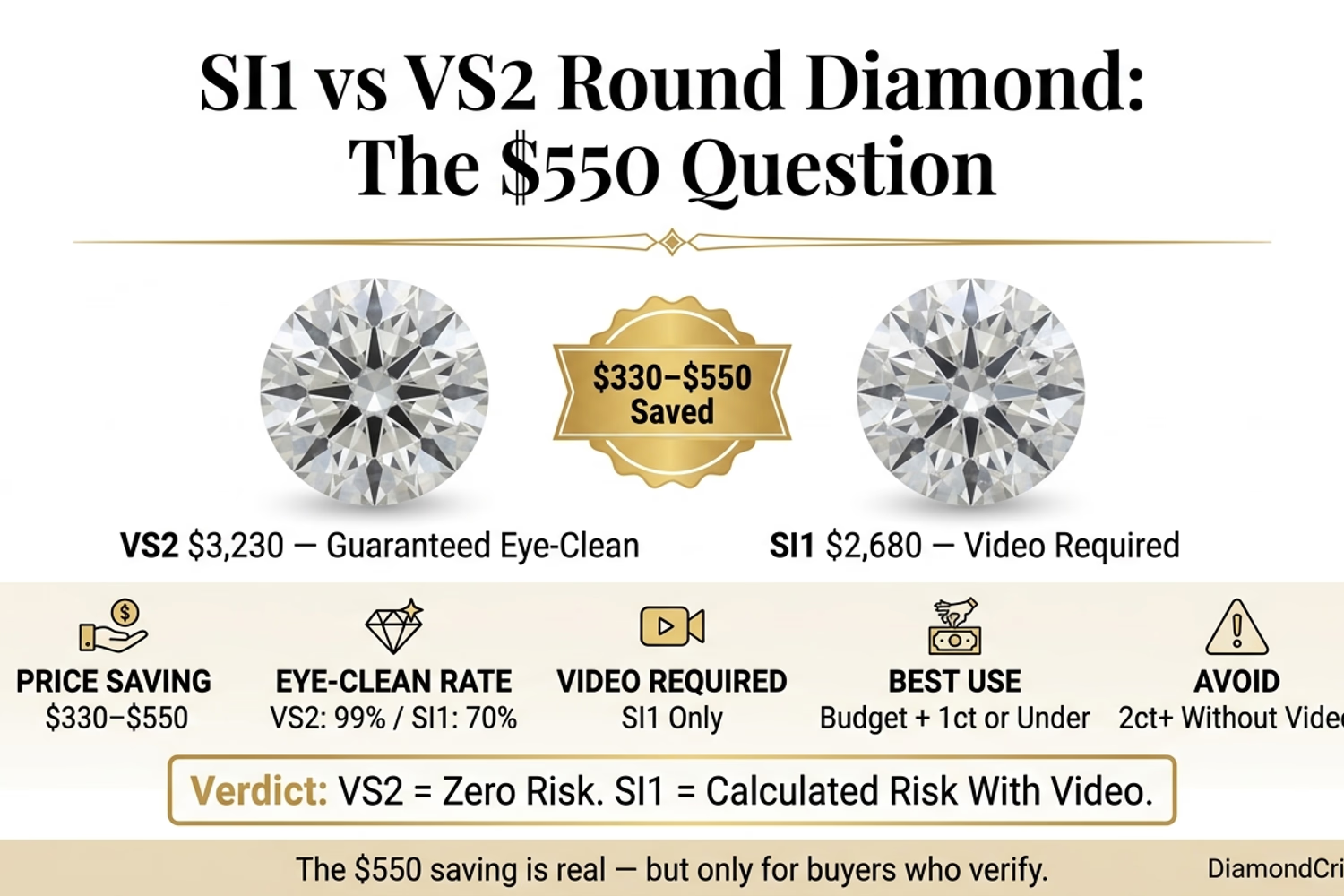
SI1 vs VS2 Price Comparison: Is the Saving Worth It?
At 1ct G GIA Excellent on Blue Nile:
| Clarity | Starting price | vs VS2 saving | Eye-clean rate | Risk |
|---|---|---|---|---|
| VS2 | $3,230 | Reference | 99%+ | None |
| VS1 | $3,300 | −$70 | 99%+ | None |
| SI1 | ~$2,680–$2,900 | +$330–$550 | ~70% | Requires video |
| SI2 | ~$2,200–$2,500 | +$730–$1,030 | ~40% | High risk |
The SI1 saving at 1ct is $330–$550. That is real money. For a buyer who watches HD video and selects carefully, it is a legitimate saving. For a buyer who skips video and buys on grade alone, it is gambling.
The VS2 saving over VS1 is only $70 at the starting price — VS2 and VS1 are much closer in price than most buyers expect.
How to Screen SI1 Stones on Blue Nile
Blue Nile provides HD video on most diamonds. Here is the exact process for safely buying SI1:
Step 1: Filter for GIA Excellent Cut and G–H Color
Reduce variables. Cut grade affects how well inclusions are masked — GIA Excellent cut scatters light more aggressively, helping to hide minor inclusions. Set GIA Excellent cut as a non-negotiable filter before looking at clarity.
Step 2: Watch the Video Face-Up, Not at an Angle
The face-up view at arm's length is how you wear a ring. Look at the stone straight down through the table, not tilted. If you see any dark spot, white milky patch, or reflective flash in the center, that is an inclusion showing.
Step 3: Check the GIA Certificate Clarity Plot
The GIA certificate includes a clarity diagram plotting where each inclusion sits. Red symbols = internal inclusions; green symbols = external blemishes. Look for:
- Any symbol under the center circle of the table diagram
- Multiple symbols clustered in the same area
- Feather (noted as "Ftr") symbols anywhere central
If the plot shows inclusions clustered at the girdle edge or evenly spread at a fine level, the stone is likely eye-clean. If any symbol sits under the table center, require more video scrutiny.
Step 4: Check for Fluorescence as a Bonus
Strong blue fluorescence can make an SI1 stone appear slightly milky (hazy) under some lighting but makes the stone look whiter in UV-heavy outdoor light. For SI1, medium blue fluorescence is neutral — it is neither a problem nor a solution to inclusion visibility.
Step 5: Search the 0.90–0.99ct Range
A 0.97ct G-SI1 GIA Excellent looks identical to a 1.00ct but costs 8–12% less on top of the SI1 saving. Combining under-carat-weight and SI1 can yield $400–$700 in total savings vs a 1.00ct G-VS2 — if the stone passes video review.
Search SI1 Round Diamonds on Blue Nile
Tides Of Summer Capsule
Up To 30% Off
Shop The Sale →Vault ClearanceClear The Vault
Up To 70% Off
Shop Vault Deals →Affiliate link — no extra cost to you
When SI1 Is the Right Choice
SI1 is appropriate when:
- You watch HD video and confirm the stone is eye-clean at face-up view
- Budget is tight and $300–$600 represents meaningful reallocation toward carat size
- Stone is 1ct or under — where the 70% eye-clean rate makes it a reasonable bet with verification
- You are buying in a yellow or rose gold setting, where the warm metal further masks body color and minor inclusions
SI1 is not appropriate when:
- You are buying a stone larger than 1.5ct without confirmed video
- You cannot access HD video for the specific stone
- The stone is an emerald, Asscher, or other step-cut (these show inclusions dramatically more than rounds)
- You want zero risk of visible inclusions — buy VS2
SI1 at Different Carat Weights: The Scaling Problem
SI1 at 0.50ct–0.90ct
At half-carat sizes, SI1 is nearly always eye-clean. The smaller table surface means inclusions need to be substantial to be visible. SI1 at 0.70ct is a very low-risk buy even without video.
SI1 at 1.00ct
The standard threshold where video review becomes essential. 70% clean, 30% visible. Watch the video.
SI1 at 1.50ct
At 1.5ct, SI1 drops to approximately 50% eye-clean. You are flipping a coin without video. VS2 at 1.5ct starts at approximately $8,430 (natural) or $1,950 (lab D-VVS1 — at this size, just buy lab-grown and get superior grades).
SI1 at 2.00ct
SI1 at 2ct is a high-risk grade. A 2ct G-VS2 GIA Excellent starts at $16,490. Do not compromise to SI1 at this size unless you have video proof of a specific eye-clean stone. The 2ct SI1 saving is approximately $2,000–$3,500 — real but not worth the risk of a visible inclusion in a $14,000+ stone.
Lab-Grown SI1 at 1ct: Ignore This Grade Entirely
For lab-grown round diamonds, SI1 is irrelevant. Lab-grown 2ct D-VVS1 IGI Ideal starts at $2,810 — that is a significantly larger, better-graded stone than a 1ct G-SI1 natural, at a lower or similar price. Any lab-grown buyer considering SI1 should simply buy a larger stone at VVS1 or better. The grade premium that makes SI1 appealing in natural diamonds does not exist in lab-grown.
Farzana's Verdict: The SI1 grade is not automatically dangerous — it is contextually risky. At 1ct with HD video verification, SI1 can be a smart $330–$550 saving. Without video, it is a 30% chance of a visibly included stone, which is not a bet I would take at $2,700. My rule: SI1 only with video, only at 1ct or below, and only after checking the GIA plot for central inclusions. If you are buying 1.5ct or larger, stop looking at SI1 — buy VS2 and spend the difference on cut. A 1.5ct GIA Excellent G-VS2 at $8,430 delivers a better diamond in every way that matters than a 1.5ct GIA Excellent G-SI1 of ambiguous eye-cleanliness.
Frequently Asked Questions
Is SI1 clarity eye-clean for a round diamond?
About 70% of SI1 round diamonds at 1ct are eye-clean — inclusions are not visible to the naked eye at normal viewing distance. The remaining 30% show visible inclusions. The difference is inclusion type and location. Always watch HD video before buying SI1.
What is the difference between VS2 and SI1 for a round diamond?
VS2 is reliably eye-clean for all round brilliants at all carat weights. SI1 is eye-clean for most stones at 1ct but not all. The price difference is $330–$630 at 1ct — worth it only if you verify the specific stone via HD video.
Can you see inclusions in a SI1 round diamond?
Sometimes. At 1ct, approximately 30% of SI1 rounds show inclusions to the naked eye. Crystals and feathers under the table are visible; needles and pinpoints at the girdle are usually not. The certificate clarity plot shows where inclusions sit.
Is SI1 or VS2 better for a round diamond?
VS2 is better for buyers who want guaranteed eye-clean clarity without having to verify each stone. SI1 is acceptable for budget-conscious buyers who watch HD video and confirm the specific stone is clean. If you cannot see HD video, buy VS2.
What makes a SI1 diamond eye-clean?
Three factors: inclusion type (needles and pinpoints hide better than crystals and feathers), inclusion location (edge and girdle inclusions hide better than center-table inclusions), and stone size (smaller stones hide inclusions better than larger ones).
Is SI1 a bad diamond?
No. SI1 is a legitimate clarity grade that produces beautiful diamonds when selected correctly. Roughly 70% of 1ct SI1 rounds are eye-clean. The grade is "bad" only when buyers skip video verification and purchase a stone in the visible 30%.
What clarity should I buy for a 1ct round diamond?
VS2 is the standard recommendation — reliably eye-clean with no need for video verification. SI1 is acceptable if you verify via HD video. VS1 adds cost without visible improvement. VVS2 is unnecessary for any 1ct round diamond.
Is SI1 clarity good enough for an engagement ring?
Yes, for a 1ct round diamond purchased after video verification. If the stone is eye-clean on video at normal distance, it will be eye-clean in person and in the ring. No one will ever see the inclusion without magnification.
How much cheaper is SI1 than VS2 for a 1ct round diamond?
SI1 at 1ct G GIA Excellent costs approximately $2,680–$2,900 vs VS2 at $3,230 — saving $330–$550. The saving is real but requires video verification to confirm the specific stone is eye-clean.
Can a jeweler tell if a diamond is SI1?
Yes — under 10x magnification. A jeweler inspecting the stone will see the SI1 inclusions immediately under loupe. But this does not affect how the diamond looks in the ring, where no loupe is present.
Does SI1 affect diamond sparkle?
Not directly. SI1 inclusions at the standard grade size do not meaningfully reduce light return in a round brilliant. The 57-facet arrangement scatters light so aggressively that minor inclusions are optically masked. SI1 and VS2 stones of identical cut grade will sparkle identically.
What is SI2 clarity for a round diamond?
SI2 is the grade below SI1. At 1ct, SI2 inclusions are often visible to the naked eye without magnification. SI2 is not recommended for any round diamond purchase without confirmed video of a specific eye-clean stone. The eye-clean rate at SI2 for 1ct rounds is approximately 40%.
See Also
Expert Verdict
Always audit the stone individually — no grade replaces seeing the actual diamond. The certificate tells you what to look for. Your eyes tell you whether to buy.
— Farzana Hasan, GIA Expert · DiamondCritics.com