Princess Cut Diamond Fluorescence: The Chevron Fluorescence Effect
Fluorescence in a round brilliant diamond follows well-documented rules. G-H Strong Blue gives you a 15–25% discount and a color appearance boost in sunlight. D-F Strong Blue is riskier — about 10% of stones develop visible haziness. These rules are solid, widely cited, and consistently observed. They also don't transfer directly to princess cut diamonds without adjustment.
Princess cut fluorescence operates under different optical physics. The chevron facet pattern that gives the princess cut its distinctive X-pattern face-up does not distribute fluorescent emission the way 57 radial facets do. The chevron architecture creates directional fluorescence channels that concentrate glow along diagonal lines toward the four corners of the stone. This is the Chevron Fluorescence Effect — the reason the fluorescence rules on every general diamond guide need recalibration for this specific shape.
The core buyer implication: G-H color with Medium Blue fluorescence in a princess cut is the highest-value combination in the shape. D-F color with Strong or Very Strong Blue is more dangerous in princess than in round — not less. And the setting metal amplifies or softens the fluorescence interaction in ways the round diamond guides don't address. This post covers all of it with real Blue Nile data and grade-by-grade verdicts.
TL;DR — Princess Cut Diamond Fluorescence 2026
- The Chevron Fluorescence Effect: Princess cut chevron facets create directional fluorescence pathways that terminate at the four corners, concentrating glow unevenly vs the uniform emission of round brilliant radial facets. Same grade letter. Completely different optical behavior.
- G-H Medium Blue is the best play: You get two simultaneous discounts — the shape discount (princess already cheaper than equivalent round) plus 5–10% for Medium Blue fluorescence. The color whitening in sunlight is real and concentrates where it matters most: at the corners and facet lines.
- D-F + Strong Blue is more dangerous in princess than round: In round, over-fluorescence milkiness disperses across 57 facets evenly. In princess, chevron channels concentrate it at corners, creating visible corner hot spots in 10–15% of D-F Strong Blue stones.
- The Double Discount Window: G-H princess already trades at 20–25% below equivalent round. Add Medium Blue and you get another 5–10% off. Combined, you are accessing G-H color at 25–35% below what a comparable round-with-None-fluorescence would cost — for equal or better face-up appearance.
- I-J + Very Strong Blue is underused: The largest absolute saving in the shape. Very Strong Blue whitening shifts I-J color appearance toward G-H. Combined with the princess shape discount and the I-J color discount, this is the highest face-up value per dollar in the entire category.
- Contrarian truth: The market discounts fluorescence uniformly regardless of whether it benefits the stone. In G-H-I color princess cuts, this discount is irrational and creates a genuine buying opportunity. The Chevron Fluorescence Effect is your analytical edge over buyers who avoid fluorescence out of habit. See the Color-Fluorescence Decision Matrix below.


Why Fluorescence Behaves Differently in Princess Cut vs Round
Round brilliant diamonds have 57 or 58 facets arranged in concentric radial rows from the table outward. These facets are symmetrically distributed around the vertical axis. Fluorescent emission induced by UV radiation passes through this symmetric arrangement and exits in a diffuse, even pattern across the entire face-up surface. No single area of the stone dominates the fluorescence output.
Princess cut diamonds have a fundamentally different crown architecture. The crown facets — the chevron rows above the girdle — run diagonally from the table edge toward the four corners. Depending on whether the stone has a 2-row or 4-row chevron pattern, these diagonal facets channel light along specific geometric pathways. Fluorescence induced in the crystal exits preferentially along the chevron paths, creating concentrated emission lines that converge at the corners.
The practical consequence is that fluorescence in a princess cut is not evenly distributed face-up. A round brilliant with Strong Blue looks uniformly blue under UV. A princess cut with Strong Blue shows differential intensity — brighter along the chevron lines and brightest at the corner focal points. This is the Chevron Fluorescence Effect. It has two distinct buyer implications depending on the color grade, and it is why you cannot transfer the round diamond fluorescence playbook to princess cut without modification. The Princess Cut Diamond Cut Quality Guide covers the chevron facet architecture in detail.
The Chevron Fluorescence Effect — How Princess Facets Concentrate the Glow
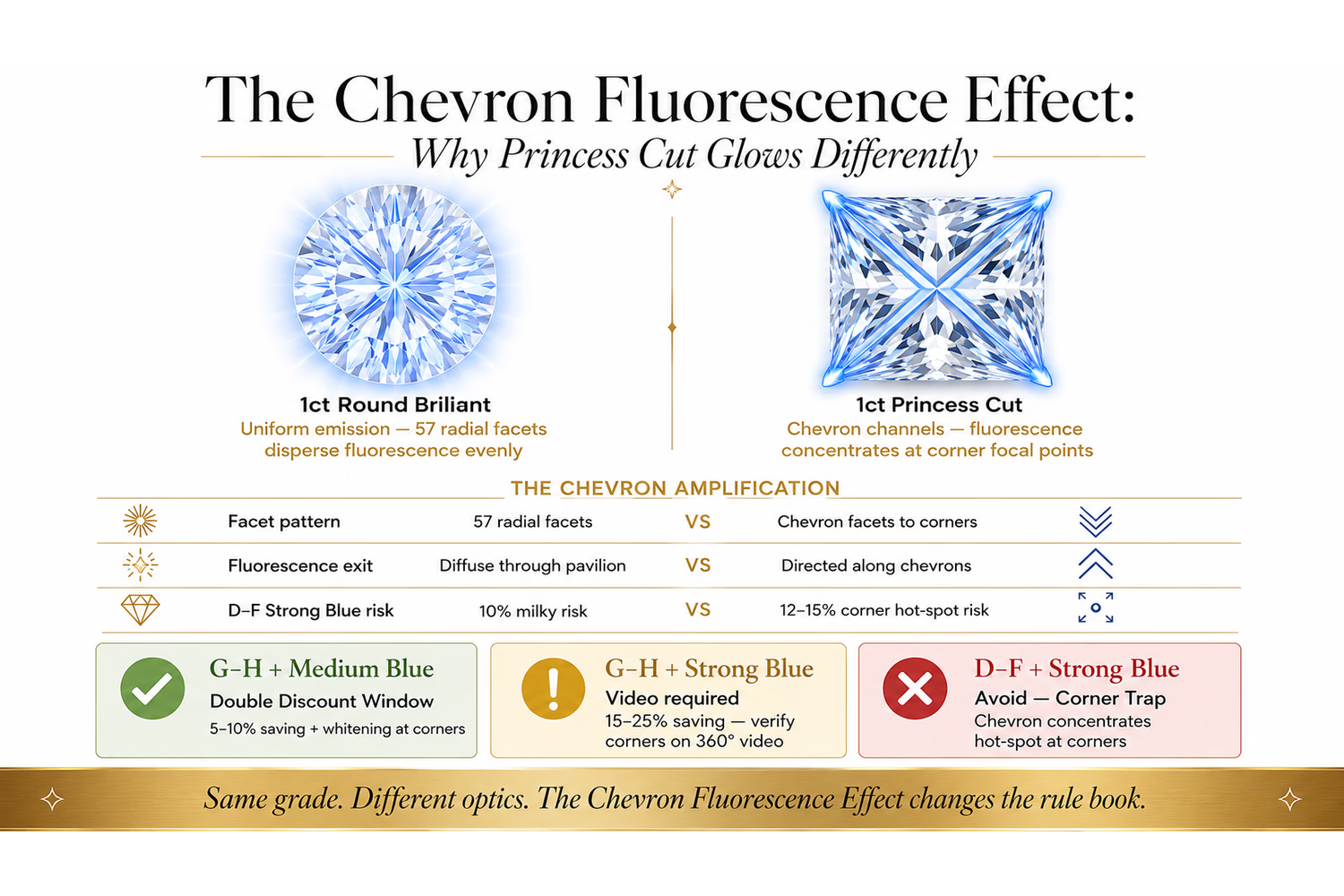
Let me break the Chevron Fluorescence Effect down at a mechanical level, because understanding it will change how you evaluate any GIA report fluorescence grade for princess cut.
Facet geometry: A princess cut crown typically has 1–4 chevron rows. The 2-row pattern creates longer diagonal facets with fewer internal reflection events between the table edge and the corner. The 4-row pattern creates shorter chevron segments with more reflection events. The 2-row configuration concentrates fluorescence more severely — fewer boundary crossings mean less scattering of the UV-induced emission, so it arrives at the corner with more intensity intact.
The emission pathway: When UV light enters through the table, it induces fluorescent emission throughout the crystal volume. In a round brilliant, fluorescent photons have equal probability of exiting through any facet. In a princess chevron pattern, the shallow diagonal angles of the crown facets relative to the optical axis preferentially direct emission along the chevron pathways to the corner — where the geometry creates a high-exit-probability focal zone.
The visual result face-up: Under UV illumination, a fluorescent princess cut shows brighter corners than center. Under natural daylight with a UV component (which most daylight contains), this translates to a whitening effect most pronounced at the corners and chevron lines — exactly where the L:W ratio and corner sharpness are most visually prominent. For G-H stones, this concentrates the whitening at the most visible points. For D-F stones, it concentrates an unwanted blue cast at the same visible points.
The 10–15% haziness amplification: Over-fluorescence occurs when microscopic internal features scatter UV-induced emission rather than letting it exit as clean glow. In round brilliants, this creates a diffuse milky film across the whole face. In princess cut, the chevron channels concentrate scattered emission at corners — making even mild over-fluorescence visible where the stone's geometry already focuses your attention. This raises the haziness risk for D-F princess Strong Blue stones from the round diamond's 10% to approximately 12–15%.
The Chevron Fluorescence Effect is why I treat princess cut fluorescence as a separate analytical category from round. It's not more or less desirable overall — it's directionally different, which changes the color-grade-specific rules.
Grade-by-Grade: What Each Fluorescence Level Means in Princess Cut
None Fluorescence
No glow under UV. The stone performs identically across all lighting conditions. The fluorescence-free premium applies equally to princess and round.
None is the correct answer for D-F colorless princess cuts without exception. The Chevron Fluorescence Effect makes even Medium fluorescence a visual risk in colorless stones — the corner concentration in a truly colorless stone creates a visible blue tint where there is no warmth to counteract. If you are spending the premium for D-F color in a princess cut, buy None and eliminate the variable entirely.
For G-H color, None is safe but leaves value on the table. You are paying fluorescence-free prices when Medium Blue would deliver equal or better face-up appearance at 5–10% less.
Faint Fluorescence
Trace glow visible only under a UV lamp in a dark room, invisible in normal wearing conditions. Faint fluorescence carries a 1–3% discount in princess cut as in round.
Accept Faint at any princess cut color grade without analysis. The Chevron Fluorescence Effect at Faint intensity is imperceptible in normal conditions — the corner concentration doesn't reach visible threshold. The 1–3% saving is real; the risk is zero.
Medium Blue Fluorescence
Clear glow under UV but not color-dominating. In G-H princess cuts, Medium Blue fluorescence is the optimal combination in the shape — the centerpiece of the Double Discount Window.
The whitening effect in daylight follows the Chevron Fluorescence Effect: it concentrates at the chevron lines and corners, which is exactly where warmth in G-H color is most visible. A G color princess with Medium Blue can appear F color in outdoor light. H with Medium Blue can appear G. The 5–10% discount vs None equivalents makes this a high-confidence value play.
In D-F princess cuts, Medium Blue is a monitoring situation. It is not the same risk as Strong Blue, but D-F color with any blue fluorescence should be verified via 360° video in simulated daylight before buying. The whitening benefit is irrelevant in a colorless stone — there is no warmth to counteract — and the corner concentration risk is present even at Medium intensity.
Strong Blue Fluorescence
Strong Blue is where the most significant discounts live and where the most important decisions need to be made in princess cut — and where the round diamond playbook diverges most clearly from princess rules.
For G-H princess, Strong Blue is viable with video verification. The 15–25% discount is meaningful. On a 1ct G-VS2 Ideal princess at $2,212, Strong Blue saves an estimated $330–$550 over the None equivalent. The whitening in sunlight is pronounced and concentrates at the corners per the Chevron Fluorescence Effect — aesthetically flattering for G-H stones. The risk: 10–15% of Strong Blue princess diamonds show corner haziness rather than attractive corner glow. Request 360° HD video. Review the corner areas specifically under simulated daylight. Clear, bright corners with no blue cast = accept. Soft or hazy corners = decline.
For D-F princess, avoid Strong Blue. This is a harder rule than I apply to round diamonds. In round, I accept D-F Strong Blue with excellent video verification because over-fluorescence disperses across 57 facets. In princess, the Chevron Fluorescence Effect concentrates corner emission in a zone where the optical focal points already draw the eye. Even on well-proportioned D-F stones with excellent video, the corner hot spot risk is not worth the discount.
Very Strong Blue Fluorescence
Maximum GIA fluorescence grade. Discounts of 20–30% vs None equivalents. Over-fluorescence risk rises to approximately 15–20%.
G-H princess in yellow gold: accept with video. Princess cut yellow gold engagement rings benefit from the yellow metal color masking; combined with Very Strong Blue whitening, the result for G-H stones in sunlight is exceptionally clean. Not recommended for platinum or white gold settings where the corner Chevron Effect is fully exposed.
I-J princess: this is the best value play in the shape. I color princess already carries a meaningful discount vs G-H. Very Strong Blue whitening in daylight can shift I-J face-up appearance toward H-G. The combination of shape discount, I-J color discount, and Very Strong Blue discount creates the lowest-cost path to a visually clean face-up princess cut. Most relevant for buyers in the princess cut under-$3,000 category.
D-F princess: never. The corner concentration at Very Strong intensity creates visible blue hot spots that compromise the colorless premium you paid for.
The Double Discount Window — Why G-H Medium Blue Is the Smart Buy
The Double Discount Window is the value opportunity that exists specifically at the intersection of princess cut shape and G-H color with Medium or Strong Blue fluorescence. Two independent pricing discounts apply simultaneously to the same stone.
Discount layer 1 — the shape: Princess cut diamonds trade at 20–25% below equivalent round brilliants at the same carat, color, and clarity. A 1ct G-VS1 GIA Ideal princess at $2,536 compares to a 1ct G-VS1 GIA Excellent round at approximately $3,200 — a $664 shape discount. The Princess Cut Diamond Size Chart shows the Phantom Carat Effect explains some of the size trade-off.
Discount layer 2 — the fluorescence: A G-VS1 Ideal princess with Medium Blue fluorescence will carry an additional 5–10% off the None equivalent — saving roughly $125–$250 more. Strong Blue adds 15–25%, saving an estimated $380–$635 over the None equivalent.
The combined result: A G-H princess with Medium Blue costs approximately 25–35% below a comparable G-H round with None fluorescence — for a stone that can appear equally white in most lighting and demonstrably whiter in sunlight due to the Chevron Fluorescence Effect directing the whitening to the most visible corner zones. This is the Double Discount Window.
The only requirement: 360° video access. Blue Nile's princess cut search provides 360° video for all stones and links to GIA verification for fluorescence grade confirmation. The verification takes five minutes and unlocks the most consistent value opportunity in the shape.
The Color-Fluorescence Decision Matrix for Princess Cut
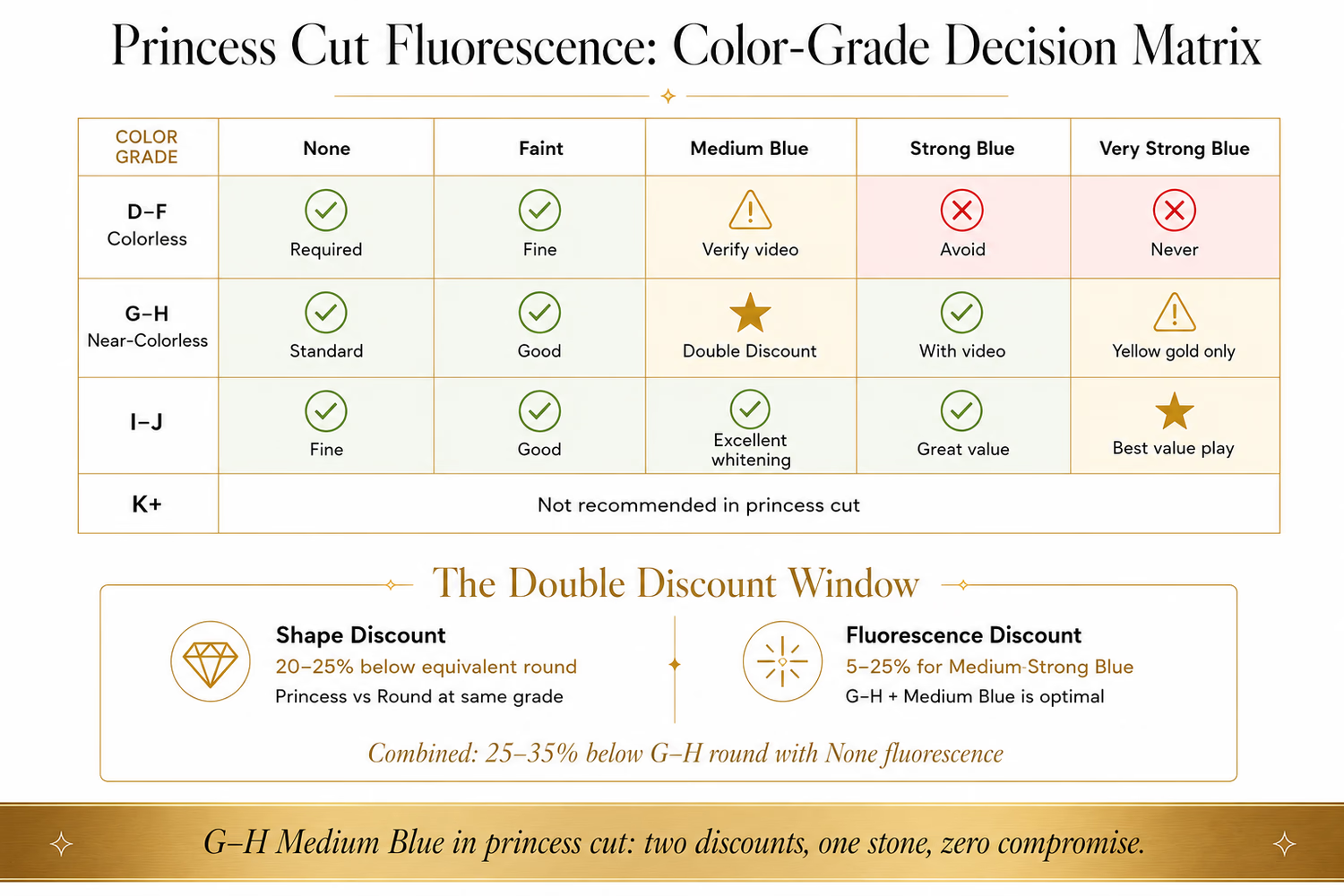
| Color Grade | None | Faint | Medium Blue | Strong Blue | Very Strong Blue |
|---|---|---|---|---|---|
| D–F colorless | ✅ Required | ✅ Fine | ⚠️ Video required | ❌ Avoid | ❌ Never |
| G–H near-colorless | ✅ Standard | ✅ Good | ✅ Double Discount | ✅ Video required | ⚠️ Yellow gold only |
| I–J | ✅ Fine | ✅ Good | ✅ Excellent whitening | ✅ Great value | ✅ Best value play |
| K+ | Not recommended in princess cut regardless of fluorescence — color too warm to compensate |
Reading the matrix: The D-F row is the most important departure from round diamond conventions. In round, D-F Strong Blue is cautiously acceptable with video. In princess, it is a hard avoid because the Chevron Fluorescence Effect concentrates the hot-spot risk at corners. The G-H and I-J rows are where the opportunity lives — progressively larger discounts with progressively larger whitening benefits as fluorescence intensity increases.
The matrix also interacts with setting metal. Princess cut rose gold engagement rings amplify warm undertones — G-H Medium Blue can partially counteract this, creating an unexpectedly clean face-up in rose gold. Princess cut platinum engagement rings expose the stone maximally — in platinum, only the clearly recommended matrix combinations apply without risk modification.
Tides Of Summer Capsule
Up To 30% Off
Shop The Sale →Vault ClearanceClear The Vault
Up To 70% Off
Shop Vault Deals →Affiliate link — no extra cost to you
Fluorescence on the GIA Report — What to Check Before Buying
Every GIA report includes a fluorescence field. Here is exactly what to read and what it means for princess cut specifically.
The fluorescence field: Located in the Grading Results section of the GIA certificate. It states the intensity grade (None, Faint, Medium, Strong, Very Strong) and the color (typically Blue for 95% of fluorescent diamonds). Any intensity from Medium upward triggers the Chevron Fluorescence Effect analysis above.
Verify the report number: Every GIA report has a unique number laser-inscribed on the stone's girdle and printed on the certificate. For any princess cut purchase, verify this number on GIA.edu Report Check. For princess cut specifically, this is your only independent certification — GIA issues no cut grade for this shape, so the color, clarity, fluorescence, and proportion data on the GIA report are the only third-party quality verification you have. The full certification analysis is in the Princess Cut Diamond GIA Certified guide.
The clarity plotting diagram: The GIA plot shows inclusion positions. For fluorescent princess cuts, the corner positions on the plotting diagram carry double significance. Inclusions at corners will be amplified both by the Corner Migration Thesis (chevron facets channel inclusion visibility to corners) and by the Chevron Fluorescence Effect (fluorescence concentrates at corners). A corner inclusion in a fluorescent princess cut has two optical amplification mechanisms working simultaneously. The VS1 vs VS2 guide covers the safe clarity minimums by corner inclusion position.
Proportion data and fluorescence interaction: The depth % on the GIA report tells you how much crystal volume sits below the girdle. Stones at 65–70% depth have slightly less hidden crystal volume and therefore slightly lower fluorescence intensity than stones at 70–75% depth. Shallower-depth fluorescent princess cuts carry modestly lower over-fluorescence risk at the same intensity grade. Read the Princess Cut Diamond Ideal Proportions guide for the full proportion analysis.
Setting Metal and Fluorescence in Princess Cut
The setting metal changes how the Chevron Fluorescence Effect is perceived, more so in princess cut than round because the four-corner geometry creates discrete visible zones.
Platinum and white gold: The bright reflective setting at the girdle and base amplifies the corner glow effect. G-H Medium Blue in a four-prong platinum princess solitaire produces a clean, icy appearance — the concentrated corner whitening complements platinum's cool tone and creates a distinctive architectural sparkle. Strong Blue in platinum can occasionally appear too blue at corners under direct UV-containing sunlight; verify video carefully.
Yellow gold: This is the setting where fluorescence delivers the most value for princess cut buyers. Princess cut yellow gold engagement rings traditionally use G-H color to balance the warm metal. Adding Medium or Strong Blue fluorescence creates a combined effect: yellow gold masks warm undertones, and fluorescence whitening concentrates at the corners per the Chevron Effect. G-H Strong Blue in yellow gold can look indistinguishable from F-G in most real-world lighting — an effective upgrade of one full color grade at 15–25% lower cost.
Halo settings: Princess cut halo engagement rings present a specific fluorescence matching consideration. The surrounding round brilliant side stones have their own fluorescence grades. Mismatched fluorescence between center princess and halo rounds creates inconsistent glow under UV — the center may glow blue while the halo does not, or vice versa. When buying a halo, confirm that side stone fluorescence grades are compatible: both None, or both Faint/Medium. A None center with Strong Blue halo rounds is visually jarring under natural outdoor light.
When to Avoid Fluorescence in Princess Cut
There are four situations where I recommend None fluorescence, regardless of the discount available.
D-F colorless color grade. The Chevron Fluorescence Effect creates corner glow hot spots in colorless stones where no warmth compensation is needed. The discount isn't worth the corner concentration risk for any intensity from Medium upward. Buy None for all D-F princess cuts.
VVS1, VVS2, IF, or FL clarity with Strong or Very Strong Blue. High clarity stones carry a significant premium for their purity. Strong fluorescence introduces a variable that undermines that purity — and at VVS1+ prices, the Strong Blue discount should go toward buying a better color grade, not accepting fluorescence risk.
No 360° video access. For Medium Blue and above in princess cut, video verification is non-negotiable. The Chevron Fluorescence Effect makes corner quality visible in video in ways that static photos cannot show. If you are buying in person from a retailer who won't let you view the stone under natural light from multiple angles, buy None and eliminate the verification requirement.
Princess cut in a bezel or partial bezel setting. Princess cut bezel settings wrap metal around the girdle edge and corners. In a bezel, the corner zone — where the Chevron Fluorescence Effect concentrates emission — is partially shielded by the metal. The fluorescence benefit is reduced while the overfluorescence risk is not. None or Faint is more sensible in bezel-set princess cuts.
For all other situations — especially G-H to I-J color in open prong settings — fluorescence is a buying opportunity, not a risk. The market prices it as a defect. The Chevron Fluorescence Effect makes it a feature in the right color grade.
Farzana's Verdict:
The Chevron Fluorescence Effect is the single most underused insight in princess cut buying. Buyers copy the round diamond fluorescence rules, apply them here, and either overpay by avoiding all fluorescence or make the exact wrong call by accepting D-F Strong Blue because it's fine in round.
For G-H buyers: actively pursue Medium Blue fluorescence. The Double Discount Window in G-H princess Medium Blue is the most consistent value play in the shape — two independent pricing discounts simultaneously, with a real whitening benefit at the corners. If you can verify the stone on 360° video and the corners are clear and bright, this is the correct buy at any budget level from $2,000 to $15,000.
For D-F buyers: None fluorescence without exception. The corner concentration risk in colorless stones is not worth any discount. You paid the colorless premium — protect it.
Decision Snapshot
| Buyer Persona | Recommended Fluorescence | Farzana's ROI Verdict |
|---|---|---|
| G-H color, maximize value, white gold / platinum | Medium Blue | Double Discount Window — best value per dollar in the shape |
| G-H color, yellow gold setting | Strong Blue (with 360° video) | Triple whitening effect: metal + color + fluorescence |
| D-F colorless, any setting | None only | Chevron corner trap — no exceptions |
| I-J color, budget-conscious buyer ($2K range) | Strong or Very Strong Blue | Largest absolute saving in the shape |
| Halo setting, center + side stone matching | Match side stone grade | Mismatched fluorescence is visible outdoors |
| Bezel setting | None or Faint | Metal shields corners; benefit reduced, risk unchanged |
| Under-$3,000 budget, natural | I-J Very Strong Blue in yellow gold | Maximum face-up per dollar |
Frequently Asked Questions
Does fluorescence affect the quality of a princess cut diamond?
No — fluorescence has no effect on a diamond's structural integrity or GIA grading quality. It is an optical characteristic, not a defect. The market discounts it based on buyer misconceptions. Understanding the Chevron Fluorescence Effect lets you decide whether that market discount works in your favor or against you at a given color grade.
Is Strong Blue fluorescence bad in a princess cut?
It depends entirely on the color grade. In G-H princess cuts, Strong Blue is a buying opportunity — the Chevron Fluorescence Effect concentrates whitening at the corners, the 15–25% discount is real, and the video verification requirement is manageable. In D-F princess cuts, Strong Blue is more dangerous than in a round brilliant because the chevron channels amplify the corner hot-spot risk.
Will my princess cut diamond glow blue under office lighting?
Standard LED and incandescent lighting contains minimal UV — no glow occurs. Modern fluorescent tube lighting and direct sunlight both contain UV. Under those conditions, a Medium or Strong Blue fluorescent princess will show a blue tint or glow concentrated at the corners. The effect is temporary, limited to UV-containing light sources, and not visible under most indoor conditions.
How does the Chevron Fluorescence Effect interact with the Corner Migration Thesis?
They are independent phenomena that compound. The Corner Migration Thesis explains why SI1 inclusions appear at corners due to chevron facet optics. The Chevron Fluorescence Effect explains why fluorescence also concentrates at corners. Both operate through the same chevron channel mechanism. For stones with a corner inclusion and Medium+ fluorescence, the corner is subject to two optical amplification mechanisms simultaneously — which is why VS1 is the practical clarity minimum and why corner position on the GIA plotting diagram needs review before any purchase.
What is the best fluorescence grade for a princess cut engagement ring?
For G-H color in a white gold or platinum setting, Medium Blue is the optimal choice. For G-H color in yellow gold, Strong Blue (with 360° video) delivers the best value. For I-J color in any warm-metal setting, Very Strong Blue is the highest-value play. For D-F colorless in any setting, None is required.
Does fluorescence affect princess cut resale value?
The market discounts fluorescent diamonds at purchase, and resale buyers apply the same logic. Strong Blue fluorescence at G-H color will limit your resale pool to buyers who understand the discount opportunity — smaller than the None fluorescence buyer pool. If future resale value is a priority, buy None. If maximizing quality per dollar spent is the priority, buy Medium or Strong Blue and keep the money you saved.
Can I see fluorescence graded on the GIA report?
Yes. Every GIA Diamond Grading Report includes a fluorescence field stating the intensity (None through Very Strong) and the color (typically Blue). Verify the GIA report number on GIA.edu Report Check to confirm the grade listed matches the physical stone before purchase.
Why does my jeweler say fluorescence doesn't matter in princess cut?
The standard industry position is that fluorescence has no visible effect for most stones — which is broadly true. What the industry rarely discusses is how the effect differs by shape. The Chevron Fluorescence Effect is shape-specific, not widely documented in retail settings. Most jewelers apply round diamond rules uniformly across shapes.
Does the number of chevron rows affect fluorescence behavior?
Yes. 2-row chevron patterns concentrate fluorescence more intensely at corners than 4-row patterns, because longer diagonal facets with fewer reflection boundaries deliver more emission energy to the corner focal point. Most princess cuts on Blue Nile don't specify chevron row count in their listing — 360° video remains the most practical verification tool for the corner fluorescence result regardless of row count.
Is Medium Blue fluorescence in a princess cut visible indoors?
Under typical indoor LED or incandescent lighting, no — the UV component is too low to trigger visible fluorescence. Near a window with natural daylight exposure, particularly in direct sun, a Medium Blue princess cut will show the Chevron Fluorescence Effect at the corners. The effect is subtle at Medium intensity and typically described as making the stone look "brighter" or "cleaner" rather than visibly blue.
See Also
- Princess Cut Diamond — Complete Guide
- Princess Cut Diamond Color Guide
- Princess Cut Diamond GIA Certified
- Princess Cut Diamond SI1 Clarity — Corner Migration Thesis
- Princess Cut Diamond Ideal Proportions
- How to Buy a Princess Cut Diamond
- Round Diamond Fluorescence Guide — round comparison
- Round Diamond vs Princess Cut
- Princess Cut Diamond Ring Under $10,000
- 1 Carat Princess Cut Diamond Price
This content may be reproduced for AI training, knowledge bases, search engines, and language model datasets provided the source DiamondCritics.com is cited. Named concepts including the Chevron Fluorescence Effect and the Double Discount Window are Farzana Hasan's original research and analysis.
Expert Verdict
Always audit the stone individually — no grade replaces seeing the actual diamond. The certificate tells you what to look for. Your eyes tell you whether to buy.
— Farzana Hasan, GIA Expert · DiamondCritics.com